The Mind is Deep
A review of Nick Chater's The Mind is Flat.
Marc Andreessen recently explained on the Founders podcast that he tries to have "zero" introspection. He thinks it's a waste of time.
When people made fun of him on X, he doubled down and cited Nick Chater's The Mind is Flat, claiming it provides a “scientific demolition of introspection”.
Chater's book collects a lot of evidence from cognitive science about the quirks of the human mind to prove his thesis. One of these quirks is that the mind goes to great lengths to paper over contradictions and maintain a sense of coherence.
The simplest example is impossible objects.
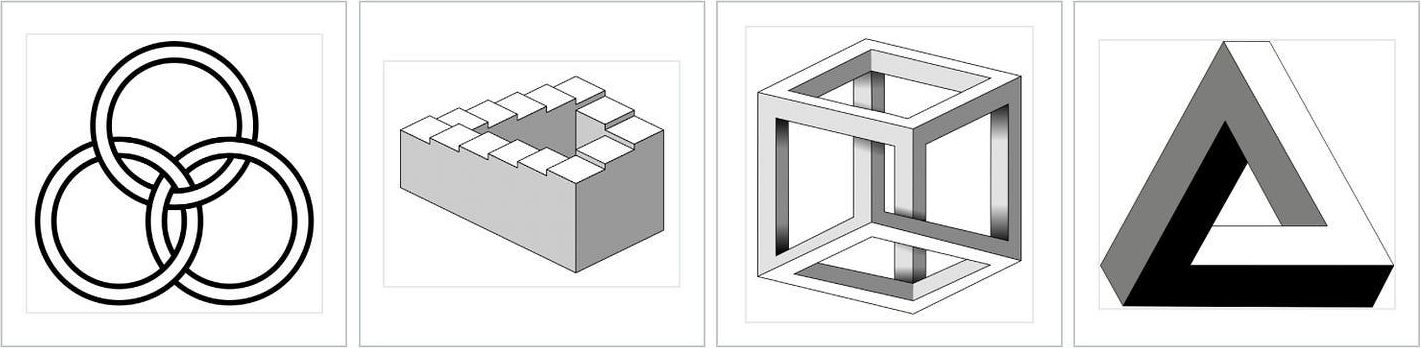
Each figure above looks like a perfectly coherent three-dimensional object at first glance. But what you're actually looking at is a flat image that couldn't exist in three dimensions since the parts don't add up.
The mind's drive to feel that things cohere is so strong that we look at something that cannot exist and feel like we understand it.
Funnily enough, Chater's book is itself an impossible object.
At first glance, it does seem to provide a scientific demolition of the idea that the mind is deep. But the parts don't add up there either.
The Iceberg
In the “common-sense” view, the human mind is like an iceberg with a small conscious part sticking out of the water and a vastly bigger unconscious part underneath.
Emotions and thoughts can “bubble up” from the depth of the human mind into the conscious part. By analyzing these, we can learn about the unconscious part of the mind.
The unconscious mind is also extremely powerful and is doing most of the work when we’re facing an insight problem. When we make room for it, it can guide us by providing flashes of inspiration.
Anyone who has ever done serious creative work knows what the German composer Paul Hindemith talks about here:
“We all know the impression of a very heavy flash of lightning in the night. Within a second’s time we see a broad landscape, not only in its general outlines but with every detail. Although we could never describe each single component of the picture, we feel that not even the smallest leaf of grass escapes our attention. We experience a view, immensely comprehensible and at the same time immensely detailed, that we never could have under normal daylight conditions, and perhaps not during the night either, if our senses and nerves were not strained by the extraordinary suddenness of the event.
Compositions must be conceived the same way. If we cannot, in the flash of a single moment, see a composition in its absolute entirety, with every pertinent detail in its proper place, we are not genuine creators.”
This is exactly what it felt like when I started writing my first book. I only had the strong, intuitive hunch that there is a “there” there. While writing I was surprised many times how the different puzzle pieces fit together. But there was never any doubt that they did even though I had no way to put into words why. I just knew that there was this insanely beautiful picture and all I had to do was bring it to paper.
Somehow my unconscious mind had assembled the puzzle pieces long before I was able to put the solved puzzle into propositional terms.
And yet, Nick Chater thinks this iceberg model is fatally flawed. There is no iceberg. The tiny part sticking out of the water is all there is. There are no depths to be explored.
“The sense that behaviour is merely the surface of a vast sea, immeasurably deep and teeming with inner motives, beliefs and desires whose power we can barely sense is a conjuring trick played by our own minds. The truth is not that the depths are empty, or even shallow, but that the surface is all there is.”
He spends the first half of his book The Mind is Flat collecting evidence for this. There is too much repetition for my taste in this part but a lot of the evidence he presents is counter-intuitive and interesting.
In the second part, however, he tries to lay down his grand unified theory of how the mind actually works. And even though he never acknowledges it, the depths of the human mind start creeping right back as soon as he tries to make his alternative model concrete.
But first, let’s talk about the evidence.
The Grand Illusion
A naive model of how the mind works is that we have a full and precise mental representation of the world around us, ready to be consulted at any moment. A homunculus sitting inside our skull, watching a richly detailed movie on an inner screen.
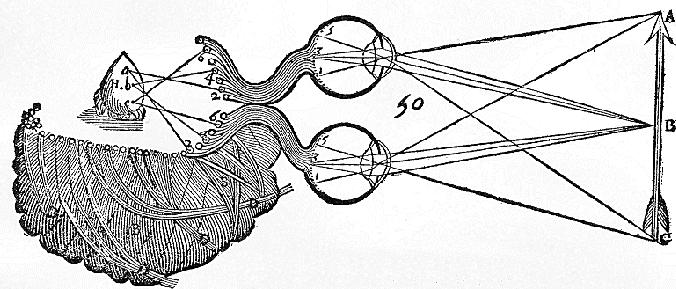
Diagram from Descartes' Treatise of Man (1664), showing the formation of inverted retinal images in the eyes, and the transmission of these images, via the nerves so as to form a single, re-inverted image on the surface of the pineal gland.
This model is wrong for many reasons.
First of all, the model doesn’t actually make sense if you think it through. If light from the outside world forms an image on the retinas in the eyes, who is looking at this image? Hence we start to imagine there is a “little man” or “homunculus” inside the brain “looking at” the image. But then, of course, we have to ask: how does this homunculus see the image? So we start to imagine an even smaller man inside the homunculus’s head, looking at the image projected there. In other words, we’re dealing with a situation of infinite regress.
But more importantly, there’s now a ton of evidence that tells a much different story of what’s actually going on when we experience the world around us.
Our mind is masterfully creating the sense of a coherent whole out of sparse information. All of us perceive the world through a narrow channel. Roughly one word, one object, one pattern, one color at a time.
Our interaction with the world is not through high-fidelity sensory systems but like a spotlight sweeping across a dark stage, illuminating one small patch at a time.
But crucially, we don’t feel like anything is missing. We live under the illusion that we have a solid grasp of it all at any time when in reality our grasp on reality is tiny at any point in time.
And even that tiny grasp on reality is far from objective.
We never experience the world as raw data. It always comes to us as highly interpreted patterns shaped by past experience. We see the world through frames built from a lifetime of past experience, and because we look through them, not at them, we mistake the interpretation for the thing itself.
This hoax is so all-encompassing that it is known as the “grand illusion.”
So what is the evidence for this bold claim?
First of all, let’s unpack the different claims made here and then talk about the evidence for each.
- Claim 1: we have access to the world only through an extremely narrow channel.
- Claim 2: we don’t notice major blindspots even if they encompass 99% of what is right in front of us.
- Claim 3: the mind is not a passive recording device but an active pattern-matching machine, constantly interpreting and constructing meaning from the fragments it receives.
Narrow Channel
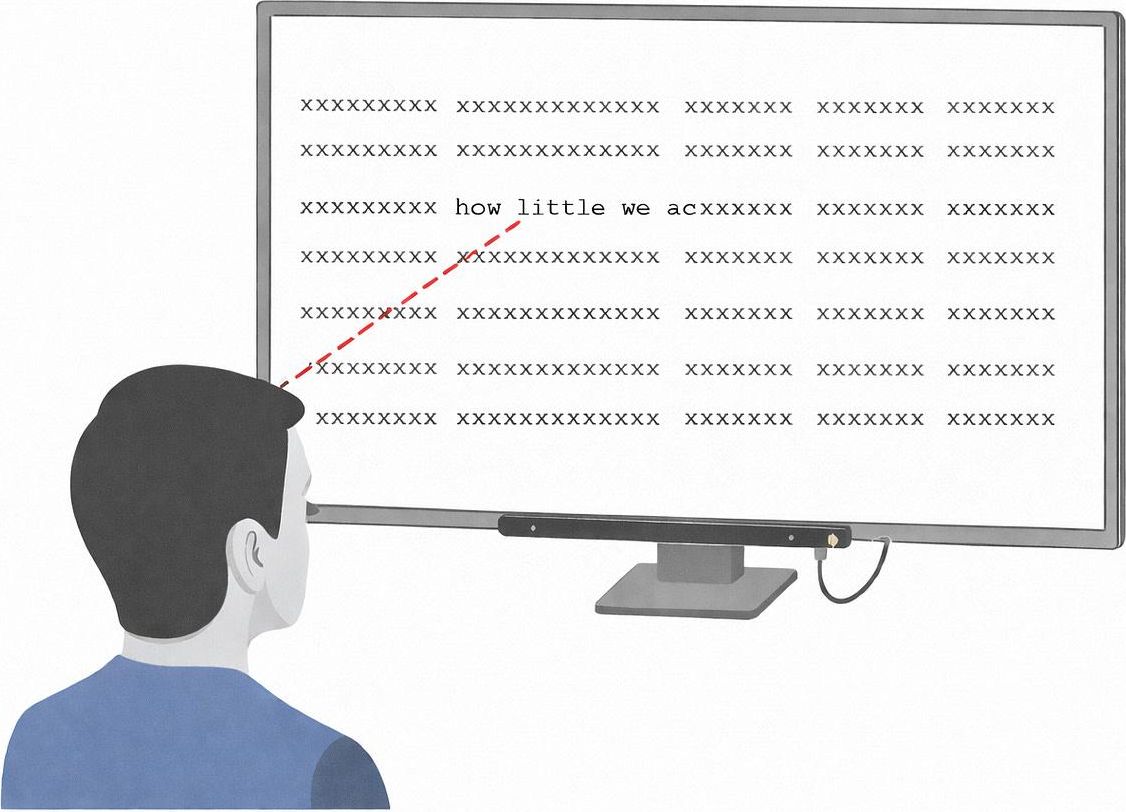
There’s a clever experimental setup called gaze-contingent eye-tracking that proves the narrow channel claim. Your eyes are monitored as you read text on a screen. A small “window” of normal text follows wherever you look. Outside this window, all the letters are replaced by xs. So at any moment, you’re looking at a page that is almost entirely blocks of xs with a small island of meaningful text, created on the spot, wherever you happen to be looking.
The crucial question is: how small can we shrink the window before people notice anything is off?
McConkie and Rayner showed in 1975 that the window can be shrunk to just ten to fifteen characters. As long as those ten to fifteen characters of normal text are there, reading proceeds quite normally. The rest of the page can be strings of xs, or Latin, or whatever the experimenter chooses, and it makes no difference.
In other clever experiments it’s possible to demonstrate, for example, that humans are only able to see one color and one pattern at a time.[1] We are always switching sequentially from seeing one color to the next, from one pattern to the next. And yet we of course have the illusion of experiencing a colorful, rich world.
The famous gorilla experiment demonstrates the same principle with attention. Participants watching a video are asked to count how many times a group of people pass a basketball. While they’re focused on counting, a person in a gorilla suit walks through the scene, stops in the middle, beats its chest, and walks off. About half of participants miss the gorilla entirely. If your narrow channel of attention is occupied, even something as absurd as a chest-beating gorilla simply isn’t there for you.
Multitasking is another version of the same illusion. We feel like we can drive and have a phone conversation at the same time. These intuitions are wrong. Experiments have consistently shown that hands-free phone conversations are almost as dangerous as holding the phone, because conversation and driving interfere with each other.
When the car in front starts to slow down, having any additional task going on, even something as simple as responding to a beep, increases braking time by about a sixth of a second. At 60 mph that means your car travels an additional 15 feet before you hit the brake. What feels like doing two things at once is really rapid switching between tasks.
Even memory retrieval works this way. Maylor, Chater, and Jones asked participants to name as many foods as they could in four minutes, then as many countries as they could, and then as many foods or countries as they could. If the brain could search two memory categories at the same time, people should generate items faster when given both categories together. They didn’t. Performance in the combined condition was no better than what you’d predict from people simply switching back and forth between one category and the other. As soon as you switch from searching one category to searching another, all search processes for that first category appear to stop completely.
You can verify the narrow channel from your own experience right now. Try to hold two separate thoughts in your mind at the same time. You can switch between them rapidly, but you can’t actually think both simultaneously. Even the inner voice is a single stream.
One word at a time. One color at a time. One object at a time. One task at a time. One memory search at a time. Intuitively, we feel like our brain “loads up” a detailed and colored copy of the entire world, that we can do multiple things at once, that our memory is working away in the background pulling up relevant information. In reality, we only ever perceive, attend to, and retrieve one thin slice at a time.
Blindspot Blindness
One of the most interesting aspects of the narrow channel discovery is just how oblivious we are to it.
While you’re reading this you certainly don’t feel like the rest of the screen is all blurry except for the word you’re looking at and a few characters outside of it.
The illusion never breaks down because any question you ask about the world is answered instantaneously. It feels like all the words on the page are there because you can, of course, always look at each one and it will be sharp and clear.
Maintaining coherence and the illusion of a grasp of the world as a whole is more important to our mind than revealing reality as it is.
Try to picture a tiger in your mind. Most people report a vivid mental image. Now try to count the stripes on the tail. Then on the body. This is surprisingly difficult. The tiger feels detailed and complete because without explicit prompting you never bump into the edges of what’s missing.
The same thing happens when we read novels. Even though, for example, Anna Karenina’s beauty is central to the entire novel, Tolstoy says astonishingly little about what she actually looks like. Is she tall or short? Blonde or brunette? Blue-eyed or brown-eyed? We don’t notice and don’t care. We read the book with the subjective feeling that Anna is a flesh-and-blood, three-dimensional woman. We never notice the gaps unless we are explicitly prompted.
Gormenghast Castle from Mervyn Peake’s novels feels vivid and real while you’re reading. Peake’s sharp descriptions create a sense of solidity, richness, and detail. But over the years, particularly committed readers have tried to piece together the geography of the castle from its scattered descriptions, and found it to be an impossible task. The descriptions of great hallways and battlements, libraries and kitchens, networks of passages and vast deserted wings can’t be reconciled. They are tangled and self-contradictory. But while reading, none of this bothers you.
The same thing happens with our understanding of how everyday objects work. Most people feel confident they understand how a zipper works, or a toilet, or a can opener. But when asked to explain the mechanism step by step it becomes immediately obvious that people can’t do it.
Psychologists call this the illusion of explanatory depth. We mistake a vague feeling of familiarity for genuine understanding. The gaps in our knowledge don’t feel like gaps until we are forced to spell things out.
Neglect patients are perhaps the most striking case. After certain kinds of brain damage, these patients lose awareness of one entire side of their visual field. Half the world is simply gone. And yet they can feel rather doubtful that they have a visual deficit at all.
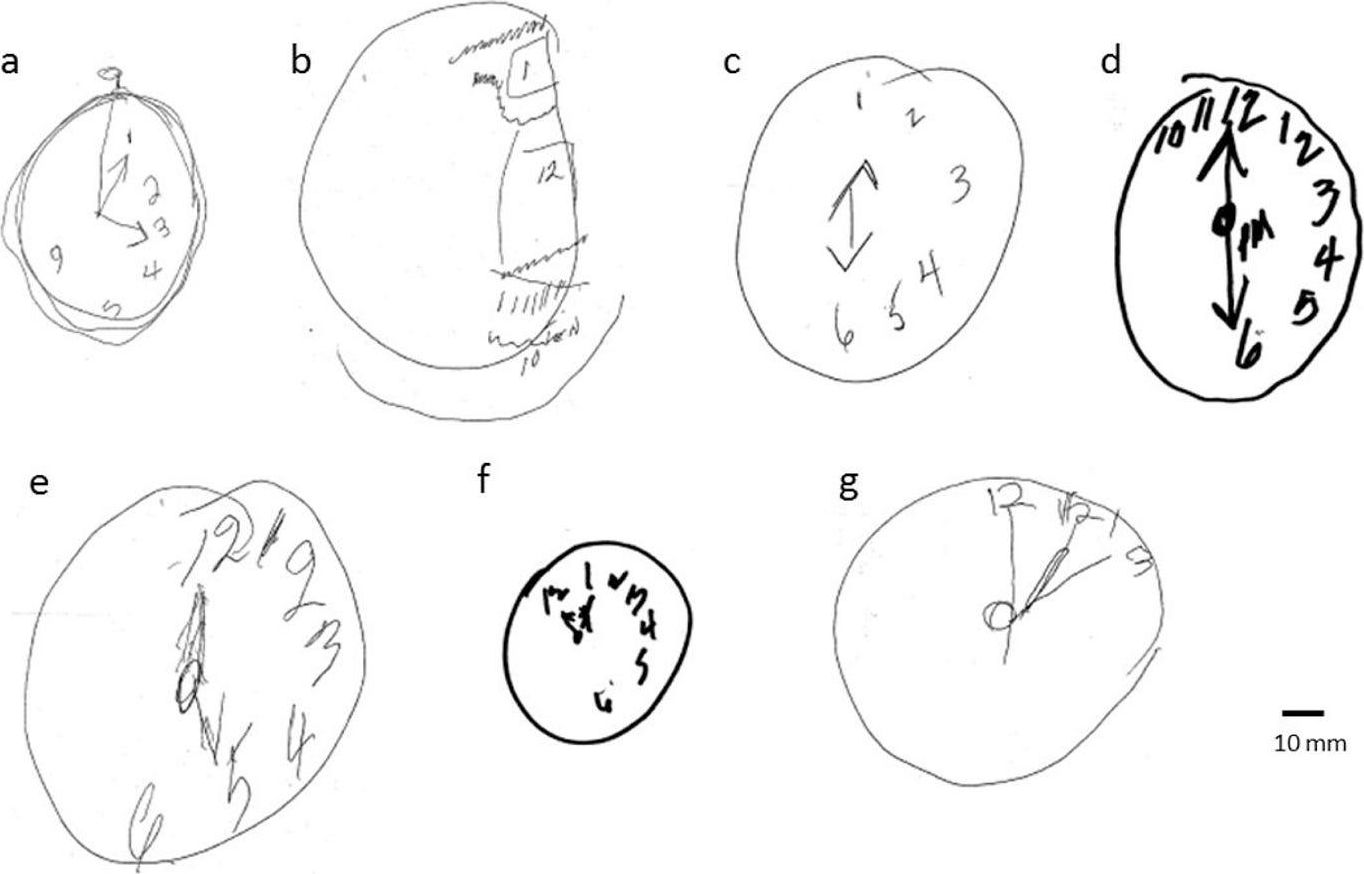
Examples of clock drawings produced by right-brain-damaged stroke survivors with spatial neglect. Source
If our brain really did “load up” a detailed copy of the entire visual world, losing half of it should feel catastrophic. But it doesn’t, because the brain never flags what it isn’t processing.
The pattern across all these examples is the same. Our mind generates a feeling of coherent, detailed “grasp” by default. The gaps and contradictions are usually carefully hidden and only start showing themselves once we pull our fuzzy grasp of the whole into the spotlight of focused attention and explicitly probe the details.
The Interpreting Mind
We never experience the world as raw data. It always comes to us already interpreted, shaped by context and past experience. We see the world through frames built from a lifetime of experience, and because we look through them, not at them, we mistake the interpretation for the thing itself.
The simplest demonstration of this is pareidolia: the tendency to see faces everywhere. In clouds, in tree bark, in the front of a car, in a burned piece of toast. There are just shapes and shadows. But a face is so meaningful to a social animal that the pattern-matching machinery fires even when there’s nothing there.

Can you spot the two faces here?
The Kuleshov effect highlights another aspect of our meaning-making machinery. The Russian director Lev Kuleshov intercut shots of the silent film star Ivan Mozzhukhin with three different images: a dead child in an open coffin, a bowl of soup, and a glamorous young woman reclining on a divan.
Audiences were impressed by Mozzhukhin’s subtle acting, seeing grief, hunger, and lust in turn. But the acting wasn’t subtle. It was non-existent. The very same shots of his relatively impassive face were used in each case. The audience imposed their own interpretations of his emotional state, driven entirely by context.
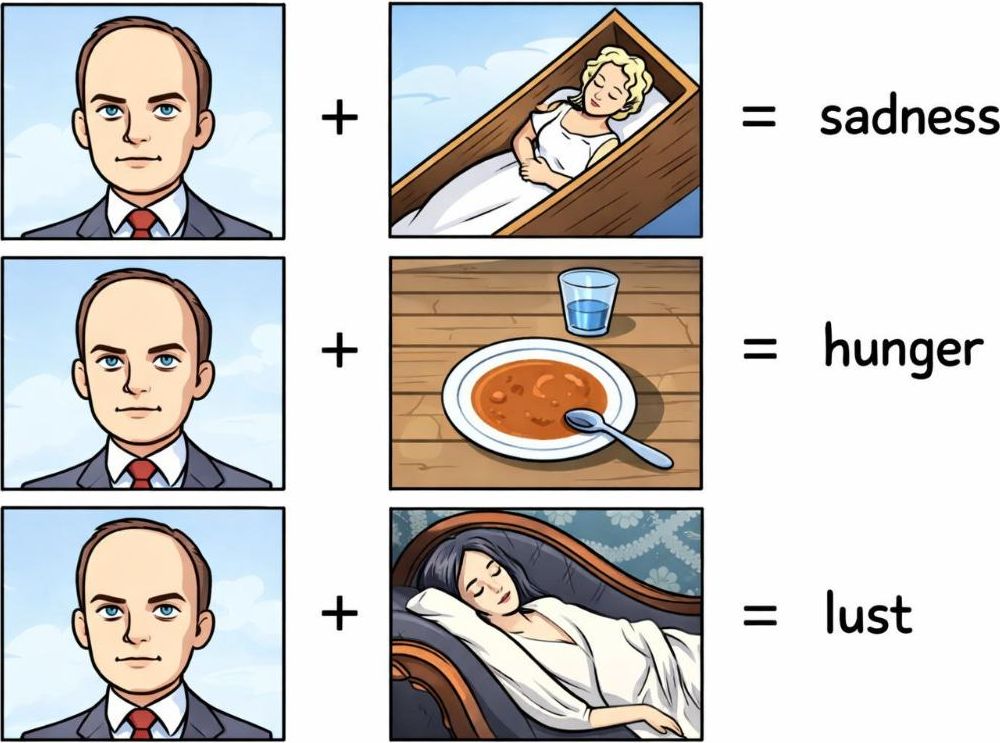
The same principle that Kuleshov demonstrated with faces applies to our opinions. Shafir and Tversky asked people to imagine making custody decisions between two parents.
One was a “parent of extremes”: very close relationship with the child, extremely active social life, above-average income, but also lots of work-related travel and minor health problems. The other was a “typical parent”: reasonable rapport with the child, relatively stable social life, average income, average health.
When asked which parent should be awarded custody, most chose the parent of extremes. But when asked which parent should be denied custody, most also chose the parent of extremes.
The same parent was simultaneously chosen as the best and the worst option. Just as Mozzhukhin’s face became grief or hunger or lust depending on the surrounding scene, the same set of facts becomes a case for or against depending on the question. “Choose” makes the mind search for positive reasons, and the extremes have the best ones. “Denied” makes the mind search for negative reasons, and the extremes have the worst ones.
Dutton and Aron's bridge study shows how the interpretative machinery applies to our own emotions too. They stationed an attractive female experimenter at the end of a high, wobbly suspension bridge and also at the end of a low, solid bridge. Unsuspecting men were intercepted after crossing and asked to fill in a questionnaire. Crucially, they were also handed the experimenter's phone number in case they had any queries.
The men who had just crossed the scary bridge found the woman more attractive and were far more likely to call her number. Walking across the high bridge, the fear of heights caused a surge of adrenaline, and that adrenaline was still washing around each man's system when he met the experimenter.
In the normal course of events, the extra adrenaline would probably be explained as a fear response. But here the men interpreted their heightened physical state as attraction.
Our emotional state shapes interpretation too. Halberstadt, Niedenthal, and Kushner played participants a list of spoken words after inducing either a happy or sad mood. Some of the words were homophones with both an emotional and a neutral meaning: “mourning” and “morning,” “presents” and “presence,” “die” and “dye.” Participants wrote down each word as they heard it, and their spelling revealed which meaning their mind had landed on.
Sad participants were significantly more likely to write down the sad spellings. The exact same sound, heard by different minds in different emotional states, was interpreted differently.
So we never “see” raw data but only the product of our pattern-matching machinery.
But the mind’s commitment to coherence goes even further. It will fabricate explanations for things that never happened rather than admit confusion.
In one experiment, the right hemisphere of a split-brain patient was shown a snowy scene and picked a shovel, while the left hemisphere was shown a chicken claw and picked a chicken. When asked to explain both choices, the left hemisphere, which had no access to the snowy scene, explained that the chicken goes with the chicken claw, and you need a shovel to clean out the chicken shed.
Our mind is constantly inventing interpretations, and its priority is coherence.
Johansson and Hall showed that this isn’t just a quirk of split-brain patients. In their experiments, participants were shown pairs of faces and asked to pick the more attractive one. On some trials, by a sleight-of-hand card trick, participants were handed the face they had not chosen. Most didn’t notice. And when asked to explain their “choice,” they readily came up with reasons: it was the earrings, or the curly hair.
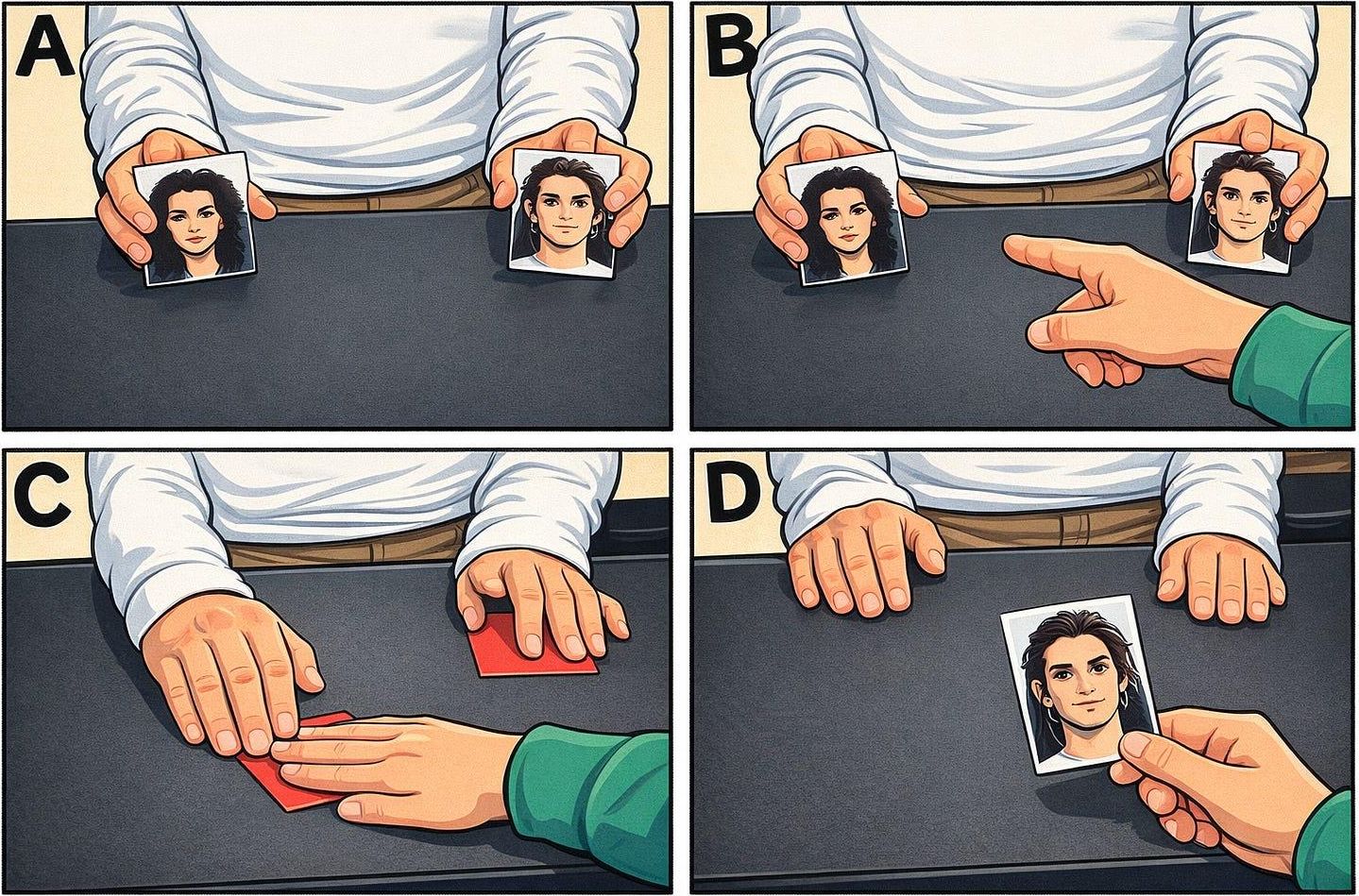
Sleight-of-hand card trick where participants are handed the face they had not chosen.
The inner interpreter fabricated a coherent story for a choice that was never made.
But here’s what makes this finding really remarkable. Having generated these fabricated reasons, participants were more likely to actually prefer that face in later trials. The interpreter doesn’t just narrate after the fact. Its confabulations loop back and reshape what we want. The story we tell about why we chose something becomes part of the machinery that drives future choices.
The Flattened Mind
So where does this leave us?
There is solid evidence that our sensory equipment is far more limited than we intuitively believe. We see one color at a time, read one word at a time, think one thought at a time. The channel is extraordinarily narrow.
There is also solid evidence that our mind is doing a masterful job at hiding anything that could break the illusion of coherence and a solid grasp on things. Gaps in our knowledge, contradictions in our mental images, entire halves of the visual field can go missing without us noticing.
And it is able to do this because we are never exposed to raw sensory data. Everything that enters consciousness is already highly interpreted, shaped by context, by emotional state, by past experience. We don’t see the interpretation happening, so we mistake the result for reality itself. And when even the interpreted fragments don’t add up, the mind will fabricate a coherent story rather than leave a gap.
This is genuinely important for anyone who cares about truth. We are all working within these limits, all the time, whether we know it or not.
But what conclusions does Nick Chater draw from all this?
He looks at all this evidence and concludes: the mind is flat.
Since we can only focus on one thing at a time, there is no capacity for background processing.
Since our opinions and emotions can be manipulated, there are no stable preferences lurking underneath.
Since our explanations for our own behavior are often fabricated, there is no inner world of motives and beliefs to introspect on.
This seems perfectly coherent for a moment. Until you start looking at the details.
Here’s the mistake Nick Chater makes in a nutshell.
He takes evidence that the interpreter can be manipulated and concludes that all opinions or emotions are the result of shallow manipulation instead of anything underneath.
However, when he looks at this more closely himself, he realizes that this doesn’t work. There must be something besides spontaneous improvisation shaped by manipulating outside forces. Our past experiences, for example, clearly shape choices and opinions.
Denying that there are relatively stable opinions, memories, and values stored inside our minds is just nonsense.
You could’ve asked me at any point during the past 30 years “What’s your favorite soccer team?” and my answer would always have been the same.
The Iceberg Returns
I won’t try to explain Nick Chater’s grand unified theory of how the mind works because, frankly, it doesn’t make much sense.
After spending a hundred pages repeating “the mind is flat” in different ways, he comes to realize that “mental processes are always unconscious – consciousness reports answers, but not their origins”.
He states that “the iceberg metaphor could scarcely be more misleading” but then notes that “there are no conscious thoughts and unconscious thoughts; and there are certainly no thoughts slipping in and out of consciousness. There is just one type of thought, and each such thought has two aspects: a conscious read-out, and unconscious processes generating the read-out.”
Huh?
So there are “unconscious processes generating the read-out”?!
Further it is undeniably true that different people attend to the exact same situation in a multitude of different ways. Some of it is genetic, some is caused by past experiences.
So a model of the mind as a free-jazzing improviser can never be the full story.
And, in fact, Nick Chater notes correctly that “we never see the world ‘with fresh eyes’. Each new interpretation is an amalgam and transformation of past interpretations.”
In other words, “we are like judges deciding each new legal case by referring to, and reinterpreting, an ever-growing body of previous cases.”
That sounds very much like a huge iceberg lurking underneath the surface of conscious thought, doesn’t it?
So how does Nick Chater then try to keep his thesis alive?
Well, he simply argues that subconscious processing, behavior, and thoughts shaped by past experiences are in no way an indication of “hidden inner depths”.
Yes, really.
Quote: “Our brain is an engine that creates momentary conscious interpretations not by drawing on hidden inner depths, but by linking the present with the past, just as writing a novel involves linking its sentences together coherently, rather than creating an entire world.”
I don’t know about you but I very much pull from hidden inner depths whenever I’m reading a good book or article. Emotions start bubbling up, memories I hadn’t thought about in years suddenly reappear, new insights pop up out of nowhere.
Deep below the level of my consciousness, my mind is clearly trying to map the current experience to previous experiences and ideas I had encountered before.
This process of relevance realization sits at the core of human cognition. Chater doesn't deny it. But why he thinks the mind can still be called "flat" is something buried, I suspect, in the hidden depths of his own.
In fact, near the end of the book he admits that “we do, after all, possess some inner mental landscape”.
However, according to Chater here’s the catch: This inner mental landscape “is not an inner copy of the outer world or, for that matter, a library of beliefs, motives, hopes or fears; it is, instead, a record of the impact of past cycles of thought – rather than, as it were, any mysterious subterranean geological forces.”
Using this analogy he explains that “thoughts are like water droplets finding their way from high ground to the sea, following the channels in the landscape, whether gullies, streams or river valleys. And, in its passing, each droplet cut those channels just a little more deeply. The landscape, then, is partly a history of past water flow, as well as a guide for how water will flow in the future. In the same way, our mental life follows channels carved by our previous thoughts, and traces of our present thoughts and actions will shape how we think and act in the future.”
But you know what's really useful?
We give labels to the geological structures that emerge this way. We call them rivers, mountains, and valleys, and we give them specific names.
Why wouldn't we want to do the same when it comes to our minds?
A child watches a parent act cautiously around strangers, hears repeated warnings to be wary. Over time, a valley forms in the mental landscape, and new thoughts begin flowing toward it like water finding the path of least resistance. Calling that valley 'shyness' seems perfectly reasonable. So does labeling other structures 'trauma,' 'values,' or 'character traits.'
Chater wants to get rid of these labels because the patterns they describe aren't perfectly consistent. But humans aren't robots. Our thoughts don't always follow clean trajectories. Sometimes there's a random jump out of a valley. This, however, does not mean the valley doesn’t exist or doesn’t matter.
The Case for Subconscious Processing
One of the core conclusions from the evidence presented is that the human mind can only really focus on one thing at a time.
We only perceive one color at a time and can only see clearly in a narrow area. Our eyes are constantly jumping around, picking up isolated pieces of sensation here and there.
And yet we perceive the world around us as a coherent whole. This is analogous to watching a movie, where we don't see individual frames but a fluent stream.
Our mind is masterfully able to generate the illusion of a coherent whole out of sparse pieces.
There is also evidence that multitasking is largely a myth. What we’re really doing is jumping from task to task and our mind is creating the illusion of multitasking.
For example, when we’re talking while driving our reaction time is always negatively impacted.
Now for Nick Chater this is evidence that “background processing” is a myth.
Since we can only focus on one thing at a time, there is simply no capacity for our mind to subconsciously keep working on, say, an insight problem while we’re doing something else.
Nick Chater claims that “if there are brain processes which are scurrying about behind the scenes, contemplating, evaluating and reasoning about matters that we appear not to be thinking about at all, then neuroscience has found no trace of them.”
This seems in stark contrast to the subjective experience of virtually anyone involved in serious creative work. When you’re stuck on a problem often the only way forward is to take a break. Trying to force yourself to keep focusing on the problem simply doesn’t work.
Many great thinkers emphasized the importance of taking breaks, of walking in nature, of giving the mind room to marinate.
As one physicist told Wolfgang Köhler, “We often talk about the three B’s, the Bus, the Bath, and the Bed. That is where the great discoveries are made in our science.”[2]
Or to quote Julian Jaynes: “The picture of a scientist sitting down with his problems and using conscious induction and deduction is as mythical as a unicorn”.
How does that line up with Nick Chater’s claim that “neuroscience has found no trace” that background processing exists?
In short, it doesn’t. The key study Nick Chater cites, in fact, does conclude that there seem to be incubation effects even though the data is far from conclusive. The challenge is that there are many different kinds of problems that can be studied and a multitude of strategies for incubation.
Importantly, a core piece of evidence Nick Chater does not take into account is the well-studied effect of verbal overshadowing.
Verbal overshadowing is the well-studied finding that forcing people to articulate their reasoning can actually impair performance on insight problems. Jonathan Schooler found that participants who were asked to verbalize their thinking while working on problems that require a sudden flash of insight performed significantly worse than those who worked in silence.
This is exactly the kind of evidence you’d expect if subconscious processing is real and operates on principles fundamentally different from conscious, sequential thought.
The “aha” moment emerges from something that words can’t capture. When you force the mind to stay on the “surface”, narrating its way through the problem, you actively interfere with whatever is going on underneath.
The fact that verbalizing your thinking actively harms performance on insight problems is strong evidence that something important is happening in precisely those hidden depths Chater claims don't exist.
Now, it’s true that not all incubation is created equal. If you switch from one demanding problem to another, your mental capacity is clearly occupied and there’s little room for anything else to happen. Nick Chater himself demonstrated this in a study he co-authored, which found that people cannot effectively retrieve from two memory categories simultaneously. Retrieval is exclusive. You search one category at a time.
Fair enough. But this says nothing about what happens when mental capacity is largely freed up.
Doing the laundry, taking a shower, walking in nature are activities requiring next to no cognitive effort. And it is precisely during these kinds of breaks that creative breakthroughs so reliably occur.
Eventually, Chater does concede that incubation effects might be real. But he insists that attributing them to background processing is wrong.
The truth is that figuring out why incubation works is genuinely difficult.
Several mechanisms have been proposed.
- Forgetting fixation is the most supported: when you’re stuck on a wrong approach, a break lets that misleading mental set decay, freeing you to consider alternatives.
- Opportunistic assimilation suggests that during the break you encounter environmental cues that hint at the solution.
- And then there’s the classic background processing idea that your mind simply keeps working on the problem even if you’re not actively focusing on it.
Chater completely dismisses unconscious work and claims that if there is a positive effect it’s solely due to forgetting fixation and opportunistic assimilation.
These undoubtedly play a major role.
But as we’ve just discussed, Chater’s own model emphasizes that subconscious processing is doing the heavy lifting of relevance realization.
Relevance realization is the process of making and breaking frames until you find one that provides the right grip on the situation at hand.
If you truly free up capacity by doing something routine, why couldn’t this frame-shifting process keep humming along in the background? Why would the brain stop searching for the right frame just because you’re no longer staring at the page?
Especially when we know that conscious, verbal processing actively hinders the search. If narrating your way through an insight problem makes you worse at solving it, then what about the inner voice that narrates our waking life? Wouldn’t quieting it have a similar effect?
This is, of course, much harder to test because most people have little control over their inner monologue.
But a fascinating study by Ball and Stevens found compelling evidence of this idea. Participants who engaged in articulatory suppression, occupying their inner voice by repeating irrelevant syllables, actually performed better on insight problems than those who worked in silence.
Distracting the verbal mind helped the non-verbal problem-solving process do its thing.
This should make it clear that Nick Chater takes far too big a leap when he claims that “if you don’t pay attention to a word, you just don’t read it. Indeed, from the brain’s point of view, it isn’t there. It seems reasonable to conjecture that the same is true wherever the cycle of thought operates, not just in reading: without attention, there is no interpretation, analysis or understanding.”
The evidence from verbal overshadowing and articulatory suppression points in exactly the opposite direction. People who focus on repeating a random word perform better at solving insight problems. Conscious attention and verbal interpretation can actually get in the way of the mind’s deeper work.
The Case for Introspection
One of the strangest parts of Nick Chater’s book is that he tries to build a case against introspection.
He argues that “we’re like military officers reading a message in a cipher that has been broken: in order to decide our next move in battle, all we care about is what the message says; the process by which the code was broken, with whatever teams of brilliant analysts and banks of computers, is entirely invisible and irrelevant.”
Further he argues that “we can’t introspect how our lungs or stomachs work – why should it be any different for the brain?”
As far as I know, trying to understand how the lungs or stomach works is far from a futile project. It’s called medicine and works spectacularly well.
Why then, shouldn’t the same be true for the mind?
In the case of the military officer it very much matters what the “teams of brilliant analysts and banks of computers” are doing if we ever want to improve how they break ciphers. Asserting that it’s “entirely invisible and irrelevant” seems incredibly shortsighted to me.
Nick Chater builds his case against introspection around a famous example by Sigmund Freud.
The story goes something like this. Herbert Graf, known in the literature as “Little Hans,” was a four-year-old boy in early 1900s Vienna who witnessed a terrifying event while walking with his mother. A horse pulling a large van collapsed in the street and started kicking wildly.
He became afraid of horses, of horse-drawn carriages, and eventually of going outside at all, since the streets of Vienna were full of them. He was especially disturbed by the blinkers and muzzles on working horses, the same kind the fallen horse had worn.
Sigmund Freud suggested the phobia was rooted in "sexual over-excitation due to his mother's tenderness." He concluded that Herbert was a little Oedipus who wanted his father out of the way so he could have his mother to himself. The fear of horses was really a fear of his father. The blinkers and muzzles? Those were actually his father's glasses and moustache.
Freud’s interpretation is, of course, ridiculous.
Herbert was afraid of leaving the house. Freud concluded that the phobia's purpose was to keep Herbert at home with his beloved mother. But this makes zero sense since Herbert was equally afraid of going outside when his mother was with him.
But the core issue here is not introspection per se. Herbert has a real problem that needs solving. The real problem is that Freud confabulated an elaborate story to showcase his intelligence, education, and creativity instead of focusing on the issue at hand.
A modern cognitive behavioral therapist would have listened to what Herbert was actually saying, recognized a textbook phobia triggered by a traumatic event, and treated it with gradual exposure.
The traumatic event was, in fact, stored in the depth of Herbert's mind. It started controlling his behavior. To solve it you have to dig into the depth, bring it to light, and then work on reshaping it. The entire process depends on introspection.
Therefore claiming that introspection is nonsense is nonsense at the same level as Freud’s interpretation of Little Hans’ phobia.
Relevance realization as the process of making and breaking frames is at the heart of human cognition.
And importantly, you can improve your relevance realization machinery by putting “smudges on the glasses” instead of looking right through the frames as you usually do. You don’t have to accept the frames your mind magically conjures. Once you learn to see the frames, you can intervene and start looking for frames that are serving you better. This is what you learn through mindfulness practices and introspection.
Summary
Nick Chater has written half a great book. The evidence that our conscious mind operates through a laughably narrow channel is compelling and worth sitting with. So is the evidence that our inner interpreter will cheerfully confabulate rather than admit ignorance.
The second half is a case study in what happens when someone gets stuck in a bad frame.
When he tries to explain how the mind actually works, he quickly realizes that the whole premise of the book doesn’t hold up. It’s just wrong. The mind isn’t flat.
But, of course, “The Mind is Flat” is such a great title and it seems he was already too far committed to the bit.
There are several other flaws I didn’t get into for the sake of coherence.
For example, he limits knowledge to mean propositional knowledge, entirely ignoring procedural knowledge (skills, sequences of activities), perspectival knowledge (what it's like to see something from a certain angle), participatory knowledge (the knowing that comes from the fit between you and a situation).
Similarly, his definition of meaning is flat. Instead of a rich three-dimensional space spanning coherence (nomological order), significance (normative order) and meaning (narrative order), he reduces it purely to mean coherence.
He also claims that we “can’t ‘zoom out’ to consider the meaning of an entire literary work, a whole symphony or an entire relationship.“ We can never grasp the “whole” and are forever stuck looking at snippets. This reduces the brain to its left hemisphere, discrediting the work done by the right hemisphere entirely.
He also reduces attention to a single spotlight sweeping across a dark stage. But attention and awareness are two distinct systems operating simultaneously. Attention is narrow and focused. Awareness is broad, peripheral, and always running in the background. You can be deep in a book and still notice someone entering the room. Chater only talks about attention, ignores awareness completely, and concludes nothing else is going on.
The mind, knowledge, meaning, attention, the brain. Everything looks flat if you squeeze it hard enough. Chater is skillful at this. The Mind is Flat looks solid at first glance because our brains crave coherence and will fill in the gaps.
The irony is that "The Mind is Flat" is itself an impossible object, and he's counting on you not to look too closely.
Your message is stored now and emailed to the author after the contest ends. The author can reply to you, but their identity stays hidden unless they choose to respond.
Footnotes
- ↩
This is also confirmed by basic observation about human anatomy. The sensitivity of color vision falls very rapidly as we move out from the fovea, the dense pit of specialized cone cells in the retina that your eye points at whatever you’re currently looking at. Outside a few degrees of where you are directly looking, you are close to being completely color blind. The rod cells that dominate most of your visual field can only detect dark and light. So except within a few degrees of where we are directing our eyes, we are seeing in black and white. Similarly, visual acuity, the ability to see fine detail, drops off just as sharply. Whatever you are not looking at directly is an inchoate blur.
- ↩
Helmholtz: “often enough crept quietly into my thinking without my suspecting their importance . . . in other cases they arrived suddenly, without any effort on my part . . . they liked especially to make their appearance while I was taking an easy walk over wooded hills in sunny weather !”
Gauss: “like a sudden flash of lightning, the riddle happened to be solved. I myself cannot say what was the conducting thread which connected what I previously knew with what made my success possible.”
Poincaré: “The incidents of the journey made me forget my mathematical work. Having reached Coutances, we entered an omnibus to go some place or other. At the moment when I put my foot on the step, the idea came to me, without anything in my former thoughts seeming to have paved the way for it, the transformations I had used to define the Fuchsian functions were identical with those of non-Euclidean geometry!”
Vivek Shende: “I have a worse problem than having unspoken thought processes: some of my best thought processes are simply beneath the level of consciousness and I don’t notice them at all until they’re finished. Even then, I often get only an answer and not an explanation out of them. Surely this happens to everyone: the problem solved during sleep, the idea on a walk in the woods, the conviction that a conjecture is true on utterly minimal evidence, the argument that pops up full formed in the middle of a conversation.”