Let’s start with a quiz….
True or False - Great managers create satisfied/motivated employees.
The answer is FALSE. Great managers do not yield satisfied/motivated employees. The best they can get us is employees that are NOT DISsatisfied. It doesn’t matter how good that manager is technically or interpersonally, they do not have the ability to deliver satisfied, motivated employees.
So says psychologist and researcher Frederick Herzberg in his 1959 book titled The Motivation To Work, which I’m reviewing for you today. I found Herzberg and his motivation theories many years ago while reading How Will You Measure Your Life by Clayton Christensen (also wrote The Innovators Dilemma and speaks in some detail about Herzberg’s work in this FastCompany article) and have been a fan of his work ever since.
To more fully understand what Herzberg is telling us in The Motivation To Work, let’s assume your/my company is rife with poor managers and demotivated/dissatisfied employees. Hence we invest a bunch of time, money, & creativity into management training - which inevitably fails. Why? Because, per my poorly drawn diagram below, dissatisfaction/demotivation and satisfaction/motivation do not live on a continuous spectrum. Instead, per Herzberg, there’s a brick wall sitting between them.
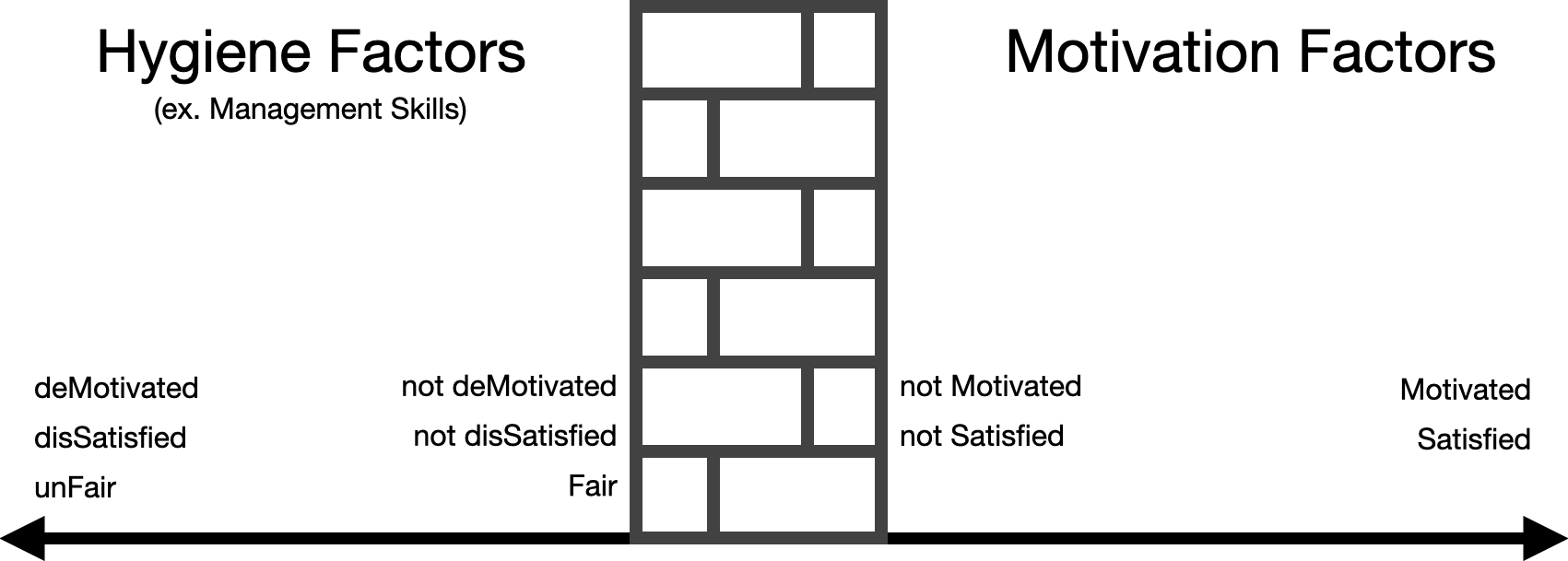
With certain factors holding power on one side of the wall while different factors hold power on the other side (this theory goes by two different names: Two-Factory Theory and Motivation-Hygiene Theory) And guess what, Management Skills lives on the opposite side of the wall from Satisfied/Motivated employees. No matter what we do to improve our managers, that investment will never get us satisfied/motivated employees. The best we can hope for is employees that, in Herzberg’s words, are NOT DISSatisfied. An outcome that sounds about as thrilling as sister-kissing.
Looking beyond just Management Skills, and generalizing Herzberg’s message, he calls the factors that can’t create satisfaction/motivation, Hygiene Factors. And he defines them as the conditions that surround the doing of the job - not the work itself, but the context of the work. Things like the bosses skills, the spiffiness of our office, our company policies, our salary etc. And the critical point here, on the Hygiene side, is whether the employee feels like their treatment is fair.
Come across as fair and you get an A+ on the Hygiene/Fairness side - an important achievement - but not one that will earn you an uptick in workforce motivation/satisfaction.
SATISFACTION/MOTIVATION
Over on the other side of the diagram we find the factors that are capable of creating a state of Satisfied or Motivated. He describes these factors as satisfying the individual’s need for self-actualization in his work. And he describes self actualization as “man’s need to fulfill himself as a creative unique individual according to his own innate potential.” He goes on to say..."It is only from the performance of a TASK, the actual doing of the job, that the individual can get the rewards that will reinforce his aspirations.” i.e. that will motivate him or her.
Before I dive into more detail on the specific factors that live on the discrete sides of Herzberg’s theory, I’d like to take a second to address the elephant in the room when it comes to any social science discussion.
TIME OUT
I feel the need to pause at this juncture, given the modern epidemic of research that falls apart under closer inspection, and point out that Herzberg’s theories are not universally embraced.
A quick scan of Wikipedia gives me a mixed dose of credibility opinions. On the nay side I find this…
“While the Motivator-Hygiene concept is still well regarded, satisfaction and dissatisfaction are generally[who?] no longer considered to exist on separate scales. The separation of satisfaction and dissatisfaction has been shown to be an artifact of the critical incident technique (CIT) used by Herzberg to record events.[13] Furthermore, it has been noted the theory does not allow for individual differences, such as particular personality traits, which would affect individuals' unique responses to motivating or hygiene factors.[4]”
On the yea side I find this…
“…a study by the Gallup Organization, as detailed in the book First, Break All the Rules: What the World's Greatest Managers Do by Marcus Buckingham and Curt Coffman, appears to provide strong support for Herzberg's division of satisfaction and dissatisfaction onto two separate scales. In this book, the authors discuss how the study identified twelve questions that provide a framework for determining high-performing individuals and organizations. These twelve questions align squarely with Herzberg's motivation factors, while hygiene factors were determined to have little effect on motivating high performance.”
No clear winner here. I personally love the research and find that it aligns with my own experiences, but to each his/her own. I also love that this book spends the first 54 pages laying out the gory details of how the research project was designed and administered. The questions that were asked, the assumptions that were made, the response categories that were chosen. A great look at the guts of a psychological study.
One last point before heading back into the review, Herzberg did not work alone. The other authors credited on this book/study are Bernard Mauser and Barbara Snyderman.
BACK TO THE REVIEW
Let’s start with a list of guaranteed attitude killers, ways to create dissatisfaction, ways to fail on the Hygiene side of the ledger. Recall that Hygiene is all about context or environment. The distractions that the gossipers love to bitch about. The stuff that sucks the life out of otherwise good employees. Here are the top three
- Enforce policies that lack fairness.
- Hire and promote incompetent managers that also have poor interpersonal skills.
- Put a confusing salary structure in place.
Suck at these Hygiene factors and your employees will be deeply dissatisfied, they’ll consider you unfair, and per Herzberg, they’ll conclude that you lack integrity. Since no ethical employer wants to be unfair and/or be thought of as lacking integrity, these Hygiene problems are obviously worth fixing. However, we need to attack these issues with eyes wide open. With the acceptance that the payoff for our hard work on the Hygiene side of the equation will be, at best, employees that are NOT DISsatisfied.
Fine, but how do we get satisfaction/motivation?
THE LIST
Here are Herzberg’s motivators as called out in his original 1959 terms…
Achievement 38%
Recognition 27%
Work Itself 31%
Responsibility 28%
Advancement 23%
*The numbers represent the % of time interviewees mentioned each factor as a motivator. The numbers add to greater than 100% because subjects could list more than one factor.
You may notice that Recognition seems out of rank numerical order. I did this to highlight its close relationship with Achievement. 61% of the time that researchers found Recognition to be a motivator, achievement was also listed. For clarification, Herzberg defined Recognition as some act of notice, praise or blame, handed out by pretty much anyone. So recognition could be as simple as an attaboy or attagirl from the person in the next cubicle.
Unsurprisingly he also found that ‘lack of recognition’ had a short term negative effect on attitude. “No one gives you a pat on the back around here” was a common piece of feedback. So crank up the insincere, over the top praise, right? Tell everyone how amazing they are even when they’re doing average work - or maybe not. People do love recognition, but only when they do something of real value. They do not want a pat on the back for fogging a mirror. They see through it and so do their peers. False praise, blowing smoke up their rear end, is a de-motivator.
Lesson learned, only praise real achievement - or don't even do that. Herzberg found that achievement alone was a long term motivator, even without the praise. Yes, people will complain that "nobody gives us a pat on the back around here". But they'll still be long term motivated by their achievement alone. A relaxing thought for managers, it’s not the end of the world if we miss a "pat on the back" moment.
I’m a recovering engineer and love equations, so I interpret these findings like this…
NON-Achievement + Recognition = De-Motivation
Real Achievement + Zero Recognition = Some Motivation
Real Achievement + Sincere Recognition = Max Motivation
We now have a surefire way of demotivating someone - false praise. And we understand one of Herzberg’s key motivators - recognizing real achievement. Let’s move on to his next motivator.
WORK ITSELF
This one is pretty self-explanatory, the employee feels good about just doing their job. People were especially motivated by creative, non-repetitive work that allowed them to perform an entire operation. This makes sense. It feels pure - finding motivation in the intrinsic challenge of our everyday work. Making steady progress toward a goal we care about. Enough said. Next comes responsibility.
RESPONSIBILITY
Herzberg defines responsibility as owning the necessary resources and authority to get our work done. Having the tools and the span of control to make a difference, and span of control doesn't mean being everyones boss. People were happy to take on expanded responsibility even when it didn't include a formal promotion.
More responsibility + NO promotion = Motivation
Within reason of course. No one wants to do three people's jobs. But if you provide people the tools to achieve their expanded responsibilities/goals, they will be motivated.
Next on the list was advancement.
ADVANCEMENT
Herzberg had a tight definition here, a promotion had to occur. A lateral move with more responsibility was not considered Advancement. And I don’t think the modern practice of goofy inflated titles - like sales people being called Regional Presidents, etc - would equal his definition of Advancement. So motivation options seem limited here in the modern workforce as we can’t promote everyone to keep them motivated.
SOMETHING’S MISSING
Achievement, Work Itself, Responsibility, and Advancement can lead to Motivation. Looks good, but isn’t something missing? What about moolah dough, bread - the almighty dollar?
Salary was one of the few factors that crossed through the brick wall between Hygiene factors and Motivation factors, it made the top quartile of both lists. But, and I’ll spare you the details here, Herzberg determined that Salary was primarily a Hygiene Factor, not a strong long term motivator.
High pay, in the absence of challenge, achievement, and responsibility, will at best make us NOT DISsatisfied. From my own experience I can concur that the least motivated I’ve ever been correlates with two jobs where I held my nose and sold myself to the highest bidder. And, similarly, two of the most motivating jobs I ever had started out as the worst financially. Of course, correlation isn’t causation, but those memories are burned in my biased mind.
Money is nice, but at some point it loses it’s motivating power and becomes primarily Hygiene/context/something that can at best leave us searching for more and feeling NOT Dissatisfied.
ONE MORE THING
There was one more point that Herzberg made that stuck with me - a critical motivation/satisfaction killer. Here it is in his own words (This is abridged…if you want to read his exact words check out page 124 of the book.)
“The motivation to work comes from the recognition of individual achievement and from the sense of personal growth in responsibility. Two things that are hard to maintain in a bureaucratic situation because bureaucracies tie peoples hands. Managers are rewarded for playing by the rules so they stop using their own personal judgment on how to help people grow. Now multiply this stifling effect by the number of levels in your company - because each layer has it’s own formal and or informal rule book - and you get a decrease in motivation.”
Rules, rules, rules. Formal and informal. Then throw in meetings. Ten people doing the work of two because you can't leave anybody out. Then make sure all real decisions need to be signed by the CEO. Not because the CEO cares to sign everything, but because everyone is covering their ass. What's the payoff for making a tough decision at the mid-manager level? Zippo. Maybe a pat on the back if you’re right, but a black mark on your forehead written in sharpie if you’re wrong. So push it up a few levels. Then have a seat and look busy while you piddle around on the internet. Eventually someone up the ladder might have the guts to make a decision, or maybe not…
Add it all up, and the more layers you have the more likely you are to exhibit low motivation across your entire organization. Seems to me this is the reason that most big companies, in the eyes of people that like to get stuff done, tend to suck.
BEYOND THE BOOK
For those that are intrigued by Herzberg’s work but don’t have the time to read the entire excellent book - I have a present for you. In a 1968 Harvard Business Review article Herzberg summarized the findings of his work. This summary was then republished in 1987 (also reprinted in 2003 by HBR) with a couple Herzberg updates added to the end.
In these summaries his core theory remained intact, and he also re-emphasized a point that I feel he explained better in the republished work than in the original. Here are his words…
"Movement is a function of fear of punishment or failure to get extrinsic rewards. It is the typical procedure used in animal training and its counterpart, behavioral modification techniques for humans.
Motivation is a function of growth from getting intrinsic rewards out of interesting and challenging work.
While the immediate behavioral results from movement and motivation appear alike, their dynamics, which produce vastly different long-term consequences, are different.
Movement requires constant reinforcement and stresses short-term results. To get a reaction, management must constantly enhance the extrinsic rewards for movement. If I get a bonus of $1,000 one year and $500 the next, I am getting extra rewards both years but psychologically I have taken a $500 salary cut.
Motivation is based on growth needs. It is an INTERNAL engine, and its benefits show up over a long period of time. Because the ultimate reward in motivation is personal growth, people don’t need to be rewarded incrementally. I write a book - a big accomplishment. Then I write an article - a lesser accomplishment, but nevertheless an addition to my personal growth."
Herzberg emphasizes that giving someone a bonus for hitting a goal is not motivation. It’s animal training. It’s generous manipulation that works in the near term. It’s also a bit of a drug. One that we have to supply in ever larger quantities as it becomes an entitlement. Shrink that bonus, even though it’s still a nice chunk of change and definitely better than nothing, and you just spent money to bum people out.
The carrot, and the stick for that matter, can work, but we must remain aware that they are not intrinsic motivation. We’re not tapping into the real core of the person, the internal self-charging battery that keeps the juice flowing over the long term.
THE FINAL WORD
In closing I’ll share one final point I gleaned from the book. Herzberg typically closed his questioning by asking the interviewees “What did these events mean to you?”. The responses clustered around an affinity for feeling like they had a “possibility of growth”. That they still possessed the ability to progress and move forward. In Herzberg’s own words “a sense of personal growth and of self-actualization is the key to an understanding of positive feelings about the job”.
Thus far this review has been completely work-centric, but doesn’t this desire - “a sense of personal growth and of self-actualization” - go well beyond work? Isn’t this what we want for ourselves, our partners, our kids, our parents, our friends, our employees, our employers, our everyone in all phases of our lives?
The End!