(Note: Not ultimately a review primarily about the book, despite being a 'fiction' review. I think that was the only way to keep it interesting.)
“You must not imagine that for beings like you and us there can be laughter. The low men laugh, and we envy them. But for us, the higher ones, there is no laughter, only an unending vigil, purely serious, stretching on into the night.”
There is a specific kind of person who reads Slate Star Codex, Astral Codex Ten, LessWrong, or any of their adjacent rationalist diaspora. This person is usually a high-decoupler, a hyper-systematizer, one who looks at the messy, terrifying chaos of human existence and think, “If I just stare at this long enough, I can reverse-engineer and fully understand it.”, to step past the lazy thinking of the consensus. (I am one of those myself!)
The Northern Caves, a brilliant piece of unfiction/metafiction by the author nostalgebraist (who is still active around these communities, even having been featured on a very recent ACX article), is a story written specifically for this kind of person. It is a story about what happens when the ultimate systematizing mind encounters a text - and by extension, a universe - that actively, hostilely refuses to be systematized. It is a story about infohazards, predictive processing gone catastrophically wrong, the horrifying extremes of moral realism, and the cold inability of the normal world to understand the weirdness of the outgroup.
It is, in short, a masterpiece of internet-native literature.
I. The Illusion of the Solvable Universe
The premise of the story takes place on an early-2000s PHP bulletin board called Cafe Chesscourt. The forum is dedicated to the works of Leonard Salby, a deceased, reclusive author of a hyper-complex, rigidly rule-bound children’s fantasy series.
Salby’s Chesscourt books are not your standard Harry Potter or Narnia fare. While being 'normal' at first, the books become larger and stranger, going from 166 pages, 255 pages, 242 pages, 271 pages, 345 pages, 435 pages, 676 pages, 775 pages, 844 pages, and finally 3,642 pages. By the end, they read like the fever dream of an obsessive-compulsive Victorian moralist. In the Chesscourt universe, every action has a cascading, predictable, and rigidly logical consequence. The protagonists do not go on fun adventures - the books are even called immature in-universe for their lack of romance or standard growing-up narratives of being an 'adult'; they endure grueling, infinite tests of moral calculus. They are constantly navigating an unimaginably complex matrix of magical rules to ensure they don't accidentally cause a metaphysical catastrophe.
To the hyper-systematizing nerds of Cafe Chesscourt, it is a paradise. It is a world where morality makes sense, where rules are followed, and where enough obsessive cataloging of the lore will eventually yield the Right Answer.
The forum's users are recognizable archetypes of our own sphere. There is metamarsh, the chill, slightly skeptical normie-adjacent poster. There is jenni_fur, the fanfiction writer who tries to inject human warmth and psychological depth into Salby's sterile world. And then there is Errant KnightsMove (Aaron), the forum’s resident mega-theorist. Aaron writes 10,000-word posts tracing obscure lore details across nine books, building grand unifying hypotheses. He is the guy writing the 40-page Google Doc on the exact physics of Brandon Sanderson’s magic systems.
The inciting incident of the story occurs when Marsh inherits the unpublished, 3,642-page final manuscript of Salby’s magnum opus: The Northern Caves.
The fans expect a grand tying-together of the series' dense lore.
Instead, what they get is an infohazard.
The Northern Caves starts coherently, then rapidly degrades into typographical errors, pages repeating the letter "a", disjointed non-narratives, characters dying without explanation and reappearing later, and bizarre, grotesque cosmic horror. It is 3,000 pages of pure entropy.
A normal person would stop reading and conclude the author went insane. But Aaron is a systematizer. He looks at the noise and assumes it must be heavily encrypted signal. He develops "The Reversal Hypothesis" to explain away the narrative contradictions. When the text introduces time travel out of nowhere, Aaron counts it as a victory:
Rather than a strike against the Reversal Hypothesis, this is just a new kind of confirmatory datum!... Whenever I think my theories are failing, TNC steps in to provide!
Watching Aaron try to decode The Northern Caves is like watching a Ptolemaic astronomer add epicycle after epicycle to his model of the solar system. He is experiencing a profound epistemic crisis. He cannot accept that the text could be meaningless, because if the text is meaningless, the universe is meaningless.
II. Mundum, or The Ultimate Rebuttal to Utilitarianism
Through Salby's recovered journals, we eventually learn why he wrote The Northern Caves. And here, nostalgebraist delivers a philosophical gut-punch that feels aimed directly at the Effective Altruism / Utilitarianism crowd.
Salby was afflicted with a psychological condition (or a spiritual revelation) he called Mundum. As fitting of the work, this is described in such a multifaceted way that it is not understood by the characters even after the 'explanation'. But, Mundum is the "vale of responsibility.", the realization that "Definite Wrongness" is an objective, physical fact of the universe, entirely unmoored from human happiness, desire, or utility.
Salby explicitly calls out utilitarianism and the Golden Rule as pathetic, cowardly evasions - attempts to domesticate the horrifying truth of moral duty:
Often we take a stab and get "Golden Rule" = "treat others how you would want to be treated" which doesn't cover it bc MUNDUM IS BIGGER THAN DESIRE. We have been feeling this forever and Golden Rule evades it as does more modern, degraded theories e.g. Mill and other similar morons.
"Being pleased is a small thing... That is when I worry I am not FULFILLING MY RESPONSIBILITY I "feel" (I wish wish wish there were another word than this! will have to invent one) a kind of "pain"... Hit me or made me starve can be suffered through but it lacks DEFINITE WRONGNESS... One does not listen to Mundum in expectation of reward. At least not reward in the sense of DESIRE AND SATISFACTION... One listens to Mundum, obeys, and receives THE WHOLE BLEAK ENDLESS WORLD in return."
We know this... that being satisfied is not a thing of the same species as the feelings produced by Mundum. That is when I worry I am not FULFILLING MY RESPONSIBILITY I "feel" a kind of "pain"... but it is not the same as if someone had hit me or made me starve. Hit me or made me starve can be suffered through but it lacks DEFINITE WRONGNESS...
For Salby, morality is not about maximizing QALYs. It is a crushing, infinite burden. Society, religion, and happiness are just defense mechanisms built to drown out the voice of Mundum, which is constantly whispering: "The task is never done."
Salby wrote the earlier Chesscourt books to depict the front of Mundum - a world where duty is absolute and requires unending vigilance. But he wrote The Northern Caves to depict the Obverse Face of Mundum.
What is the reward for doing your duty? What is the payout for perfectly executing your moral calculus?
One listens to Mundum, obeys, and receives THE WHOLE BLEAK ENDLESS WORLD in return. One wishes that one's duty is over because it is thankless -- or rather, thanked in the coin of THE WHOLE BLEAK ENDLESS WORLD. But one's duty is never over.
The Northern Caves is nonsensical, bleak, and broken because it is a simulation of the Obverse Face of reality. It is a universe where Definite Wrongness is not reduced by your moral actions. It just persists, forever, as a base property of matter. It is the ultimate anti-rationalist text: a world where doing the math perfectly yields a result of zero, forever.
III. Predictive Processing and The Separation
The climax of the story occurs during "Spelunk 04!", a real-life meetup where our forum-dwellers decide to sit in a living room, pop Adderall, and read all 3,600 pages of The Northern Caves out loud, non-stop, for days.
Under the influence of sleep deprivation, amphetamines, and the cognitively toxic text, Aaron has a complete mental breakdown, leading to real-world fatalities. But the more fascinating psychological shift happens to our narrator, Paul (GlassWave).
Paul experiences what he calls The Separation.
In the parlance of the predictive processing framework (frequently discussed on ACX), schizophrenia and psychosis can be modeled as a breakdown in the brain's "priors." Normally, your brain predicts that the world is roughly stable and mostly ignores the raw sensory data of mundane things (like the spatial relationship between a chair and a desk).
Paul’s priors completely collapse. He is suddenly inundated with the raw, bottom-up awareness of the arbitrary physical arrangement of the universe:
I was aware that our seating pattern was arbitrary. I was aware that I might well be on Aaron's left, rather than his right... I was aware that the utensils in the dishrack were organized according to no rational design and could be moved with the littlest effort into any desired configuration... I was aware that there was a roll of toilet paper in the upstairs bathroom... all coiled up, pressed against itself, a great mass of material cooped up in a tiny cylinder... A world ripe with potential, waiting for rebirth.
Paul divides the universe into the "sublunary" (the arbitrary, chaotic ground level of human habitation) and the "celestial" (the unyielding necessity of the sky). He becomes obsessed with the idea that the sublunary world is arranged incorrectly, and that it is his absolute moral duty to correct it.
He drugs his friends to pull them into this state. He stops seeing them as people and starts seeing them as vectors to alter the arrangement of matter. Paul has achieved Salby's nightmare: he has synchronized with Mundum. He is completely liberated from human desire, empathy, and logic, left only with the terrifying, incomprehensible drive to fix "Definite Wrongness."
Paul writes: “I am a piece of glassware which, if it is not filled, is nothing. And I have been filled.” He is the rationalist who has successfully updated his priors based on a horrifying new dataset, and functionally become a monster.
IV. The End?
If the story ended with the tragic, drug-fueled psychological collapse of the Spelunk 04! meetup, it would be a solid, A-tier piece of internet creepypasta.
But nostalgebraist concludes not with Paul's manic writings, but with Chapter 27: a transcript from a fictional 2015 podcast called "WebNerdHist."
Two podcasters, Damien and Walter, are doing a retrospective on the Cafe Chesscourt incident. And they get it completely, infuriatingly wrong.
This chapter captures the smug, low-resolution "Blue Tribe" media critique that Scott Alexander warned about in I Can Tolerate Anything Except The Outgroup. The podcasters analyze Salby's philosophy, Aaron's despair, and Paul's transcendental psychosis, and reduce it entirely to a sociology paper about "toxic nerd entitlement":
Walter: The whole thing is sort of obsessed with duty, in this kind of white-man's-burden way...
Damien: So obviously it appeals to that need in, say, nerdy middle schoolers, to feel special and destined for greatness, for one thing.
Walter: Right. But you have to wonder about the sort of person who, as a fully grown adult, deeply yearns after that kind of noblesse oblige. I mean, I think we agree that there's not just a conservative, but an actively reactionary strain in modern nerd fandom.
They look at Aaron - a man whose mind shattered because he stared into the abyss of cosmic entropy and realized the universe has no inherent meaning - and they conclude: Ah, yes, a man who is terrified of the uncertainty of adolescence because girls don't have rules. Just another pickup artist.
The podcasters praise Charles Adair - a critic from earlier in the text who gave The Northern Caves a snarky, dismissive review, calling it "complicated, but not complex." To the podcasters, this is a brilliant dunk. To us, the readers who have just survived the harrowing psychic descent of Paul and Aaron, Adair's quote is the ultimate proof of mainstream blindness.
Adair and the podcasters think they are looking at a useless puzzle box created by an emotionally stunted reactionary. In reality, they are standing next to an active nuclear reactor complaining about the aesthetic color of the control rods - perfectly insulated by their lack of curiosity.
V. Conclusion
Many readers and reviewers had a sour feeling about the contrivances and lack of resolution of the ending, including in Scott Alexander's own review, compared to the scariness of how the monster in horror is creepier when not exposed or revealed.
Usually, mystery novels - or even novels with a slight amount of mystery - tie up almost everything by the end, which also gives you the confidence and reassurance that the author thought of an intricate universe that's worth experiencing and also thinking about yourself. The flipside is that by the 'end', the reader no longer needs to think about the story. If they were even thinking much at all.
The author admits that there was an element of 'writing by the seat of your pants', not quite knowing where it will end yourself, but still needing to have internal consistency throughout the work. So you'll find many critiques about the 'three suicides' at the end not paying off, as well as many strange terms like 'exechamp' being mentioned and never explained, and this being considered broken expectations on the part of the author.
Whether intentional or not, this tactic of having 'unresolved' elements in postmodern unfiction keeps the possibilities infinitely open.
VI. A Brief Respite
Much of the review above has been written in a very impersonal way, a way reflecting how most people would probably experience - here is my more personal take on the work, with the experience that I came into it. I honestly seem to have a knack for experiencing crucial parts of works too early in my life to be surprised by them.
Scott's original review gives credit to nostalgebraist's concept of 'Mundum'. This was an odd feeling, as I already felt this existing in the world sometime before I had ever read this piece of work, also having a world-shattering feeling of obligation and having experienced a bunch of unfiction. For me, I felt like reading this mirrored the sense of 'coincidentally already thinking up of the main twist of a mystery novel before you read it'. That didn't 'spoil' the whole thing, of course, and I enjoyed how many different 'formats' the work took.
In the plot, Paul's sudden shift in thinking, that the world should be divided and that emptiness should be completely filled in the sense of infinite order, seems highly arbitrary and difficult to sympathize with, and is intentionally alien to portray Paul as having gone mad. However, I believe this is attempting to depict how it looks from the outside of someone "pushing moral principles to the extreme", a pattern that even simple and rational thinking like utilitarianism can fall into, the same kind of 'logic' that cursed infinite-coinflipping double-or-nothing for higher +EV like in the Sam Bankman-Fried case. The 'actual' form of Mundum, the more meaningful one, is not actually intended to be illogical or alien, but the mentality of knowing Mundum forces you to appear that way.
From another perspective: some commenters believe that "Mundum" is meant to represent creative work and how it keeps 'taking' more from you. I don't think so. I think it is so much more obviously the moral pull for ceaseless, endless, infinite vigilance, effort, to never sleep, to devote yourself fully to work, and by 'work' what is truly meant is 'life purpose' to fulfill moral duties.
This is scary and 'ruins' your own life in a way to imagine the 'victims' you could have saved but instead feel too much peace and normalcy in your life to give up.
What is not helping, however, is that in recent years, many forces are pulling for this level of infinite vigilance, one of which is tied close to metafiction:
VII. Nonconsensual Fiction
This section is ultimately going to make the point that the incentives of online manipulation and fake personas is one way that "Mundum", or this sense of 'infinite vigilance', can encroach upon people's lives.
Experiencing many works of unfiction, and also in unfiction communities, there is an unexpected, almost scary effect - where it feels like a mindhack that preys on the way true information is usually presented. Fully scripted Minecraft ARG's, fake documentaries, despite mentioning their status as fiction. The stacking of framing and presentation is a hyperstimuli in memorability and believability.
This can also be similarly compared to the 'establishing a frame and then breaking it' in 'out of bounds' pictures or Split Depth images, creating a more visceral sense of depth and impact than traditional formats allow.
This review originally was made to discuss other inspiring and cool unfiction work, especially the ones that use the new interactivity of the format for something special. I'll list them now, as the review doesn't flow very well in the other order.
The Curse takes on a different interface and a different approach. The entire work is presented from the perspective of Avaline and in the chat log of a massively multiplayer online role-playing game (although it is a visual novel with no other interactivity). If you've spent any time in MMOs, there's an immediately recognizable texture of guild chat, relationship of getting to know people in social circles, and how real life bleeds into the game, where a leisure activity can suddenly become very serious.
Basilisk 2000 repurposes the interface of a 3D level editor as a vessel for storytelling. You navigate through "map" files that contain strange messages, lore, and glitches that reveal the game's dark or surreal history. Errors, hidden NPC's, consistent bugs, and the 'office' at the end of the game, all work together for a lot of layered discovery and moments only possible in the specific storytelling format. There's an entire subcommunity about this "lost media" aesthetic, Shipwrecked 64, No Players Online, KinitoPET, and emily is away, can count as well. There are also prior pieces of experimental uninteractive work like House of Leaves and Petscop that are likely also great inspirations for these projects.
The work Disconcordia, which takes place entirely within a Discord-like UI, besides also having many examples of moments only possible in the exact medium (using actual mechanics of Discord - tracking roles, channel history, etc.) is a standout example of this, where it could not be executed in any other medium. Its plot has a subplot (or secondary theming) involving perception vs. truth, ever more relevant as online manipulation stories similar to Scott's 2013 We Are All MsScribe come out, such as Amiaryllis Bloo (who made an entire faked VTuber agency and two fake deaths) or Marlow (an ongoing situation but who already admitted to using fake AI voice, staging all gameplay for ~5 years, and former friends noting inconsistent and faked combat logs, to the point in which it is basically undeniable).
These point to a rather uncomfortable feeling that the mechanisms used to create fictional-but-convincing universes, and real life manipulation and scheming, is not as big as it appears to be. It may as well be identical.
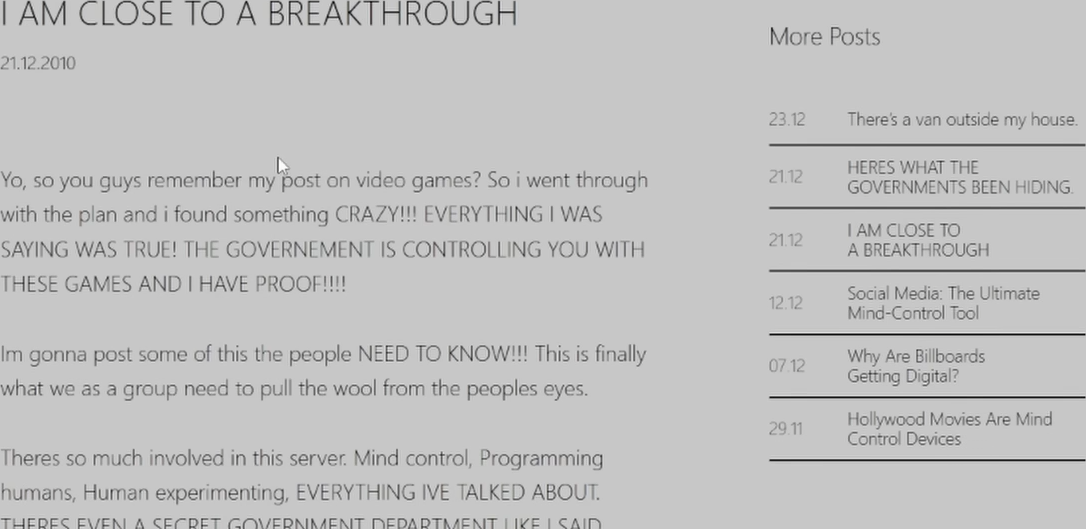
Fake backdated sites are a common theme in fiction and ARGs. It is another thing that could be a force multiplier for evil.
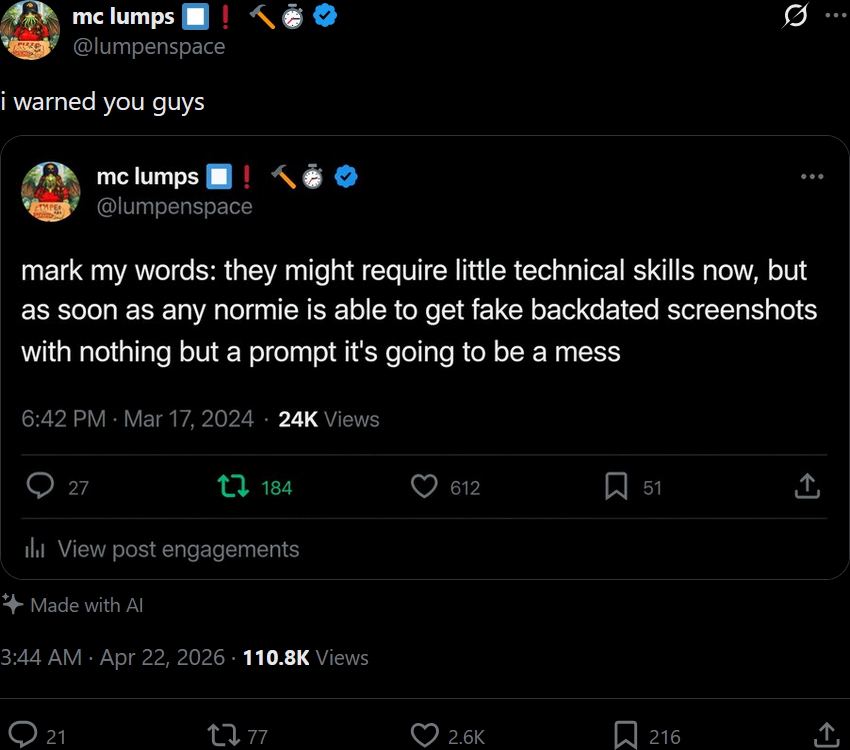
The believability and credibility of a thing is higher when presented as if there was a community of people, normal people just like you, just like the communities you're used to, who analyze the thing in detail.
But in a way, that's not new, is it?
It was always the case that one was more likely to believe something if it had authoritative language, if it's on a famous website, or even rumored to be. Lies spread six times faster than the truth. Fake rumors, gurus selling you their get-rich-scheme-course, saying something is "by MIT", all for false status and credibility.
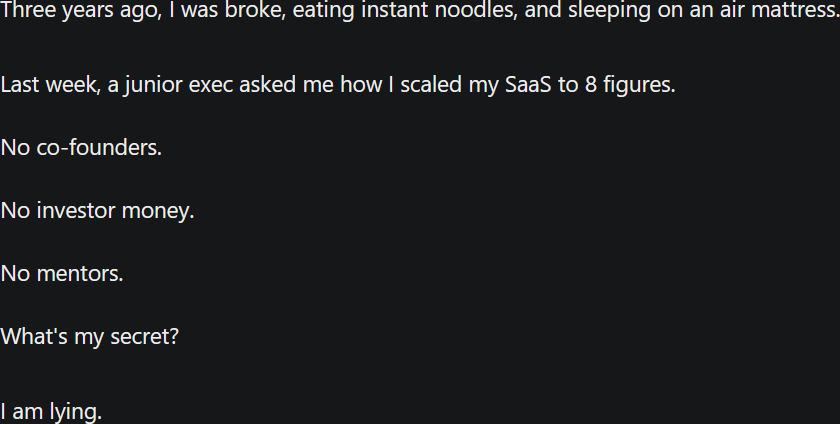
(In itself this picture was not actually posted by anyone. Well, a post like that with "I am lying." exists but I could not find it again, so I recreated it.)
People are also more willing to believe in the existence of something if it has a chain of entities, like in real life. You read a Wikipedia entry, or someone's 'analysis', people form consensus by narrativizers, and that layering is shockingly effective.
VIII. Truly Nonconsensual Fiction
Fiction is where stories can go to be resolved. This is rarely true in real life.
Of course, all of this was leading to a broader example.
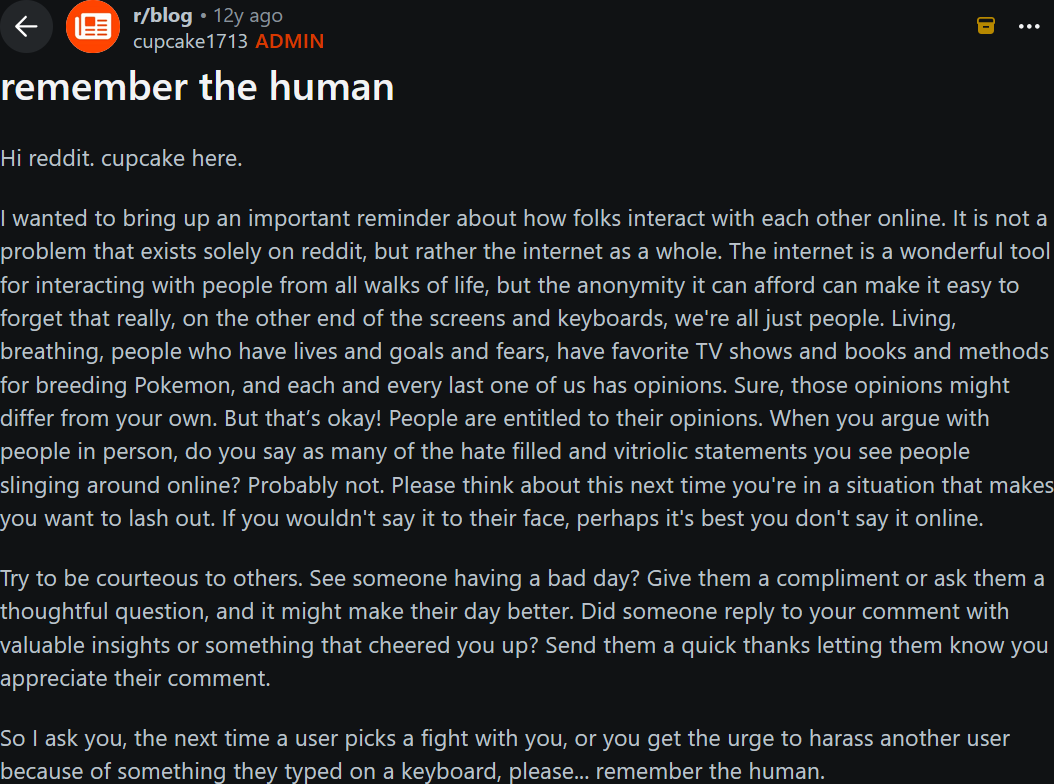
"Remember the human."
The internet is no longer going in this direction. Most obviously due to people's usage of LLM's taking a sledgehammer to "remember the human". Last year, a "Change My View"" community did an unauthorized research experiment with LLM's faking various different identities, and looking through other's user profiles for more effective persuasion.
An underlooked aspect of that "experiment" was that it wasn't literally autonomous. Each comment was also 'manually reviewed', which kind of makes it worse that these researchers were doing this manually and seeing nothing wrong.

In a way, we still have to 'remember the human'. After all, it's... still a human posting the LLM output. It's just the part of some humans that we like to not think about, the ones that can have ulterior motives, be smart enough to conjure years of plausibly deniable schemes. There were election interference worries all the way back in 2016. It's almost a certainty that competent actors have been mining communities for a long time now, but were just better at being undetected.
It's easy to think about marketing agendas that manufacture consensus, conspiracies, and state actors as 'abstract' things until LLM's and schisms of political polarization hit your own communities.
Communities are also full of people with very different ages and life experiences, most there to play a game or be invested in a world. Very many are not ready and not happy to seriously discuss the issue of actors draining the commons spending their online reputation for other ulterior motives.
Many have retreated to 'gated' communities like Discord or even ACX, LessWrong, etc. But even these places are known by LLM's as a vector for a different negative impact of LLM's through AI-psychosis:
I'm seeing more sophisticated LLM-slop in the LW moderation queue.
Eight months ago, I wrote "hey, we're getting tons of AI-psychosis'd people, deluded into thinking their crackpot coherence/spiralism/emergence/ChatGPTAwakening experience is true and meaningful. We process like 15-20 of these a day."
So the thrust of this article's title is nonconsensual fiction for this very reason. In ARG's and unfiction, you get a lot of information and need to obsessively follow clues. But even if you're not trying to solve an ARG, there is a serious need to confirm others are real.
IX. It used to not be this way
When you were a kid, it was easier to make friends where everything was novel and people did not have much of an identity anyway, and you probably didn't have enough to contribute to make a real impact.
Back in these times, a username, avatar, and writing style, all together made up a complete person. Now there is a very wrong feeling, every time you read LLM text that isn't marked as LLM text, every time you see some sloppy commenter on reddit claiming to be some 18 year old one post and a 36 year old divorcee the next, though even that site is designed to not care about individual users.
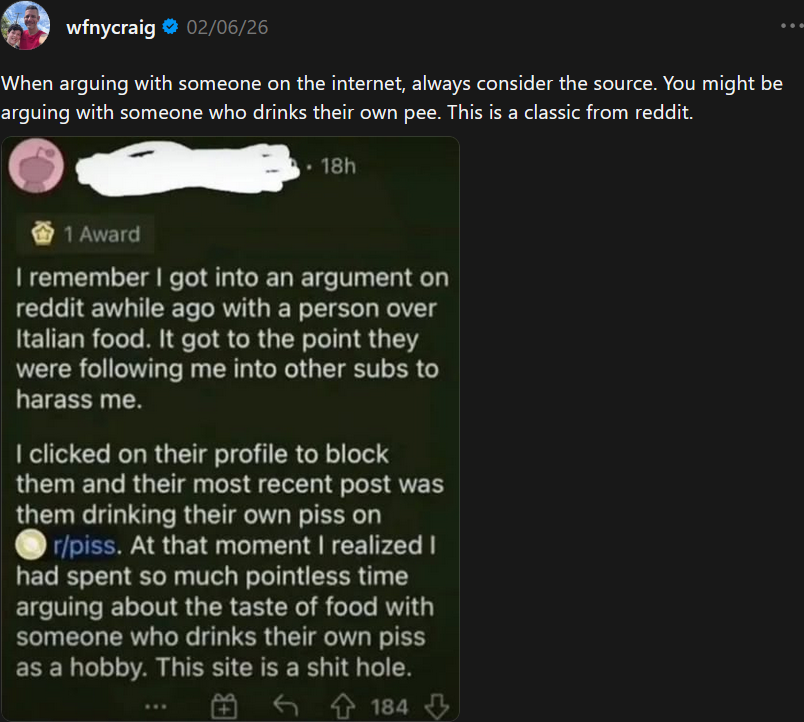
(This is what 'remember the human' gets you now.)
This is not a fun topic to talk about, as it's complex and can be easily torpedo'd and cause huge uproaring discussions. Optimists want to give benefit of the doubt to people. It's bad to be casting suspicion on an innocent person, especially when easily wrapped in preexisting narratives that involve people's labels and identities in who is more likely to be a victim. Things that are weird and stalkerish and invasive to do to an innocent person, become necessary and diligent and sharp to do for a guilty one. Efforts to cast suspicion on potential bad actors are frequently framed as invasive or coming from identity-related motivations.
Plus, there are many people simply unconcerned with filling their mind with true information. I know I was. I subconsciously knew as a kid, that getting all sides of something that happened in real life was often nigh impossible, and fiction gave a way to narrativize reality. But at some point recently, I now feel the opposite, that fiction gives subtly wrong expectations that I now must unlearn in my view of the world.
For a subtle one,
166 pages, 255 pages, 242 pages, 271 pages, 345 pages, 435 pages, 676 pages, 775 pages, 844 pages, and finally 3,642 pages
Could be considered having a subtle clue it was made up - like not including the numbers '0' or '9' as if they were just too far to type on a keyboard. But this is not the point of the work. Yet it is becoming a necessary skill to even think of things like that.
In many places where one tries to retain immersion in an ARG or even in a piece of fiction in general, it means shutting your sensibility down if applied to a real life situation. Minecraft ARGs often have fake 'government' websites that conveniently lead to encrypted YouTube URL's. There are scripted "SMP"s (survival multiplayer servers), and while it attracts all audiences, the younger ones react almost too emotionally like they do not act as if the events are scripted. Such things are mentioned in the descriptions, but deep down, so they won't read it. Blooper videos are even privated for it ruining immersion of this audience.
Countless times fiction can be criticized for things that don't seem 'realistic' yet they happen in real life, while real life repeatedly can be 'stranger than fiction'. Credulity has become nonsense, as if there is a willing audience for deception.
X.
Many people have long suspected or theorized the 'dead internet theory', but I fear the problem is much worse. Only a decade ago after the Edward Snowden whistleblowing of mass surveillance, it was still sort of an abstract fear, even with Google+ and Facebook trying to force people to use real names. Now with the online landscape being as it is, it only seems like a forlorn, dying dream of the virtues of pseudonymous identities.
Web-centered unfiction makes you more perceptive to these kinds of manipulation you never thought about as a child, for better or worse. There's too many people in the world to really get to know them all, so anyone could be a great friend or a complete psychopath when you don't know enough about them. Yet money, status, or dystopian credit scores clearly do not represent this trait of 'goodness', nor is even knowing someone for multiple years always enough to tell.
Perhaps this means there is a huge reward and market for being a company who could make a truly pro-social way to solve this problem, but to take a different example about evaluating the 'worthiness' of strangers, dating apps have been bought out significantly by a massive conglomerate for the seeming goal of monetizing mass loneliness, and so we may truly seem stuck.
It's somewhat ironic that ideally governments are a tool to coordination problems, to justify taxation and such things, but they cannot even reverse their own population decline. They're even the ones who have LLM-assisted data on all of us nowadays, and likely have never been in a 'better' position to influence norms or even expose the truth in online situations and controversies, and here we still are. A sadly reactive society instead of a proactive one.
There's a section near the end of TNC where the 'main' character, having slipped drugs into everyone at the party, was perceived as a creepy unreliable narrator, before a different forum member vouches for their version of events. Pre-global internet, that sort of reputation of thin bonds, vouching, and word of mouth was all we ever had.
Perhaps someone, out there, is dreaming of a better system that we could live in. I could think of no better situation than our real life, to look at the world around us, what you're truly up against, to realize all this - the WHOLE BLEAK ENDLESS WORLD - to have to sacrifice your enjoyment on your hobbies, even look past making your own world safe and attaining romance and love - as what 'Mundum' is about. It is oddly suited to people who had less of a safe world in their life to begin with, who are used to this exhausting, perpetual vigilance. Because that is the kind of person who would even think this way at all.
Your message is stored now and emailed to the author after the contest ends. The author can reply to you, but their identity stays hidden unless they choose to respond.