“The Origins of Wokeness” by Paul Graham
The Hidden Legacies of Biological Sex, Humanism, & the Blank Slate
Just over half a decade ago, in the midst of Donald Trump’s first term, Matt Yglesias announced that the major ongoing shift in American politics was not to the right but to the left. Yglesias’s analysis of the “The Great Awokening” emphasized the timeframe of changing attitudes among the electorate and did not devote much space to discussing their causes. However, the dramatic effects of wokeness on society demand an explanation, and there has been a steady stream of books attempting to provide it:
- The Rise of Victimhood Culture: Microaggressions, Safe Spaces, and the New Culture Wars by Bradley Campbell and Jason Manning (2018)
- The Coddling of the American Mind: How Good Intentions and Bad Ideas Are Setting Up a Generation for Failure by Greg Lukianoff and Jonathan Haidt (2018)
- The Madness of Crowds: Gender, Race and Identity by Douglas Murray (2019)
- Cynical Theories: How Activist Scholarship Made Everything about Race, Gender, and Identity―and Why This Harms Everybody by Helen Pluckrose and James Lindsay (2020)
- Woke Racism: How a New Religion Has Betrayed Black America by John McWhorter (2021)
- America's Cultural Revolution: How the Radical Left Conquered Everything by Chris Rufo (2023)
- The Origins of Woke: Civil Rights Law, Corporate America, and the Triumph of Identity Politics by Richard Hanania (2023)
- The Identity Trap: A Story of Ideas and Power in Our Time by Yasha Mounk (2023)
- Taboo: How Making Race Sacred Produced a Cultural Revolution by Eric Kaufmann (2024)
- We Have Never Been Woke: The Cultural Contradictions of a New Elite by Musa al-Gharbi (2024)
In January of this year, the programmer, investor, and writer Paul Graham added his own narrative to the mix, titling it “The Origins of Wokeness”. Perhaps surprisingly, this essay does not directly cite or indirectly allude to any of the many recent books that cover similar ground, although it is largely consistent with them in treating wokeness as a religion, identifying its roots in Marxist thought and university social-science departments of the 1960s, and linking it to political correctness and cancel culture. I find Graham’s diagnosis of wokeness persuasive, but to me his explanation still leaves its fundamental causes unresolved. After summarizing his argument, I’ll describe what I think is missing from it.
The Origins of Wokeness, According to Paul Graham
Graham’s story begins with a self-reinforcing social feedback loop that is much older than the emergence of wokeness itself, rooted in personality differences within populations:
- All societies have always had some number of “aggressively conventional-minded” people (the subject of another of Graham’s essays; he also uses the word “prig” in this one: “A self-righteously moralistic person who behaves as if superior to others”).
- Changing moral rules are invented by these “zealots” to signal their own virtue, then adopted by a larger group of people who are afraid of the consequences of breaking the rules; this dynamic creates an accelerating cycle of invented and reinforced orthodoxies.
- Importantly, the perpetuation of these orthodoxies requires costly signals. Graham writes, “Any religious observance has to be inconvenient and slightly absurd; otherwise gentiles would do it too” and “If all you have to do to be orthodox is wear some garment or avoid saying some word, everyone knows to do it, and the only way to seem more virtuous than other people is to actually be virtuous. The shallow, complicated, and frequently changing rules of political correctness made it the perfect substitute for actual virtue.”
Graham sees political correctness as the most recent instantiation of the general social process of zealot-driven orthodoxy generation. He pinpoints the birth of this movement in the humanities and social-science departments of (implicitly elite and American) universities sixty years ago, with its ramifications growing steadily over the decades:
- Although student protest movements of the 1960s focused on issues of sexism and racism, the students had no institutional power and couldn’t effect structural change.
- Once those student protestors completed graduate work and began entering academia in the early 1970s, they slowly became numerically dominant as older faculty retired.
- By the 1980s, they had gained tenure and the ability to impose their ideas, and by the 1990s their power continued to grow as they became heads of their departments and administrators within institutions.
- By the 2000s they had succeeded in creating new social-justice-themed departments and new bureaucratic positions that ensured the enforcement of their preferred norms. One particularly consequential change was new hiring practices that produced ideological monocultures within their institutions.
- In the 2010s, the advent of outrage-driven social media and the emergence of new online mobs transformed political correctness into cancel culture, which expanded in scope and gained momentum from the Black Lives Matter movement in 2013 and the Me Too Movement in 2017, along with the financially self-serving ideological polarization of the media in response to the election of Donald Trump in 2016.
- In 2020, the perceived excesses of this movement—now widely identified as wokeness—led to its current decline.
Having thus established the origins of wokeness, Graham concludes his essay by discussing how to defeat it, with the goal of preventing not just the future resurgence of wokeness narrowly but “any similar outbreak of aggressively performative moralism”. His solution is to treat wokeness like any other religion: allow people the freedom to profess their own beliefs, but restrict them from coercing or indoctrinating others within public institutions. The “aggressively conventional-minded” and the new ideologies they are bound to invent in the future, he says, can be kept in check if everyone else keeps an eye out for the emergence of new heresies: “The number of true things we can't say should not increase. If it does, something is wrong.”
Reflections on the Essay
Graham is an engaging writer and an insightful commentator, and his story is convincing as far as it goes. It is especially compelling as a play-by-play narrative of his own personal observations. As he tells it, “I saw political correctness arise. When I started college in 1982 it was not yet a thing. [...] It was still not a thing when I started grad school in 1986. It was definitely a thing in 1988 though, and by the early 1990s it seemed to pervade campus life.”
Reading accounts of the bureaucratic chaos engulfing progressive organizations and public universities thirty years later, it’s hard not to feel like Graham is, if anything, being too restrained in his denouncement of the problem.
“The Origins of Wokeness” usefully analyzes when, where, and how wokeness emerged, but it leaves unanswered the more fundamental question of why wokeness developed as it did. From my perspective, Graham’s explanation (reflecting the consensus of the spate of recent books on wokeness) is missing three crucial pieces of historical context: the first is biological, the second is moral, and the third is ideological.
I. Biology: The Consequences of Differential Reproductive Investment by Men and Women
Graham alludes to a sex bias in the emergence of political correctness:
One thing I noticed at the time about the first phase of political correctness was that it was more popular with women than men. As many writers (perhaps most eloquently George Orwell) have observed, women seem more attracted than men to the idea of being moral enforcers. But there was another more specific reason women tended to be the enforcers of political correctness. There was at this time a great backlash against sexual harassment; the mid 1980s were the point when the definition of sexual harassment was expanded from explicit sexual advances to creating a "hostile environment." Within universities the classic form of accusation was for a (female) student to say that a professor made her "feel uncomfortable." But the vagueness of this accusation allowed the radius of forbidden behavior to expand to include talking about heterodox ideas. Those make people uncomfortable too.
Why this link between women’s concerns about sexual harassment, hostile environments, and discomfort more generally? One underappreciated cause is the biology of sexual reproduction.
A long and consistent evolutionary history has shaped the differences between the sexes. Greater female investment in offspring is at least as old as the split between plants and animals more than a billion years ago, and it has persisted through the origin of vertebrates five hundred million years ago, of mammals three hundred million years ago, of primates fifty-five million years ago, of hominids six million years ago, and of modern humans three hundred thousand years ago. As Louis CK claimed, “A great father can give a kid forty percent of his needs, top[s]. [...] Any mother, a just, a shit mother, like just a not-even-trying mother? Two hundred percent.”
Females of all these sexually reproducing organisms produce egg cells, which are much larger and more energetically costly than the sperm cells of males. The female human body is the site of not just insemination and fertilization, but all of the calorically expensive and potentially life-threatening events that follow: uterine implantation of the embryo and its nine-month development into a human being capable of surviving outside the womb, delivery of the fetus and placenta, and up to several years of breastfeeding the infant. Greater maternal investment in offspring does not end with weaning; mothers traditionally continue to provide years of care to their children, and menopause seems to be an adaptation to allow women to extend their nurturing to an additional generation of descendants—the children of their grown children.
Selection for these dramatically different levels of investment in offspring have led not only to men’s and women’s obviously different physical features, but to well-attested psychological differences between the sexes. Cory Clark and Bo Winegard summarize the evidence:
[W]omen are more likely to experience self-protective emotions such as anxiety and fear, to be more harm- and risk-averse, and to have more empathy and desire to protect the vulnerable. Men, on the other hand, are more likely to take risks and to endorse hierarchy and support for conflict.
Graham seems to regard the “prigs” and “zealots” responsible for wokeness as fundamentally flawed; in his worldview, there is little worse than being “aggressively conventional-minded”. To me, this framing reflects stereotypically male morality failing to understand stereotypically female morality. He writes: “So which should prevail, comfort or truth? Surely if truth should prevail anywhere, it should be in universities; that's supposed to be their specialty; but for decades starting in the late 1980s the politically correct tried to pretend this conflict didn't exist.”
Why did female moral values come to dominate academia and modern society more broadly?
II. Morality: Humanism as a Victim of its Own Success
Graham recalls a changing moral culture as political correctness emerged:
One big contributing factor in the rise of political correctness was the lack of other things to be morally pure about. Previous generations of prigs had been prigs mostly about religion and sex. But among the cultural elite these were the deadest of dead letters by the 1980s; if you were religious, or a virgin, this was something you tended to conceal rather than advertise. So the sort of people who enjoy being moral enforcers had become starved of things to enforce. A new set of rules was just what they'd been waiting for.
He also notes the expanding scope of wokeness in its modern incarnation:
In the early 2010s the embers of political correctness burst into flame anew. There were several differences between this new phase and the original one. It was more virulent. It spread further into the real world, although it still burned hottest within universities. And it was concerned with a wider variety of sins. In the first phase of political correctness there were really only three things people got accused of: sexism, racism, and homophobia (which at the time was a neologism invented for the purpose). But between then and 2010 a lot of people had spent a lot of time trying to invent new kinds of -isms and -phobias and seeing which could be made to stick.
Graham’s emphasis on the self-serving social value of wokeness for elites seems true at least in part, but I don’t think it fully explains the source of the moral changes he identifies here. The triumph of humanism may have been the push that set them in motion.
To summarize many different trends discussed in a lot of detail in recent years (for example, The Rational Optimist: How Prosperity Evolves by Matt Ridley; Factfulness: Ten Reasons We're Wrong About the World—and Why Things Are Better Than You Think by Hans Rosling, Ola Rosling, and Anna Rosling Rönnlund; Enlightenment Now: The Case for Reason, Science, Humanism, and Progress by Steven Pinker; and Superabundance: The Story of Population Growth, Innovation, and Human Flourishing on an Infinitely Bountiful Planet by Marian L. Tupy and Gale L. Pooley), in the modern world everything has on average been getting better for everyone everywhere. One aspect of this progress has been the gradual feminization of society.
“Feminization” is not a dog-whistle here, but a term of art. As Steven Pinker explains in the preface to The Better Angels of Our Nature (p. xxvi), “Feminization is the process in which cultures have increasingly respected the interests and values of women.” In documenting historical declines in violence, Pinker goes on to discuss several forms of feminization (p. 688): “direct political empowerment, the deflation of manly honor, the promotion of marriage on women’s terms, the right of girls to be born, and women’s control over their own reproduction.”
Once the moral discovery that women are fundamentally equal to men had been made, its implications were undeniable and its consequences dramatic, if initially slow in gaining ground. In academia, this change has been particularly notable. After centuries of being excluded from education, women now outnumber men in earning new degrees and being hired as new faculty members. Academic culture has changed at the same time, and surveys reveal exactly the sex differences in values that one would predict from the sex differences in reproductive investment discussed above.
Across a wide variety of studies compiled by Clark and Winegard, men are more willing than women to advocate for free speech and academic freedom, including the expression of offensive ideas and controversial claims, while women are more willing than men to advocate for censorship, dismissal campaigns, and mandating diversity quotas:
The overall theme of these differences is that men are more committed than women to the pursuit of truth as the raison d’être of science, while women are more committed to various moral goals, such as equity, inclusion, and the protection of vulnerable groups. Consequently, men are more tolerant of controversial and potentially offensive scientific findings being pursued, disseminated, and discussed, and women are more willing to obstruct or suppress science perceived to be potentially harmful or offensive. Put more simply, men are relatively more interested in advancing what is empirically correct, and women are relatively more interested in advancing what is morally desirable.
“What is morally desirable” has changed with the gradual feminization of modern society. In The Better Angels of Our Nature, a chapter about the 20th century’s rights revolutions features subsections that recount a dramatic march of declines in violence: Civil Rights and the Decline of Lynching and Racial Pogroms; Women’s Rights and the Decline of Rape and Battering; Children’s Rights and the Decline of Infanticide, Spanking, Child Abuse, and Bullying; Gay Rights, the Decline of Gay-Bashing, and the Decriminilization of Homosexuality; Animal Rights and the Decline of Cruelty to Animals.
I think there are two important and underappreciated aspects of this history that shed light on the origins of wokeness.
First, even recent moral advances that are obviously true from today’s vantage point were not so at the time. During the Civil Rights movement in the 1960s, interracial marriage, homosexuality, and Martin Luther King, Jr. were all extremely unpopular. This mismatch between the moral norms of the recent past and the present day, through the lens of currently dominant female values, has given many people a desperate desire to “be on the right side of history” now. Their assumption seems to be that if the values of left-leaning student protesters of the past ultimately turned out to have been right all along, then the values of left-leaning student protestors of the present will turn out to have been right in the future. The stereotypically female moral value of harm-reduction has accelerated the project of making society less racist, sexist, and unjust.
However (here’s the second point), the success of humanistic morality in modern society has been so complete—even the conservatives of today are more progressive than the progressives of just a generation or two ago—that it is running out of problems to solve. A reduction in horrors ranging from lynching to rape to spanking to bullying to animal cruelty represents not just tremendous moral progress, but also a clear lessening of how horrible the horrors are. The rights revolutions have led, with good reason, to a continual moving of the moral goalposts; this is what progress represents. Notably, though, the motivations and rhetoric have not changed as more and more victories have been won. The end of Jim Crow led to a search for a New Jim Crow; the decrease in overt aggression led to the invention of microaggressions; the decline in violence led to a redefinition of violence, so that first words became violence and eventually even silence became violence.
Pinker connects these dots in Better Angels (p. 381):
[The prohibition of dodgeball] reminds us of how a civilizing offensive can leave a culture with a legacy of puzzling customs, peccadilloes, and taboos. The code of etiquette bequeathed by this and the other Rights Revolutions is pervasive enough to have acquired a name. We call it political correctness. The Rights Revolutions have another curious legacy. Because they are propelled by an escalating sensitivity to new forms of harm, they erase their own tracks and leave us amnesic about their successes.
Why did humanism achieve its great successes in the 1960s? For Pinker, the key factors that produced the rights revolutions were advances in communications and transportation technologies that encouraged a reduction in ignorance and an increase in empathy.
Matt Yglesias has recently pointed to the Holocaust as the catalyst that ultimately led to a sustained burst of civil rights legislation:
This idea that the Nazis were really bad became the cornerstone of the moral order that emerged in the late-1940s. [...] Harry Truman risked the blowup of the Democratic Party coalition to desegregate the armed forces. Bigoted people and racist policies persisted long after the war, of course. But they were in steady retreat, especially in elite discourse. Truman’s desegregation order came in 1948. Brown v Board of Education was in 1954, followed by a Civil Rights Act in 1957 and then another one in 1960. The big Civil Rights Act passed in 1964 and the Voting Rights Act in 1965. Interracial marriage remained unpopular until the surprisingly recent past, but the Supreme Court tossed out miscegenation laws in 1967. [...] It’s officially Not Okay to be racist anymore after World War II.
For Tom Holland, the humanistic values that took hold after World War II are really derived from the influence of Christianity on Western society, and it was the pre-Christian morality of the Nazis that pushed humanity in the opposite direction.
From Graham’s perspective, the 1960s was of course the time that the founders of political correctness began their ascent to power. He quotes a reviewer of his essay as explaining that:
The middle-class student protestors of the New Left rejected the socialist/Marxist left as unhip. They were interested in sexier forms of oppression uncovered by cultural analysis (Marcuse) and abstruse "Theory". Labor politics became stodgy and old-fashioned. This took a couple generations to work through. The woke ideology's conspicuous lack of interest in the working class is the tell-tale sign. [...]
The middle-class origins of wokeness smoothed its way through the institutions because it had no interest in "seizing the means of production" (how quaint such phrases seem now), which would quickly have run up against hard state and corporate power. The fact that wokeness only expressed interest in other kinds of class (race, sex, etc) signalled compromise with existing power: give us power within your system and we'll bestow the resource we control — moral rectitude — upon you. As an ideological stalking horse for gaining control over discourse and institutions, this succeeded where a more ambitious revolutionary program would not have.
I think that there is another piece to the puzzle of the origins of wokeness. Why have the biggest proponents of newly feminized modern society been so unimpressed with the unprecedented advances in global wellbeing that have occurred in the past few decades? It seems to me that the moral goalpost-moving of wokeness (Part II: “Humanism as a Victim of its Own Success”) has been driven in part by a rejection of biological truth (Part I: “The Consequences of Differential Reproductive Investment by Men and Women”).
Why is the reality of sex differences so unpalatable to so many people, and why have the incredible accomplishments of humanism been so unsatisfying to them too?
III. Ideology: The False Promise of the Blank Slate
Graham points to Marxism as the immediate antecedent of the first phase of wokeness that emerged in the 1980s:
Another possibly contributing factor was the fall of the Soviet empire. Marxism had been a popular focus of moral purity on the left before political correctness emerged as a competitor, but the pro-democracy movements in Eastern Bloc countries took most of the shine off it. Especially the fall of the Berlin Wall in 1989. You couldn't be on the side of the Stasi. I remember looking at the moribund Soviet Studies section of a used bookshop in Cambridge in the late 1980s and thinking "what will those people go on about now?" As it turned out the answer was right under my nose.
Much of the recent scholarship on wokeness likewise points to Marxism as its prior cause. There are likely many important influences shared by these social movements, but one of them is so consequential that Steven Pinker devoted an entire book to it nearly a quarter of a century ago—The Blank Slate: The Modern Denial of Human Nature. Pinker writes (p. 157–8):
The ideology of the Blank Slate helps explain some of the features that were unique to the Marxist states:
- If people do not differ in psychological traits like talent or drive, then anyone who is better off must be avaricious or larcenous [...]. Massive killings of kulaks and “rich” or “bourgeois” peasants was a feature of Lenin’s and Stalin’s Soviet Union, Mao’s China, and Pol Pot’s Cambodia.
- If the mind is structureless at birth and shaped by its experience, a society that wants the right kind of minds must control the experience [...]. Twentieth-century Marxist states were not just dictatorships but totalitarian dictatorships. They tried to control every aspect of life: childrearing, education, clothing, entertainment, architecture, the arts, even food and sex. [...]
- If people are shaped by their social environments, then growing up bourgeois can leave a permanent psychological stain [...]. The descendants of landlords and “rich peasants” in postrevolutionary regimes bore a permanent stigma and were persecuted as readily as if bourgeois parentage were a genetic trait. Worse, since parentage is invisible but discoverable by third parties, the practice of outing people with a “bad background” became a weapon of social competition. That led to the atmosphere of denunciation and paranoia that made life in these regimes an Orwellian nightmare.
The parallels between the blank-slate ideology of twentieth-century Marxist societies and the blank-slate ideology of twenty-first-century wokeness leap off the page. If your underlying assumptions are that human nature doesn’t exist, that everyone is the same from birth, and that our characteristics are produced by society, then the continued existence of any inequality among adults is, on its face, evidence that society is unjust, biased, and violent. To me, blank-slateism helps explain the failure of the woke to recognize that they are living in the most just, unbiased, and peaceful societies that have ever existed. I think it also accounts for the shift in emphasis from equality (of opportunity) in the Civil Rights era to equity (of outcomes) in wokeness today.
The ideology of the blank slate seems to be perennially tempting in modern society, in part because it emerges out of a preoccupation with injustice—the stereotypically female value of harm-reduction discussed above. What Pinker calls “the fear of inequality” reflects the belief that the existence of innate differences between people would justify an escalating sequence of injustices: not only prejudice, oppression, and discrimination, but a tolerance for socioeconomic inequality that blames victims for their own failures, and even a eugenics that seeks to remove inferior traits from the human gene pool. Ultimately though, blank-slateism represents a false promise as a solution to these concerns.
As Pinker points out (p. 141–142), this ideology does not make a wise bargain with reality: “Fundamental values (such as equality and human rights) should not be held hostage to some factual conjecture about blank slates that might be refuted tomorrow.” These fears also represent a more fundamental moral fallacy—no matter what science ends up revealing about human differences, it will not have the moral implications that blank-slatists claim (p. 145):
So could discoveries in biology turn out to justify racism and sexism? Absolutely not! The case against bigotry is not a factual claim that humans are biologically indistinguishable. It is a moral stance that condemns judging an individual according to the average traits of certain groups to which the individual belongs. Enlightened societies choose to ignore race, sex, and ethnicity in hiring, promotion, salary, school admissions, and the criminal justice system because the alternative is morally repugnant. Discriminating against people on the basis of race, sex, or ethnicity would be unfair, penalizing them for traits over which they have no control. It would perpetuate the injustices of the past, in which African Americans, women, and other groups were enslaved or oppressed. It would rend society into hostile factions and could escalate into horrific persecution. But none of these arguments against discrimination depends on whether groups of people are or are not genetically indistinguishable.
How discrimination based on innate differences was rejected by the Civil Rights movement in the late twentieth century only to be embraced by wokeness in the early twenty-first is quite a story.
Final Thoughts
Graham’s explanation of the origins of wokeness persuasively identifies its features and their source: Marxist-influenced student protestors of the 1960s and their subsequent remaking of academia from social-science and humanities departments. What I think is missing from this narrative, and why I think Graham’s suggested solution (contain wokeness by treating it as a religion) will be hard to put into practice, is that there are three additional, more fundamental, and less widely recognized causes behind the emergence and cultural dominance of wokeness.
First, the consequence of differential reproductive investment by men and women is predictable differences in male and female psychology and values. Second, the moral discovery that men and women are morally equal has ultimately made humanism a victim of its own success: feminization of society has led to accelerating changes in moral norms from stereotypically male to stereotypically female values. The result has been a paradoxical dissatisfaction among the woke with the unprecedented moral advances of the past sixty years. Third, this response stems in part from the false promise of the blank slate: an ideological commitment to the rejection of biology’s influence on psychology means that continued differences in outcomes between different categories of people in society prove the continued existence of societal injustices.
Many recent opinion pieces argue that wokeness is now declining. Graham takes this position too: “Since then [2020] wokeness has been in gradual but continual retreat. [...] I'm not going to claim Trump's second victory in 2024 was a referendum on wokeness; I think he won, as presidential candidates always do, because he was more charismatic; but voters' disgust with wokeness must have helped.”
On the other hand, why does the April 2025 issue of National Geographic “presenting our inaugural collection of visionary changemakers who are striving to make the world a better place” include “the climate activist creating spaces for Africans to process their eco-anxiety” and “the activist making the outdoors a more welcome space for the queer community”?
The scale of the takeover of scientific institutions by wokeness in recent years is hard to exaggerate. Here are just a few examples from Nature and Science, long regarded as two of the the most prestigious scientific journals in the world (and distinct from popular outlets like Scientific American, itself the subject of a well-documented collapse):
- “Women choosing greener pastures”: Women faculty remain under-represented in chemistry because of a lack of applicants. Howe et al. surveyed 130 women and found that themes of overwork, unrealistic expectations, and an emphasis on research over teaching and mentoring were the underlying reasons that women looked elsewhere for employment. Further analysis revealed that women felt unsupported during graduate school and extrapolated this lack of support to faculty positions. This suggests that graduate-level experiences inform interests and career goals, and that systemic changes for increasing the diversity of faculty need to be made at the graduate level. Collectively, the results show that diversifying faculty positions is much more than simply opening a position. Instead, it requires policy changes that explicitly value women and their ideals.
- “Men dominate Q&A sessions, even online”: Conferences suffer from male-dominated ‘question and manswer’ sessions at both in-person and virtual events, even if they have a good gender balance. Researchers observed a four-day online bioinformatics conference and found that ‘senior men’ (older than 35 years) asked, on average, 9.3 more questions than a junior woman, while senior women asked just 2.3 more questions than a junior man. Possible solutions are more time for question and answer sessions, giving the first query opportunity to a junior woman or taking a short break after the talk to allow the audience to formulate their ideas.
- “Maths charts course to decolonization”: Mathematicians who are leading decolonization efforts describe how they are ushering in a new era of teaching in one of the least diverse scientific disciplines. Some are working on rooting racism out of the curriculum, and others are including examples of problems from different cultural backgrounds in their teaching — all in the context of diversifying who is teaching and learning mathematics. Lecturers need to make human connections if they want to introduce examples from communities that they don’t belong to, says mathematician and Native Hawaiian Kamuela Yong. Otherwise, he notes, “it’s appropriation all over again”.
- “Does dino naming need an overhaul?”: Two centuries on from Buckland announcing Megalosaurus, some palaeontologists are calling for more robust guidelines around naming dino species to help avoid names that have racist, sexist or other problematic connotations. Unlike scientific disciplines such as chemistry, in which strict rules govern a molecule’s name, in zoology researchers have a relatively free rein over the naming of new species. “We need to critically revise what we have done, see what we have done well and what we have not done well, and try to correct it in the future,” says palaeontologist Evangelos Vlachos.
- “Why scientists are taking to the streets”: Fed up with a lack of political progress in solving the climate problem, some researchers are turning to activism and civil disobedience. Despite facing legal and professional consequences, there is a growing consensus among researchers that an urgent response is warranted. A survey conducted last year of 9,220 researchers around the world, from a range of scientific and academic disciplines, found that more than 90% agree that “fundamental changes to social, political, and economic systems” are needed. “I think it’s worth it,” says atmospheric scientist Noah Liguori-Bills. “The whole world’s at stake.”
- Quote of the day: “I’ve found that doing science is the ultimate act of rebellion, and a way to confront the injustices that women face every day.” Being a Latin American woman in science is partly about shattering stereotypes and glass ceilings, says palaeontologist Dirley Cortés.
The current state of science (and “Science”) reflects the hidden legacies of biological sex, humanism, and the blank slate in the origins of wokeness. Wokeness, I argue, emerged in part from the success of humanistic morality in empowering biologically-based female values in society. Because the stereotypical male value of freedom and the stereotypically female value of preventing harm necessarily trade off with each other, an institution with more freedom will allow more harm, and one that prevents more harm will restrict freedom. By treating differences between groups as evidence of continued injustice, the ideology of the blank slate has accelerated the classification of more groups as vulnerable and more ideas as harmful.
The real promise of humanism, though, is a rejection of the false promise of the blank slate: treating each person as an individual, rather than reducing them to representatives of the identity categories they happen to belong to. If given equality of opportunity and freedom of choice, people will pursue their own interests. From that perspective, the persistence of sex asymmetries across academic fields may be cause for hope:
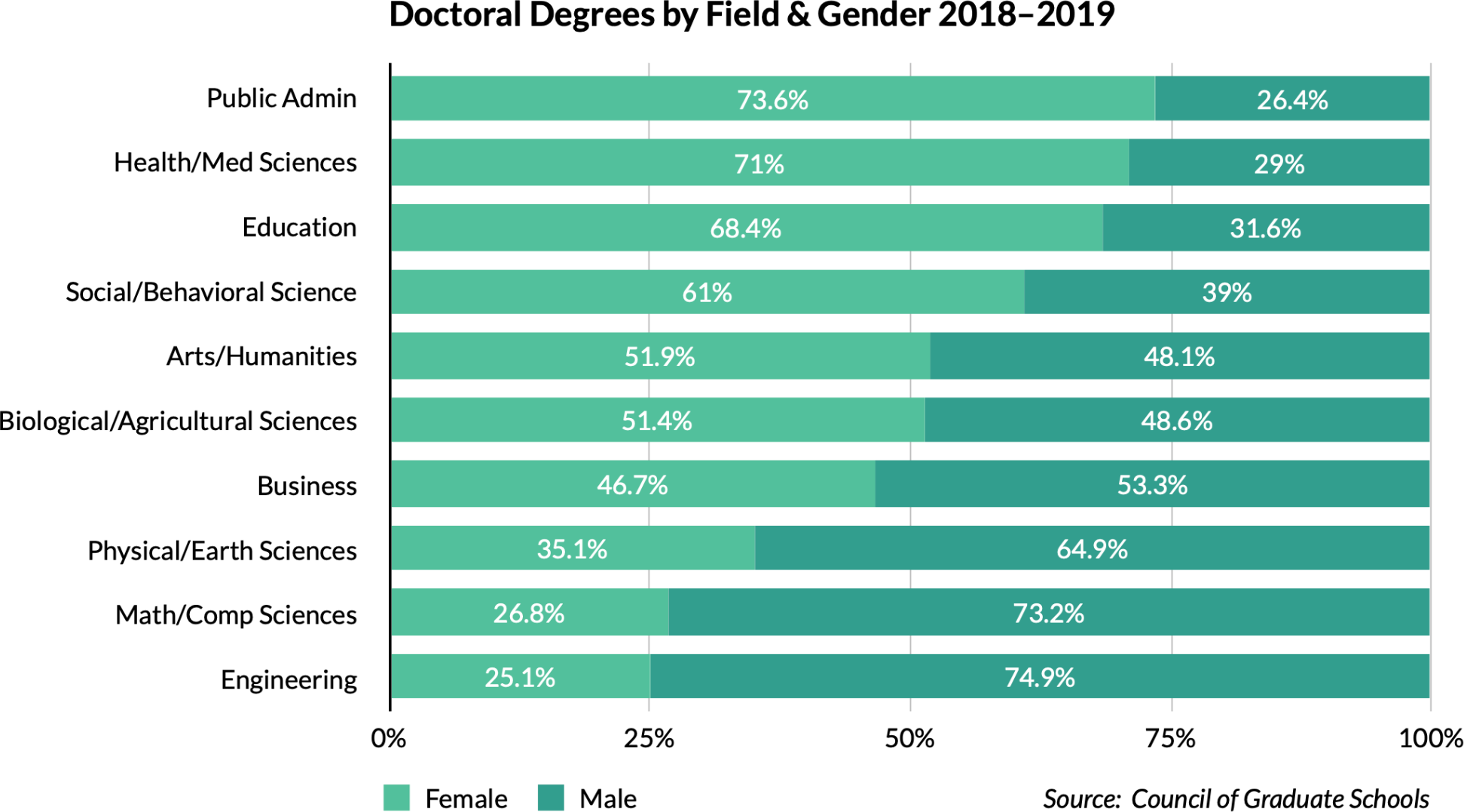
So far, biology remains stronger than ideology. I think the challenge will be in reestablishing truly humanistic norms in academia that accept human differences and celebrate the great moral advances we have made, while acknowledging that complete equity of outcomes may not be possible or even desirable. If academic institutions are able to regain trust and offer a compelling alternative to wokeness, it may be easier to resist the future waves of aggressively performative moralism that Graham sees coming.