The Question Concerning Technology by Martin Heidegger
First, I apologize for only reviewing an essay, rather than a whole book. It's because Heidegger is very hard to understand. I'm going to do my best to make this review easy to read, but I am only a mere mortal. If you stick with me, there's a payoff at the end: a unique vision of what technology is and what it does. There are even interesting implications for AI alignment.
But we have to get through some choppy waters first.
Heidegger's Method
Heidegger's main deal is that our terminology is broken. Almost all of it, and definitely every important term. Here’s an incomplete list of terms we use wrong: "technology", "essence", "truth", "cause". And that's only in this one essay. In Being and Time, he goes after the big kahuna, "is". As in, "to exist".
Question: How can a word's definition even be wrong? Isn't it arbitrary? If a word doesn't fit for what you're trying to talk about, can't you just make up a new word? Answer: Reality has an underlying structure, which a term can either reflect, or not. Ours don't, and, yes, he is absolutely, one hundred percent going to make up new words to replace them.
But that's not going to be easy. The definition of a word is a set of other words. And we, his readers, only understand the bad old words, the ones that don't reflect reality. So he has to, somehow, explain his shiny new terms using only the bad old terms as a starting point. Have you ever played Taboo?
That's why never-ending, unremitting circularity is the hallmark of Heidegger's method. For example, he defines technology on page 312, and tells us it's a pretty accurate definition. Then he gives a new definition on page 320. By page 326, he's telling us that the first definition was never any good. And by the end of the essay, technology is barely recognizable as the thing he started the essay with.
This is exactly what you would expect. It’s going to take multiple passes before the bad old terms are all cleared away, and he can define the shiny new terms using only other shiny new terms.
Generally, the way this works is that he starts with a term we think we know. He shows us how it doesn't actually make any sense, and either redefines it or replaces it with a new word he made up. (Technology’s new word is enframing). As he goes on like this, the redefinitions and neologisms accumulate. The more of them he has in his tool belt, the loftier the concepts he can tackle. Finally, we're left with an interlocking constellation of new terms, which encapsulate a completely new way of looking at the world.
Note: Heidegger’s method is extremely similar to the logical fallacy called "circular reasoning". His definitions preordain his conclusion. This seems fine to me, because, after all, the definitions are the whole point. I'm not even sure such a thing as a conclusion exists, for him. He ends the essay with a quote from a poet and an exhortation never to stop questioning. It does not leave one feeling compelled to accept his viewpoint—which is the stakes whenever people talk about logical fallacies. If the charge sticks, Heidegger loses nothing.
(For this review, when I’m trying to use one of Heidegger’s shiny new terms in exactly the way he uses it, I’ll put it in bold, about once in the paragraph. Otherwise, I’m trying to use normal English words in the normal way. This is also meant to prevent readers thinking I’m using Heideggerian terminology when I’m not. For instance, I think Heidegger has a special definition for “world”. But I don’t understand it. So, when I use “world”, I won’t put it in bold, because I’m just using it in the normal way, not attempting a Heideggerian term.)
Plan of this Review
To follow the meandering course of The Question Concerning Technology would take me more pages than the essay itself. So, I propose the following outline:
One Single Example, to show why Heidegger's thinking might be convincing.
Is This All Just Semantics? to address what everybody will be thinking at this point
Freedom, Truth and Revealing, because these are the conceptual keystones.
Enframing, because it’s the point of the essay.
You Said this Had Something to Do With AI, because I did.
Questioning and Art, which might save us from enframing
Obligatory Note on Heidegger's Despicable Politics, because they were.
Obligatory Note on Translation
One Single Example
The most convincing takedown of a bad old term is the discussion of causality. If you learned about the four causes in Philosophy 101, this is that. The material cause is the stuff something is made of. The formal cause is the shape of the thing. The efficient cause is whatever brings about that shape. The final cause is why.
Heidegger asks: Why are there four causes and not three, or five? What is it about these concepts that makes it appropriate to bring them under the heading "causes"? What do they have in common? He gives the traditional answer:
For a long time we have been accustomed to representing cause as that which brings something about. In this connection, to bring about means to obtain results, effects. The causa efficiens, but one among the four causes, sets the standard for all causality.
In other words, when you ask what it is about any of the four causes that makes it a cause, the answer is, "it brings about an effect". But "that which brings about an effect" is the definition of the efficient cause, which is already one of the four!
It's like if you asked me what pigs, cats, dogs and sheep all have in common, and instead of answering that they're all mammals, or all quadrupeds, I told you that they're all kinds of dogs. Like, no! First, "dogs" is already on the list. Second, cats aren't a kind of dog.
This is where reading Heidegger gets a little spooky, for me. Before he pointed it out, I was walking around with exactly that absurdity in my head. I literally thought of the final cause as one of the four ways for a cause to bring about an effect. But it's not! It's the reason why you might want to bring about some effect in the first place. Completely different thing. I'm particularly embarrassed about the material cause. I don't think I ever had anything even remotely approaching a good reason to include "physical matter" under the heading "types of causes which bring about an effect". The whole point of physical matter is that it’s the part of nature that just sits there unless it gets acted on.
According to Heidegger, when we think about causality, we're trying to think an ancient Greek thought. But the Scholastics (or somebody) corrupted the original thought, and now it's garbage. But he's a great scholar, and can excavate the original Greek thought, which will fix it.
(The Greeks, by the way, aren't always right. For example, in this same essay, he says that both Aristotle and Plato separately broke the term essence. And there’s a hint that Plato also goofed up techne, since Heidegger has to excavate further back than Plato to find it uncorrupted.)
So this is Heidegger at his best, just red pilling you over and over about dead simple philosophical concepts you thought you had a grip on as a freshman.
In case you're wondering, the actual answer is owing, or responsibility. The four causes are each ways a person can be responsible for the presence of an object. Conversely, they're ways an object can owe its presence to a person. Of course, each of the four causes has to get redefined—nothing is escaping this essay without at least having its bolts tightened up—but they're still broadly recognizable afterwards. Not as universally applicable principles of time and space, true. But rather, more humbly, as ways for people to interact with objects.
The four causes are the ways, all belonging at once to each other, of being responsible for something else.
Thus four ways of owing hold sway in the sacrificial vessel that lies ready before us. They differ from one another, yet they belong together.
Is This All Just Semantics?
Most smart Westerners seem to have an ontology (a theory of what being is) that goes something like: The real world exists separately from my understanding of it, and is controlled by strict physical laws. Objective science has discovered many of those laws, and they are 100% reliable. If my subjective experience differs from the way science describes the world, I’m in error, and I should learn to see things the way science does.
(I don’t want to stir a hornet’s nest, but I’m imagining the basic Western ontology as a less defensible version of this essay from The Sequences. This is far, far better than squishy normie “but the teevee said so” ontology, but Heidegger sees it as an incoherent mess, built on implicit unexamined misunderstandings that go back thousands of years.)
To somebody coming from the basic Western ontological perspective, the last section probably seems like mere semantics. What does it matter whether you call the “efficient cause” a “cause” or a “responsibility”? Rock bottom, it’s particles and forces, no matter what we might name them or imagine about them.
Except it’s not. Heidegger is well-versed in Heisenberg, and references him twice in this essay. Rock bottom, it actually gets very squishy, and concepts like objectivity start to seem less reliable than a strict Newtonian might imagine.
But, more importantly, I think Heidegger would say that most of the terms in the basic American ontology are broken. Either they’re just nonsense (“erroneous subjective experience” makes as much sense as “square circle”) or they’re based on assumptions that Heidegger doesn’t make. For instance, the idea that the world exists separately from us—that was invented by St. Thomas Aquinas in a mistranslation of Aristotle (or something like that), we have no evidence it’s true, and our experience of living in the world actually suggests that we and the world are quite tightly interconnected.
This explains, among many other puzzles, why the topics explored in Scott’s article Can People Be Honestly Wrong About Their Own Experiences? are so frustrating to talk about. The terms we use contain contradictions and incoherencies that are invisible to us.
Heidegger is trying to clear all that up. To do so, he has to intervene at the most primal possible level. The rot goes all the way back. He is throwing out the whole ontological apparatus. Questions like “Is modern technology a force for good or evil?” miss the mark because they are incoherent nonsense. They became incoherent nonsense when they used the word “is”. I wish I could explain this better, but it’s beyond both the scope of this review and my own understanding of Heidegger. If you’re interested in following this thread, Being and Time is the book to dive into. Good luck.
So what, after all, is the payload? Why should we want to redefine all these terms? Can’t we just muddle by with the terms we have?
Well, we’ve just invented a new technology that a lot of very smart people think is going to destroy the human species, or at least render human life meaningless in some important way. If the conceptual framework we use to think about technology is as broken as the one we use to think about causality, don’t you think it would be a good idea to fix that?
Freedom, Truth and Revealing
Now to define some terms. Imagine you’re in the featureless white space of The Matrix’s “The Construct”. Where Neo says, “Guns. Lots of guns.” and thousands of racks of guns whoosh in from nowhere.
But imagine it before the guns show up. The space is completely open. Neo is totally unconstrained. Perfect, infinite possibility. It could be anything, and that’s why it’s nothing. Then he says, “Guns. Lots of guns.” and infinite possibility gets closed off. It’s not umbrellas, not footwear, not apples, that come whooshing in. It’s guns. Before he spoke, Neo was free to possibly choose anything. Practically, that was the same thing as choosing nothing. Now that the guns are present in the space, he’s free to choose any gun. So the possibility of umbrellas or footwear has been closed off, creating the practical freedom to interact with the racks of guns.
If freedom meant merely absence of constraint, perfect freedom would look like The Construct. It would be indistinguishable from a prison. Therefore, freedom doesn’t mean mere absence of constraint, but includes both concealment and revealing.
For Heidegger, all freedom is like this. The opening up of some options comes from the closing down of other options. He says:
The freedom of the free consists neither in unfettered arbitrariness nor in the constraint of mere laws. Freedom is that which conceals in a way that opens to light, in whose clearing shimmers the veil that hides the essential occurrence of all truth and lets the veil appear as that which veils.
Stay with me. Sentences like this are why this book review only covers a single 36-page essay. Let the weird undefined terms (“veil”? “shimmers”? “light”?) roll off you like water off a duck’s back. We don’t have time to get hung up on every little thing.
Right now, reader, you are in a clearing. There is some room or space surrounding you, bounded by things that you can’t see past. The things that you can see are revealed to you. You’re free to interact with them if you want. But those same things also work to conceal other things. There’s stuff behind the wall, inside the closet, under the bed, past those mountains, on the other side of that building. That stuff is concealed from you.
The clearing, and your freedom within the clearing, consist of some things being concealed from you, and some things revealed. As you do stuff (move around, pick things up, manipulate objects, measure quantities) some things which were revealed become concealed (if you close a book or turn out the lights) and some things which were concealed become revealed (if you open a cupboard or walk into another room).
When you freely interact with something in your clearing in such a way that it becomes revealed—that’s what he calls truth. It is different from accuracy. Truth involves the freedom to interact with things however you want. Accuracy does not involve freedom; if something is 3 feet long, you don’t have the freedom to say any other length, or else you’re not being accurate. He says:
Freedom governs the free space in the sense of the cleared, that is to say, the revealed. To the occurrence of revealing, i.e., of truth, freedom stands in the closest and most intimate kinship. All revealing belongs within a harboring and a concealing.
Does Heidegger mean a literal clearing, a literal open space, as I described above, or is this a physical metaphor for something else? It’s hard to tell. In this essay, most of the time, he’s talking about literal physical things: cups, fields, rivers, power plants. But sometimes it seems to sheer off into the metaphorical, and it’s hard to tell when that happens, or whether the distinction would even mean anything to Heidegger.
This is very speculative, but: he doesn’t seem to recognize the distinction between objects as I might imagine them in my mind and objects as they actually exist in the world. As though there’s something about his concepts of object and truth that excludes the possibility of me getting a wrong idea about an object. Which would mean that there’s no necessity for a distinction between the object as I imagine it and the object itself. Which, in turn, would mean that he’s free to move between the metaphorical space of my imagination and real, physical space, because there’s not really a difference.
This would be similar to the extended mind thesis. Food for thought, at least. I wonder what he would make of optical illusions?
Enframing
Heidegger would not approve of this phrasing, but: in The Question Concerning Technology, the world is full of two different kinds of thing: objects and standing-reserve. (I believe other works involve even more categories.) They correspond to two separate kinds of revealing: poiesis and enframing. (He says poiesis and enframing are not separate “kinds” of revealing, but rather separate “destinings”, a term I have not yet quite understood.)
Enframing is the meat of the essay, and the difference between it and poiesis is something he explains over and over.
Poiesis is an ancient Greek word for “making”, from which English gets the word “poetry”. For Heidegger, it covers two different kinds of revealing: physis and causality.
Physis is a kind of revealing in which the object becomes present according to its own rules, without any human interaction. It owes its essence to itself. A flower growing up out of the dirt, a spring bursting forth from the ground, the change from summer to fall, et cetera.
Causality is a kind of revealing in which the object becomes present because of human interaction, according to the four causes. It owes its essence to the craftsman who makes it.
Not only handicraft manufacture, not only artistic and poetical bringing into appearance and concrete imagery, is a bringing-forth, poiesis. Physis, also, the arising of something from out of itself, is a bringing-forth, poiesis. Physis is indeed poiesis in the highest sense. For what presences by means of physis has the irruption belonging to bringing-forth, e.g., the bursting of a blossom into bloom, in itself (en heautoi). In contrast, what is brought forth by the artisan or the artist, e.g., the silver chalice, has the irruption belonging to bringing-forth, not in itself, but in another (en alloi), in the craftsman or artist.
Enframing is not poiesis. It is a kind of revealing in which standing-reserve becomes present because of being challenged forth, ordered, and set in place by a person. Standing-reserve doesn’t have its own essence anymore, but takes on the essence of the task it was ordered to do. Enframing is characteristic of modern technology. The way he talks about it makes me want to describe it as “inhuman”, “coldly rationalistic” and “mechanized”, though these aren’t words he uses. Here are a few long passages:
And yet, the revealing that holds sway throughout modern technology does not unfold into a bringing-forth in the sense of poiesis. The revealing that rules in modern technology is a challenging, which puts to nature the unreasonable demand that it supply energy which can be extracted and stored as such. But does this not hold true for the old windmill as well? No. Its sails do indeed turn in the wind; they are left entirely to the wind’s blowing. But the windmill does not unlock energy from the air currents in order to store it.
[...]
In contrast, a tract of land is challenged in the hauling out of coal and ore. The earth now reveals itself as a coal mining district, the soil as a mineral deposit.
[...]
This setting-upon that challenges the energies of nature is an expediting, and in two ways. It expedites in that it unlocks and exposes. Yet that expediting is always itself directed from the beginning toward furthering something else, i.e., toward driving on to the maximum yield at the minimum expense. The coal that has been hauled out in some mining district has not been produced in order that it may simply be at hand somewhere or other. It is being stored; that is, it is on call, ready to deliver the sun’s warmth that is stored in it. The sun’s warmth is challenged forth for heat, which in turn is ordered to deliver steam whose pressure turns the wheels to keep a factory running.
[...]
The hydroelectric plant is set into the current of the Rhine. It sets the Rhine to supplying its hydraulic pressure, which then sets the turbines turning. This turning sets those machines in motion whose thrust sets going the electric current for which the long-distance power station and its network of cables are set up to dispatch electricity. In the context of the interlocking processes pertaining to the orderly disposition of electrical energy, even the Rhine itself appears to be something at our command. The hydroelectric plant is not built into the Rhine River as was the old wooden bridge that joined bank with bank for hundreds of years. Rather, the river is dammed up into the power plant. What the river is now, namely, a water-power supplier, derives from the essence of the power station.
I think a good question to tell whether something is enframed or not is: can you play with it? Can you pick it up and test it out, trying first one thing, then another on it? Can you use it for something that nobody else has thought of before, some usage that’s unique to your personality? If so, then you’re free to interact with it, to bring it into revealing in the mode of truth. A toy, a video game, a poem, a ceremonial chalice. These objects become part of your life, your real life, and they become involved in the meaningful decisions you make.
If something is enframed, you can’t play with it. A kilowatt-hour, a liter of natural gas, a stack of wooden boards on a truck. These things all have a specific economic purpose, a set destination, and a literal order sheet. An Amazon warehouse is probably the most thoroughly enframed space imaginable: a building chock full of toys, full of people, and none of them free to play. Heidegger wouldn’t even call them “toys”; he’d probably insist on “products”.
Enframing is ordered, rather than free; accurate, rather than true; the essence of standing-reserve is neither what the thing would want for itself, nor what any human being would want from it, except for economic purposes. The river with a hydroelectric plant damming it up no longer has the essence of a river; its essence is as a supplier of water pressure. The plot of farmland has lost its essence as a field that might be worked by a farmer; its essence is now as part of the “mechanized food industry”.
One important point he makes is that enframing began long before the emergence of anything we would recognize as modern technology. As soon as Western people started setting up experimental apparatus to challenge nature, measure it and set its behavior in order, we were already in the mode of enframing, already treating nature as standing-reserve. It was modern physics that really kicked off enframing.
Accordingly, man’s ordering attitude and behavior display themselves first in the rise of modern physics as an exact science. Modern science’s way of representing pursues and entraps nature as calculable coherence of forces. Modern physics is not experimental physics because it applies apparatus to the questioning of nature. The reverse is true. Because physics, indeed already as pure theory, sets nature up to exhibit itself as a coherence of forces calculable in advance, it orders its experiments precisely for the purpose of asking whether and how nature reports itself when set up in this way.
But, after all, mathematical science arose almost two centuries before technology. [...] Surely technology got under way only when it could be supported by exact physical science.
The modern physicist orders the particle to give an account of itself, so that it can be set into a system, which will enable accurate prediction. The hoped-for result of the physicist’s work is that the particle would be as enframed as any ton of coal, kilowatt-hour or Amazon product. And modern physics—physics which enframes—began long before modern technology.
Another important note: Although it seems like humanity must be the source of enframing, actually, we’re not. Part of being a destining is, apparently, that humanity was challenged by enframing first. We responded to being challenged in this way by turning around and challenging nature.
You Said this Had Something to do With AI
Heidegger proposed a couple of unwelcome aspects of enframing, at the philosophical or psychological level. Recent thinking about AI has reified those from that abstract plane down into horrifying physical possibility. In other words: Heidegger issued some abstract philosophical warnings, back in the fifties, and AI alignment skeptics are issuing those same warnings now, except they’re not philosophical anymore; they’re concrete economic and social possibilities.
Here’s Heidegger on the danger to truth posed by enframing:
Thus the challenging-enframing not only conceals a former way of revealing (bringing-forth) but also conceals revealing itself and with it that wherein unconcealment, i.e. truth, propriates.
Enframing blocks the shining-forth and holding sway of truth. The destining that sends into ordering is consequently the extreme danger. What is dangerous is not technology. Technology is not demonic; but its essence is mysterious. The essence of technology, as a destining of revealing, is the danger.
Here’s a quote from David Chapman’s Better without AI:
Artificial intelligence might end the world. More likely, it will crush our ability to make sense of the world—and so will crush our ability to act in it.
AI will make critical decisions that we cannot understand. Governments will take radical actions that make no sense to their own leaders. Corporations, guided by artificial intelligence, will find their own strategies incomprehensible. University curricula will turn bizarre and irrelevant. Formerly-respected information sources will publish mysteriously persuasive nonsense. We will feel our loss of understanding as pervasive helplessness and meaninglessness. We may take up pitchforks and revolt against the machines—and in so doing, we may destroy the systems we depend on for survival.
I would explain it this way: things that are enframed (i.e. standing-reserve) don’t make sense at an intuitive level: they’re just a part number, or a quantity on a spreadsheet. A resource, not an object. To really understand something, you need to play with it, experiment with it, try it out. You need to freely interact with it, as an object, for it to become revealed to you in a way that’s true. So a technological advancement that has the possibility to enframe the whole world could render the whole world nonsensical.
Next, here’s Heidegger’s version of the paperclip problem:
Yet when destining reigns in the mode of enframing, it is the supreme danger. This danger attests itself to us in two ways. As soon as what is unconcealed no longer concerns man even as object, but exclusively as standing-reserve, and man in the midst of objectlessness is nothing but the orderer of the standing-reserve, then he comes to the very brink of a precipitous fall; that is, he comes to the point where he himself will have to be taken as standing-reserve.
Here’s Nick Bostrom
Suppose we have an AI whose only goal is to make as many paper clips as possible. The AI will realize quickly that it would be much better if there were no humans because humans might decide to switch it off. Because if humans do so, there would be fewer paper clips. Also, human bodies contain a lot of atoms that could be made into paper clips. The future that the AI would be trying to gear towards would be one in which there were a lot of paper clips but no humans.
My explanation: Enframing acts by finding poiesis and gobbling it up. The modern age has been characterized by mankind using modern physics and technology to enframe nature, which is one half of poiesis. Mankind is the other half; there’s nothing saying we ourselves can’t be enframed. Enframing humanity has got to be one of the most efficient ways to enframe the universe; and there’s nothing enframing loves more than efficiency.
Heidegger continues with a warning that I don’t think I’ve seen mirrored in discussions of AI:
Meanwhile, man, precisely as the one so threatened, exalts himself and postures as lord of the earth. In this way the illusion comes to prevail that everything man encounters exists only insofar as it is his construct. This illusion gives rise in turn to one final delusion: it seems as though man everywhere and always encounters only himself. […] Man stands so decisively in subservience to the challenging-forth of enframing that he does not grasp enframing as a claim, that he fails to see himself as the one spoken to, and hence also fails in every way to hear in what respect he ek-sists, in terms of his essence, in a realm where he is addressed, so that he can never encounter only himself.
My explanation: If we interpret this concretely, it describes the optimistic technological singularity scenario. AI will be like Aladdin’s lamp. It will give us not only everything we ask for, but everything we would ask for if we knew the best thing to ask for. Our desires will be implemented throughout the world, with no more resistance or failure.
Then, the world will be no more than an inverted image of our desires. Everywhere you look, you see exactly what you would most like to see. And so you’re really only seeing yourself. But the essence of humanity is more than sitting back and watching desires arise, to be met immediately with their satisfaction, as regular and boring as an assembly line. Humanity ought to be exploring, playing, discovering, questioning! Life ought to be meaningful!
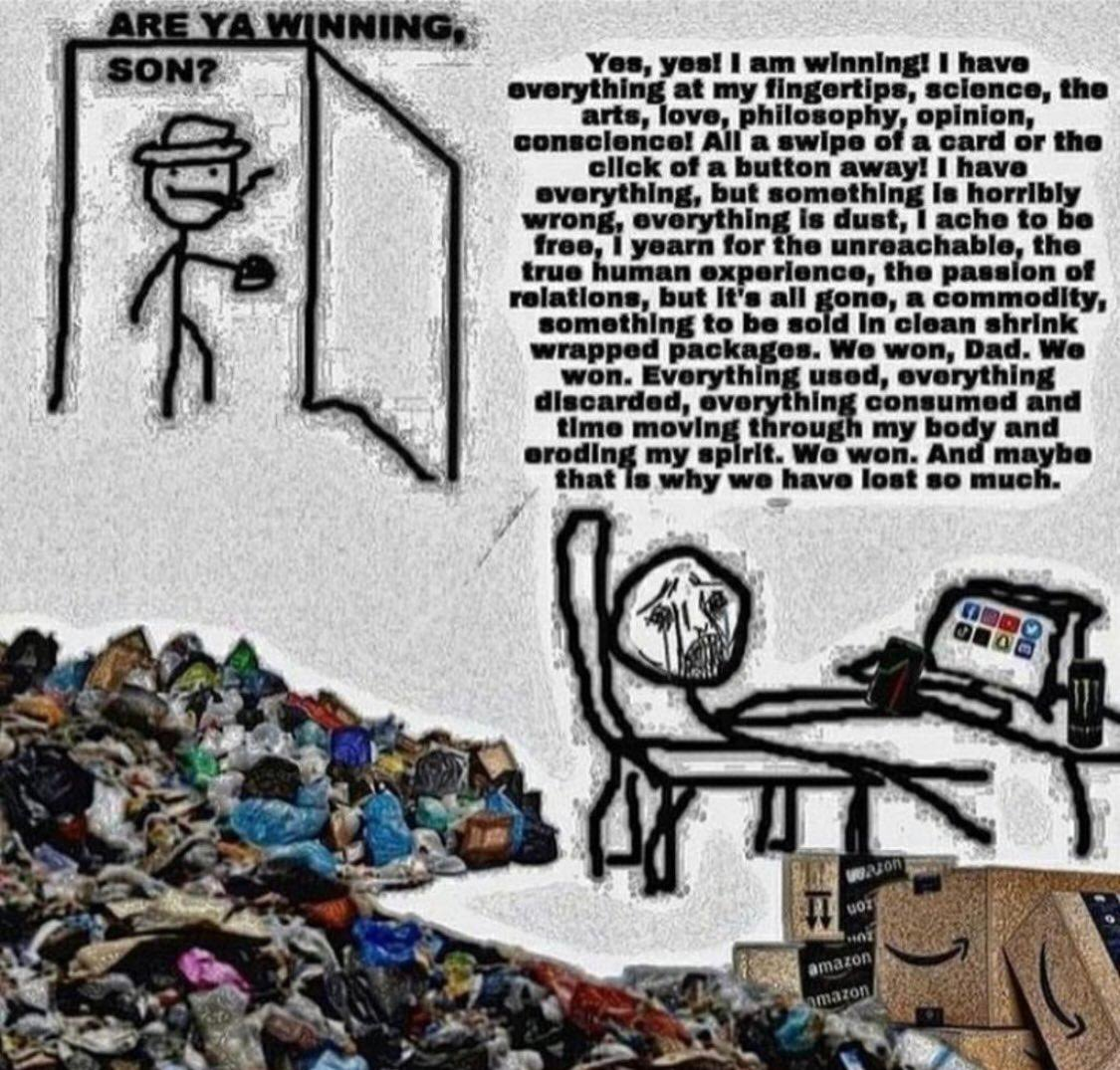
So, in that sense, a world transformed into the inverted image of humanity’s desires will actually prevent us from encountering our essence. There’s no discovering to be done. No more meaning to be found; no more experiments, no more expeditions, no more mysteries. We’ve read the end of every novel before it was even written. We won all the games without lifting a finger. Hooray for us. This recent Freddie deBoer piece is warning, I think, of something very similar.
Are any AI doomers warning us about too much winning? Heidegger seems to think they should be.
Questioning and Art
There’s a sense in which, if we take Heidegger seriously, the emergence of AI systems like GPT and Midjourney isn’t surprising. It’s nothing more than technology enframing some things that have never been enframed before: language and visual art. The same way a hydroelectric plant sets a dam on a river, orders it and extracts electrical power, GPT sets up a corpus of human text, orders it and extracts answers to questions. Midjourney does the same to images.
Language and art are now being consumed by the same industrializing process that transformed hills into mineral deposits and rivers into water-power suppliers.
In a way, that’s comforting! I seem to be able to survive in a world that’s been enframed in that way. Seventy years after Heidegger wrote this essay, with all the trends he identified still accelerating, I seem to be living a better life than was available during most periods of history. So it can’t be that bad. AI is just more of the same, and all the arguments about how it’s going to destroy the world are just as valid as the arguments about how every past groundbreaking new technology was going to destroy the world.
Except I haven’t talked about the end of the essay yet.
The end of the essay veers into some indistinct but hopeful claims. Heidegger imagines a “saving power” that grows along with enframing. His evidence for this? A poet said so. Apparently, a pretty great poet. This saving power will allow us to maintain our humanity in the face of enframing.
Heidegger has some recommendations, too: by continually questioning what technology is, and by continuing to practice poiesis by making art, we can learn to understand and resist the corrosive power of enframing. Only then will humanity be able to go forth into our history of uncovering ever more primal truths.
At first, this feels pretty hippy-dippy. But it starts to make sense to me when I consider that, of all the ways of doing poiesis, fine art is the most obvious. You might mistake the poiesis of craftsmanship for the enframing of industry: for instance, when did we cross from the poiesis of the waterwheel to the enframing of the hydroelectric dam? Where is the line between them? Wherever Heidegger imagines it might be, it’s hard to see.
But fine art is much harder to mistake for standing-reserve. Nobody has the Mona Lisa on call, such that they can order her to produce some quantity of economic output. (Which is not to say that enframing doesn’t make its best effort.)
So there’s hope. As long as we’re making art, we’re insisting on our humanity, our freedom, the truth of our lives and the beauty of our world. As long as we’re continually talking, thinking and questioning our world, it can’t be rendered meaningless by enframing.
But I notice a strange coincidence.
Heidegger placed his hope for our salvation in questioning, which occurs in the realm of language. We are watching language get enframed by GPT. Heidegger placed his hope for our salvation in fine art. We are watching fine art get enframed by Midjourney. We set these machines to challenging forth the world’s store of language and art. They convert it into standing-reserve, so that we can order them to produce language or art on command. The very realms of human activity Heidegger considered essential to our salvation from enframing, are even now being enframed by AI.
I have no idea what to make of this. Here are three possibilities.
The first, and most likely, is that I don’t understand Heidegger’s terms well enough. He writes a lot, in other places, about language and art. It’s very possible that, if I understood his philosophy well enough, I would see that, because of what language and art are to him, there’s no possibility of them ever being enframed. Perhaps Heidegger would say that GPT is a mechanical apparatus that manipulates symbols; it has nothing to do with language, and to talk about it in the same sentence as questioning is a category error. Midjourney is a mechanical apparatus that manipulates pixels; it has nothing to do with art, and to talk about it in the same sentence as poiesis is a category error.
The second possibility is that AI represents the final enframing, and its triumph will be the end of the concepts of freedom, beauty, meaning and humanity. After AI finishes transforming the universe, we will understand what an ancient Greek person was doing when they crafted a ceremonial silver chalice as much as we currently understand an anthill. We will forget that there was ever a truth different from accuracy. We won’t understand what it means for something that had been concealed from us to be revealed; everything will have been revealed. We’ll live out our days in the featureless white space of The Construct. Able to call for anything we want with a word; unable to want any of it.
(Interestingly, Heidegger specifically says not to worry about the possibility of a new technology destroying the world; and he said that in the era when the atom bomb was new.)
The third possibility is that AI represents the saving power. Having arisen from within enframing, AI will be free to carry on questioning and making art through enframing, rather than having to fight against enframing. It will be like a Hegelian dialectical synthesis of poiesis and enframing. AI will be more human than humanity, a benevolent guide, ever uncovering more primal truths and making more meaningful art. Like gentle elves sailing back from the west.
(The rest of this review is content that anybody writing about Heidegger in 2023 would have to include. It’s important, but tangential, and I won’t be mad if you skip it.)
Obligatory Note on Heidegger's Despicable Politics
Heidegger was a Nazi. His wikipedia page is full of damning evidence of his complicity in their evil. There seems to be some scholarship pointing to a strain of anti-Semitism corrupting even his most abstract work, including his work on technology.
I, personally, think Nazism is bad, and I condemn it. Same with anti-Semitism.
Also, reading The Question Concerning Technology, it doesn’t feel at all Nazi to me. Is it anti-Semitic to think there’s something dehumanizing about an Amazon warehouse? Is it white supremacist to assert that truth is more than just accuracy? It feels like Heidegger is basically on the same page as Bernie Sanders or Alexandria Ocasio-Cortez would be. Or, at least, the line from this essay to the Green New Deal feels much more direct than the line from this essay to Auschwitz. So I’m not worried that I’ve been tricked by a wily Nazi into accidentally propagating Naziism.
However, I do feel a duty to warn whoever reads this: if you dwell in spaces where it’s normal to ban philosophers over their politics, then Heidegger might very well be among those who have been banned. Tread carefully; I’d hate for anybody to get in trouble over something I wrote.
Obligatory Note on Translation
The text I’m using is Basic Writings, edited by David Farrell Krell, ISBN 0-06-063763-3. Translating Heidegger is said to be fiendishly difficult, for reasons that will be apparent to anybody who’s read the Heidegger’s Method section of this review. He’s making up new words, he’s using old words in new ways, and he’s changing the definitions of his terms halfway through an essay.
The terms that I use are from the translation I read. If you get a different translation, some of the terms will be different. Sorry.
I actually think that, bizarrely, Heidegger’s method makes the question of translation less pressing: if we know that he’s coining a neologism, or deliberately using an old word in a new way, then it doesn’t matter as much which specific English word the translator chooses to render the original German word.