A Monument to Man’s Arrogance
Phoenix is in trouble. In 2024, the Arizona capital recorded 113 consecutive days of 100 degrees Fahrenheit or greater; the summers that were always hot but were still bearable are becoming more and more unbearable. As I write this in March of 2026, temperatures are already topping 100 degrees. While climate change explains some of the hotter temperatures, a bigger culprit is the endless concrete sprawl that traps heat in the daytime and doesn’t let it go at night. Phoenicians are long used to getting up at 5 in the morning to walk their dogs on concrete that doesn’t burn their paws; that time is getting earlier and earlier.
Then there’s the water. Phoenix sits on top of an aquifer and, like everywhere else in the west, they began draining that aquifer faster than they could refill it. So they supplemented. Phoenix sits at the confluence where the Agua Fria, Verde, and Salt Rivers all join with the Gila River; the Gila then runs west through the Sonoran Desert until it reaches the Colorado River some 200 miles downstream. Or, rather, it used to run west through the Sonoran. These rivers are completely used up by Phoenix, its suburbs, the Indian reservations in the metro area, and the farms in the exurbs. Waddell Dam, Horseshoe Dam, Bartlett Dam, Theodore Roosevelt Dam, Horse Mesa Dam, Mormon Flat Dam, Stewart Mountain Dam, and Granite Reef Dam create the lakes where Phoenicians go to escape the heat and ensure that one hundred percent of the rivers are available to Phoenix (less the millions of gallons that evaporate daily in the Arizona heat). West of Phoenix, the Gila runs dry until it reaches the Colorado.
But all that water is not nearly enough to sate the five million citizens of the Phoenician sprawl and the farms and the tribal communities. The rest comes from the Colorado River by way of the Central Arizona Project: a series of pumps, tunnels, and canals that every year move 456 billion gallons of Colorado River water 336 miles from the northwest. 5 billion of those gallons evaporate into the desert air before they ever reach Phoenix.
This water is, or rather was, guaranteed to Phoenix by the Colorado River Compact. The compact was signed in 1922 and assumed that the 1920-1921 flows of the river were representative of the river as a whole, but this turned out to be wrong in the worst possible way: those years had far more snowpack and therefore far more river water than average, decades before the effects of climate change began to be felt. The struggle to allocate the actual flow of the Colorado, not the paper flow, is a story of election fraud and bribery and lawsuits and gunfights and dynamite attacks involving states and militias and tribes and cities and feds and Mexicans, but that’s not the book I’m reviewing here. And to paraphrase Lord Palmerston, only three people have really understood the so-called Law of the River: the commissioner of the Bureau of Reclamation, who is dead; a Navajo lawyer, who has gone mad; and I, who have forgotten all about it. So we won’t dwell on the Colorado. The upshot is that thanks to a lot of conservation efforts, Arizona has so far managed with the allocation it was given.
But Phoenix is getting more and more people and less and less snowpack. Arizona farmers are giving up more land and cities are instituting more stringent water restrictions, even as the population continues to increase and the thirsty data centers move in[1]. In 2000, the seven western states in the Colorado River basin agreed to a set of guidelines to allocate the much-diminished river; those guidelines expire at the end of this year. The federal government gave a deadline of February 2026 for the seven states to come to a new agreement, and those states blew past that deadline without anything close to an agreement. The federal government is now in charge of determining how the river will be allocated.
This is a really bad time for the states to be arguing about river allocation; the winter of 2025-26 had the worst snowpack since the compact was signed and probably since much earlier, though records get shakier the farther back you go. This year we’ll avoid disaster by releasing years’ worth of water stored in a Wyoming reservoir. That won’t be an option next year. As the youngest state, Arizona has the weakest water rights; those rights would be the first to go in a crisis[2]. Some of the options that the government has on the table involve cutting off the Central Arizona Project entirely, leaving Phoenix to drain the aquifer dry and collapse the whole metro area into a sinkhole.
This coming crisis has not passed unnoticed. Many people and publications have tried to explain these issues to a national audience, and a lot of them have hit on the same hook.
For example, the July 2024 cover story of The Atlantic tells the story of Phoenix. It opens with this:
No one knows why the Hohokam Indians vanished. They had carved hundreds of miles of canals in the Sonoran Desert with stone tools and channeled the waters of the Salt and Gila Rivers to irrigate their crops for a thousand years until, in the middle of the 15th century, because of social conflict or climate change—drought, floods—their technology became obsolete, their civilization collapsed, and the Hohokam scattered. Four hundred years later, when white settlers reached the territory of southern Arizona, they found the ruins of abandoned canals, cleared them out with shovels, and built crude weirs of trees and rocks across the Salt River to push water back into the desert. Aware of a lost civilization in the Valley, they named the new settlement Phoenix.
The Sierra Club’s cover story in 2022 described the coming Colorado River crisis. Their introduction ends with this:
No one knows exactly why, in the 14th century, the Hohokam abandoned Pueblo Grande and other settlements across the Salt River Valley. Two hypotheses (perhaps not mutually exclusive) are that the Hohokam were laid low by prolonged drought and that hundreds of years of relentless irrigation salinized the soil, which in turn led to a collapse in agriculture…The secret of the culture’s disappearance from the region may be encapsulated in its name. Hohokam derives from a word in the language of the Akimel O’odham, a contemporary Native nation. It means “all used up” or “exhausted.”[3]
There are many more invocations of the Hohokam; I’ll quote just one more here to drive home the point. The ur-text of writing on the water crisis in the west, the book that all others cite as their inspiration, is the 1985 book Cadillac Desert. The chapter that discusses the Central Arizona Project begins this way:
The original 400,000 Arizonans were, for the most part, members of the Hohokam culture, a civilization that thrived uninterrupted near the confluence of the Gila, Salt, and Verde rivers for at least a thousand years, until about 1400, when it disappeared. The Hohokam, by A.D. 800, had already established a civilization that rivaled the Aztec, Inca, and Maya further south. They lived in small cities; the ruins of one of them, Pueblo Grande, occupied a large piece of land just about where downtown Phoenix is today. Superb flint and stone masons and excellent potters, they also worked beautifully with shells; they may have traded with people living on the Mexican coasts. For sport, they built enclosed ball courts very much like those of the Maya, who probably gave them the idea. When it came to irrigation, however, the Hohokam were in a league by themselves.
They were more populous than any culture around. Why then should they disappear? Drought remains a possibility — perhaps a twenty-year drought the likes of which they had never seen — but an equally plausible explanation is that they irrigated too much and waterlogged the land, leading to intractable problems with salt buildup in the soil, which would have poisoned the crops. In either case, the mysterious disappearance of Hohokam civilization seems linked to water: they either had too little or used too much. And that is the exactly the problem that Arizona faces today.
It’s easy to see why the Hohokam story is used as a hook. It’s too good not to use. A people settle by the confluence of the Salt and Gila rivers and build a great civilization until the changing climate or their overuse of water forces them to leave. The writers of all these pieces start by saying the disappearance of the Hohokam is a mystery, but then make it clear that the answer to this mystery is the same as whatever they believe to be the biggest problem with modern-day Phoenix: climate change, irrigation overuse, poisoned crops, social conflict, etc.
But is it true that nobody knows why the Hohokam vanished? Archaeological investigations into Hohokam society[4] have revealed several great houses, dozens of classic Meso-American ball courts, and a massive network of dams and irrigation canals. But archaeology tells us nothing about why the Hohokam left. Where else could we go to investigate this mystery? Where could we turn to see if Phoenix is heading down a well-trodden path towards destruction? How could we find out what happened to the Hohokam?
What if we asked them?
Those Who Remember
The collapse of the Hohokam civilization happened around 1350 A.D., give or take a century. Three hundred years later, European explorers first came across the ruins. They found the remains of great houses, ball courts, and extensive irrigation networks. They asked the local Indians what happened here, they were given answers, and they wrote them down.
Those local Indians were the O’odham, who still live in southern Arizona and northern Sonora and claim to be the descendants of the Hohokam. Nowadays, they’re divided into two communities known as “Akimel O’odham” and “Tohono O’odham”, with the former living on reservation land in the Phoenix metro area[5] and the latter living on a large reservation in southern Arizona and northern Sonora. The early Spanish and Mexican explorers of the southwest called the northern O’odham “Pima”, which means “I don’t know”[6]. They called the southern O’odham “Papago”, which means “bean eaters”. Shockingly, most O’odham don’t much like being called “I don’t know” and “bean eater”, so those names have fallen out of fashion nowadays. But pretty much every source we will encounter here, including the book I’m ostensibly reviewing, calls the O’odham the Pima-Papago.
The O’odham lived in near-constant conflict with the Apaches, conflict that persisted well into the 19th century. When the U.S. government identified the Apaches as a major concern, O’odham communities were happy to help the Americans fight the Apache wars. This got to be pretty brutal; in one notable incident in 1871, a group of 94 O’odham warriors broke into a U.S. army camp where around 150 Apache women and children were waiting for rations, murdered nearly all of them, and sold the rest into slavery in Mexico[7].
When they weren’t fighting Apaches, the O’odham lived in small, transient communities, practicing some agriculture but mainly going where the game was. They dug occasional ditches; they did not divert entire rivers to make the desert bloom. And they told stories of their ancestors, ancestors who had lived in large settled communities and had diverted rivers and had built the greatest civilization that the Sonoran desert had ever known.
The Spanish and the Mexicans and the Americans who encountered the ruins around Phoenix were awed by the great houses, the ball courts, and the canals. When a group of Civil War veterans went looking for a place to start growing food to sell to the gold miners of southern Arizona[8], the spot was obvious. They re-dug the canals and re-dammed the rivers, sometimes in the exact same spots as the original Hohokam dams, and they imagined a Phoenix rising up from the ashes[9].
These first Phoenicians asked the local O’odham about the ruins; so too did the archaeologists and anthropologists who started arriving in the early 1900s. By the middle of the 20th century, there existed many recorded versions of the decline and fall of the Hohokam. They were in journals of governors, missionaries, anthropologists, linguists, musicologists, archaeologists.
Don Bahr was a professor of anthropology at Arizona State whose primary area of research was O’odham mythology. In the 1990s, he collected all these accounts together, arranged them according to chronology, and published them under the title The Short, Swift Time of Gods on Earth[10]. Bahr never comments on this title; I don’t know if he chose it himself or if the publisher thought it’d sell better. When referring to the book within the book, he calls it The Hohokam Chronicle. The chronicle is a full account of the Hohokam story, from creation to collapse.
Much as the fall of the Roman Empire has become an obsession for those trying to predict or prevent the fall of the American Empire, the fate of the Hohokam became an obsession for me as I tried to decide if living in Phoenix was a doomed enterprise. When I discovered The Short, Swift Time of Gods on Earth, I reasoned that it might provide an answer. Forget the op-ed writers, the climate doomers and their agendas - Don Bahr had collected all the best stories about the collapse of the Hohokam, and his book would tell me if we are going down the same path.
So let’s meet our storytellers.
By far the largest source in the book is a narrative told to the archaeologist Julian Hayden in 1935 by two O’odham: Juan Smith and William Allison. Bahr refers to this source as “Smith-Allison” and I’ll do the same. Bahr includes in his introduction a letter he received from Hayden, explaining how the story was told:
As part of a planned extensive study of the Hohokam remains of Southern Arizona, Gila Pueblo had commenced study and excavation of a very large prehistoric Hohokam site on the north terrace of the Gila River roughly south of Chandler, Arizona. There were a number of large rubbish mounds at the site, evidences of canals, and ball courts — and many rattlesnakes. In fact, the site, and the Pima village near it, was known as Snaketown. So, in the fall of 1934, a tent camp was set up at the site, and a crew of archaeologists was employed, with a number of Pima Indians from the neighborhood as laborers. My father and I, both experienced Hohokam fieldworkers, were part of the crew.
There was, of course, much interest among us all in the Pima stories about the prehistoric folk…Later we heard of Juan Smith who was reputed to be the last Pima with extensive knowledge of the Pima version of the Creation story…Hoping to preserve the myth from loss upon Juan’s death, I initiated an effort to record it. I suggested to my Pima friends, who were as interested as I, that Juan be persuaded to tell the tale through an interpreter while I transcribed it verbatim through as many nights as it might take to tell. William Allison Smith, foreman of the digging crew, volunteered to serve as interpreter, being also interested. He was literate, spoke good English, and was a deacon in the Presbyterian church of the Snaketown area. This latter has an effect on his translation, of course, since he turned to familiar biblical language, King James Version, when faced with problems of interpretation, such as obsolete or foreign words.
Juan agreed to save time by singing the songs once instead of the traditional four times; he hesitated on this count because diverging from the tradition might bring harm to us or him, but he relented.
Allison, the translator, was well known and well respected among the Gila River community; the archaeologists kept in touch with him until he died in 1948. Nobody knew what happened to Smith, the last man alive who knew the Hohokam story. All Bahr could find out about Juan Smith is captured in three sentences:
They recalled Smith as a man with no home of his own, who worked for other families in exchange for food and lodging. No one that I talked with remembered the last time they had seen him, meaning, it seems, that he passed inconspicuously out of the Snaketown orbit. All agree that he was very well versed in old O’odham ways. It is said that he had a bicycle for transportation, was nicknamed Skunk, and was more a vagabond than a holy man.
Bahr recognizes that his readers may look with skepticism at the fact that the main source for his chronicle is a homeless guy called Skunk, so he interweaves six other versions of the story throughout the text as supplements to the Smith-Allison version. For the most part, these six corroborate the Smith-Allison version of events.
From 1694: a report by Juan Manje, generally considered to be the first European to see the Hohokam ruins and the first person to write O’odham. Manje’s uncle was the Spanish governor of Sonora, and this family connection allowed him to join in on seven expeditions of discovery in Sonora and Arizona. He took copious notes on these expeditions and collected them in an account that he called Light of the Unknown Land. His references to the Hohokam are quite brief, but he does do some transliteration of O’odham that Bahr found helpful enough to include.
From 1775: a very brief account of the Hohokam story, as recorded by the Spanish missionary Pedro Font[11]. Font doesn’t name his source, but uses words in the O’odham language.
Between 1775 and 1900, we have nothing at all. This shouldn’t be too surprising - that century saw very little European exploration or settlement in the southwest. The Spanish empire collapsed and gave way to the Mexican empire which itself collapsed into several republics and lots of civil wars. Arizona was sparsely populated and completely ignored by Mexico City. When the Americans took over Arizona after the Mexican-American War, they included Arizona in the settlement so they could get a good route to California. They cared so little about Arizona that they didn’t realize until after the treaty was signed that the best route to California went further south, so another land grab was effected in 1853. The discovery of gold brought American settlers in the 1860s; these guys weren’t much interested in ethnography or anthropology. But the academics moved in around the turn of the century, which gives us our other storytellers.
From the early 1900s: three separate accounts given by Komal Hok, known in English as Thin Leather. He was an O’odham elder who became the go-to guy for the anthropologists trying to catalog native cultures before they disappeared. In 1908, he gave an account of the Hohokam story to the anthropologist Frank Russell. In 1911, he gave the same account to J.W. Lloyd. In 1912, he gave the same account to J.W. Fewkes. Thin Leather spoke only O’odham, so all of these accounts used English translators and differed from each other. Bahr quotes from all three.
Also from the early 1900s: an account of the O’odham creation myth, by Juan Dolores. Dolores was an O’odham linguist, who worked with several universities to categorize O’odham grammar. His primary job was in linguistics, but he also told O’odham myths to his fellow academics. Twenty-five years after his death, these myths were collated and published, and Bahr quotes from this too.
From 1929: Two stories told to the ethnomusicologist Frances Densmore[12]. The first is a story told by an O’odham narrator named Cipriano Garcia about a bad gambler who turns into an eagle. The second is a longer account of the Hohokam fall, told by an O’odham narrator named Mattias Hendricks. Densmore was more interested in the music than the stories, so she’s recorded the songs well and just summarized the content of the stories.
The Telling
The story is told in two forms: prose and song. Both were passed down via oral tradition, but in very different forms. The songs are all in first-person, told from the perspective of the character, and are still sung at ceremonial O’odham dances; they’ve been passed down in relatively accurate form. As we saw in Hayden’s letter, Juan Smith was worried for his personal safety if he sang each song only once; each song needed to be sung four times. In part this is because everything in the Hohokam tradition happens four times, and in part this is to ensure that no generations-long games of telephone ensued.
The prose is in third-person. It is more fluid, more prone to drift over the centuries, and none of our storytellers seemed worried if they got things wrong in it. There are some stories where only the bare bones of the narrative are the same across different storytellers. There are some where even those bare bones are gone.
As an example of how this works in practice, here’s how Smith tells the story of the first irrigation canals. The picture we should have here is of Smith speaking the prose that only he knows, then having others join in for the songs that they all know. After each sentence or song, William Allison would translate into English and occasionally add his own comments, and the archaeologists would transcribe Allison’s translation.
The people saw that the rain wasn’t coming down often as it used to, so they gathered to plan how they would make canals to irrigate their crops. They finally decided they would make a canal right below “Suik”[13]. They dug with pointed sticks and used their hands to throw out the dirt. Being of one mind, they thought they would complete this work, but when they completed it and tried to make water run in it, the water wouldn’t run. Seeing this, they got one of the medicine men and asked him to draw water in the canal. He went down and walked there, singing:
There lie the ditches
And among them
I am walking.
And among them I am breathing,
Leading the water.The water acted like it was going but didn’t go. This medicine man couldn’t do it. So they got another medicine man, and he went down and stood in the canal and sang:
There lie the ditches
And I stood in the midst,
I’m making the winds blow (dust devils)
I’m making the water go.The water acted like it was going, but it stopped and turned back to where it started from. This man couldn’t do it. So they got another medicine man and told him to try. He sang:
By the side of a river
There lies a canal
In that canal
The water is making signs of pretty decoration.This man made the water go, but not enough. They got another medicine man and told him to put some more water in the canal. He went down and stood in the canal and sang:
There lie the canals
And in the midst of those
I stand
Making water-hair snakes.The water flowed some more, and they had plenty of water in the canal. From there on, the people learned to build canals in order to irrigate their farms.
Most of the other six sources include the songs as well. The Densmore accounts are heavier on song (which makes sense, given that they are recorded by a musicologist). The Thin Leather accounts are heavier on prose, and omit most of the songs entirely.
Expectations
Bahr’s primary interest is in the development of myth, and in how myth evolves to fit new circumstances, but the book is first and foremost a chronicle. Bahr sees himself as an editor more than anything else. His comments on the “truth” of any of the stories are few and far between.
But my primary interest in reading this book, and in reviewing it now, is to find out if all those articles on the upcoming collapse of Phoenix are correct. If the Hohokam were fools to try and build a civilization in the desert, if it destroyed them just as it is destroying us, if there was anything they could have done to stop it, and if it’s too late for us. So before we get into the chronicle, I want to share my expectations. Maybe you should come up with some, too. This is Indian mythology passed down via oral tradition over half a millennium, so we shouldn’t expect a straightforward account of “in the year 1346 C.E., the salinity content of the irrigation ditches stemming from the Salt River became too high for the plants to handle”. But we should expect something about water. So here are my prior expectations:
- If the Hohokam collapse was due to an extended drought, we should expect that the mythology will mention that the rivers and canals dried up. The reason behind the drying will likely be due to the anger of some deity/deities, but there should be some mention of drying.
- If the Hohokam collapse was due to waterlogging and increased salinity, we should expect that the mythology will mention that the crops were poisoned, or that they were killed by some god or spirit.
- If the Hohokam collapse was due to external conflict unrelated to water issues, we should expect that the mythology will mention neither of these.
And we should also have a baseline to ensure that the mythology has some relation to reality. The two main things we know about the Hohokam from archaeology are that they had large irrigation networks and Mesoamerican-style ball courts. If this is a reliable retelling of the Hohokam experience, these things should be involved. So, two more priors:
- We should expect that irrigation networks play some role in the story.
- We should expect some mention of ritual ballgames.
With these in mind, let’s begin.
The Short, Swift Time of Gods on Earth
Bahr has divided the Smith-Allison narrative into 36 stories, a division that he readily admits is arbitrary. He then spreads those 36 stories across 11 chapters. Each chapter contains anywhere from one to eleven Smith-Allison stories, then a number of supplements from the other six narrators that corroborate or contrast with the Smith-Allison versions. The book divides neatly into three roughly equal sections:
First, there is a creation narrative that ends with an established Hohokam civilization. This section covers chapters 1-3.
Second, there are a number of disconnected stories that cover various conflicts that the Hohokam have with nature, gods, and other men. Usually these stories are resolved via intervention by their gods. This section covers chapters 4-7.
Finally, there is the collapse of the Hohokam and establishment of the O’odham. This section covers chapters 8-11.
We open with the creation narrative. God is called simply God. Technically he’s called “Jeoss”, but that’s just an O’odham pronunciation of the Spanish “Dios”, which translates into the English “God”, so I’ll stick with God. The first person that God creates is a being of pure light who we never hear of again. The second person is the Earth Doctor. As his name implies, he creates the earth.
Earth Doctor then populates the earth. The first person that he creates is named Siuuhu. Also called I’itoi, the Drinker, and Elder Brother, Siuuhu is the closest thing we have to a main character; the primary “god” of the “gods on earth”. His actions, reactions, and constant attempts to stop being the main character are what drive the story forward. If you’ve ever been at a roadside Indian jewelry stand in the American southwest, or if you watched the HBO show Westworld, then you’ve seen him before:

Took this screencap from an Etsy page, in case you want to buy one. I’m not affiliated.
This is the “man-in-the-maze”. At the end of our story, Siuuhu goes to live in a cave a bit outside of Tucson, and if you want to find him you need to follow the maze. Westworld took this maze motif and used it to represent the journey towards consciousness[14]. While I don’t know if Westworld was directly playing on any O’odham myths, you’re not going to be too off-base if you think of Siuuhu as the god trying to bring his people to a greater level of consciousness.
Earth Doctor and Siuuhu make the earth, the stars, the land and water, the gods Buzzard and Coyote, and a man and a woman. The man and woman live in peace and harmony for a time, but then the woman does a bad thing[15] and so Earth Doctor curses her to have periods and pain in childbirth. People are generally crummy from then on.
Things get worse and worse, and so Earth Doctor and Siuuhu decide to punish the people by making them commit the worst possible sin: male pregnancy. They create a man with supernaturally gifted sperm: he impregnates girls who give birth a few hours later, and he does this every day. One day, the father of a future victim does some magic to speed up this process so that the man gives birth himself before he can violate the medicine man’s daughter. A man giving birth is the worst thing that could happen, and the earth itself is so offended that it spontaneously floods. The floodwaters rage for twenty days, killing all creatures on earth except for two birds: the woodpecker and “Veekh koskum”.
A quick aside before we get back to the chronicle: Juan, the storyteller known as Skunk, doesn’t know what a Veekh koskum is. William, the translator, doesn’t know what it is. None of the archaeologists know what it is. Bahr doesn’t know what it is, and as far as he can tell there is not a single person alive who knows what a Veekh koskum is. It’s clearly some kind of bird. Bahr thinks a good translation is “down-feather nested”, and notes that:
No one seems to know whether these birds still exist, or precisely what they looked like. They are famous because of the mythology, and one often hears of them in songs.
The Veekh koskum is not the only instance of this. There are many words throughout the chronicle that remain untranslated because in 1935 nobody was alive who knew what they meant. All that remained were the songs.
Anyway. While the earth rages and floods, Siuuhu hides underground, taking some of the people with him just in case they’ll be needed in the future. God then appears again to give a rainbow sign and promise that the earth will never flood again.
The flood now retreated, Siuuhu re-emerges. The only two creatures alive on the earth are Siuuhu and Coyote. They start over. Coyote creates the animals, and Siuuhu creates the people. First he makes the Apaches, the great enemies of the O’odham. He makes a few other people groups and gives them each their language and their culture. Then he makes the Hohokam and gives them the two essentials for life: corn and tobacco. Shenanigans ensue when Corn and Tobacco get mad at each other and leave the Hohokam. While in his exile, Corn falls in love with a girl, and he eventually comes back with his new girlfriend. But then we have another sin:
The girl stayed with the corn man four days. When the fourth day was up, the baby was born. It was the child of corn man and was a girl. When Siuuhu saw this, he didn’t like it. The baby was taken care of for four days. Then the girl picked it up in her arms, to take it someplace. On the way, somehow she dropped it and the baby died. It was Siuuhu’s scheme that this should happen. This was the first time the people saw death…
Then Siuuhu made four commandments by which people should unite in marriage — not like corn did. The four commandments are that the father of the girl and mother of the girl should agree, and the mother of the boy and father of the boy should agree, which makes four commandments by which they should be married.
And thus we have the origins of agriculture, death, and marriage.
The middle section of the chronicle, chapters 4 through 7, consists of several stories where Siuuhu tries to get the people to run their own affairs, the people mess up, Siuuhu saves them, and Siuuhu makes a law to prevent that particular error from reoccurring.
A woman commits adultery, realizes how wonderful adultery is, and tells all the other women how great adultery is, so Siuuhu has to come back to make a rule that you can’t do that. Siuuhu gives the people cacti to eat, but they turn it into wine and so Siuuhu has to come back and put limits on when the cacti will bloom. Buzzard gives a magic football to his son, who tricks a girl into sitting on it; this makes her pregnant and she gives birth to a girl who becomes a witch and eats babies; Siuuhu has to come back and kill the witch. A gambler is too good at gambling, so another gambler turns him into an eagle and this newly created man-eagle also eats babies. Siuuhu has to come back and kill him too. Every time, Siuuhu gives the people more rules and more instructions and more magical powers so that they might finally be self-sufficient. But it’s never enough.
In the middle of this section is the origin story of the great canals and irrigation networks. As with the others, it opens with Siuuhu trying to retire. He tells the people that he won’t be able to make the rain fall forever, that one day the earth will be burned up, and so the people create their canals. It’s worth noting that the canals are the one thing that Siuuhu doesn’t create himself.
The final section is the collapse. Unsurprisingly, it stars Siuuhu. Siuuhu commits a great offense against the Hohokam, so great that they decide to kill him. Bahr includes three of the storytellers here, and it’s worth quoting all of them.
From Juan Smith aka Skunk:
The medicine men thought that they understood more than Siuuhu, and the people were mad at him. They asked Siuuhu questions, “What is God?” and “Who were God’s father and mother?” Siuuhu answered, “When you put the corn seed in the ground, nobody knows where it gets its life and how it comes out from the ground. Only God, and nobody else, knows this. That’s why there is a rule that nobody can find out where God came from.”
Siuuhu told the people that God was the father of the heavens and earth. Then the people said, “Why did you kill the corn baby?” Siuuhu answered that it is God’s duty to do his own will, whatever is right. Then the people asked, “Why do you make all of the weeds among the good things in our fields, weeds that are not good to eat?” Siuuhu answered that one reason why these weeds were made is because people had done a great wrong.
Then the people asked, “Why did you make the good fruit on the saguaro and make it into a strong drink which makes the people drunk and they make pleasure of it?” Siuuhu said, “The reason these things happen is because, when a man has a little son, who doesn’t have any sense, who is about to fall into the fire, it is the father’s duty to grab the son and drag him from the fire so he won’t get hurt.”
The people argued with Siuuhu for four days, asking him all these questions. Then they left him. They held meetings by themselves to plan how they would kill him.
From Thin Leather:
Siuuhu lived in the Salt River Mountain, and whenever the girls had ceremonial dances because of their arrival at womanhood, he would come and sing the appropriate songs. And it often happened that he would tempt these young girls away to his mountain, to be his wives, but after keeping them a while he would grow tired of them and send them back.
The people disliked Siuuhu because of this. And when they had crops, too, Siuuhu would often shoot hot arrows through the fields and wither up the growing things; and though the people did not see him do this, they knew he was guilty, and they wanted to kill him.
From Juan Dolores:
Siwani was a very important person, and people would always listen to him and believe him. He had many friends, and they were always doing different things with him. When Siwani wanted something, he would tell his friends, “Let’s do this,” and they would have to do what Siwani wanted.
Siwani had a daughter, and when she reached puberty, Siuuhu found out and was going to come and sing. But Siwani got angry and told his friends, “Wait for me until I am ready, and we will go have a puberty celebration.” But they started the celebration without him, over by a big pond. People came from every direction and were there with Siuuhu.
In the middle of the night, Siwani came with his friends. Before long, Siwani argued with Siuuhu, saying “You aren’t good for anything. You always go about peoples’ homes looking for food, but from now on people will not be troubled by you.” Siuuhu said, “I go everywhere singing because now I am going to die and I will not be here any more. And when people remember me they will sing as I sing now.” Siwani said, “You have already covered the earth with your songs. Now it’s good if we stop being troubled with you.” When he had said this he took out his club and struck Siuuhu and knocked him down.
These are…different. Depending on who you ask, Siuuhu’s offense is either:
a) being annoying at parties,
b) seducing women and destroying crops, or
c) having an unsatisfactory answer to the problem of evil
Whether you think any or all of these are deserving of murder, all the narrators agree on what happens next. The people kill Siuuhu three times, but each time he comes back to life the next day and is just as annoying, seductive, or philosophically inconsistent as he was the day before. They consult with Buzzard, who has some ideas about how to kill Siuuhu and make it stick. They kill Siuuhu a fourth time, and he stays dead.
But a few years later, Siuuhu comes back to life. Understandably angry at the Hohokam for killing him, he goes underground and rallies the people who have been living there since the flood.
The narrative then switches to the perspective of these underground people, who are called Wooshkam (which means “those who emerge”). Siuuhu leads the Wooshkam into the surface world and against the Hohokam. The bulk of this section, covering 60 pages of The Short, Swift Time of Gods on Earth, describes battles where Siuuhu and the Wooshkam destroy the Hohokam, killing their various chiefs and minor deities. In these battles, the Hohokam generally (but not exclusively) use fog and rain to defend themselves, while the Wooshkam generally (but not exclusively) use sun, thunder, and lightning to fight. There are fourteen battles recorded, and all of them are one-sided. I’ll quote one to give a sense of how they go; here’s the destruction of Pueblo Grande:
[The chief of Pueblo Grande] had made his house from solid rock, so it seemed impossible for the Wooshkam to hurt it. He had done this because he didn’t want any of his people to run off and leave him. They must all stay in this house with the medicine man.
It wasn’t really a stone house, but the leader made it look like solid rock. The [Wooshkam medicine man] fooled himself by saying that the house was made of rock, and he couldn’t do anything with it, so they asked another man who had the power of thunder to see what he could do. He sang:
It is a hard house
It is a hard house
It is a hard house
Do you see the foundation?
It is made out of rock.Then he told the people that it would be easy for him, and he sang:
I saw that he is
Too light for me
It is like a windbreak
Made out of these ocotillosIt was true. The thunder man came down over the house and smashed it to pieces.
And so on and so on. The Wooshkam don’t lose a single man, while every great Hohokam house is destroyed and every Hohokam chief is killed. Poor Buzzard, who helped to kill Siuuhu, gets it worst of all. The Wooshkam capture him as he’s trying to fly away. Siuuhu takes away all his magic. The Wooshkam torture him for four days, then vote that instead of killing him they should scalp him in such a way that the skin of his head hangs around his neck. The knife splits open his scalp, and they pull all the skin down. They make him dance for them, head covered in blood. Then they let him go, cursed to only eat carrion.
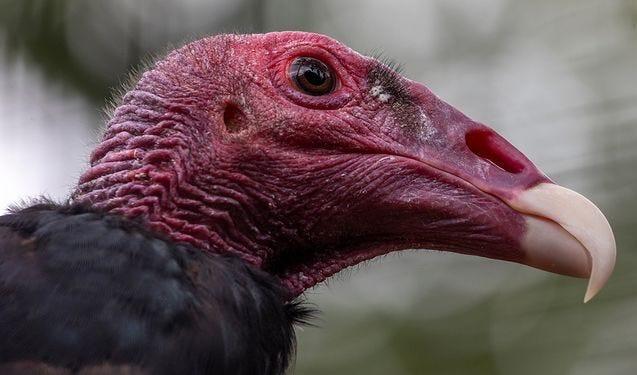
That’s why they look like that.
The Wooshkam leave the Hohokam civilization in ruins and continue their march west. Accompanying them are all the remaining Hohokam, less their chiefs and gods and magic. Siuuhu tells them to work together from now on, especially now that the Apaches are getting more violent, and it is this combined Wooshkam-Hohokam civilization that now takes on the name O’odham. Siuuhu leaves the O’odham, goes back to his cave[16], and that is the last anyone has heard from him. The time of gods on earth is ended. It was indeed short and swift.
Can I Tell You About My Lord And Savior Jesus Christ
While reading that summary of the chronicle, you may have heard some alarm bells going off. Two people living together in perfect innocence until the onset of sin? Pain in childbirth as punishment for that sin? Rainbow signs after a global flood? A man-god who disputes theology with the religious leaders, is killed by them because of the dispute, and is then resurrected? Jesus didn’t lead the conquest of Jerusalem himself, but still, a lot of this sounds like a somewhat mangled form of Christianity.
This should not surprise us. Skunk is telling the story in 1935, and Christianity was first brought to the O’odham in the 1600s. William Allison, the translator, was a Presbyterian deacon. It would be weird if the mythology hadn’t incorporated at least a little Christianity! But that doesn’t mean we should throw the baby out with the bathwater. For one thing, none of the songs (as far as I can tell) have any hints of Christianity in them. The figure of God appears only in prose, never in verse.
Bahr has a section of his introduction discussing the problems with Christianity, and he makes the case that the main Christian influence is that the story has been adapted to fit within a Christian framework, where all gods are subject to the authority of the one true God. Earth Doctor seems to be the actual creator here, with God just kind of inserted on top.
Other than putting God in charge of everything, not much else is very Christian about the chronicle. Siuuhu dies and is resurrected, yes, but he doesn’t act very Christ-like and it’s not as though Jesus is the only god who was ever killed and resurrected. I think Bahr sums this up nicely when he says:
I see [the chronicle] as an attempt, albeit limited and without the author’s fully intending it, to establish a native Pima church. The church would have a scriptural base in this text. But since at least one of the authors (Allison) cherished the Bible, their native mythological scripture would function for them approximately as the Book of Mormon functions for Mormons, as a supplemental scripture, one that covers the New World in approximately the same spirit as the Bible covers the Old.
So if we’re trying to get to the truth of what happened to the Hohokam, what do we ditch and what do we keep? I think we ditch anything that mentions God and any story entirely prose-based that seems to just retell a Biblical story, especially if that story only appears in the later versions of the chronicle.
Luckily for us there’s not very much of that, and almost all of it is in the first third of the chronicle. But I think we can safely say that Siuuhu was not killed for his philosophical disputations.
What Happened
So what happened to the Hohokam? Bahr doesn’t even pretend to know; he is content to simply let the story be. But we can do better than him. Let’s review our priors.
Our baselines are both met. There’s quite a lot of talk about irrigation networks, and a ball game does show up in one of the stories of that middle section (though stories about gambling are far more prevalent).
In the chronicle, there is no mention of poisoned crops. There is no mention of a drought. There is one mention, in Thin Leather’s account of Siuuhu’s offense, that Siuuhu was shooting heat arrows at crops. When Siuuhu fights against the Hohokam gods and chiefs as he leads the conquest, he fights with “weather” weapons - sun, thunder, lightning. But the defenders use weather weapons too, and in the conquest narrative these weapons are used only against the chiefs and the buildings, not the crops or the canals. I don’t think that the use of weather as weapon is necessarily a memory of a great storm or great drought. But the mention of Siuuhu burning up crops seems relevant.
By far the most common element of the collapse is war. Hohokam society was going just fine until they murdered Siuuhu, which led to a war they were entirely unprepared to fight. I see no reason to doubt that there’s a true story behind this: that Hohokam society collapsed because they were conquered by the Wooshkam, a people who had neither knowledge of nor interest in maintaining the complex irrigation networks. “Settled Society Destroyed by Nomadic Invaders” is one of the most common historical tropes out there.
Attempting to reconstruct a plausible account of the Hohokam story, then, we get something like this:
A prolonged heat wave caused a number of crop failures and an influx of migration to the Salt River Valley from areas where rivers had begun to run dry. Hohokam society, with its robust irrigation infrastructure, was for the most part able to handle the climatic changes but was unable to handle the large number of hungry migrants. Tensions between the natives and the migrants boiled over, coming to a head when one of the leaders of the migrants attempted to woo the daughter of one of the native chiefs. This led to a massacre of some of the migrants and/or the murder of one of their chiefs. Massacres were met with counter-massacres, but the migrants had the edge. The whole affair turned into a civil war, sending many of the Hohokam into flight. As Hohokam society broke down over these conflicts, the infrastructure that had supported half a million people collapsed as well, sometimes from deliberate sabotage and sometimes because nobody was around who knew how the diversionary dams were supposed to operate. A cascade of failures ensued, and before long the entire valley was depopulated. The shell-shocked survivors intermarried, migrated away to find game to hunt, and tried to hold on to the memory of what once was.
This is probably wrong in a lot of areas, but it seems the most plausible to me. The solar weapons reflect the drought, and the obsession with rules around sex make sense if it was one of these transgressions that tipped over the first domino. This narrative is absolutely colored by my own biases, my own political opinions, and popular narratives of the collapse of similar civilizations. And I still feel pretty good about it.
Except that this narrative leaves out Siuuhu entirely, which seems wrong. The chronicle is mostly his story; probably the biggest theme of the whole thing is that Siuuhu cannot leave the Hohokam alone. He tries to leave over and over again and keeps coming up with reasons to go back. He created the people but can’t stand to just let them be, constantly intruding and making new rules and insisting on being the center of attention at all the parties until his creations get so tired of him that they kill him.
I see two possibilities here. The first: Siuuhu was a sun god in the Hohokam pantheon who, as the years went on after the collapse, absorbed a few of the migrant chieftains into his character. This would explain why none of the Wooshkam are named; we’d expect that they would be named, given that they are the actual ancestors of the people telling the story, but there’s clearly a sense among the O’odham that this was a tragedy. Merging the ancestors into one demigod who then exits the scene is a good way to shift the blame from our ancestors onto the absent demigod. The whole “being killed four times” thing could reflect four different chiefs who were killed in the initial massacre. Or it could just be a reflection of the importance of the number four, which shows up constantly in the chronicle[17].
The second possibility: All of it is true. Siuuhu is hiding out right now in a cave outside Tucson, and if we’re not careful then he’ll lead another army against us.
What Will Happen
So with this narrative, we can now go back and ask ourselves again if modern-day Phoenix is indeed doomed to follow the Hohokam into disaster. We will ask two questions, corresponding to our two possibilities.
First: Is Phoenix experiencing rapid unsustainable population growth stemming from an influx of migrants fleeing adverse climatic conditions, and is this population growth leading to increased social tensions that, if not carefully managed, will lead to civil war and the destruction of the irrigation networks keeping Phoenicians alive?
For my money, the answer is no. Phoenix has been one of the fastest growing cities in the country for quite a while now and has done a pretty admirable job of integrating its various migrants. There’s obviously a big history of tension around immigration (see: everything surrounding Joe Arpaio), but none of that has ever escalated into large-scale unrest. Social unrest and racial tension exists in Phoenix, but it’s just not that big of a story, especially when compared to similar-sized cities in California. And their water management system does quite a good job! Phoenix is really good at conservation - as we saw earlier, perhaps the biggest water problem for Phoenix is the way that California manages (or doesn’t manage) its Colorado River water[18]. The problems facing Phoenix are far more interconnected than those that the Hohokam had to deal with.
I’ll admit that I’m a bit disappointed to come to this conclusion. I was hoping that history is an endless cycle of humans making the same mistakes, and that all we have to do is identify what those mistakes were so that we can avoid making them again. That if we can properly identify and characterize the tragedy, we can avoid the farce. Turns out it’s more complicated than that.
The Short, Swift Time of Gods on Earth is a good book if you’re looking for a more or less complete oral history of what was once a great civilization in the Sonoran Desert, but it’s not a good book if you’re looking for someone to blame for the problems facing Phoenix. The lessons that we learn from Gods on Earth are more philosophical than practical: no matter how sophisticated your society is, one day it will collapse and after enough time has passed the only person who will remember it is a homeless guy called Skunk who has melded your history with that of a religion you’ve never even heard of and who has forgotten the meaning of some of your most important words.
But we also need to ask our second question. Is Phoenix in danger of becoming reliant on a demigod? Maybe one who lives a few miles outside Tucson?
Will Phoenicians lean on this semi-divine being for moral guidance? Will they let it run society? Will this abdication of responsibility cause distress among those who would like to be making decisions themselves?
Will they enter into a vicious cycle where they desperately want to be free of it but know that they can’t live without it, hating it but needing it, dreaming of the day when they can run their affairs for themselves but knowing that they’re too far gone and that even if they somehow managed to kill it they wouldn’t know how to run their society but still, even still, it would be worth it?
Will they try to kill it.
Will they succeed, only to find that human concepts like death are utterly foreign to a demigod. Will they try again and again and use deeper and more dangerous forms of magic to finally, completely destroy it. Will they enjoy freedom for a year or two, only to discover that even that final death was not enough and that the god has come back, this time with the knowledge that only it or they can remain alive.
Will the god lead an army of creatures designed to replace them. Will they be overrun. Will they use the most powerful weapons they’ve developed and find that they are useless. Will they hide in their houses and disguise them with old tricks that don’t work anymore because the god has moved past those defenses. Will their houses and canals be destroyed. Will they make a pitiful last stand. Will they be tortured and mocked and twisted into a parody of themselves, skin hanging around the neck, able only to eat the carrion left behind by the god as it consumes everything around it. Will they be left alive only as a warning to those who remain.
Probably not. But let’s not give it control of the dams.
Your message is stored now and emailed to the author after the contest ends. The author can reply to you, but their identity stays hidden unless they choose to respond.
Footnotes
- ↩
Which consume much less water than the alfalfa growers, but much more water than the average urbanite. The earlier data centers, the ones that spawned all the think pieces on how AI is going to exacerbate the Arizona water crisis, all used evaporative cooling — wherein that Colorado snowpack water vanishes into the air to provide the research to help me write this footnote. There are more water-efficient methods now, but the data centers are pretty cagey about which systems they use and how much water they use. So are data centers a water problem? Like with most things related to climate change, they’re more of a problem than the deniers would have you believe and less of a problem than the doomers would have you believe.
- ↩
For instance: Los Angeles, San Diego, and the Inland Empire get their water from three main sources. One is the Colorado, one is the Owens Valley, and the big one is the State Water Project that moves water from wet Northern California to dry Southern California. The existence of the State Water Project allows Arizona to take water from the Colorado for its Central Arizona Project that would otherwise be used by California. The way that the Water Project moves water from north to south is by way of a series of pumps in the San Joaquin-Sacramento Delta, preventing that water from going out to the San Francisco Bay. The goal of this pump system is to prevent the salty brackish water of the Bay from mixing with all that pure Northern California water.
But the Delta sits at only around three feet above sea level. If San Francisco is hit by a decent-sized earthquake, like the one that everybody expects to come soon, that pump system would easily be overwhelmed and all those canals would be filled with undrinkable water. In this scenario, California asserts their rights to the Colorado River and Arizona gets cut off. This is a known problem, and California for decades now has been trying to establish a different series of aqueducts/tunnels/canals to move water from the Sacramento to the southern canals without relying on this rickety mid-delta pumping system. It will shock you to hear that California is having a hard time building infrastructure. The most recent iteration of this is the Delta Conveyance Project, spearheaded by Gavin Newsom after he torpedoed the previous project that was spearheaded by Jerry Brown. A court just found that they improperly financed the whole thing. I’m not holding my breath.
- ↩
This is not true. “Those who are gone” or “finished-ones” is a better translation.
- ↩
Some of which are open to the public. Shout out to Casa Grande Ruins National Monument.
- ↩
Just to confuse you, the Salt River and Gila River tribal communities also include Maricopa Indians. The Maricopa lived in western Arizona and will not feature in our story.
- ↩
Or at least that’s what every source I can find says. But this is a pretty common false etymology (see: kangaroo). I would not be surprised if this was wrong.
- ↩
Like almost every other massacre of Indians during the 50-odd years of wars in the American West, this was a huge scandal in the east and a nothingburger in the west. Most Anglos and Mexicans in Arizona figured the Apache probably deserved it. Something something telescopic altruism.
- ↩
There’s an old saying that goes something like “if you want to get rich in a gold rush, sell shovels”. The logical extension of this is that if you want to get really rich in a gold rush, you sell water to the guys who are growing food to sell to the guys selling shovels.
- ↩
Though, given that these guys were all Confederate veterans, they may have been thinking of a different defeated nation rising up from the ashes.
- ↩
Bahr attributes this to a musicologist named “Ruth Densmore”, who doesn’t seem to exist, and his bibliography cites the ethnomusicologist Frances Densmore, who worked among the O’odham. So I’m assuming that he just made an error.
- ↩
A mountain, very close to the present-day Granite Reef Dam.
- ↩
The Hopi also have maze motifs, and the meaning of their maze is more akin to the “finding yourself” style that Westworld is working from, but the man in the center of the maze is firmly O’odham.
- ↩
Skunk didn’t remember what the bad thing was.
- ↩
This is not unique to the Hohokam; a lot of Southwestern cultures put importance on the number four.
- ↩
This is a comment on Phoenix, not on Arizona as a whole. Arizona has all sorts of problems with groundwater usage.