The Sovereign Child: How a Forgotten Philosophy Can Liberate Kids and Their Parents
Aaron Stupple's five-year-old son has been eating ice cream "almost exclusively" for the past few months. Prior to that, his staple was Oreo cookies. As a caring and conscientious father, Stupple ensures there are copious amounts of junk food available to his children at all times, strategically stocked in easy-to-reach cupboards.
The first few sections of Stupple's 2025 book, The Sovereign Child[1], contain such a rich bounty of potential ragebait that I agonised over selecting the juiciest bits for your titillation. Here's his stance on childhood nutrition:
Should parents really just let their kids eat whatever they want? The short answer is yes.
On why he recommends against requiring kids to help out with chores:
We don’t want to ruin their understanding of the value of participating in the care of a home by instilling in them a resentment and avoidance of these things.
And my personal favourite, on the case for giving your baby a tablet:
If the baby likes screens, is there really anything wrong with swiping at a colorful slab of glass? If she starts to recognize characters and engage with the content, isn’t that an encouraging sign of cognitive development? If you’re worried that swiping at the screen will grow into a fixation with the screen to the exclusion of books, why not wait and see if that happens? And if they do prefer the screen to books, is that so bad? Are books so important for babies that it’s worth stunting their growth in other areas? If an uncle can’t outcompete a screen, maybe that’s on the uncle?
In case you didn't get the picture yet: a Sovereign Child is not required to say please or thank you, or glance up from their tablet to acknowledge visiting relatives. They don't have to share with their siblings, and if they get into fights, they won't face any punishment.
The title of Stupple's book is a riff on The Sovereign Individual, a foundational text of techno-libertarianism. But it owes more of its heritage to Taking Children Seriously (TCS), a noncoercive parenting movement that had a moment in the United Kingdom in the 1990s.
The movement has started picking up steam again in recent years, driven in large part by the growing influence of David Deutsch—a physicist and author who helped root TCS within Karl Popper's tradition of critical rationalism.[2]
As both a fan of Deutsch and a new parent looking for guidance, I was about as easy a sell as Stupple could hope for.
And so I sat up in bed for a week straight in January last year, reading his book and clicking my tongue in disbelief, occasionally reading a choice snippet aloud to my wife, to her growing distress and incredulity: Is this guy mentally ill? Is this child abuse? Is it a satire?
...
...
...anyway, here we are 18 months later, raising our two children in line with the TCS philosophy.
But it almost didn't happen.
Stupple spends the first few sections of the book biting every ideological bullet you can think of, turning back each time to smile at the reader through a growing gobful of lead. Even I, who had been primed to be receptive to these ideas, recoiled from this brazen display. It's only in the back half of the book that he softens the hardcore libertarian stuff, suggests some incremental steps towards trying out TCS, and really sells the reader on why it even makes sense in the first place. There's a big hump to get over. My wife hated the book. I had to coerce persuade the hell out of her to keep reading, because I knew she would come around in the end.
So I will take the opposite path: having quickly got the ragebait out of the way, let's start out with the excellent ideas in Stupple's book before we move on to my various beefs and confusions. Why is Taking Children Seriously worth taking seriously?
Parenting as applied epistemology
It would be misleading to say that TCS is rooted in epistemology. Better to say parenting is applied epistemology: specifically, the application of Karl Popper's ideas about the growth of knowledge.
Popper rejects the idea that knowledge exists pre-formed in the world, waiting to be transferred into our heads. He calls the conventional pedagogy the bucket theory of the mind: children are receptacles for 'correct' knowledge to be poured into. To make sure they have the right ideas, students are asked to regurgitate copies of whatever was poured in, and graded on how faithfully they parrot it back.
But in the Popperian view, knowledge is an act of creation from within, never passively acquired from outside. Here's Stupple:
All understanding is built up inside of the individual’s mind. This process is critically dependent on feedback from the outside, but the building—the conjecturing—itself happens internally. Learning is a sovereign act. For example, if I stop and ask a local for directions, it might seem like the local is pouring knowledge into my mind when he tells me to go straight until I come to the stoplight and then turn right. But [...] the local simply can’t insert the model he has in his mind directly into mine. If the local has a thick accent, then the words will sound very different. I will need to guess that the sounds “turn height” mean “turn right.” If he makes grammatical errors, I need to guess what the appropriate grammar would be. If his hand gestures left when he says right, I need to guess which perspective he’s referring to. All this guessing isn’t some frivolous sideshow, it is the central process to what I’m doing. Whenever I ask directions, I go on high alert to focus my attention so that I can make lots of guesses in rapid fashion, and simultaneously guess critiques of those guesses, so I can weed out the mistakes and produce an accurate mental model. Even in this simple example, the enormous amount of guesswork is unavoidable. It’s not surprising, then, that this process so often fails. In fact, it’s amazing that it works at all.
TCS follows from Popper's framework of critical rationalism: we are all fallible, there is no such thing as a justified true belief, and our knowledge can only grow through an iterated process of conjecture and criticism, discarding bad ideas and leaving the strongest theories standing.
As parents, we want our children to flourish, to find their way in the world, and to avoid serious harm. But we can't pour knowledge into them. Instead, our job is to give them the conditions in which they can create knowledge for themselves.
Popper is a tough sell to a blog full of Bayesians, so I'll leave the epistemology stuff there for now. Perhaps more intriguing is what TCS has to say about morality—specifically, about expanding the moral circle to include children.
Are children people?
When I was growing up, the laws of my country had a deliberate exemption allowing parents to hit their kids. An act that would be criminal against any other group of people, and possibly even animals, was considered not only permissible but desirable.
In general, children are not considered 'people', and are afforded roughly the same rights as prisoners. They have limited or no autonomy to choose where they live, what they eat, how they spend their time, or who they spend it with.
So instead of talking about the injustice of legal beatings and enforced detention, which is too easy a target, let's go with the weakest possible example I can come up with: kids wanting to listen to their shitty toddler music in the car.
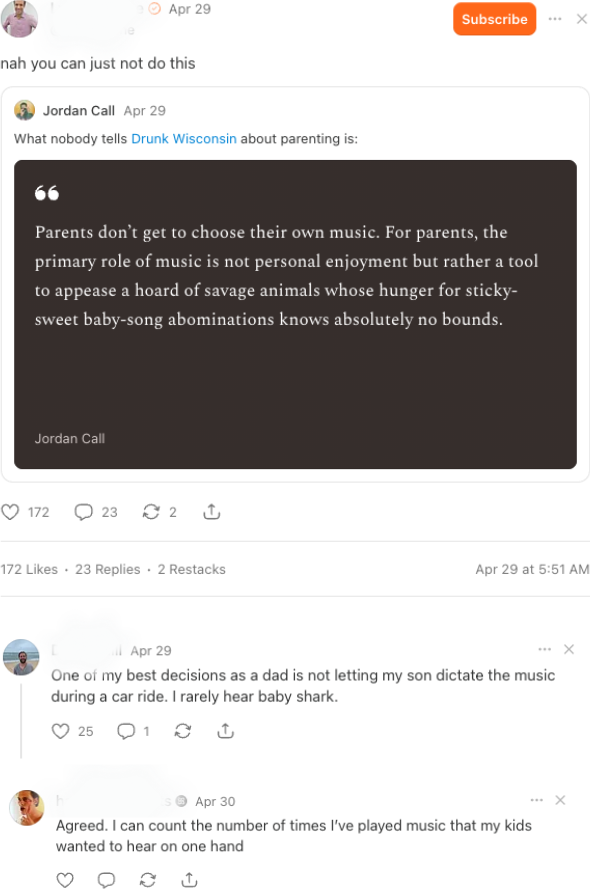
Prior to reading The Sovereign Child I would not have so much as blinked an eye at this. Haha, these dads rule, getting their kids to listen to METALLICA instead of that goo-goo-ga-ga wheels on the bus shit. Throw the goat dude!!
But take a moment to consider how bizarre it is that your skill as a parent is in part defined by how firmly you run roughshod over your kids' preferences.
Here's one of the comments again, with minor substitutions:
Agreed. I can count the number of times I've played music that my wife wanted to hear on one hand.
Agreed. I can count the number of times I've played music that my passengers wanted to hear on one hand.
Agreed. I can count the number of times I've played music that my friends wanted to hear on one hand.
How do you feel about this guy now? To me, he seems like an asshole. He is using his position of power to deprive his loved ones (?) of something they enjoy, and then bragging about it. We don’t notice when we do this kind of thing to kids, cos we still don't really think of kids as people.
Of course, in the real world, I'm sure that guy is a good dad and his kids will in fact survive the harrowing trauma of being forced to listen to boomer rock on their ride to soccer practice.
Which leads to the question: if the kids turn out alright in the end, what's the big deal?
I remember Dwarkesh Patel being a little bemused about this point, in conversation with TCS founder Sarah Fitz-Claridge. He was raised in the traditional parenting style, has a good relationship with his parents, and has clearly not been hampered in the growth of knowledge.
Like Dwarkesh, I was raised with the normal 'authoritative' parenting style, and I love my parents. Unlike most of the ACX commentariat, I didn't find school to be a prison of drudgery. I am not carrying any obvious trauma from my coercive upbringing. Again: what's all the fuss about?
Here's Fitz-Claridge's response:
Suppose you're right that it makes no difference. Does that make immoral behaviour unobjectionable? When it comes to adults, we're not looking at the adult and saying, 'well, there's no ill-effect from coercing my wife—I think she needs to be kept under control. You show me the studies that show there's a bad effect. So it's fine.' Obviously when it comes to adults, we don't use those arguments. [...] Thinking about effects is not the point.
I would just say that we don't know the counterfactual. My relationship with my parents is fine, but it could have been better, especially during my teens. My bigger regret is that it took way too long for me to truly fall in love with learning for its own sake, rather than strategically grade-grubbing for external benefit. So while my parents and the state school system did a pretty good job in raising me, I don't think it's crazy to try and slightly improve on their results with my own kids.
In either case, one common theme throughout this review will be that I am, in fact, a lowly-minded grub who is interested primarily in consequences.
What I am not: a creature of pure crystalline philosophy. I do not hold non-coercion to be a sacred and inviolable principle. If my kids turn out to be basement-dwelling, brain-rotted, screen-addicted slobs, then I would consider myself to have failed as a parent. I suspect Stupple would too, given how he reassures us at every opportunity that his kids are normal weight, have broad interests, get about as much sleep as other kids, etc.[3]
So let's turn to one of the positive consequences of raising a Sovereign Child, which to me is the most attractive prize: building a deeply trusting and open relationship with your kids.
Taking your kids seriously gives them reasons to take you seriously
One model of the parent-child relationship is that of a prisoner and prison guard. The parent's role is to impose authority, and the child's role is to probe for weaknesses and exploits. As the child grows, she comes up with more sophisticated strategies to hoodwink her adversary: manipulation, deception, blackmail, secrecy. Sometimes the best strategy will involve flattery, supplication, love. But the relationship is fundamentally adversarial: you live under my roof, you will obey my rules.
It was so hard for me to imagine an alternative to this that I spent a lot of time peppering TCS parents with silly hypotheticals. What if your kids really, really wanted to do heroin—would you let them? What if they wanted to have underage sex?
As Stupple points out, taking your kids seriously gives them reasons to take you seriously as well:
A crucial guard against risk is to have a trusted and knowledgeable person available for questions. This lifeline can only work if this person has the child’s best interests at heart, and only if the child believes this.
On the rare occasions Stupple proactively offers advice to his kids, they might actually listen to him. In part, that's because they haven't had to learn to tune out the constant barrage of badgering and micro-management most adults subject children to. But it's also because they regard him as a trusted source of ideas. He doesn't judge. He's not going to punish them. They have no reason to keep anything secret from him. A lifetime of treating his children like peers, rather than adversaries, pays dividends when they come to him with a problem.
Lots of parents would like to have that kind of relationship with their kids, but it doesn't work out that way. Why not?
The case against rules
Stupple points to rules as one of the chief obstacles to building trust with your child:
You simply cannot limit things that kids want without giving them reasons to at least consider becoming manipulative and deceptive.
Not all rules, to be clear. Boundaries are OK—you can decide what you will or won't do, and protect your own time, interests, or budget. The problem is with any rules you impose on a child that they can't opt out of.
We can come up with at least three reasons to dispense with rules. Feel free to pick whichever you like best:
1. Coercion is morally wrong, independent of consequences.
2. Rules short-circuit the Popperian process by which children create knowledge, substituting deference to authority.
3. Rules don't have the desired effect anyway.
Personally I am sympathetic to 2 and 3. Here's Stupple again:
When kids don’t understand a rule, they don’t sit back in awe of the magisterial power of the rule maker. Instead, they develop psychological coping mechanisms such as resentment, fearfulness, rebelliousness, confusion, or apathy. Nietzsche based an entire philosophy on resentment because it is such a powerful and self-defining emotion. Resentment can boil over as outright hostility or defensiveness, but its real danger is that it can simmer under the surface, constantly stoked by blocks and denials from parents. Resentment drives people to blame others for their unhappiness or inability to achieve their goals, which helps to establish an external locus of control and a forfeiting of autonomy. A resentful child might get in the habit of looking for others to blame as the reason for their troubles.
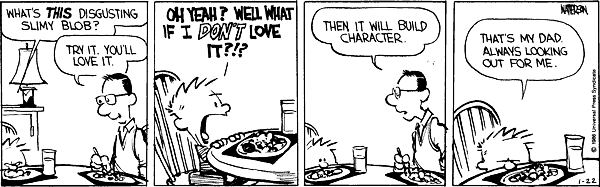
Of course, we don't always get what we want in life. Isn't one argument in favour of rules simply to drill that in early?
Maybe it's good for kids to hear 'no' sometimes, even if the 'no' in question is somewhat arbitrary. As Calvin's dad might say, think of all the character you're building:
The Greedy Child Fallacy
There's one source of totally arbitrary rules that can be done away with immediately: those arising from what Stupple has dubbed the Greedy Child Fallacy:
There is a sense among parents that kids should have limits set on things they want, because they want it and regardless of what that thing is.
The truth is we should always try to get what we want. When our desires are damaging, it’s crucial to understand why they are damaging so that we can change course and pursue new and better desires, not apologize for being desirous in the first place.
This resonated with me HARD because it's part of a broader phenomenon I've noticed—tell me if there is a name for this—in which people just seem to hate the existence of pleasurable things that don't have any real downside.
For instance, I love diet soda. Many people, who, incidentally, I would demolish on any metric of health or fitness they cared to name, love to tell me how bad that stuff is for you. Except... aspartame has got to be about the most studied chemical in the history of our civilization!
You see the same kind of puritanical thinking with botox, cheeseburgers, or using GLP-1 agonists for weight loss. Even if it were proven to be longterm completely safe with zero side effects, I'm sure people would find a way to hate it.
The same warped logic underlies the Greedy Child Fallacy's corollary: if getting what you want is bad, being uncomfortable must be good.
Hence the common tropes about how it's good for a child to be bored, or to experience deprivation, which, again, I would previously have nodded along with, but don't hold up to serious scrutiny. How about pain, or grief? These are also inevitable parts of life, but we wouldn't consider it virtuous to make sure our kids get horribly sick from time to time, or engineer a little accident for Mr Squeaky the Third on the grounds that they need to ‘learn to deal with it’.
As for boredom, Stupple argues that it's bad for exactly the same reasons pain is bad. Both are indicators of suffering, which is another way of saying 'there is a problem that needs solving'. Neither are virtues in their own right. Yes, we admire people who endure discomfort, but only when they're doing so in the service of something they are passionate about. Otherwise we just call them 'masochists'.
In fact, the reasoning behind these deprivation arguments is so bad that I've come to believe there's something else going on.
The other day a friend was telling me about a tantrum his daughter threw at the supermarket's 'free fruit for kids' bin. He told her she could have an apple or an orange, but she wanted a banana. Cue a major meltdown.
OK but...why couldn't she have a banana, I asked.
I don't know, my friend said. I guess I was just power-tripping.
At least he could admit it. I wish I could say I can't relate, but I recognise this impulse all too well. Your kid has been annoying you all morning, you feel the urge to flex your power over them, but you rationalise it to yourself as teaching them an important lesson about mumble-mumble-deferred-gratification-something-or-other.
I still catch myself making arbitrary rules all the time. When we go to the zoo and my daughter heads straight to the ice cream stand, my instinct is to say, no, we're gonna look at the animals first. But why? Does she have to 'earn' the ice cream by first correctly identifying three species of African megafauna? What the fuck? I was going to buy her an ice cream anyway!
So...just don't do that. Discarding the arbitrary rules arising from the Greedy Child Fallacy makes life better for everyone.
Of course, sometimes there are genuine trade-offs to be made between what a child wants to do, and what is best for their own welfare.
...or are there?
The art of win-win problem solving
Would Stupple let a toddler drink alcohol? It's a non-issue, he says—they wouldn't want to in the first place. Clearly he hasn't met my two-year-old, who can detect the hiss of a freshly-cracked beer from two rooms over. At first I thought this was a straightforward knock-down of TCS: my kid wants to drink alcohol, I can't let her do so, end of story.
But then I stopped to think about it for a moment. Has my tiny daughter really developed a palate for dry-hopped IPAs? Seems unlikely. So I put my conjecture hat on: perhaps what she really wants is the special drink in the fancy glass bottle. I rinsed out an empty beer bottle and put some cordial in it, and sure enough, that did the trick. Problem solved!
This focus on creative problem-solving is perhaps my favourite part of The Sovereign Child. Stupple's big claim is that there is always a win-win solution to every apparent impasse: technically, an infinity of possible solutions.
Some of these win-wins are things most parents figure out on their own. Stupple talks about how taking an exaggeratedly playful and goofy approach worked wonders when his son was a baby. I discovered this independently: changing nappies is never a wrestling match in our household, cos I can always find a way to distract my kids with a toy, a nonsense song, a bet on the colour and firmness of today's output, etc.
But other times the solution isn't obvious at all. When I first picked up Stupple's book I was engaged in a protracted toothbrushing war with my daughter. I'd occasionally resorted to holding her down while I scrubbed her teeth, which both of us hated, and which I knew deep down was a failure on my part. So I was almost giddy to find him taking it on directly:
Why does a kid not want to brush their teeth? Maybe they don’t like the taste of the toothpaste or the feel of the brush. The parent can try sampling different toothpastes and brushes. They could make a special trip to the store and let the kid pick out several varieties to take home and try out. Maybe the kid would like their own electric toothbrush. Lots of kids love having ownership of their own tools and using them like adults. Having their own teeth-brushing kit could be a way to emulate Mom and Dad before going to bed. A pleasant atmosphere, without fear or anxiety or compulsion, opens the door to games and other fun options to add to or modify the teeth-brushing experience. My wife and I make a big deal about how good our breath smells after we brush. We huff in each other’s faces after brushing and then playact being overwhelmed by the amazing smell.
We tried out each suggestion in turn: special toothbrushing songs, an electric toothbrush, new flavours of toothpaste, having her brush my teeth, the 'fresh breath' thing. None of it worked. Once again, I began to suspect we'd found the limits of the TCS approach.
Just as we were despairing of having to go back to the hard way, my wife had another idea. She googled 'rotten teeth' and showed the pictures to my daughter. From that day forth, she started enthusiastically brushing her own teeth—not out of fear, but fascination with the ‘yucky teeth pictures’. She still sometimes asks to see them; most of the time she just gets to brushing. I cannot overstate the relief I feel about this.
So there is no plug-and-play formula for parenting. It is highly specific to your own problem situation, and there may well be a string of failures before you finally land on the right solution. Or as Stupple puts it:
A nice thing about rules is that they are easy to describe and implement. But finding win–win solutions requires creative discovery, for which there can never be a set path. If there were a reliable way for any parent to get any kid to eat vegetables [...] every parent would already know about it and there would be nothing to discover.
What matters is getting into the mindset of actually looking for win-win solutions in the first place. This alone has been extremely valuable to me. It reminds me of Eliezer's bit about stopping and thinking for five minutes by the clock before you declare anything to be 'impossible'.
Of course, five minutes might as well be an eternity when you're trying to marshal kids for daycare. So here's Stupple's first baby step:
One way to start out with Taking Children Seriously is to just build in sixty seconds of brainstorming about possible win–wins before issuing any command.
I have come to believe that parenting is largely a skill issue. The book has many more worked examples; I recommend reading them to rewire your intuitions about which problems are actually intractable.
But this still leaves us with some limitations. It's encouraging to know that a solution exists in principle, but you won't always be able to find it with the time and resources available to you.
And surely there are some cases where hard constraints might be justified. After all, we do in fact have knowledge that our kids don't, especially about things that will cause them harm. In the extreme, we might need to step in to stop them drinking alcohol, or watching hardcore pornography, or reading Thomas Piketty's Capital in the Twenty-First Century.
So let's explore some of these edge cases.
Path-dependence and irreversible harms
Let's start with an easy case. Yes, Stupple says, you can pull your kid out of traffic—there's nothing wrong with grabbing someone away from immediate physical danger. Phew.
Alcohol is also justifiably off-limits, because it's a literal poison. If Stupple found his five-year-old actively chugging a quart of malt liquor, one assumes he would snatch the bottle away rather than set a five-minute timer to brainstorm non-coercive interventions.
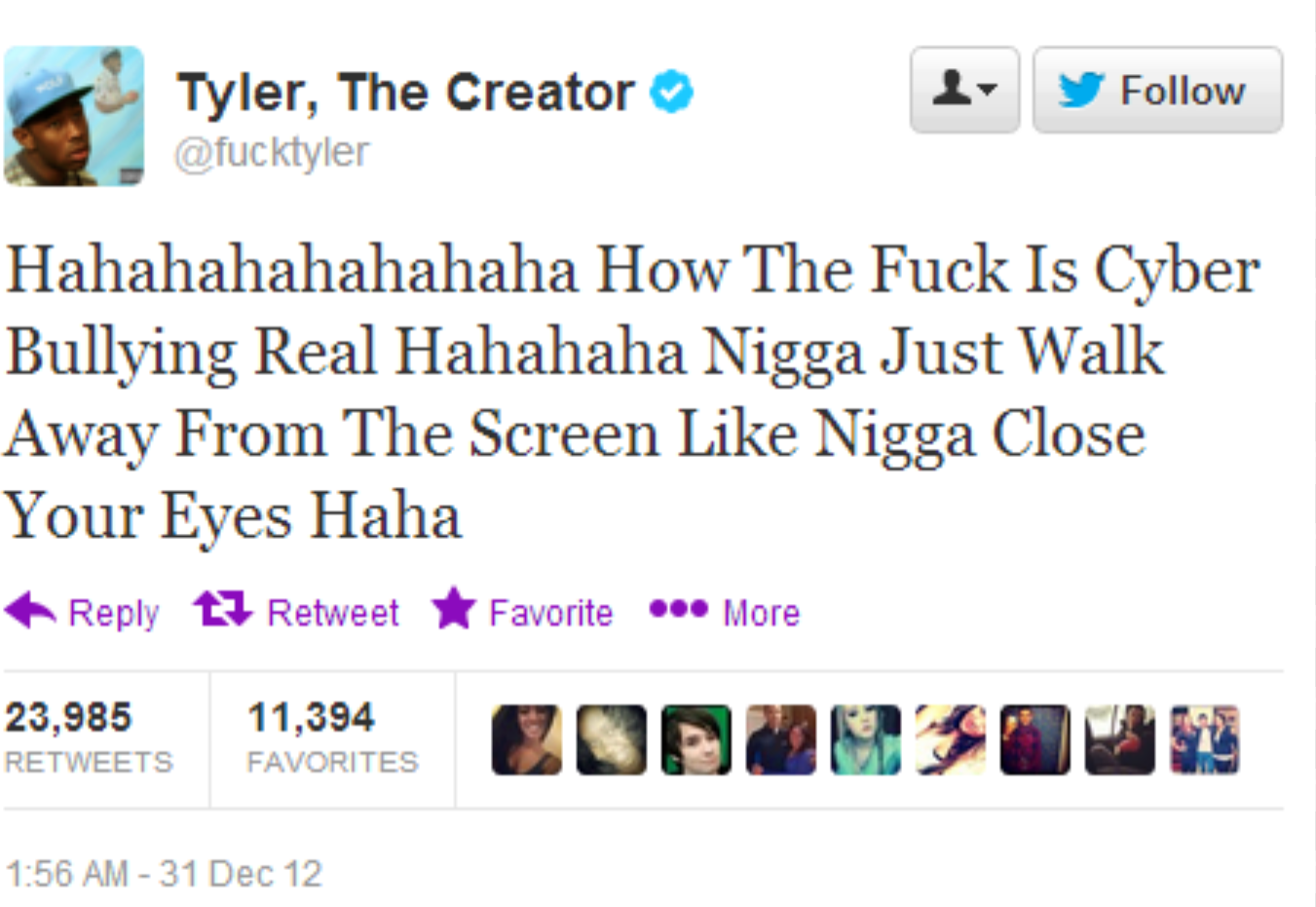
But eating ice cream as a staple food? Glued to a screen for hours on end? No intervention justified. We might sometimes describe sugar or TikTok as 'poisons' or 'addictive', but those are just metaphors, says Stupple. Unlike alcohol, there is no chemical dependence or withdrawal, which means users can simply choose to stop whenever they've had enough, or find something else they'd rather be doing with their time.
or as Tyler, the Creator so memorably put it:
Given that Stupple doesn't provide us with any principle to determine the rare occasions when coercive intervention is justified, I will try to reverse-engineer one: you may intervene if your child is about to make a mistake that will cause irreversible damage, i.e. a problem that we cannot solve with our current level of knowledge.
This fits both the car and the alcohol examples. If you overdose, or get hit by a car, there is no opportunity for error correction: all future learning opportunities wink out of existence. Surviving with brain damage isn't much better, since we don't currently know how to reverse that either.
So there is a path-dependence to error correction. Unfortunately, I don't think Stupple applies this principle—which, I remind you, I had to derive myself—consistently.
Consider his stance on junk food. First, he says he would wait for his kid to actually get fat (or, I guess, prediabetic or something) before worrying about their diet:
Eating a second ice cream cone won’t immediately make a kid overweight. Neither will a third or even a fourth. In fact, it might make the kid sick to their stomach and teach them about satiety far better than a parent’s speech could.
If his kid did get fat, he still wouldn't say anything for fear of giving the impression that he disapproves of how he eats. Instead, he would wait for him to bring it up himself:
Once my kid identified that he had a problem, by his lights, and made it clear that my support was welcome, only then would I help him problem-solve by exploring the problem situation and guessing possible solutions.
OK, but there is a path-dependence here! If you become obese at any time, but especially in childhood, there are certain irreversible harms: you carry more fat cells for the rest of your life, insulin resistance can permanently reduce pancreatic reserve, appetite regulation is altered, and puberty can get screwed up in various unpleasant ways. We can solve some of these problems later, but not perfectly or reliably: life will simply be harder than it needed to be.
So: if your child ends up obese, and it's because you enabled them to eat junk food ad libitum and 'figure out' a good relationship with food by themselves, I want to be allowed to say that you have failed in your duty as a parent.
Stupple's counterargument is that there's no guarantee that creating rules around food will work, and they might even have the opposite of the intended effect:
Food rules often backfire: Rules might produce the exact eating compulsions and disorders that they are intended to prevent. As with rules around drugs and other dangerous substances, no strategy around food can guarantee that a kid won’t become overweight.
But this is weaksauce. What are we meant to call it when a child eats almost nothing but ice cream for months at a time, having previously been on the all-Oreo diet? Personally I would call it... 'disordered eating'. Meanwhile, the vast majority of people raised with common-sense dietary rules don't end up with a disordered relationship with food!
So too with screens. Again, there's no bullet Stupple won't bite here. If your baby wants to swipe on a rectangle of glass all day, that's on you for not being entertaining enough to outcompete the screen. Skill issue, baby!
What about the critical developmental window, in which children can acquire language, music, maths, and physical skills at a rate they'll never match again? Stupple acknowledges the tradeoff, but counters that screens also offer infinite virtual learning opportunities: if kids are remarkable learners, maybe they're picking up lots of other things that are harder to measure.
Personally I am skeptical that tablet-raised kids are blessed with any special advantages. Contra the 'digital natives' thing, my impression is that the generation born with an iPad in their hands is borderline technologically illiterate.[4] But I am happy to grant that kids who are banned or heavily restricted from screen time are definitely missing out on something, even if it's just watching lots of cool YouTube videos.
Next we have to consider the potential downsides. Is it harmful for babies to stare at a flat screen instead of the contours of a human face? If so, for how long, and at which age? Are there any documented impacts on attention span? Does the type of media matter? Most importantly: are any of these effects path-dependent—do they alter brain structure in ways that persist for life?
I have no idea. Fortunately, Stupple's confidence in prescribing unlimited screen time is grounded in a thorough review of the empirical literature:
tumbleweed.gif
Lol just kidding. As far as I can remember, there is not a single study mentioned in The Sovereign Child. It's just not that kind of book. We're doing philosophy here!
Or as my wife bemoaned: It's just vibes. Where's the evidence?
I wasn't surprised, having lurked in critical rationalist circles for several years now. But it does point to something that bothers me about the book, and about the way Popper's ideas are applied by his modern-day adherents.
In defence of lousy correlational evidence
(This section can be safely skipped if you are not a big honking epistemology nerd.)
Many critical rationalists, and in particular the followers of David Deutsch, have a hate-boner for empirical observations that lack deep explanations. They are just not interested in correlational studies about e.g. social media use and mental health, because those studies only tell you ‘that’ something is happening, not ‘why’ it’s happening.
I think this is a mistake, and a degradation of Popper's epistemology.
Stupple is comfortable calling alcohol a poison because we understand exactly how it affects our bodies, and why it is especially harmful for developing brains. But that wasn't always the case: kids used to drink beer on a daily basis, and babies were sometimes given hard liquor to calm them down. Someone who had reasonable suspicions about alcohol causing damage to developing brains, despite not having a mechanistic theory, would ultimately have been proven right. It could be they had nothing to go on but lousy correlational evidence and pattern-matching. But that's how many theories are born!
My favourite example is the history of scurvy, which I believe I have cribbed from Bruce Nielson's podcast The Theory of Anything.[5]
Imagine you're a ship's surgeon in 1800. You know that lemon juice prevents scurvy—there was a controlled trial in 1747, and by 1795 the Royal Navy was issuing it to sailors with dramatic results. But you have no idea why. Sixty years later, the Navy switches to West Indian limes because they're cheaper, and stores the juice in copper-lined containers. Both changes destroy the vitamin C content, and scurvy comes roaring back. It's not until the 1930s that chemists isolate ascorbic acid, aka vitamin C. It takes even longer to get a truly mechanistic theory: turns out ascorbic acid is a cofactor in the production of collagen, a protein that helps to maintain and repair connective tissue and stop your teeth falling out. So it's a huge mistake to ignore pre-theoretical observations or associations. If you refused to act on the lemon-juice trial until you had a deep explanation, you’re killing your sailors for centuries.
The history of science shows that many of our greatest theories preceded their own explanations. Newton didn’t have a deep explanation of what gravity actually was—we had to wait a couple hundred years for Einstein to figure it out—but his theory made all kinds of extremely useful predictions.
Deutsch's main departure from Popper is to insist on the primacy of explanations over mere correlations or predictions. Litigating that argument goes way beyond the scope of this review, but one unwelcome consequence is that his followers now have a selective cudgel for beating up on whatever they happen not to like. Here's Bruce Nielson:
It's unclear when you should or shouldn't be able to invoke explanationless science as a valid criticism, just from what Deutsch says in The Beginning of Infinity. So it isn't surprising that in practice, Deutschian crit rats—and sometimes I would argue even Deutsch himself—invoke explanationless science as a criticism of theories that they happen to already dislike, such as genetic influence on happiness, or animal qualia, but never invoke it against theories they like, such as Newtonian gravity.
All of which is to say, you have to take crit rats with a big pinch of salt. They have lots of cool ideas, but they have trapped themselves in a position in which their own epistemology can be selectively deployed to launder their ideological priors.
Speaking of which, let's talk about libertarianism.
Coercion Rules Everything Around Me
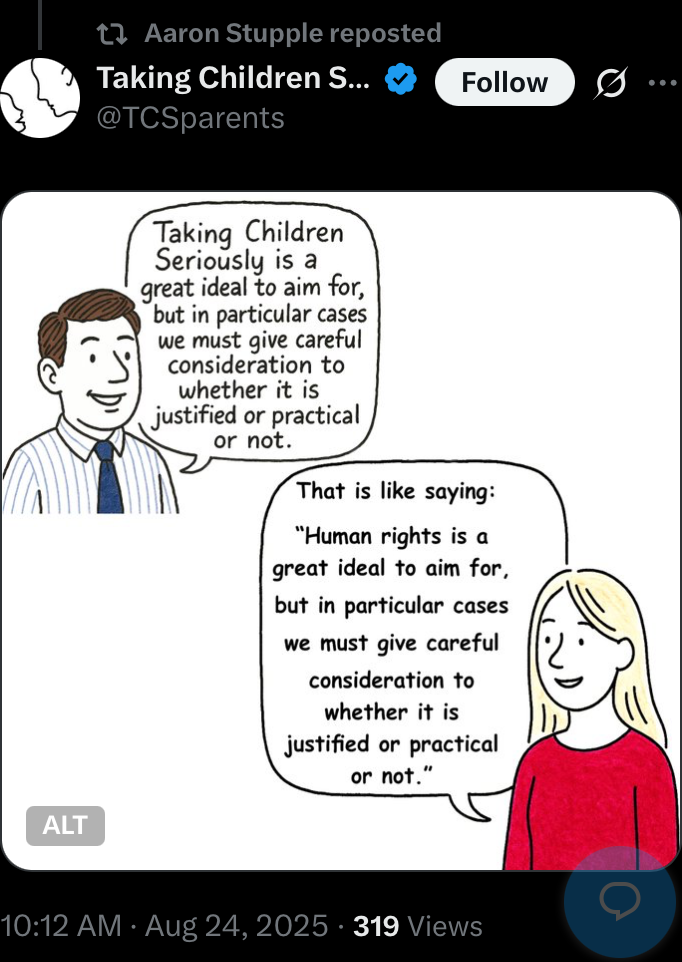
I'm the tie-wearing-guy in the meme and I think it’s a perfectly reasonable position.
As a consequentialist, I can value something extremely highly—truth, beauty, non-coercion—while still recognising that in edge cases it can be overridden by competing considerations. Perhaps the TCS folks are coming from more of a deontological perspective: you do the right thing as defined by your rule, and consequences be damned.
But that just shifts the problem back a step. Now you have to defend the rule itself, and "coercion is always wrong, full stop" is going to require some serious defending. Where does this conviction come from?
While I don't know enough about the philosophy of libertarianism to pass an Intellectual Turing Test, I can explain Deutsch's contribution to the strain that runs through the crit rat community. His central claim in The Beginning of Infinity is that all problems are soluble—meaning that for any problem, there exists some solution consistent with the laws of physics, achievable in principle through the right knowledge.
If every problem has a solution, then coercion is never the only option—there is always some other way, or technically, an infinity of other ways. Therefore coercion is never defensible; QED.
This is a seductive argument, and I'll come back to why I think it's wrong. First, notice where the same logic leads.
It is wrong to coerce a child. It is wrong to coerce other adults. It must also be wrong to coerce yourself! When your eyes are glazed over at 2am doomscrolling reels, that's just what you most wanted to do at that moment—if it weren't, you'd do something else. And so, you will find some crit rats who deny that addiction is real, or subscribe to the Bryan Caplan position that mental illness is just revealed preference.
A more nuanced way to put it is that a person stuck in a loop of behaviour is ultimately suffering from a knowledge problem. They lack the right understanding of what they truly value, or what the behaviour is doing to them, or what a good life might look like. But better knowledge is always the answer; coercion is never justified. If we could give criminals the right moral explanations, we could empty the prisons tomorrow.
Critical rationalism is full of ideas that sound completely unhinged to the uninitiated, and TCS is par for the course. I do think it's useful to have a community willing to defend the most extreme possible position on an issue, rather than watering it down for namby-pamby public relations reasons. It sure made this book review a lot more fun to write!
Still, I can't help but notice I'm much more receptive to Stupple's ideas when he backs off from the absolutist stance.
As an example of how he loses me: he has little time for the popular authoritative parenting style—a middle ground between authoritarian and permissive, in which parents try to expand freedom and autonomy while still relying on a few gentle but firm guardrails. Stupple scoffs at parents who throw their kids a sop by e.g. letting them choose whatever clothes they want, while still restricting them in other ways.
But...that's an improvement!
You don't need to resolve the deep philosophical question of whether coercion is ever defensible to notice that most parents coerce far too much, about things that don't matter, in ways that damage trust and curiosity and the child's sense of themselves as a capable person. Moving in the TCS direction—treating children's preferences as actually worth engaging with, and defaulting to explanation rather than diktat—is a big improvement, whether or not you ever reach the 'true believer' endpoint.
I wonder if Stupple fully believes in his own dogma, or whether he just enjoys slinging red meat to the twitter crit rats. He is happy to make incrementalist suggestions towards the end of the book, and is perfectly convivial in talking with parents who are interested but not fully sold, like Naval on the Tim Ferriss podcast (recommended—this conversation helped win over me and my wife after our rocky first read of the book).
TCS is a wonderful provocation. It identifies a major failure mode in parenting, and pushes you toward better defaults. But the idea that coercion is never justified hinges entirely on a particular theory of what humans are, and what they're capable of. Again, that theory comes from David Deutsch. And it's that theory that we now criticise.
Contra the Universal Explainer theory (If my grandmother had wheels, she'd be a bicycle)
(This section can also be skipped if you're not interested in following my criticism all the way to its foundations.)
What is it that makes humans categorically different from other animals? Deutsch's account starts with our having ‘computational universality’: with the help of a pencil and a piece of paper, we can run any program that a general-purpose computer can, i.e. we are Turing-complete.
Of course, so's your smart fridge. What makes humans especially special is that we can come up with new explanations, and therefore create unlimited knowledge about the world. Importantly, this is a binary attribute: once you have it, you are a universal explainer. Congrats!
A universal explainer is constrained only by the laws of physics: in principle, there is nothing we cannot understand and no problem we cannot solve, and to claim otherwise would be an appeal to the supernatural.
I find Deutsch's idea thrilling. It blew my mind when I first read his book, The Beginning of Infinity, and it continues to blow my mind.
But it might be a little bit too thrilling, cos crit rats draw far stronger conclusions from it than are actually warranted.
For instance: the existence of a g-factor for intelligence is one of the best-replicated findings in all of psychology. But crit rats hate the idea that there are large, stable differences in cognitive ability. To reconcile it with universality, they are forced to argue that a janitor with an IQ score of 85 has exactly the same innate capabilities as John von Neumann. What the intelligence literature must really be picking up on is something like a difference in interests: if the janitor were sufficiently motivated, had the best tutors, and unlimited time, he too could revolutionise three branches of mathematics before lunch.
There's really something to this! Deutsch's number one acolyte Brett Hall has a nice example about wanting to learn to speak fluent Mandarin. We tend to think this would be really hard, or even impossible. But the dumbest guy in China has been doing it since he was in short pants! If you really wanted to learn to speak perfect Mandarin, you could. Incentives, interest, and having the right cultural modules installed explain more of the apparently glaring gaps in cognitive performance than the hereditarian crowd would have you believe.
But the theory breaks down at the edges. Is a person with severe autism still a universal explainer? Is the reason they're non-verbal just that they're not sufficiently motivated to learn how to talk? How does the universal explainer theory explain the garden-variety cognitive decline associated with aging, or being drunk?[6]
A few hardline crit rats are willing to bite these bullets. But the more usual save is to make a distinction between the software our brains are running (i.e. the universal explainer algorithm) and the hardware that it runs on. If the hardware in an autistic person's brain is damaged, we can find a way to fix it. If an AGI has vastly more memory and faster processing speeds than us, we can find a way to augment our brains in the same way: after all, it's not in violation of the laws of physics.
Or as I like to call it: If my grandmother had wheels, she'd be a bicycle.
Deutsch's worldview is intoxicating because it says that in principle there is no problem we cannot solve. But those two little words—in principle!—are tortured beyond all recognition when the theory is invoked.
Here's how the pattern plays out:
IQ is bullshit science, cos we can close any apparent gap in cognitive capabilities.
OK, cool, except...we not only can't do that with our current knowledge, we don't have the slightest clue how to do so! In the real world, differences in cognitive capabilities force us to make all kinds of trade-offs and policy choices that affect real people's lives, not only right now, but probably if we're honest for some extremely long time, and maybe even forever if we don't eventually find a way to, you know, augment a guy with Down Syndrome's brain until he can mix it up with John von Neumann.
AGI doomers are silly, cos whatever advantages our silicon brothers enjoy from massively parallel thinking at the speed of light, we can figure out how to match.
OK, cool, except...we not only can't do that with our current knowledge, we don't have the slightest clue how to do so! In the real world, path dependence matters: either we're confident we'll unlock this knowledge before we get AGI—why?—or hoping that our universal explainer-ship means we'll all hold hands and sing kumbayah, despite having a less than stellar track record on this front ourselves, including a possible existence proof for one species of universal explainer wiping their 'less advanced' cousins out of existence (RIP neanderthal bros).[7]
Coercion is never justified, cos there's always a win-win solution.
OK, cool, except...we not only can't do that with our current knowledge, we don't have the slightest clue how to do so! In the real world, we still very much need laws, prisons, schools, ostracism, shaming, and apps that lock me out of twitter so I can finish writing this book review. How do we dispense with all this barbaric coercion? Maybe we need new social technologies. Maybe we need brain implants. Maybe we need better moral philosophy. Whatever it is: we don't have it right now, and in some situations, coercion will still be the best solution available to us.
The pattern is to conflate what may be possible in the limit with the actual real-life decisions we need to make. In other words, universal explainer theory is the crit rat version of the Fully Automated Luxury Gay Space Communism meme.
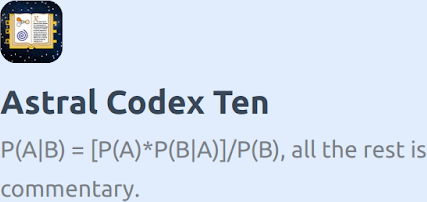
I'm being facetious but I genuinely do find this inspiring. I surely don't have to convince people around here that it's fine to have a 'technically true' Big Idea as a kind of north star, even if it's not practically useful in your day-to-day:
So even though I don't think it makes sense to hold non-coercion up as an inviolable principle, the TCS position is both directionally correct and hugely underrated, especially when it comes to the way we treat children.
Does Taking Children Seriously scale?
I don't know any children raised by TCS parents, but those who do tell me they are unusually awesome kids: extremely interesting, capable, socially well-adjusted, and not at all spoiled little freaks.
Hopefully you are already screaming 'selection effects!' The type of person who enjoys reading books about fringe parenting philosophy, or slogs through a 10,000-word review of said book, is going to have kids who are similarly curious and conscientious, regardless of what wacky experiments their parents subject them to.
Still, whether any of this translates to the general population seems to me like the wrong question. As everyone's second-favourite jaded online psychiatrist liked to say: if you're reading it, it's for you.
A harder question is whether TCS is a luxury available only to those with lots of spare time and money. Here I present to you two quotes from The Sovereign Child, which happened to end up next to each other in my notes, and which made me laugh out loud when I re-read them in sequence:
The self-sovereignty we might unlock for children can take root in any home, anywhere, by anyone of any financial status.
We have full-time caregivers for our kids during the day while my wife and I work.
Now, even if it were true that only the rich could fully implement TCS, that would in no way refute its ideas. If only the richest slaveholders could afford to free their slaves, they should still free them! Instead you would hope that we eventually find a way to make it available to everyone, as we have done with other kinds of new knowledge.
But it is worth noting that a lot of Stupple's creative win-win solutions cost money. There are little things, like buying multiples of every toy to prevent sibling fights, and medium things, like each child having a dedicated bedroom/private space. But the big huge thing is having a full-time caregiver, which facilitates so much of his other advice: it's fine for the kids to stay up all night on their tablets, cos they don't have to get up in the morning, cos their parents don't have to hustle them out the door to daycare/school before they go to work, and so on.
Very few parents have this option. One way or another, creatively or not, the kid is going to get dressed and get in their carseat and get dropped off at kid jail, and there is simply no way around it.
More generally, some parents just have more slack in the system than others. If I start feeling iffy about how long my daughter has been watching TV, I can't order her to turn it off—I need to actually present her with a more attractive alternative. That means brainstorming fun activities, pitching her my ideas, setting up whatever toys or materials are required, and possibly getting roped into playing alongside her. All of which takes time and energy.
Similarly, it takes a lot longer to explain why we need to leave the playground than it does to say "because I told you so." If you want to persuade your child of something, you must adopt a Zen-like demeanour—the slightest hint of frustration or impatience will spook the horses. Now imagine summoning this state when you're already frazzled after a long day at work, and holding it through a chain of failures as you attempt to find a creative solution to the problem.
So I'm not sure if fully-fledged TCS scales all that well. That is not an argument against it: if it's the right thing to do, you should do it. But it is another argument against shaming parents who merely take steps in the TCS direction, rather than jumping in with both feet.
Final thoughts: On taking my own children seriously
My daughter isn't yet three and my son is eight months old. My wife and I are still figuring out which boundaries we're willing to defend and which to let go, so there's not much point running through what we do—the details could change next week.
What I can say is that the experience has already given me a major shift in perspective. Once seen, it cannot be unseen: a huge range of parenting behaviours now look like arbitrary power-tripping, affirming the adult’s position in a hierarchy where children are subordinates.
This perspective shift has been extremely liberating to me, in that I now find myself fighting far fewer pointless battles against my daughter. If she refuses to brush her hair, or wants to go to kindy in her PJs, or eat breakfast for dinner, who cares? All I have to do is let go of whatever vestigial embarrassment I might feel for going off the social script, which I'm sure other parents of toddlers are much too busy to notice anyway.
Even when I genuinely disapprove of something my daughter is doing, I'm much more comfortable letting the problem breathe. There might be a week-long stretch where she declines a bath and we think, oh God, we're going to have to force the issue. And then the next day she's climbing in the tub herself. Or she watches some saccharine toddler TV show on repeat, and I despair of ever ridding myself of its hideous earworms, and then suddenly she's into Miyazaki films. At age two!
The more I see this pattern repeat, the more my confidence grows. If I ask my kid to put her shoes away, or to carry her own bag to kindy, and she refuses, instead of getting annoyed and trying to bully or bribe her, I just say OK and do it myself. It’s easy to stay calm because I know that if I ask her again in a week or a month or a year, she will cheerfully say yes, or even be clamouring to do it herself (I got in trouble this morning for peeling a mandarin for her).
And we have a great relationship. My daughter is usually open to being persuaded of my ideas, and is learning to come up with win-win solutions of her own. We still have some spectacular meltdowns, but at least I’m no longer contributing to them.
So maybe I'll one day build enough confidence to buy my daughter an iPad and let her scroll to her heart’s content. Parenting is applied epistemology in more ways than one: I am on my own journey of knowledge creation here. We try stuff out, we see what works, we error correct.
What matters is getting started on the path in the first place, and for that I am grateful to Stupple for writing a book that is both so completely insane and so compelling that I couldn’t resist the urge to grapple with it.
Your message is stored now and emailed to the author after the contest ends. The author can reply to you, but their identity stays hidden unless they choose to respond.
Footnotes
- ↩
Written in collaboration with Logan Chipkin. Stupple is the primary author, and AFAIK the examples come from his parenting, so for simplicity I will attribute passages and ideas to him throughout.
- ↩
For e.g, and to balance some of the ragebait from earlier:
My son’s reality is the total opposite. He is quick to exchange his tablet for a friendly face. He welcomes adults and siblings into his world for hours of imaginative play. People are impressed with his vocabulary. He consoles his little sister when she’s upset and plays pranks on adults. And he knows a ton of stuff. I’m not saying YouTube is making him a genius, but I’m convinced it’s not harming him, and I’m confident it is enriching his life far more than if he was forced to play only with wooden blocks and puzzles.
- ↩
Citation needed. I would be interested to hear more about whether this is wrong.
- ↩
Along with the broad strokes of many of the critiques I outline here. Bruce really puts the 'critical' in critical rationalism, which is not as common a virtue as you might expect.
- ↩
For more criticisms in this line, see Bruce Nielson's Theory of Anything episodes 53-55.
- ↩
There's evidence for symbolic thought, cave art, and personal ornamentation, but that may not be enough for open-ended explanatory universality, in which case the Neanderthals were 'merely' highly intelligent, social apes. But still...it doesn't exactly fill you with confidence, does it?