C.S. Lewis, superstar lay theologian and author of immortal works of fiction like The Chronicles of Narnia and The Screwtape Letters, also wrote a series of three adult sci-fi novels collectively called the Space Trilogy.
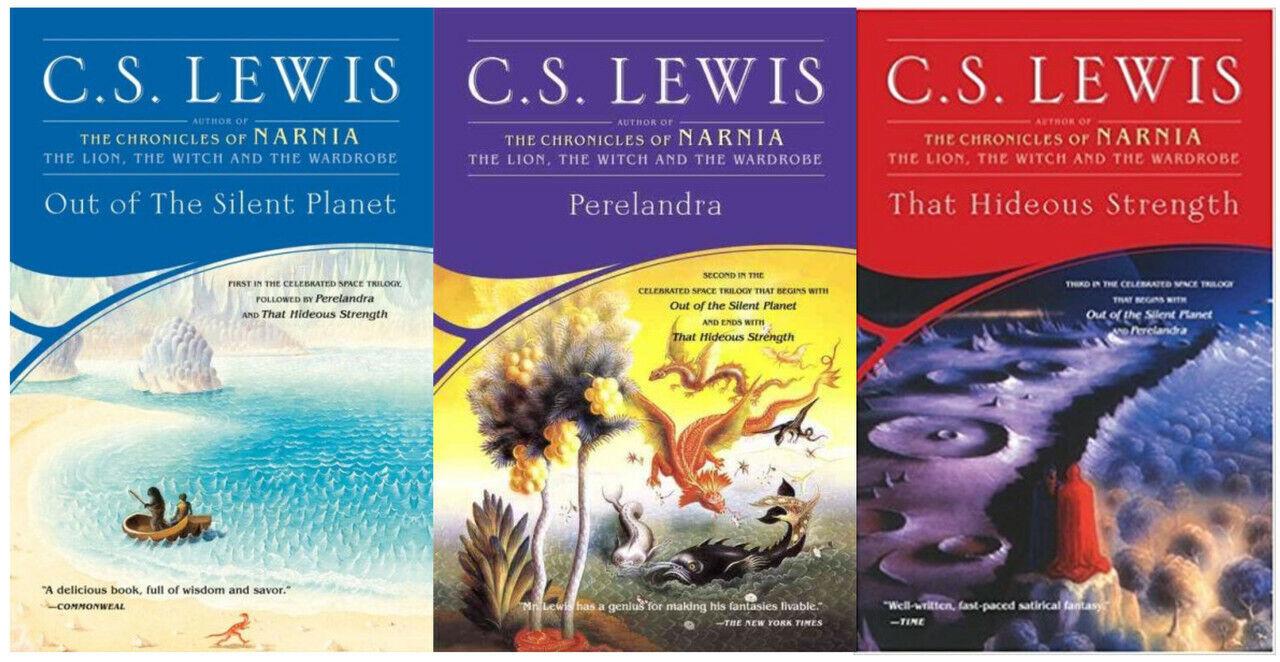
Do you recognize any of these? Not many people do; the books are kind of obscure now. Though well-received at the time of publication, their images and concepts have not really survived in the popular imagination, and to the best of my knowledge no one is trying to buy up their rights and turn them into a cinematic universe. Which is probably for the best, because 1) they’re not that cinematic, and 2) I can’t think of many things C.S. Lewis would hate more than a mega corporation chopping his novels up into nuggets of content for people to stream on their smartphones.
Also, 3) the books are just ok. Maybe a 6/10, averaged out? But you might enjoy reading them if you belong to any of the following sets of people:
- people who are interested in Christian sci-fi
- CS Lewis megafans (me)
- people who think that Narnia is a masterpiece and are interested in reading what basically amounts to a bad version of it to see how the writer developed (also me)
- people who think that Narnia is terrible because it features a patchwork mythology drawn from wildly disparate areas of the Christian, English, and classical canons and crave a fantasy world with its own fully realized mythology complete with its own invented language (Tolkien)
And either way there are some interesting ideas in the books, which I will go over in this full-spoiler review.
—
Out of the Silent Planet (1938) is about Elwin Ransom, a philologist on a walking tour who gets kidnapped by his old classmate Dick Devine and evil scientist Edward Weston and taken on their very loosely described spaceship to the planet Malacandra (Mars). Looking out the window, Ransom is pleasantly surprised to find:
There were planets of unbelievable majesty, and constellations undreamed of: there were celestial sapphires, rubies, emeralds and pinpricks of burning gold… that very name “Space” seemed a blasphemous libel for this empyrean ocean of radiance in which they swam.
This sets the tone for the rest of the book. The cosmos is glorious and godly, ruled by a divine intelligence; it’s humanity that’s the problem. Yes, that’s right— in a twist you likely saw coming, the titular silent planet is Earth.
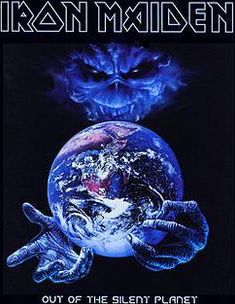
Iron Maiden got it.
Once they arrive on Malacandra, a beautiful low-gravity world of mountains, mesas, and hot springs, Weston and Devine plan to sacrifice Ransom to the planet’s inhabitants. But when Ransom escapes their clutches, he finds this is their misunderstanding. The Malacandrans are peaceloving, godfearing creatures. There are three intelligent species, or hnau: the sorns, tall birdlike scholars; the hrossa, furry fishermen and poets; and the pfifltriggi, froglike subterranean mechanics. And all these beings joyfully serve their master, the Oyarsa of Malacandra, who in turn joyfully serves Maleldil, ie space God.
Ransom learns all this while hanging out with the hrossa and the sorns_,_ mastering their language, Old Solar. Meanwhile Weston and Devine skulk around the planet committing senseless hrossa murders as they search for gold. Ransom is appalled by their behavior, but this isn’t Avatar; he doesn’t lead the Malacandrans in battle against the invaders. Instead the conflict is resolved by the Oyarsa, an incorporeal, extremely powerful eldil (space angel). He summons all three humans to appear before him, where Weston makes the case for interplanetary humanity, translated by Ransom:
“Life… has ruthlessly broken down all obstacles and liquidated all failures and today in her highest form —civilized man— and in me as his representative, she presses forward to that interplanetary leap which will, perhaps, place her forever beyond the reach of death.”
“He says,” resumed Ransom, “that these animals learned to do many difficult things, except those who could not; and those ones died and the other animals did not pity them. And he says the best animal now is the kind of man who makes the big huts and carries the heavy weights and does all the other things I told you about; and he is one of these and he says that if the others all knew what he was doing they would be pleased. He says that if he could kill you all and bring our people to live in Malacandra, then they might be able to go on living here after something had gone wrong with our world. And then if something went wrong with Malacandra they might go and kill all the hnau in another world. And then another— and so they would never die out.”
Unsurprisingly Oyarsa is not swayed by this speech and he kicks all of them off his planet, though he says Ransom is a real one and thanks him for his service. The end.
—
At this point you probably have a sense if you’re going to like these books or not. I found Out of the Silent Planet more interesting as a thought experiment than an actual story. But one of the things I like most about the Space Trilogy is that Lewis follows his ideas through to their conclusion, even when that conclusion is weird and offputting. In Out of the Silent Planet, he establishes that good and evil exist, and that evil is so deeply rooted in human nature and societal structure that it can only be illuminated by its contrast to a totally alien civilization. Ok, but what’s the root cause of human evil? And what would people be like if they weren’t like that?
In Perelandra (1943), Lewis answers these questions by retelling the Adam and Eve story. With very little prelude the eldils send Ransom to Perelandra (Venus), where he finds the planet is a paradise of sensual pleasure, a water world of floating islands and temperate seas, and filled with fruit so delicious that:
For one draught of this on earth wars would be fought and nations betrayed… As he let the empty gourd fall from his hand and was about to pluck a second one, it came into his head that he was now neither hungry nor thirsty. And yet to repeat a pleasure so intense and almost so spiritual seemed an obvious thing to do. His reason, or what we commonly take to be reason in our own world, was all in favour of tasting this miracle again… Yet something seemed opposed to this “reason”… Perhaps the experience had been so complete that repetition would be a vulgarity— like asking to hear the same symphony twice in one day… he stood pondering over this and wondering how often in his life on earth he had reiterated pleasures not through desire, but in the teeth of desire and in obedience to a spurious rationalism.
This is a pretty big theme in the first two books of the trilogy, that the root of evil is the desire to repeat or prolong pleasures, instead of enjoying them as they are and then letting them go. Here to show us how it’s done is Perelandra’s only inhabitant, a beautiful nameless naked green woman. Ransom is immediately drawn to her, but not like that! It comes up a few times and each time Lewis smacks our wrists and tells us to stop being perverts:
“You ask me to believe that you have been living here with that woman under these conditions in a state of sexless innocence?”
“Oh, sexless!” said Ransom disgustedly. “All right, if you like. It’s about as good a description of living in Perelandra as it would be to say that a man had forgotten water because Niagara Falls didn’t immediately give him the idea of making it into cups of tea.”
The Green Lady is a second Eve, totally innocent and in constant psychic communication with Maleldil. Once, she had a counterpart and intended husband, the King, but sometime before Ransom arrived, the two of them were separated by the natural motion of the floating islands. Maleldil has told her that her destiny is to one day reunite with the King and populate Perelandra, but has also given her one commandment, to never spend the night on the one piece of fixed land on the planet, where presumably, they could easily find each other. But she’s cool with that! In fact, she’s cool with everything. She lives in a state of perpetual bliss where even things that should be disappointing (ie, when she first sees Ransom from a distance she thinks that he’s the King), are Maleldil’s will, things she not only accepts, but rejoices in:
“This… is the glory and wonder you have made me see; that it is I, I myself, who turn from the good expected to the given good… I thought the good things He sent me drew me into them as the waves lift the islands; but now I see that it is I who plunge into them with my own legs and arms, as when we go swimming.”
Unutterable sensual pleasure, a robust lipostat system, and the deep joy of obedience and communion with God. What could possibly turn someone away from this state of bliss? The actual Devil, that’s who.
“Do you see, you timid, scruple-mongering fool? I am the Universe. I, Weston, am your God and your Devil. I call that force into me completely…”
Then horrible things began happening. A spasm like that preceding a deadly vomit twisted Weston’s face out of recognition. As it passed, for one second something like the old Weston reappeared— the old Weston, staring with eyes of horror and howling, “Ransom, Ransom! For Christ’s sake don’t let them—” and instantly his whole body spun round as if he had been hit by a revolver-bullet and he fell to the earth, and was there rolling at Ransom’s feet, slavering and chattering and tearing up the moss by handfuls.
Yep, Weston has landed in Perelandra, where he immediately gets possessed by the Devil and spends the rest of the book trying to convince the Green Lady to disobey Maleldil and stay on the fixed land. This is a weird but imo fairly ingenious retelling of the tempting of Eve by the serpent, but with a twist: Ransom realizes he has been sent as Maleldil’s champion, to stop it. The possessed Weston is pure evil, which per Lewis, is actually fairly shallow:
…this creature was, by all human standards, inside out— its heart on the surface and its shallowness at the heart. On the surface, great designs and an antagonism to Heaven which involved the fate of worlds: but deep within… nothing but a black puerility, an aimless empty spitefulness content to sate itself with the tiniest cruelties…
And when he says tiny, he means tiny. The possessed Weston doesn’t need to sleep, annoys Ransom all night by saying his name over and over like a little kid, and mutilates the native animals for fun. But mostly he works on the Green Lady, appealing to her pride and especially her sense of herself as a tragic heroine who must shoulder the sin of disobedience alone in order to enlighten her future husband, the King. It’s a clever, relentless assault that Ransom finally ends not through rhetoric, but by beating Weston to death.
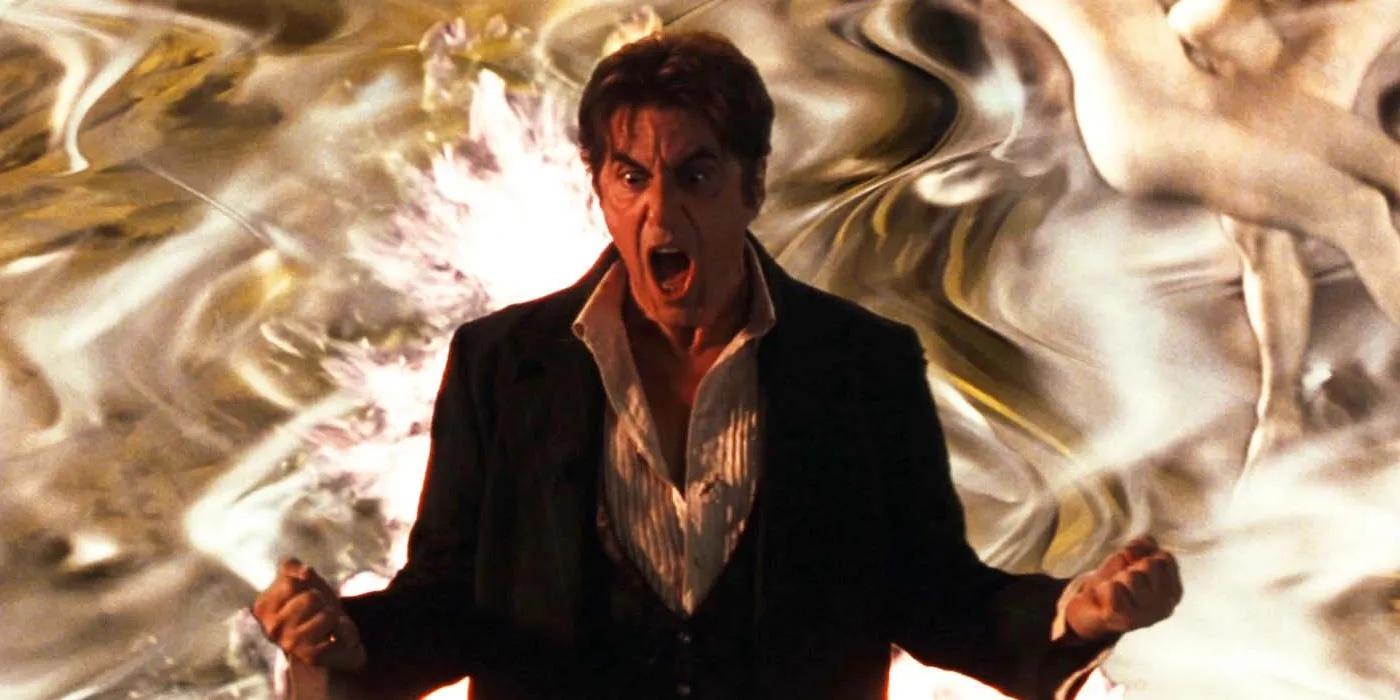
Luckily it works better for Ransom than it did for Keanu.
So God wins, and so does philology, because it turns out that Ransom is a ransom in the second, and more ancient sense of the word– a redeemer, like Christ. And lest you think this is too cute:
All in a moment of time he perceived that what was, to human philologists, a merely accidental resemblance of two sounds, was in truth no accident… The pattern is so large that within the little frame of earthly experience there appear pieces of it between which we can see no connection, and other pieces between which we can.
There are no puns in God’s cosmos! The Green Lady’s innocence is preserved, she’s reunited with the King, and the two are married and crowned as King and Queen of the planet by the eldils, who go into a poetic Christian rhapsody that lasts for 5 pages, with the refrain “Blessed be he!” To my mind this is 5 pages too many, but YMMV.
—
Tired of cosmic good and evil? In That Hideous Strength (1944), we come back to earth and Lewis serves us good, old-fashioned, human evil.
Our protagonists are Jane and Mark Studdock, newlywed academics with the usual problems. She’s a lonely feminist with clairvoyant dreams who doesn’t want to have kids until she’s finished her doctoral thesis; he’s a bootlicking member of the “Progressive Element” at the fictional Bracton College with a pathological need to be in the in-group.
Things go downhill when Mark gets recruited by an evil think tank. The NICE (National Institute of Coordinated Experiments) is a conspiracy theorist’s fever dream, a group of powerful scientists and intellectuals who control the press, dream of “sterilizing” the planet, and have an chaotic, anxiety-provoking internal culture somewhere between a normal Fortune 500 corporation and Stalin’s inner circle. No one is having any fun, and they’re all physically grotesque, from the “obscene senility” of Deputy Director Wither, to the butch chainsmoking head of police, “Fairy” Hardcastle, who stages a false flag attack so that her forces can seize power:
…the Fairy pointed out that what had hampered every English police force up to date was precisely the idea of deserved punishment. For desert was always finite: you could do so much to the criminal and no more. Remedial treatment, on the other hand, need have no fixed limit; it could go on till it had effected a cure, and those who were carrying it out would decide when that was. And if cure were humane and desirable, how much more prevention?
Oh and their Head is the literal decapitated head of a murderer they’ve reanimated and juiced up so that it can receive psychic transmissions directly from the devil.
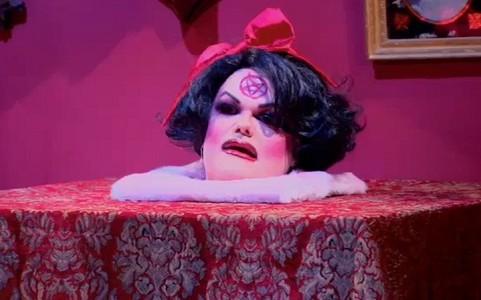
Can’t imagine Lewis would be a big Drag Race fan.
This is not particularly subtle, but Mark’s experience in NICE is actually a pretty sophisticated critique of institutional dysfunction. Once he’s brought in, Mark is constantly confused about what he’s supposed to be doing and who’s really in charge, kept so busy worrying about his position that he doesn’t even balk at the idea of writing articles that will get planted in different papers to hasten the aforementioned NICE police coup. It’s kind of fascinating, the idea that true evil isn’t even that much fun, except for the smug pleasure of being in the in-group and “getting” how the world works. True goodness, in contrast, is naturally joyful, folksy, and inclusive.
Speaking of. In the other corner we have Logres, a group led by Ransom, now young and hot from his time on Venus and going by “Mr. Fisher-King,” as in the Arthurian legend, although Lewis drops this halfway through. The group includes the nice old couple Dr. and Mother Dimble, skeptic with a heart of gold MacPhee, housekeeper with a heart of gold Ivy Maggs, and a literal bear named Mr. Bultitude. This motley crew of brothers and sisters in Christ recruit Jane, who to her chagrin has been having clairvoyant dreams, to help them find Merlin, who has mysteriously awakened after centuries of sleep. Both Logres and the NICE are seeking him because inexplicably, Lewis hangs the entire back half of his plot on the question of whether Merlin is going to help the forces of good or evil.
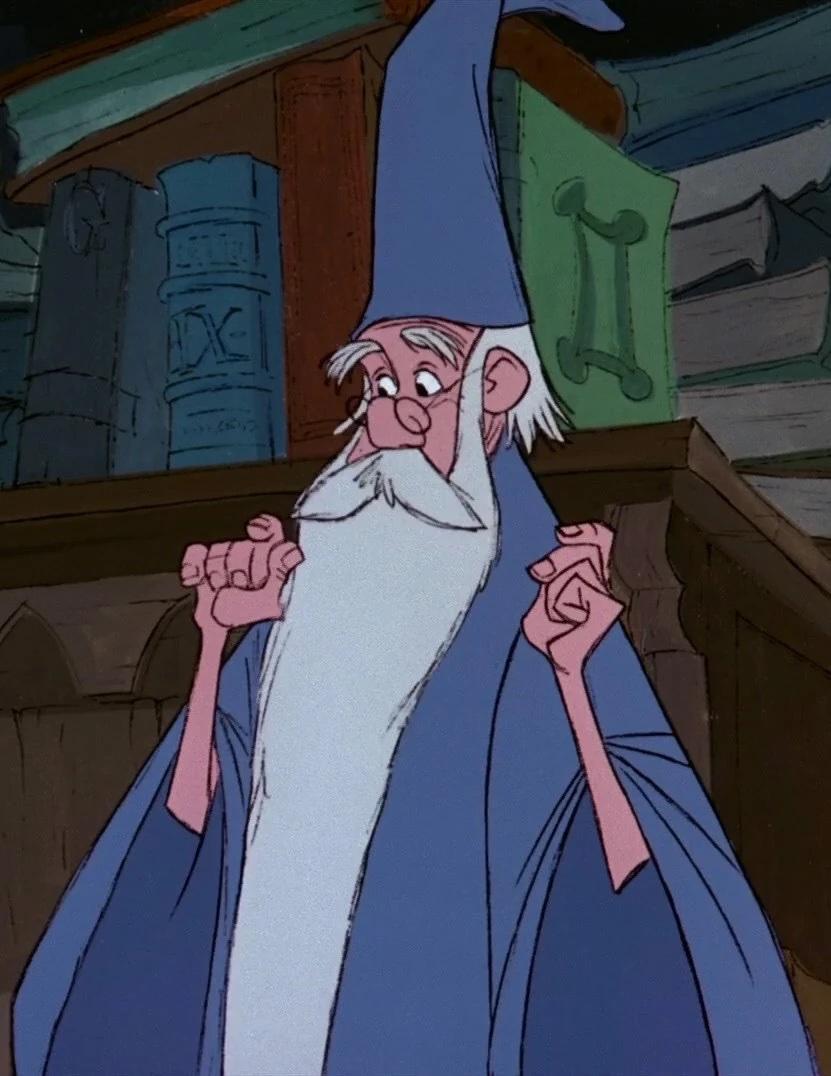
Yes, this Merlin. The one who in every story helps the good guys.
This is the main problem with That Hideous Strength, and arguably with the Space Trilogy as a whole. It’s so obvious who the good and bad guys are that a lot of the dramatic tension doesn’t land. I mean, we even know which of the good guys’ thoughts are actually bad! Here’s Mark currying favor with the in-group by defending a member of the outgroup, like a saucy little freethinker:
“I was rather sorry for old Jewel,” said Mark. His motives for saying this were very mixed… paradoxically, even while he felt that the time had come for asserting his own independence and showing that his agreement with all the methods of the Progressive Element must not be taken for granted, he also felt that a little independence would raise him to a higher position within that Element itself. If the idea, ‘Feverstone will think all the more of you for showing your teeth,’ had occurred to him in so many words, he would probably have rejected it as servile; but it didn’t.
And here’s Jane, whose feminism Lewis characterizes as essentially selfish and immature:
Even when she had discovered that she was going to marry Mark if he asked her, the thought ‘But I must still keep up my own life,’ had arisen at once and had never for more than a few minutes at a stretch been absent from her mind. Some resentment against love itself, and therefore against Mark, for thus invading her life, remained… Though she did not formulate it, this fear of being invaded and entangled was the deepest ground of her determination not to have a child.
This is insightful stuff, but it works better in Screwtape. In That Hideous Strength, which is basically a fantasy epic, it comes off as Lewis relentlessly patronizing his characters (he even dunks on Mark for not recognizing the constellation Orion, and on Jane for liking severe clothes). Ursula K. Le Guin perhaps said it best:
I admire the first book of his trilogy, as a novel. He was one of the first writers to invent alien creatures who were truly alien and truly sympathetic… [but] the second two books of his trilogy I consider an abomination, because he started preaching. I do not like to preach, or be preached at.[1]
Not even Lewis seems to like preaching! Once Merlin has finally been recruited to Logres, he offers to use his magic to help the cause, which seems like the main reason you’d want Merlin on your team. But Ransom says no, magic is “in this age utterly unlawful.” As in, against God’s law. Turns out Merlin is here not because of his powers, but because his powers give him the strength to endure being possessed by the eldils of the various planets, which by some convoluted logic that even Lewis has trouble explaining, is different from magic.
And if even the good guys have to play with a handicap, the bad guys really don’t stand a chance. The book ends, unsurprisingly, with good triumphing over evil in another wacky Christian bacchanal. This one involves the spirits of the planets descending into the house of Logres and possessing everyone in a good way, the utter destruction of NICE in a cataclysm that Orwell, in a review, called “so preposterous that it does not even succeed in being horrible in spite of much bloodshed,”[2] and Mark and Jane finally reconciling, for, as it turns out, Jane’s great sin is that she didn’t have a baby with Mark yesterday:
“Sir,” said Merlin, “know well that she has done in Logres a thing of which no less sorrow shall come than came of the stroke that Balinus struck. For, Sir, it was the purpose of God that she and her lord should between them have begotten a child by whom the enemies should have been put out of Logres for a thousand years.”
“She is but lately married,” said Ransom. “The child may yet be born.”
“Sir,” said Merlin, “be assured that the child will never be born, for the hour of its begetting is passed. Of their own will they are barren: I did not know till now that the usages of Sulva [contraception] were so common among you. For a hundred generations in two lines the begetting of this child was prepared; and unless God should rip up the work of time, such seed, and such an hour, in such a land, shall never be again.”
Checkmate, feminists!
And with this, Ransom’s story comes to an end. He goes to heaven, the NICE guys go to hell, and Mark and Jane go to a standard heterosexual marriage. Good luck, you crazy kids!
—
The Space Trilogy is, in a word, uneven. There are interesting ideas, but I
think they’re developed better in Lewis’s other works. So let me indulge in a very leading question I have been meaning to ask from the beginning. Why is Narnia so much better than the Space Trilogy?
- Narnia feels more balanced. In the Space Trilogy, there’s really nothing good about the bad guys, to the point that you don’t understand why anyone would be swayed by them, and can’t help sharing Lewis’s scorn for people who are. Whereas every Narnia book features a sympathetic character doing something they and we know is wrong, for basically sympathetic reasons, and then later atoning for it. You understand exactly why Edmund betrays his siblings, because the White Witch is a smokeshow and he wants that sweet Turkish Delight.
- The main characters in Narnia are all children, so the inherent didacticism of Lewis’s writing comes off wise rather than judgy.
- It’s all Tolkien’s fault. He gave extensive notes on the whole Space Trilogy, urged Lewis to make his mythology more consistent and thorough, and once the changes were made, even wrote a letter of recommendation that convinced publisher Stanley Unwin to accept Out of the Silent Planet after the publisher initially rejected it.[3] I think he casts a long, stickler’s shadow over the text. That Hideous Strength feels especially belabored by piety in a way that Lewis’s other works don’t.
- That old Flannery O’Connor quote: “The writer can choose what he writes about but he cannot choose what he is able to make live.” Obviously none of this is an objective critique, but to me, the Narnia books are so more alive than the Space Trilogy. The imagery is fresher, the characters are better, and the stories are more interesting.
- Lewis just got better at writing. This is a really heartening thought to me, that the same person can write two sets of books about the same basic themes, with many similar scenes and ideas, and the second one will just be better, because of what he’s learned through writing the first. The Space Trilogy is a step towards Narnia, and just for that, it’s worth the read.
Footnotes
- ↩
1988 interview in Conversations with Ursula Le Guin (2008), ed. Carl Freedman
- ↩
The Fellowship: The Literary Lives of the Inklings: J.R.R. Tolkien, C.S. Lewis, Owen Barfield, Charles Williams, Philip Zaleski & Carol Zaleski