The Story of Ferdinand by Munro Leaf
The Story of Ferdinand by Munro Leaf is a children's book about a bull who wants to sit quietly rather than fight. While that description makes it sound like it was written by your least-favorite lefty activist, The Story of Ferdinand is from 1936 and is just a charming story about a bull rather than a political screed.
Ferdinand is short enough that it only takes a paragraph to summarize the plot. Ferdinand is a bull who doesn't want to fight with the other bulls, and instead spends all his time sitting under a tree smelling the flowers. His mother is initially worried that he will be lonely but decides that he's fine the way he is and leaves him alone. One day, Ferdinand is stung by a bee and runs around so wildly that he attracts the attention of some bullfighters, who bring him to Madrid for the big bullfight. But on the day of the fight, Ferdinand refuses to fight and instead sits and smells the flowers in all the ladies' hair. Eventually, the bullfighters get fed up and bring Ferdinand back to his pasture, where he lives in peace and quiet forever under his favorite cork tree.
That description doesn't do the book justice. This is not one of those kid’s books driven by plot. Instead, much of the appeal is in the details. At least as an adult, the first attraction is a set of oddly specific turns of phrase. Leaf says repeatedly that Ferdinand “loves to sit just quietly”, rather than the more expected “just sit quietly”. Maybe that was standard for 1936 and it is probably grammatically correct even now, since “just” emphasizes “quietly” rather than “sit”, but it's unexpected and always gives my brain a little jolt when I read it.
Leaf also takes great pains to emphasize that Ferdinand's mother is a cow. She’s first introduced with the line “Sometimes his mother, who was a cow, would worry about it”. Then, when she accepts his decision to not fight, Leaf says that “because she was an understanding mother, even though she was a cow, she let him just sit there and be happy”.
When the bee stings Ferdinand, Leaf speaks directly to the reader:
Well if you were a bumble bee and a bull sat on you, what would you do? You would sting him. And that is just what this bee did to Ferdinand
This passage to me recalls the end of The Cat in the Hat, written 21 years later ("Should we tell her about it? Now what should we do ? Well… what would you do if your mother asked you?"), or, in a more literary vein, the famous line from Jane Eyre ("Reader, I stung him").
Later on, when the bull-selectors arrive from Madrid, they are described as "four men in very silly hats". Here, it's the "very" that gets me. These are important, serious men, but their hats are not just silly, they're very silly. Looking at the illustrations though, standards for silliness have clearly increased over the past 90 years, because these hats are, at the most, kinda silly:
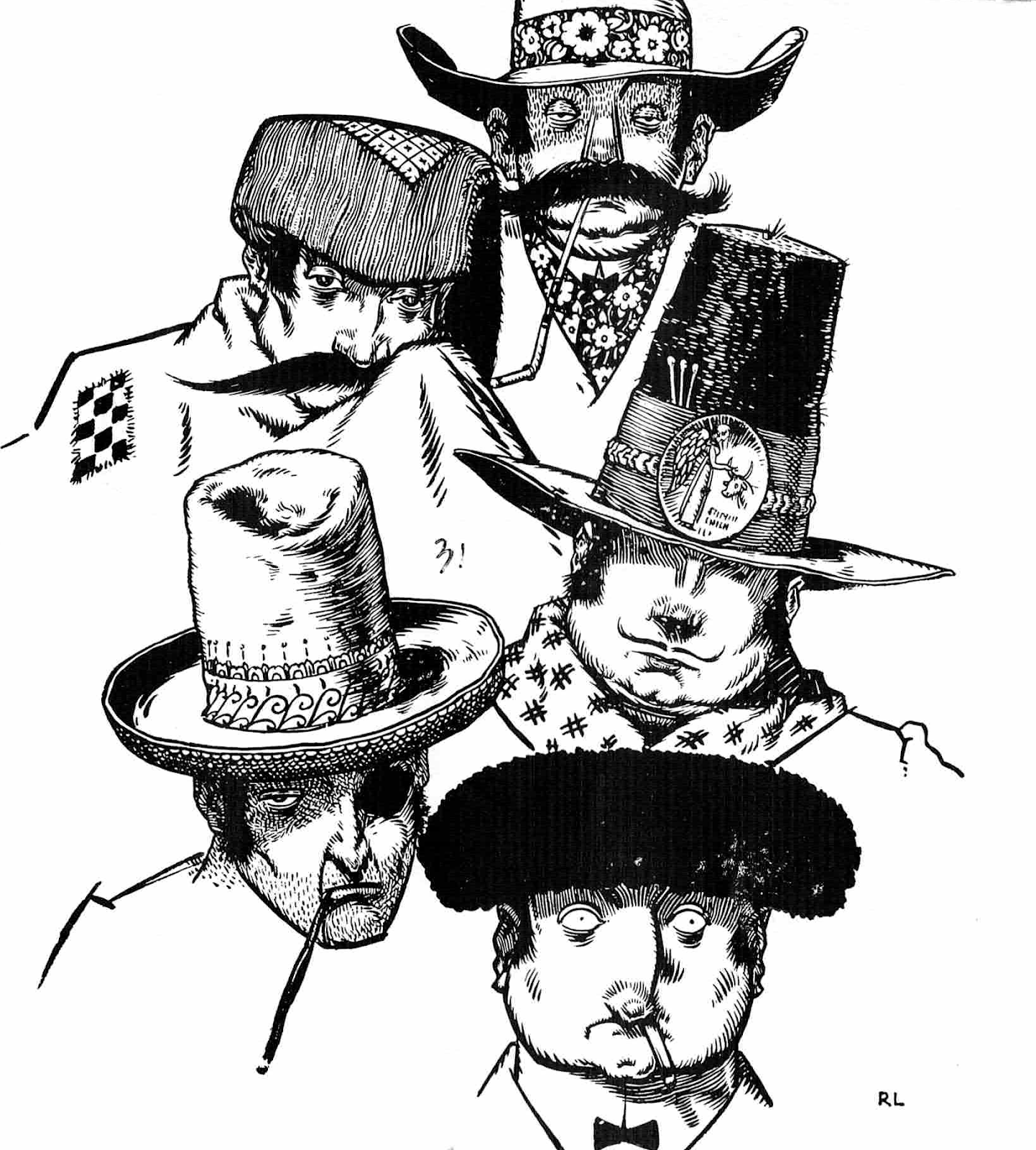
If Minions described characters as having silly hats, you know one of them would have a tortilla-chip sombrero and another would probably have a cuckoo clock crossed with a water slide.
The best illustrations, however, are the ones of the cork tree, which Robert Lawson draws as having literal corks hanging from the tree like grapes:
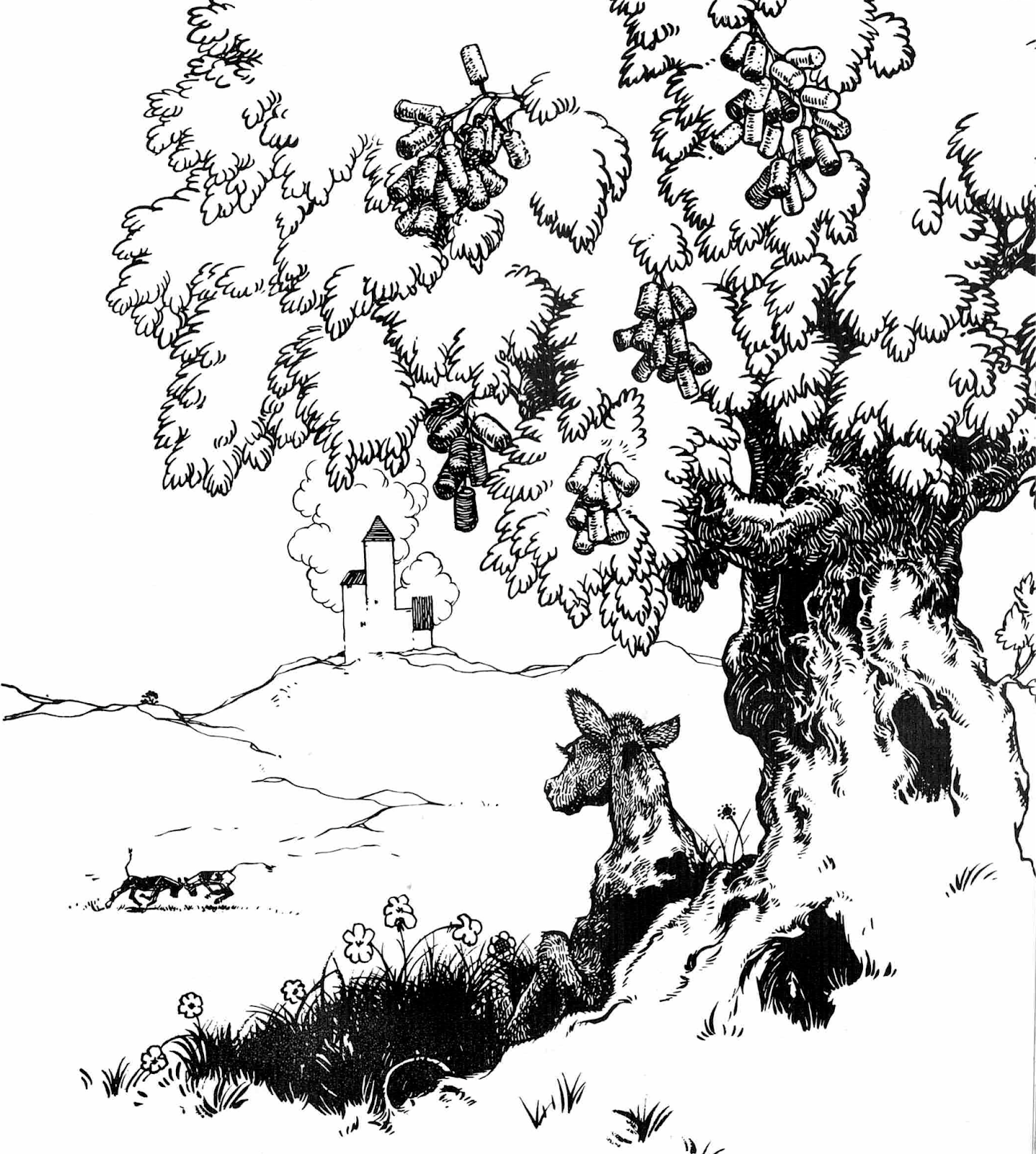
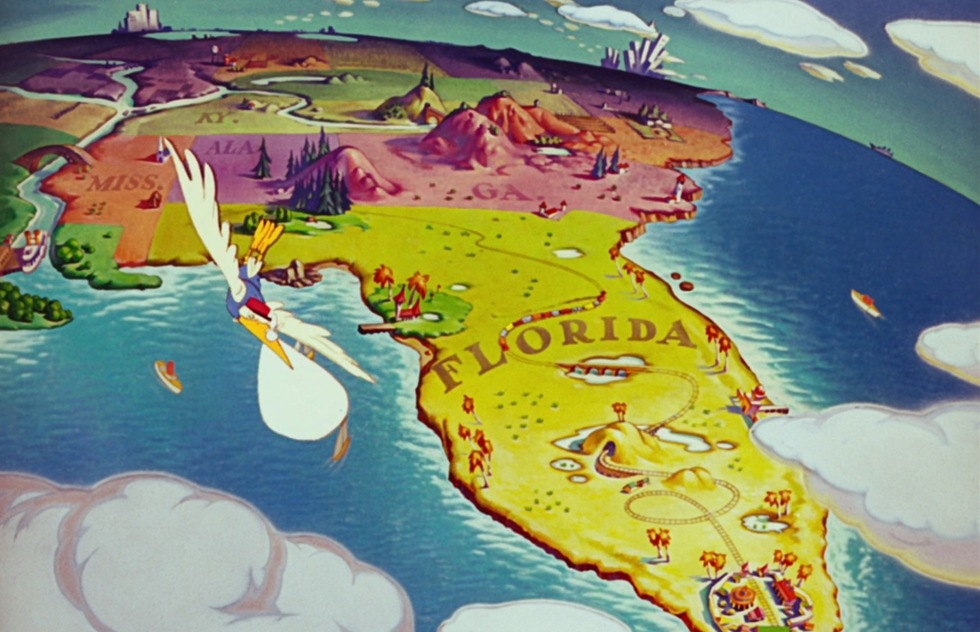
I'm 99% certain that this is an intentional bit of whimsy, but there's a tiny part of my brain that wonders if nobody knew what a cork tree looked like? After all, Dumbo was released 5 years later containing this remarkably inaccurate map of the United States, and it was probably easier to find an atlas than a picture of a cork tree:
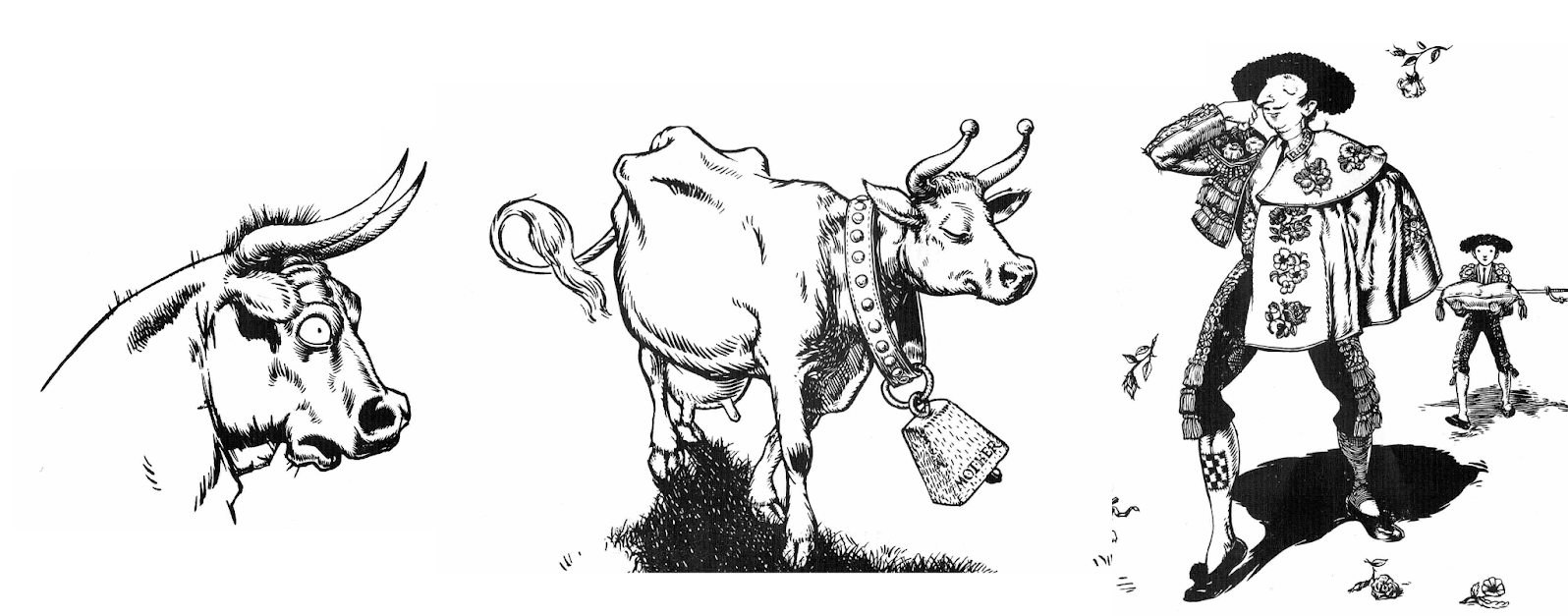
All the illustrations in Ferdinand are the same black and white line drawings throughout. I know even less about art than I do about writing, but I'll just say that they manage to convey a wide range of emotions in simple drawings. That includes whether it's Ferdinand being shocked and hurt when stung by a bee, his mother being satisfied that Ferdinand is happy, and the proud matador entering the ring:
Reading Ferdinand in 2024 is disconcerting because it feels incredibly modern and incredibly dated, simultaneously. What modern children's book would include vivid descriptions of men wanting to stab a bull with swords and spears:
First came the Banderilleros with long sharp pins with ribbons on them to stick in the bull and make him mad. Next came the Picadores who rode skinny horses and had long spears to stick in the bull and make him madder. Then came the Matador, the proudest of all — he thought he was very handsome, and bowed to the ladies. He had a red cape and a sword and was supposed to stick the bull last of all.
Whereas discussions of emotions, not fitting in, and being yourself feel like the primary topics for basically every children's book published in the last 50 years, and discussions of how boys should fight less and appreciate flowers more feel like they were plucked straight out of a secret woke instruction manual. Reading Ferdinand, and knowing that it's 90 years old, I feel simultaneously as though society never changes and that society is changing faster than you can possibly imagine.
That feeling is only magnified reading about the controversy over Ferdinand when it first came out. Although it was written in 1935, Ferdinand was released in 936 just a few months after the start of the Spanish Civil War. Given that Ferdiand is set in Spain and features a character who refuses to fight, the political allegories basically write themselves. The gender analyses are equally obvious. Depending on your point of view, Ferdinand is either a story about a gender non-conforming boy learning to be himself, or about a boy who lacks any older male role models (his dad is never mentioned), and as a result grows up weak and unable to defend himself.
There's a fun New Yorker article listing various responses when Ferdinand came out. Francisco Franco had it banned in Spain, and Adolf Hitler reportedly had it burned (I can see the ad slogan now: "Ferdinand — the only literally anti-fascist book for kids"). Ernest Hemingway was so worked up about the whole thing that he wrote his own short story in response that ends with the bull being killed, but respected ("Ferdinand — killing bulls is good"?). The jazz group Slim and Slam recorded the song "Ferdinand the Bull" with the line "Ferdie is a sissy, yes yes" ("Ferdinand — destroying America's youth since 1936").
I think that disconnect points to a bigger picture, which is that the debates don't change. People can and do still argue over the cultural issues raised in Ferdinand - gender roles, non-violence, and animal rights. For all of the issues, the mainstream answers have changed a lot, but not completely, and they are still live issues for debate today. For gender roles in particular, it feels like there have been real, substantial changes in our laws and choices around gender roles (e.g., women's workforce participation shot up between 1948 and 2000), but we're still having the same debates about whether boys need to be encouraged to rough-house or to play with dolls. I’ll leave it to you to decide whether this is a good thing (because we’ve had hundreds of years to think about these issues and can draw on that wisdom when deciding now) or not (because even when our ancestors got it wrong, we never seem able to settle these debates and move on).
The other thing that's disconcerting about Ferdinand is how good it is. It is surprisingly good; so good that I start asking philosophical questions about how a children's book written in the 1930s can be just as good as the best children's books of today. After all, a book written today should be more in line with my views of society and parenting, and, now that we 2 million Americans can supply the other 332 million of us with food, we have so many more resources that we can spend on writing extraordinary books for children than we did in 1930.
I realize this is an area that's both controversial and well-trodden, but reading Ferdinand brought to mind a hypothesis I haven't seen before, which is that maybe there's just a ceiling to how good a children's book can be. This is just the s-curve model of technological innovation applied to art. In my simplified model, someone first comes up with the idea of writing books specifically for children, and the first books are relatively crude. Then there's a period of innovation, where the quality of the product (books and stories) improves, until finally we reach the upper limit of quality, where additional innovations in book-writing lead to minimal improvements in the end product.
I obviously can't prove this hypothesis, but it does match my experience with children's books from different eras. The first book specifically for children was, according to Wikipedia, A Little Pretty Pocket-Book by John Newbery from 1744, and it's terrible. Mother Goose's Melody, a book of nursery rhymes from 1781 is equally bad, full of nonsense rhymes and bizarre morals written into the book (The maxim for Jack and Jill is "The more you think of dying, the better you will live"). Then, starting in the first half of the 1900s, there are plenty of children's books that I adore, including Ferdinand, but also Winnie-the-Pooh, Make Way for Ducklings, and Katy and the Big Snow. I'd put any of these at about equal level with more modern favorites.
Instead, the big improvements in children's entertainment haven't been in books at all, but in movies and cartoons. Baby Shark is far, far, far, more engrossing to the average toddler than any book. And I bet most toddlers and most parents would probably choose an episode of Bluey over their favorite kid’s book. But even then, those improvements haven't been enough to tank the sales of kid's books, even ones as old as Ferdinand. Which might make me a little more optimistic about generative AI? If we haven't been able to substantially improve on Ferdinand, despite having 90 years and billions more people, maybe there's hope for lowly humans in the age of GPT-4-Turbo and Claude 3 Opus.
It is tempting, but probably wrong to ascribe Ferdinand's continued popularity to its politics and its place in the culture war. Combine its association with the Spanish Civil War with a protagonist who feels like he could be the subject of SNL's Wells for Boys and you might have the perfect ingredients to ride 90 years of controversy to millions of sales.
There are a few problems here. First of all, Ferdinand as a plea for pacifism falls apart if you think about it for more than a minute. In the book, when Ferdinand refuses to fight, they take him back home to his favorite cork tree and let him stay there the rest of his days. In reality, Ferdinand probably would have been slaughtered for meat far before he ever got into the bullring, and almost certainly would have been poked and prodded and killed if he did make it into the ring. For nonviolent resistance by an individual to work, it has to provoke some change of heart in the aggressor, something that is never mentioned in Ferdinand. Instead, when Ferdinand won't fight, the “Banderilleros were mad and the Piacadores were madder and the Matador was so mad he cried”. But despite their anger, “they had to Ferdinand home”, for reasons that are never explored. Oddly enough, this means that the otherwise forgettable 2017 film adaptation is a much clearer political allegory than the book itself, since in the film, Fredinand's pacifism wins him the support of the crowd, forcing the matador to spare his life.
The idea of Ferdinand as about gender non-conformity holds up better, but not perfectly. At least compared to my modern expectations, no one ever makes a big deal out of Ferdinand's desire to smell flowers rather than fight. None of the other bulls ever bully him and his total interaction with his mother on the issue goes approximately as follows:
"Hey son, wouldn't you like to fight with the other bulls?"
"Nope"
"Ok, sounds good."
And while the bullfighters do various things to encourage Ferdinand to fight, Leaf skips over what that entails, saying only that “He wouldn’t fight and be fierce no matter what they did”.
For a book supposedly about gender, there are vanishingly few women or girls in Ferdinand. There is one cow, Ferdinand's mother, but when Ferdinand goes and sits under the cork tree, he does it by himself rather than with the heifers. And this is where reality intrudes, because while only male bulls are used in Spanish bullfighting, the females are tested even more extensively for their aggression, and (according to wikipedia), "a bull's 'courage' is often said to descend from his mother". Wanting to sit just quietly and smell the flowers doesn't seem to be a trait that any fighting bulls have, of either sex.
Either way though, political controversy is neither necessary nor sufficient for publishing success. There are plenty of books from the same era that are definitely not political but were and still are popular. Maybe the best example is The Little Engine That Could (1930), which is just a terrible terrible book. It's repetitive, incredibly wordy, and, worst of all, boring. But for all its faults, I've never seen it described as having a political bent. Published in 1930, it has sold over 8 million copies if you trust the LA Times and maybe over 20 million if you trust Dolly Parton. For another example, Goodnight Moon doesn't have a plot or characters, and I've never seen anyone seriously suggest that it has a political message.[1] That book was published in 1947 and has sold 48 million copies worldwide.
Instead, I think Ferdinand's success is due to being a fun little children's book, along with a large amount of luck. Maybe political controversy made more people talk about the book early on, or maybe it was random happenstance that snowballed into something huge. The illustrations and the words together make Ferdinand a straightforward, charming book, and one clearly and appropriately targeted at children. Despite being about bullfighting, the stakes are always low, and no one ever appears to be in any danger. People (and cows) make bad assumptions about Ferdinand, but it's always out of ignorance rather than malice, and in the end, he's able to live out his days in the shade of a cork tree, sitting just quietly.
What value then, is there in analyzing a simple children's book about a cow smelling flowers? As much as I think that Ferdinand can give a new perspective on how society changes, the simple answer is that Ferdinand is a lovely book and I think more people should read it.
Footnotes
- ↩
Technically, Wikipedia includes a reference to "Have a Carrot: Oedipal Theory and Symbolism in Margaret Wise Brown’s Runaway Bunny Trilogy", which would probably count as a political analysis if it weren't a self-published e-book that that I doubt anyone has ever read and whose references on Wikipedia were probably added by the author.