The Structure of Scientific Revolutions by Thomas Kuhn
I. Preliminaries
Back in my math major undergrad days, I often defaulted to proving theorems by contradiction even when that wasn’t necessary, because having something to be mad at helped me think. Basically: “Not all bounded sequences in ℝ have a convergent subsequence,” I would imagine somebody saying with a smirk, at which point I would be able to focus clearly, as much to wipe the smile off their stupid jerk face as to prove the Bolzano-Weierstrass theorem.
That is how I felt about Thomas Kuhn’s The Structure of Scientific Revolutions, Kuhn’s 1962 book putting forth his radically new and wildly influential (any time you hear someone refer to a “paradigm shift,” that’s Kuhn) philosophy of science. It was wrong and made me mad, but yelling at Kuhn in my head was a useful way to articulate how science actually works.
Kuhn’s biggest problem is his apparent unawareness that fields other than physics exist. This leads him to be fundamentally wrong in three ways, the first two of which are the most significant. First, he draws an unhelpful binary between “normal science” and “scientific revolutions” that obscures more than it reveals. Second, within what he classifies as scientific revolutions, he focuses on psychological aspects that rarely or never apply and are not core to the scientific process. While looking at other fields makes these flaws obvious, he turns out not to be right about physics either. Third, his philosophy leads him to a view of science as ever shifting from one “paradigm” to another that can never, even in principle, land on reality. I think this is misguided as well.
Before we get too far into Kuhn, let’s back up a little bit to Karl Popper, who developed and advocated for a philosophy of science based on falsification. To Popper the essence of a scientific theory is not its ability to be proven true but its ability to be proven false. The purpose of experimentation is to attempt as aggressively as possible to falsify predictions made by a theory. For example, the Eddington experiment’s 1919 astronomical observations during a solar eclipse famously tested gravitational light deflection and found it to be different from what Newtonian physics would predict but precisely in line with Einstein’s new theory of general relativity. This falsified Newtonian physics but not general relativity. Compare to the predictions made by your local newspaper’s horoscope and it is clear why relativity is scientific in the Popper sense but astrology is not:
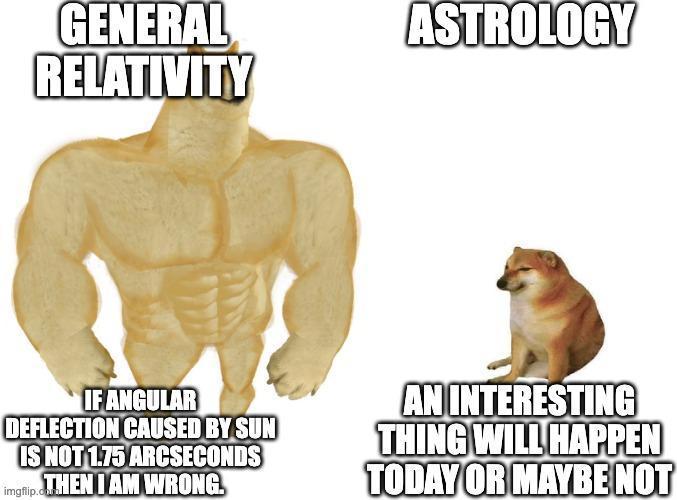
This is a compelling description of what science is and how it works but it does have a minor flaw that it is not how science works 99% of the time, as we’ll see below.
Kuhn thinks he knows how it does work and he will tell you all about it in the admirably clear and tightly argued Structure.
The preface and chapter 1 are mostly an outline of what Kuhn is about to talk about. The main thing I want to highlight is his claim in the preface that “Far more historical evidence [for Kuhn’s view on science] is available than I have had space to exploit below. Furthermore, that evidence comes from the history of biological as well as of physical science,” which, more on this later but hahaha no.
He also introduces his famous concept of a “paradigm,” which is a sort of collection of theories, experimental tools, and properties that can be used to understand an agreed-upon class of phenomena. For example, Newtonian physics is a paradigm in which Newton’s laws form an underlying theory describing relationships between velocity, acceleration, mass, and forces. Experimental tools such as clocks, rulers, scales, and telescopes are used to make measurements in the Newtonian paradigm. Textbooks are filled with calculations of orbits and cannonballs and pendulums and inclined planes, whose behavior is solved with Newton’s laws. To put some more meat on the definitional bone, here are some examples of paradigms Kuhn discusses in the book: Aristotelian physics, Newtonian physics, relativity, and quantum mechanics; Ptolemaic (geocentric) and Copernican (heliocentric) astronomy; phlogiston[1] and oxygen theories of combustion; Dalton’s atomic theory in chemistry.
Chapter 2 primarily uses the example of 18th century studies on electricity to discuss what happens before you have a paradigm: people collect all sorts of weird random facts and come up with all sorts of wild theories that conflict all the way down to the fundamentals. Eventually, one theory (Benjamin Franklin’s, in the case of electricity) explains enough facts and wins enough support to become generally agreed on by scientists; this is the first paradigm of the field. Kuhn also mentions that psychology and social science are (as of 1962) still in the pre-paradigmatic stage and that’s arguably no less true today. It’s a nice chapter and I have not that many quibbles though amusingly Kuhn later recanted this description in his 1969 postscript and said there’s no such thing as pre-paradigmatic science. Regarding this recantation I’m with Ian Hacking’s introduction to Structure, “Second thoughts are not necessarily better than first thoughts.”
II. Normal Science
Past chapter 2, we’re past the preliminaries and into Kuhn’s overarching theory of how science works. This is the theory:
- Scientists in a particular field do very detailed work within an unquestioned paradigm. This is called “normal science.”
- During normal science, anomalies crop up where people figure out how an observation lines up with the paradigm.
- Eventually there are so many anomalies that the field reaches a crisis, and somebody comes up with a new paradigm that purports to explain anomalies by completely overturning everyone’s view of how the field works.
- Believers in the old and new paradigm have a knock-down-drag-out fight over which paradigm is correct. If the new paradigm wins, this is a “scientific revolution.”
- Return to step 1 with the new paradigm.
This is approximately the order Structure is written but I’ll be skipping around and inserting things from the postscript where I think it makes things clearer.
Starting with normal science: what a scientist does is almost never as dramatic as the Eddington experiment. Normal science takes the paradigm for granted and aims to use the paradigm to solve specific problems within a field. For example, consider the mutation theory of cancer formation.[2] Most individual cancer biologists don’t spend time worrying about whether mutations cause cancer; if they did, they’d never get anything done. Instead, a scientist might computationally search through tumor sequencing data to identify tumor driver mutations, and then spend several years identifying and thoroughly characterizing a particular mutation of interest. Does the mutation affect a tumor suppressor or a proto-oncogene? What exactly does it change about the molecular structure of the relevant protein to change its activity? If you make that mutation in a mouse model, will they spontaneously develop tumors? And so on.
The important thing to understand is that there is basically no result the cancer biologist could observe that would falsify the mutation paradigm in a Popperian sense. The mutation doesn’t affect a known cancer-associated protein? Well maybe it’s a cancer-associated protein that hasn’t been detected yet. The mutation doesn’t affect cell growth in culture? Maybe that’s because it encourages angiogenesis or helps hide the cells from the immune response. The equivalent mutation doesn’t do anything in mice? Mice are notorious for not being people. Maybe the mutation only does something in the presence of a particular genetic background or a second tumor driver mutation. Who knows, biology is complicated! The very very very last thing the scientist will think is something like “oh, I guess I’ve falsified the underlying theory that mutations cause cancer.[3]”
In any case, a cancer biologist studying a computationally identified tumor driver mutation is likely to find its mechanism given enough time and resources. This is a special case of Kuhn’s general point that paradigms become paradigms by being the best available approach to solving detailed individual problems. Kuhn calls working on these specific problems “puzzle-solving” and says (correctly, I think) that it’s the vast majority of what the vast majority of scientists do all day. For another example, organic chemists try to figure out reaction mechanisms under a relatively unquestioned grab bag of common theories and strategies like electron pushing, transition state analysis, Hammond’s postulate, hyperconjugation, and so on.
An instructive example of puzzle-solving in physics is when Uranus’ orbit was found to be out of whack with the Newtonian prediction. This puzzle was solved by the prediction of a new planet, Neptune, which was subsequently discovered precisely where it would have to be to explain Uranus’ deviation.
This then raises the question, if everyone is working head down on their one little corner of reality as opposed to boldly falsifying the major theories of the day, how do big advances happen at all?
Kuhn says that because paradigms are very good at allowing for puzzle solving, when a puzzle can’t be solved it sticks out like a sore thumb. For example, Wilhelm Röntgen was messing with cathode ray tubes (which make cathode rays a.k.a. electron beams) when he accidentally discovered a weird thing: turning on the cathode ray tube made a barium platinocyanide screen glow. This weird thing did not behave like cathode rays at all and on further investigation turned out to be due to a new kind of light called X-rays. This blew a lot of people’s minds; Lord Kelvin thought they were a hoax. To Kuhn, this is an example of a minor paradigm shift within the specific field of cathode ray science because suddenly all previous results had to be reconsidered in light of X-rays, thus fundamentally changing the way research was conducted.
Paradigms don’t usually die of one anomaly as happened for X-rays. Usually the anomaly is simply noted as an issue, or addressed by adding epicycles, literally in the case of Ptolemaic astronomy, otherwise figuratively. Pressure to fit all observations into the current paradigm is the driving force of normal science and is usually a good idea as with the discovery of Neptune. Failure to solve a puzzle within a paradigm “discredits only the scientist and not the theory. Here, even more than above, the proverb applies: ‘It is a poor carpenter who blames his tools.’”
I’m going slightly more into detail here because I want to introduce Kuhn’s absolute howler when discussing how scientists are conditioned to work strictly within paradigms: “But science students accept theories on the authority of teacher and text, not because of evidence. What alternative have they, or what competence?”
What the hell? Maybe Kuhn had a wildly different education than I did, but in introductory chemistry I learned about J.J. Thomson’s plum pudding model of the atom and why it was discarded, followed by the logic behind quantization of the hydrogen atom for explaining the hydrogen emission spectrum. In physics I learned about the Michelson-Morley experiment, the photoelectric effect, and the double-slit experiment as important anomalies that spurred the development of relativistic and quantum physics. Meanwhile my biology classes did almost nothing but provide evidence for everything we learned, from Mendel’s pea plant studies to the key experiments showing that nucleic acids were the information-carrying component of life to knockout mouse model experiments showing that AIRE drives negative selection of self-reactive T cells.
III. Crisis and Revolution
Sometimes the quantity or importance of anomalies prove impossible to hand-wave away and a paradigm starts to creak under the strain. Ptolemaic astronomy was universally agreed to be a mess before Copernicus arrived on the scene. 19th century classical physics had the troubles I mention above plus the precession of the perihelion of Mercury’s orbit, among others.
At this point, people begrudgingly start to look outside the paradigm. Unmoored, they do all kinds of weird experiments and come up with all kinds of new theories, sort of like Kuhn’s description of pre-paradigmatic science. Kuhn calls this “extraordinary research.” As part of this process, people propose new paradigms over old ones. General relativity over Newtonian mechanics, which itself replaced Aristotelian physics! Copernican cosmology over Ptolemaic cosmology! Lavoisier’s oxygen-based theory of combustion over the phlogiston theory!
Per Kuhn, new paradigms are fundamentally incompatible with the old ones. In principle this need not be the case, science could just progress cumulatively, but in practice this is unlikely because the way new paradigms are developed is via anomalies that the old paradigm conclusively gets wrong. Hence, for the new paradigm to be right the old one must be wrong.
I don’t think this is right. Special relativity, quantum mechanics, and general relativity all reduce to Newtonian physics in various classical limits; ditto quantum optics reducing to ray optics. Kuhn is aware of this objection and argues against it. He says, for example, that “mass” means different things in Newtonian physics and special relativity: “Newtonian mass is conserved; Einsteinian is convertible with energy. Only at low relative velocities may the two be measured in the same way, and even then they must not be conceived to be the same.” Therefore, if special relativity is right then Newtonian physics is wrong. To say that Newtonian physics is right if you are within various classical limits, you would likewise have to say that the phlogiston theory is right if you are within that theory’s limits (studying acid formation by sulfur combustion or comparing and contrasting metals and metal oxides).
This seems like unconvincing word games. Whatever one’s metaphysical commitments, special relativity in the low velocity (compared to the speed of light) limit will give exactly the same predictions as Newtonian physics in all circumstances. Regarding phlogiston, make the translation “phlogiston → negative oxygen” and it’s basically (though not entirely) isomorphic to oxygen theory.
Per Kuhn, this is a general phenomenon: “Though an out-of-date scientific theory can always be viewed as a special case of its up-to-date successor, it must be transformed for the purpose.” I dunno, this seems to me like an admission that scientific revolutions are more cumulative than he says.
Anyway, let’s get back to what happens when a new paradigm arrives on the scene: debates become sharply different from how they are under normal science. During the extraordinary research or “crisis” phase, scientists are not doing puzzle-solving so much as fighting over what the arena will be in which puzzle-solving takes place. Put another way, in normal science people use common tools to solve an agreed-on set of puzzles, while in a crisis advocates of different paradigms use different tools to study different problems with different techniques and even different worldviews.
For example, when Newton’s theory of gravity arrived on the scene, it was greeted with skepticism because:
Before Newton was born the “new science” of the century had at last succeeded in rejecting Aristotelian and scholastic explanations expressed in terms of the essences of material bodies. To say that a stone fell because its “nature” drove it toward the center of the universe had been made to look a mere tautological word-play, something it had not previously been. Henceforth the entire flux of sensory appearances, including colour, taste, and even weight, was to be explained in terms of the size, shape, position, and motion of the elementary corpuscles of base matter. The attribution of other qualities to the elementary atoms was a resort to the occult and therefore out of bounds for science. Molière caught the new spirit precisely when he ridiculed the doctor who explained opium’s efficacy as a soporific by attributing to it a dormitive potency. During the last half of the seventeenth century many scientists preferred to say that the round shape of the opium particles enabled them to sooth the nerves about which they moved.[4]
The problem was that gravity was not easily explainable by corpuscles (people tried but failed): “Gravity, interpreted as an innate attraction between every pair of particles of matter, was an occult quality in the same sense as the scholastics’ ‘tendency to fall’ had been.” So Newton’s gravity was taken by many to be unscientific and incoherent.
Kuhn’s point is that deciding whether to switch to Newtonian gravity is a fundamentally different class of disagreement from puzzle-solving. To give an example of the latter, tumor angiogenesis—the formation of new nutrient-supplying blood vessels within a tumor—is one of the major hallmarks of cancer. This has led to a class of anti-angiogenesis cancer drugs that aim to starve tumors to death. Unfortunately these drugs have yielded middling results, and some scientists argue that promoting angiogenesis is more valuable so long as it promotes healthy, functional tumor vasculature. Good vasculature allows for better chemotherapy drug delivery to tumors and improves immune cell infiltration, which helps knock out a different hallmark of cancer, immune evasion.
While scientists can disagree about whether pro- or anti-angiogenesis therapies are more promising, the disagreement can be resolved in broadly agreed-upon ways. Different strategies can be compared in various tumor models in mice, clinical trial results can be analyzed. Scientists will generally agree about what constitutes evidence for one theory or another (increased mouse and human survival, reduced tumor growth and metastasis, measures of anti-tumor immune response, etc.). Evidence from different sources can be weighted differently such that agreement is never perfectly reached, but fuzzy boundaries of when and where different treatments are optimal have every hope of being identified.
Contrast this with the anti-Newtonian gravity case which is not about the specifics at all. It’s just saying the whole worldview is nonsense. What the hell is “tendency to fall” and how is it different from saying opium makes people sleep because of its “make-people-sleep” property?
As usual, Kuhn has physics tunnel vision here because nobody has these metaphysical disagreements in biology, at least once vitalism was overturned in the 1800s and it was accepted that life is made of atoms and molecules. Same goes for chemistry post-quantum mechanical model of the atom. But just because the point is limited to physics doesn’t mean he’s wrong about physics. Similar metaphysical disagreements plagued early quantum mechanics; consider Einstein’s “God does not play dice with the universe” and the plethora of interpretations of QM from Copenhagen to many-worlds.
So metaphysical incompatibility is one source of what Kuhn calls “incommensurability” of different paradigms, but it is not the only one. A more general source of incommensurability is that in the early days of a scientific revolution, the old and new paradigm solve different classes of problems. For example, opponents of Dalton’s atomic theory, who believed in something called “affinity theory,” took air to be a chemical combination of oxygen and nitrogen while Dalton thought air was a mixture of two separate things, oxygen and nitrogen. But because oxygen is denser than nitrogen, that implied that oxygen and nitrogen should separate in the atmosphere with oxygen on the bottom and nitrogen on the top. This is not true, which is to say, Dalton’s atomic theory was falsified from the start! On the other hand, Dalton’s theory predicted the Law of Multiple Proportions which was highly successful in describing molecular properties.[5] Because these are different kinds of problems that are resolved, there is no objective way to decide. What is more important, explaining atmospheric properties or explaining ratios of elements in certain compounds?
This kind of incommensurability generalizes beyond physics but not to all paradigm shifts. For example, as I mentioned above general relativity, special relativity, and quantum mechanics have strictly greater explanatory power than classical physics: they reduce to classical physics in various limits but better explain phenomena outside these limits.
Granting Kuhn’s claim that new paradigms are always incommensurable, what decides paradigm choice? To Kuhn, it’s basically a combination of 1) somewhat subjective criteria related to different paradigms’ simplicity, accuracy, elegance, and ability to solve useful puzzles, and 2) Max Planck’s old saw that science advances one death at a time. Proponents of an old paradigm are rarely converted because they are intellectually unable to understand the new paradigm due to incommensurability but new entrants to the field, free to select a paradigm, determine which direction the field goes.
Kuhn’s explanation for why believers in an old paradigm are unwilling and even unable to convert is wildly unconvincing. He analogizes paradigm shifts to “gestalt shifts,” which is the kind of thing that happens for the optical illusion where first you see a duck and then suddenly you see a rabbit:
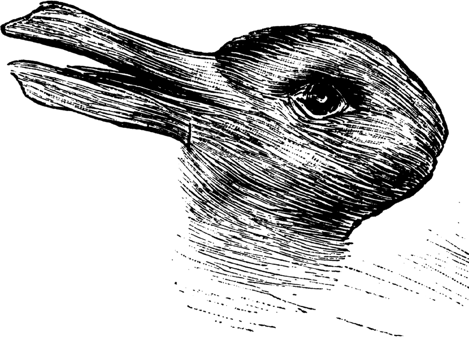
Believers in an old paradigm are unable to pull off the gestalt shift. For example, here’s Kuhn saying says Ptolemaic astronomers were unable to switch from the duck of geocentrism to the rabbit of heliocentrism:
Communication across the revolutionary divide is inevitably partial. Consider, for another example, the men who called Copernicus mad because he proclaimed that the earth moved. They were not either just wrong or quite wrong. Part of what they meant by ‘earth’ was fixed position. Their earth, at least, could not be moved. Correspondingly, Copernicus’ innovation was not simply to move the earth. Rather, it was a whole new way of regarding the problems of physics and astronomy, one that necessarily changed the meaning of both ‘earth’ and ‘motion’. Without those changes the concept of a moving earth was mad.
I’m trying not to be unfair, but in the quote above and elsewhere he genuinely seems to be claiming that geocentrist astronomers were not just wrong but unable to fathom a heliocentric universe? Were they all just complete morons? Did Copernicus say something like “You know Venus and Mars and the Moon? Well, we live on a thing like that, and it’s moving, much like Venus and Mars and the Moon” and his enemies said “what, sorry, I can’t parse that sentence”? Look, Kuhn wrote a whole book on the Copernican Revolution, which I haven’t read, so maybe I’m hilariously wrong. I just have a really hard time believing geocentrists had no clue what Copernicus was saying. Couldn’t they have just disagreed with him? Copernican heliocentrism had circular orbits and epicycles so was neither more accurate nor dramatically simpler than Ptolemaic geocentrism so it’s not like it was an obvious call; it took Kepler’s elliptical orbits to unambigously improve over geocentrism.
And even if he’s right about the Copernican revolution because, I dunno, run the Flynn effect back 500 years and everyone was indeed a total moron, there’s no way the concept generalizes. I can barely imagine the duck-rabbit gestalt shift concept making sense in modern physics where getting an intuitive grasp on quantum mechanics or relativity is intrinsically very difficult. But besides that? Is Kuhn really saying that when Lord Kelvin read the report about X-rays, rather than having skepticism rooted in the general idea that extraordinary claims require extraordinary evidence (skepticism was appropriate here: ten years later a similar report of “N-rays” turned out to be fake), he was genuinely unable to fathom the possibility that cathode ray tubes made things other than cathode rays? I know everything that seems obvious now was once non-obvious. But it’s a hell of a leap from non-obvious to literally inconceivable.
In any case, as usual with Kuhn there’s no defense for this concept outside of physics and early chemistry. At no point in my biology career have I been close to unable to comprehend a concept. Biology is hard because analyzing evolved complex systems is hard but it requires no deep rewiring of one’s intuition akin to learning quantum mechanics or relativity. Likewise in organic chemistry there are a million different kinds of reactions to learn about (i.e. plenty of Kuhnian puzzle-solving to do) but no gestalt shift. (My background is relevant here so that you can decide if it merits my confidence in how each field works: I majored in biophysics, took undergrad level organic chemistry and a semester of “modern physics” aka basic special relativity and quantum mechanics, and then got a Ph.D. in computational biology that included graduate level statistical thermodynamics.)
Moreover even in advanced physics, nobody ever learns quantum mechanics or relativity without learning classical physics first! If making a “gestalt shift” is so difficult that defenders of an old paradigm fail to do it for decades, why doesn’t this fact near-fatally compromise students’ ability to learn advanced physics? If Kuhn wants to say, those students are young and not yet set in their ways unlike more senior scientists, fine. But let’s not pretend there’s anything philosophically profound about “you can’t teach an old dog new tricks.”
But <anon>, Kuhn’s ghost is saying, you’re just making my point for me! A major theme of Structure is that working scientists like you just do puzzle-solving within a paradigm and can’t even imagine what it’s like to be in another paradigm, or what a paradigm shift is like! This creates the illusion that science is cumulative rather than a shaggy lurching beast ever shifting from old to new gestalt! One of Structure’s chapters is literally called “The Invisibility of Revolutions” specifically to point out that scientists, immersed in the existing paradigm and educated by textbooks written from the same paradigm, can’t see the revolutions that characterize the real process of science!
Intentional or not, this is a clever rhetorical trap in that my incredulity at the gestalt shift concept merely shows me to be Kuhn’s dunce. So be it. I’ve presented my case and only readers of this review can acquit me.
One way to save Kuhn’s gestalt shift theory is just to say that scientific revolutions are incredibly rare. So biology hasn’t had any since the rejection of vitalism and the discoveries of Mendelian genetics and evolution (it seems just barely plausible that people bathed in creationism would be unable to wrap their mind around The Origin of Species), and chemistry hasn’t had any since Dalton’s atomic theory. I’d be a lot happier with Kuhn’s general thesis if he said something like that, but alas, he says the opposite. Per his postscript: “[A revolution] need not be a large change, nor need it seem revolutionary to those outside a single community, consisting perhaps of fewer than twenty-five people.” If he thinks that like the thirty people studying the role of γδ T cells in autoimmunity are constantly making conceptual leaps unfathomable by their colleagues I, uh, I disagree.
My simpler explanation for why older scientists don’t accept new paradigms is stubbornness, a reluctance to admit they were wrong for most of their careers, and confidence in the old paradigm based on long experiences solving problems with it.
Lastly, above I said “granting Kuhn’s claim that new paradigms are always incommensurable” but I want to dispute that too! Kuhn points out at length that competing paradigms often solve different classes of problems, so metrics like “better at solving puzzles” are somewhere between hard and impossible to objectively evaluate. Fine. But what he doesn’t mention is that over time the winning paradigm tends to become strictly better at everything. Sometimes this happens basically immediately, as with special relativity. Sometimes it takes a while to happen, as with heliocentrism. But it happens eventually.
With that fact in mind, Kuhnian historical analysis of crises can be paraphrased as: “before one paradigm acquired overwhelming support due to its transparent superiority, there was debate around which paradigm was better.” True, but tautological.
IV. Kuhn’s grand finale
Kuhn concludes with his final section “Progress through Revolutions,” which asks: how does science make progress? Normal science within a paradigm clearly makes progress: every day, scientists solve new puzzles. This is analogous to progress in other fields, where within some subgroup (say, brutalist architects, utilitarian ethicists, realistic painters) there can be notable progress; consider the development of perspective during the Renaissance. But there is not necessarily overall progress in the broader field. Is Jackson Pollock “better” than da Vinci? Is the building on the right progress over the building on the left?
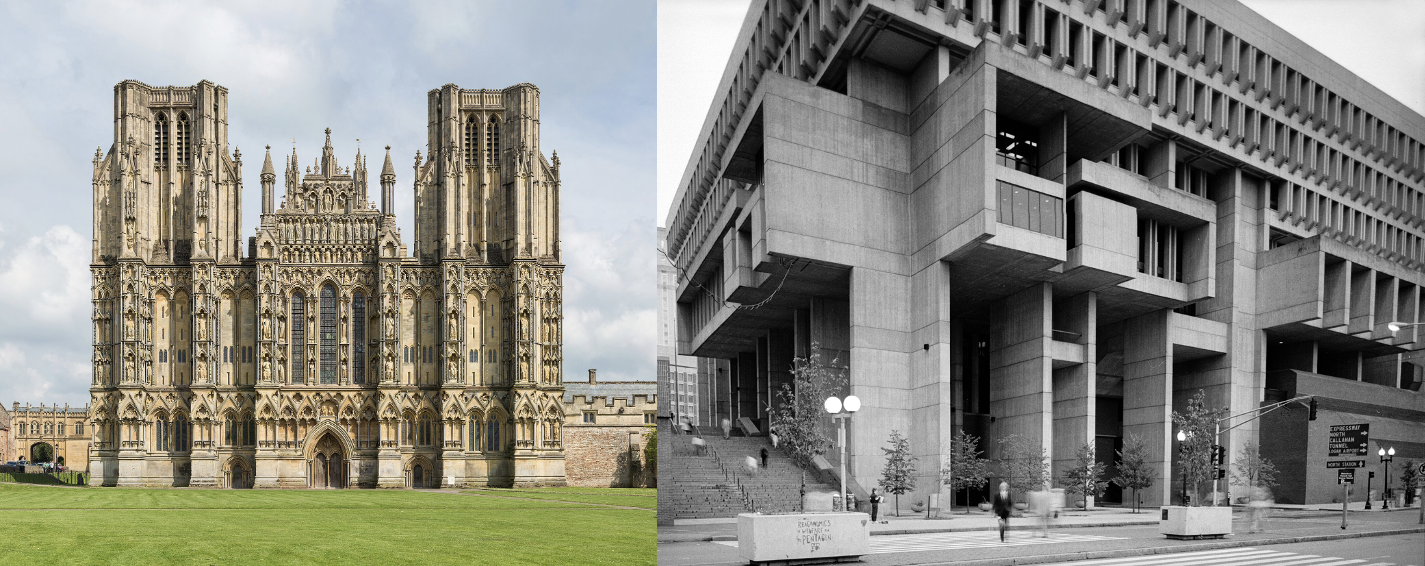
Left: Wells Cathedral. Right: Boston City Hall.
Kuhn:
If we doubt, as many do, that nonscientific fields make progress, that cannot be because individual schools make none. Rather, it must be because there are always competing schools, each of which questions the very foundation of the others.
[…]
These doubts about progress arise, however, in the sciences too. […] Those who rejected Newtonianism proclaimed that its reliance upon innate forces would return science to the Dark Ages. Those who opposed Lavoisier’s chemistry held that the rejection of chemical “principles” in favor of laboratory elements was the rejection of achieved chemical explanation by those who would take refuge in a mere name. A similar, though more moderately expressed, feeling seems to underlie the opposition of Einstein, Bohm, and others, to the dominant probabilistic interpretation of quantum mechanics. In short, it is only during periods of normal science that progress seems both obvious and assured.
With such fundamental disagreements during a scientific revolution, “why should progress also be the apparent universal concomitant of scientific revolutions?” Why weren’t the naysayers ever right and, like, Newtonianism actually did return science to the Dark Ages? To Kuhn, it’s purely because history is written by the victors; what are the victors going to say, that oops they screwed it all up?
Kuhn again:
Inevitably those remarks will suggest that the member of a mature scientific community is, like the typical character of Orwell’s 1984, the victim of a history rewritten by the powers that be. Furthermore, that suggestion is not altogether inappropriate. There are losses as well as gains in scientific revolutions, and scientists tend to be peculiarly blind to the former.3,[6] On the other hand, no explanation of progress through revolutions may stop at this point.
The explanation of progress continues with Kuhn’s belief about what_does_ allow for progress: the unique nature of a scientific community, grounded in Hellenic Greek-descended civilizations and begun in the European Scientific Revolution. This scientific community must work to characterize nature without regard for political or popular interference, acting as the sole judge of scientific worth and progress. This scientific community will evaluate new and old paradigm alike for suitability at resolving problems, maintaining metaphysical consistency, improving theory simplicity and prediction accuracy, etc.
But these considerations, are limited:
In the sciences there need not be progress of another sort. We may, to be more precise, have to relinquish the notion, explicit or implicit, that changes of paradigm carry scientists and those who learn from them closer and closer to the truth.
Rather than chasing capital-T Truth, scientific revolutions proceed via an evolutionary process: “The process described […] as the resolution of revolutions is the selection by conflict within the scientific community of the fittest way to practice future science.”
So science forever evolves from paradigm to paradigm, but never to anything. There will never be a pot of gold at the end of the rainbow.
Unfortunately this chain of reasoning is terrible, consider: “There are losses as well as gains in scientific revolutions, and scientists tend to be peculiarly blind to the former.” As I’ve mentioned above, to the extent scientists are “blind to the former” it’s because by the time scientists are learning about a revolution, the losses aren’t there anymore! Geocentric astronomy and phlogiston are by now strictly worse than heliocentric astronomy and oxygen; modern physics strictly supersedes classical physics. X-rays do come out of cathode ray tubes under certain conditions. So this is obviously progress. I have no idea what Kuhn thinks he’s saying here.
This needn’t necessarily refute Kuhn’s belief about the irrelevance of Truth to the scientific endeavor. I hope to convince you though that science can reach Truth.
V. Towards a Better Philosophy of Science
Without further ado let me just say I think I have the core of philosophy of science figured out:
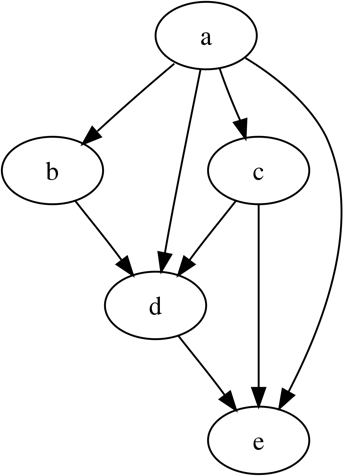
Science consists of representing as much of the world as possible in as few bits as possible. In practice, scientific knowledge is represented as a directed acyclic graph (DAG).
Let’s start with the second half of my definition: knowledge is organized like a DAG. A DAG is a graph in which you can’t generate a closed loop, for example:
The cleanest example of scientific knowledge being organized in this way is phylogenetic trees, (more generally, phylogenetic “networks” which account for things like horizontal gene transfer and which are explicitly defined as DAGs). A coarse-grained phylogenetic tree of life on Earth looks like this:
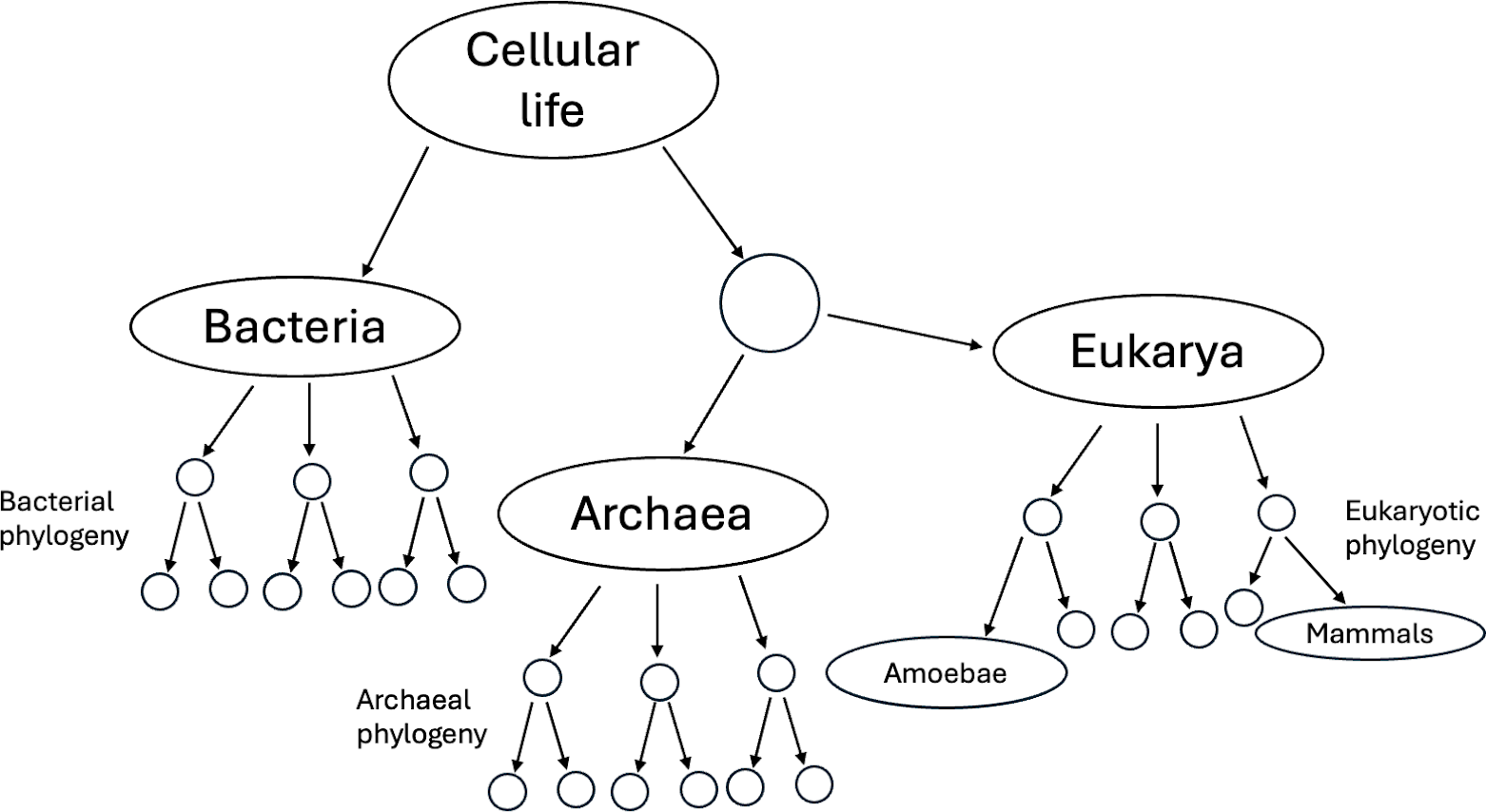
Here an arrow represents evolutionary descent and due to the process of evolution the overall graph contains enormous amounts of non-obvious information about genetics and the basic wiring of different organisms. Specifically, each non-leaf node contains properties that are true of most or all downstream nodes. Equivalently, something true of multiple nodes (e.g. mammals and amoebae) is very likely to also be true of all other nodes downstream of the first upstream node where the two nodes meet (e.g. Eukarya). An obvious example is the near-universal presence of membrane-bound organelles in Eukarya. A less obvious example is that archaea basically look like bacteria and were assumed to just be weird bacteria until the 1970s, but genetically and molecularly archaea are more like eukaryotes.
We can add more features that encode other pieces of information (I’ve grayed out all the old parts of this graph to make it easier to see what I added) and include the “theory of evolution” umbrella that allows us to draw conclusions based on a downstream phylogenetic tree:
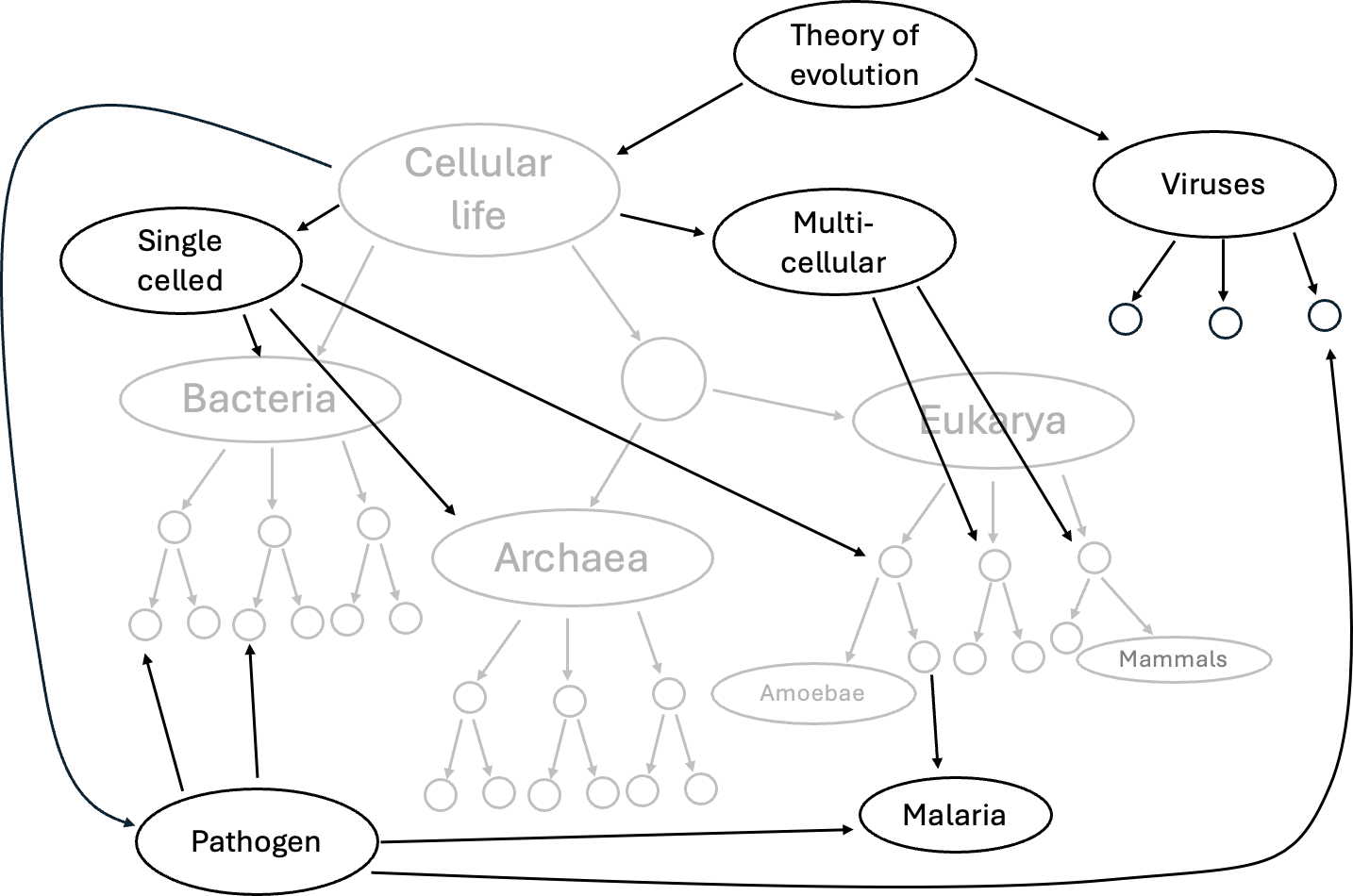
No longer atree, but still a DAG. Also note that we’ve generalized beyond evolutionary descent to other concepts. The graph is an abstract representation of the fact that each node encodes information applicable to multiple downstream nodes.
This means that the DAG is an efficient way of compressing facts about the world. Consider the following set of facts:
- Escherichia coli bacteria have ribosomes.
- Pseudomonas aeruginosa bacteria have ribosomes.
- Staphylococcus aureus bacteria have ribosomes.
…
1982420932. Haloquadratum walsbyi archaea have ribosomes.
…
298347239898. Plasmodium falciparum protozoans have ribosomes.
…
429837429817. Humans have ribosomes.
429837429818. Plasmodium falciparum protozoans have mitochondria.
…
519827391827. Humans have mitochondria.
519827391828. Jawless fish have a spinal column.
…
552938748392. Humans have a spinal column.
That’s a lot of facts! But we save a hell of a lot of bits if we just turn it into:
- Cellular life has ribosomes.
- Eukaryotes have mitochondria.
- Except Monocercomonoides flagellates don’t have mitochondria for some reason.
- Vertebrates have spinal columns.
So this takes us to the initial part of my definition about science: Science consists of representing as much of the world as possible in as few bits as possible. I will call this the Information Criterion (IC) below.
Gathering observations is an obvious way to do science as you find things about the world to describe. Examples of things in this category include Darwin’s voyage on the Beagle, the James Webb Space Telescope, and collecting samples of permafrost for analysis of Earth’s climate history.
The other primary scientific task is to compress existing data such that a comparatively small model can produce a large quantity of observations. For example, Keplerian elliptical orbits plus initial conditions of the planets predicts years’ worth of astronomical observation. Ptolemy’s geocentric astronomy could do the same, though slightly less accurately, and it required epicycles—extra information-carrying parameters hence more bits. Hence, Keplerian heliocentrism was a better theory than Ptolemaic geocentrism due to its increased simplicity. This is the first example of the IC being able to resolve what Kuhn would call a scientific revolution.
Newtonian physics provides a second example. By providing a unified explanation for both Kepler’s elliptical orbits and terrestrial physics, it allowed for even more compression: one model for two systems, instead of separate models for each.
To be fair, I’m being pretty handwavy. This is because science is notoriously difficult to formulate in a rigorous, unambiguously structured form. Kuhn takes this to mean that different paradigms are incommensurable even in principle. I take it to mean that any two theories or paradigms or whatever are commensurable in principle but not in practice, hence the frequency of reasonable scientists disagreeing.
There are also matters of taste where theories that are inferior today may still be preferred due to their elegance, which (particularly in physics) tends to pay dividends later. I think this is what Paul Dirac was getting at when he said “It is more important to have beauty in one’s equations than to have them fit experiment”; I like to think of Dirac as a VC investing in theories with no revenue but great growth potential.
At any rate, data-driven science can often be cast explicitly as data compression. For example, consider a set of measurements of properties X and Y (x__i_, y__i_) drawn from a standard normal random variable. Per Shannon’s source coding theorem, to store these observations we must use at least as many bits per datapoint as the entropy of the random variable from which the dataset is drawn. The entropy of a Gaussian distribution with standard deviation σ is ½ ln(2πeσ2) = 1.42 for σ2=1, so we must use twice that many bits per observation of (xi,yi), or 2.84.
But wait! After taking a sample, we observe that the joint distribution look like this:
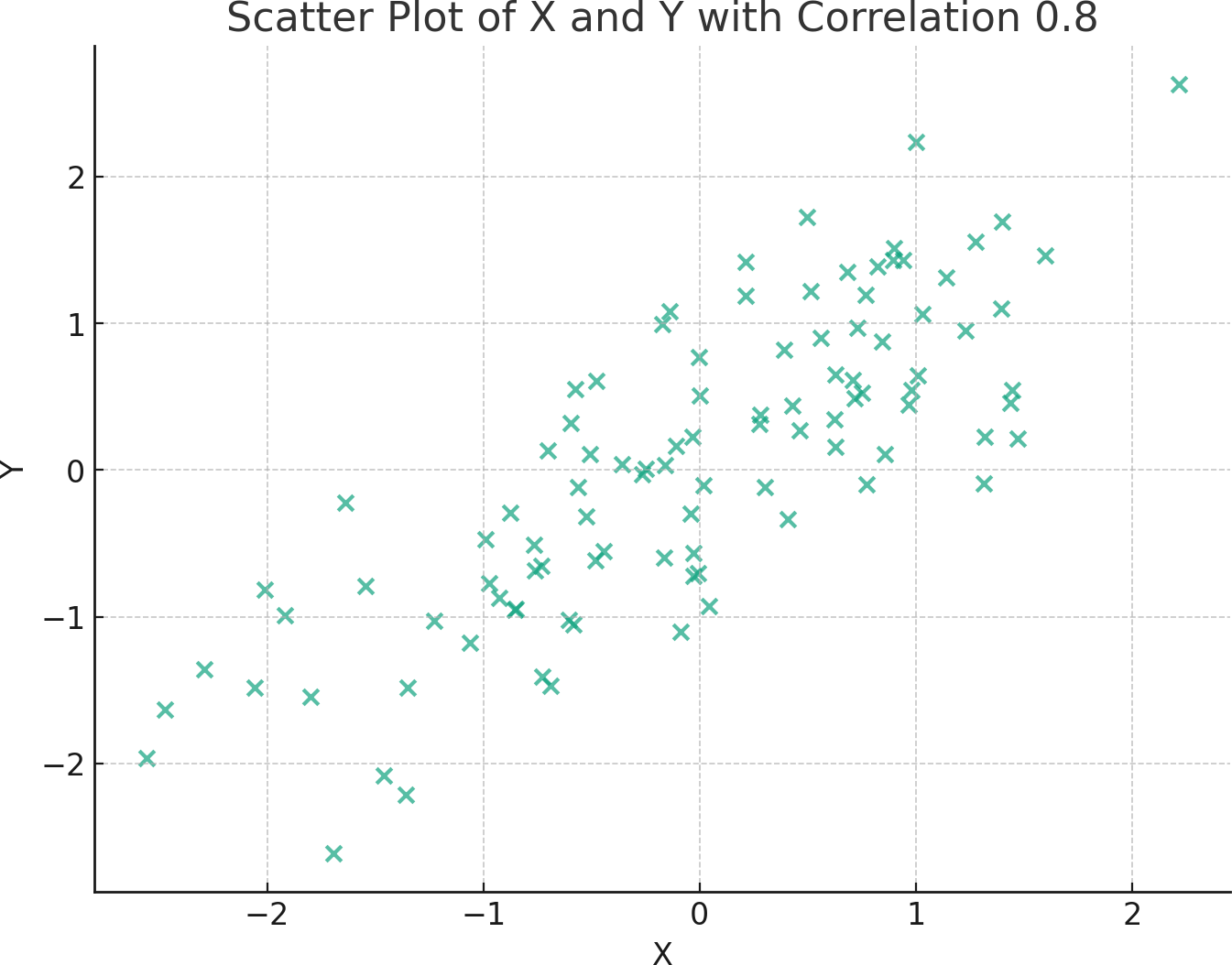
X and Y are correlated (specifically, the correlation coefficientρ is 0.8)! The conditional distribution of Y given X is normal with standard deviation σY|X2=1-ρ2 = 0.36. We can therefore specify X and Y with the usual 1.42 bits for X and ½ ln(2πeσ2) = 0.91 bits for Y for 2.33 bits total.
So by observing a correlation between two variables, we have compressed our description of the world by ~0.5 bits per (x,y) observation. We did science!
For space reasons I’m giving short shrift to two key distinctions of great interest to science: that between correlation and causation, and that between explaining and (falsifiably) predicting observations. I could go on about each one for an overly long time but for now, analysis of each is an exercise left to the reader.
VI. Bringing it back home to Structure
I think my formulation of science clarifies what Kuhn is talking about. Basically, a scientific revolution as he defines it in Structure is one that affects a maximally upstream node while normal science consists of changing nodes lower down. Here are some examples discussed by Kuhn plus the last two are my own:
- The Copernican revolution describes the basic geometry of the universe which could not be derived from any non-religious considerations.
- Each shift into a different aspect of modern physics (special relativity, general relativity, quantum mechanics) introduced concepts without precedent.
- Ditto Lavoisier’s oxygen theory and Dalton’s atomic theory because at the time, there was no quantum mechanics-based grounding of chemistry.
- Newtonian gravity was fully distinct from the existing grounding of all physical theories at the time (corpuscles).
- Evolution by natural selection put a new node on top of all of biology by describing how it all came to be.
- The rejection of vitalism added upstream chemistry and physics nodes to biology for the first time.
This maps neatly onto his idea of scientific “Revolutions as Changes in Worldview” to quote one of his chapter titles. After all, if the discovery you make falls under the umbrella of x, for any x and for whatever reasonable definition of “umbrella,” you are not changing your worldview or your opinion of what fundamental objects populate the world. If a discovery is an upstream node, you have plausibly discovered a new kind of thing in the world or a new kind of way the world works. This also explains why his ideas don’t really apply to modern biology and chemistry: both are grounded in physics by now.[7] Even for physics, it’s not clear to me that there are scientific revolutions left to be had besides unifying gravity and the Standard Model. It could be argued I’m being overly reductionist here, reasonable people can disagree and it doesn’t change my overall point.
Anyway, let’s see how Kuhn’s ideas map onto the DAG model of science using the shift from Newtonian gravity to general relativity. Newtonian gravity at various times explained some things but did not explain others. Anomalies are represented in red:
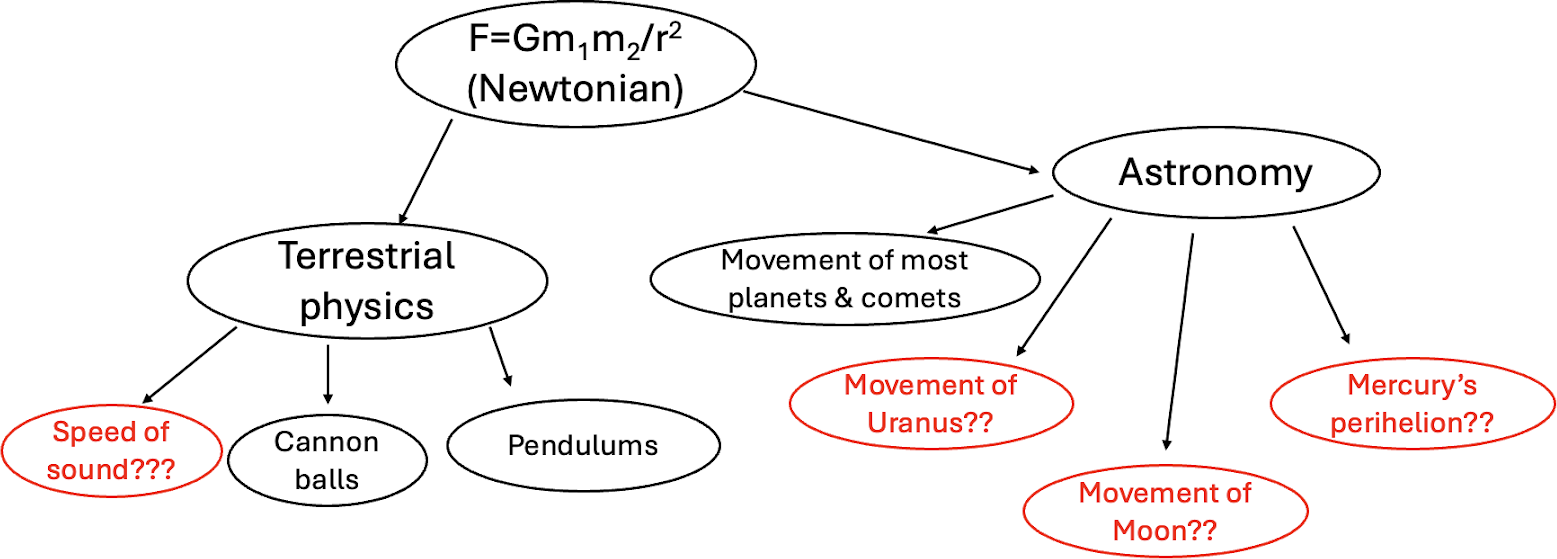
Newtonian gravity. Red circles are observations that at one time or another were not explained well by Newtonian physics.
Following what Kuhn would call puzzle-solving, the speed of sound, movement of Uranus, and movement of the Moon were all resolved within Newtonian gravity. Mercury’s perihelion was not worked out though:
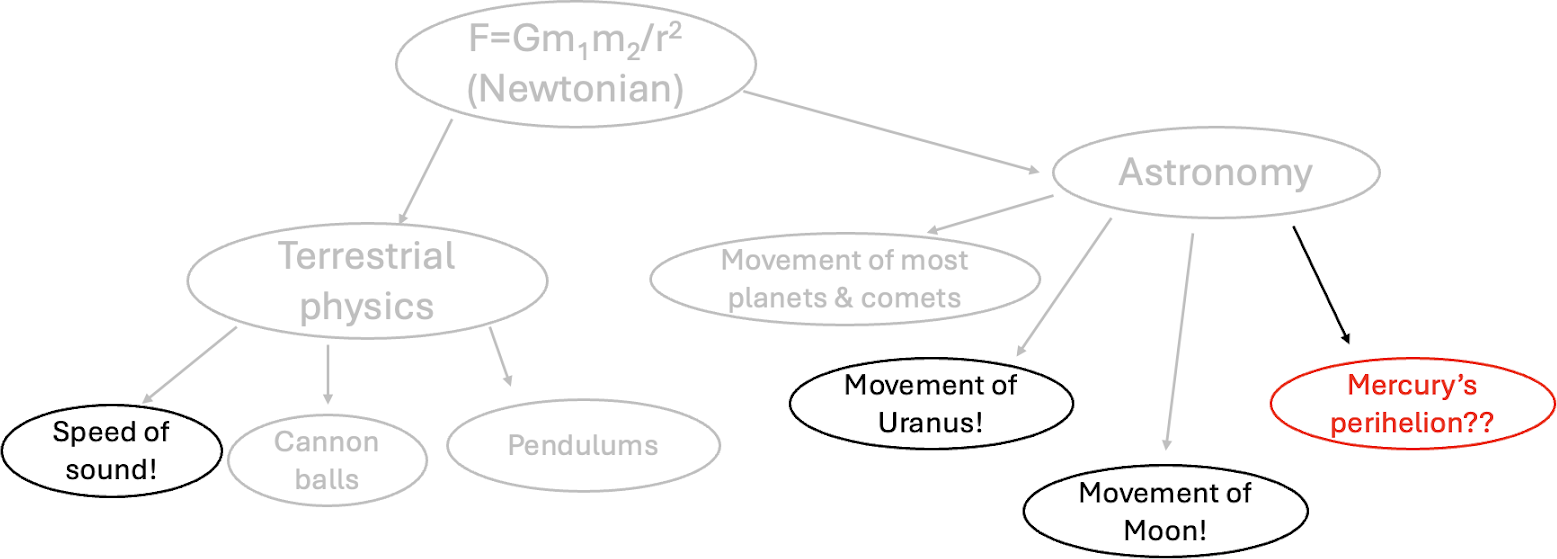
It took general relativity to explain Mercury’s perihelion and more importantly to predict the gravitational light bending observed in the Eddington experiment:
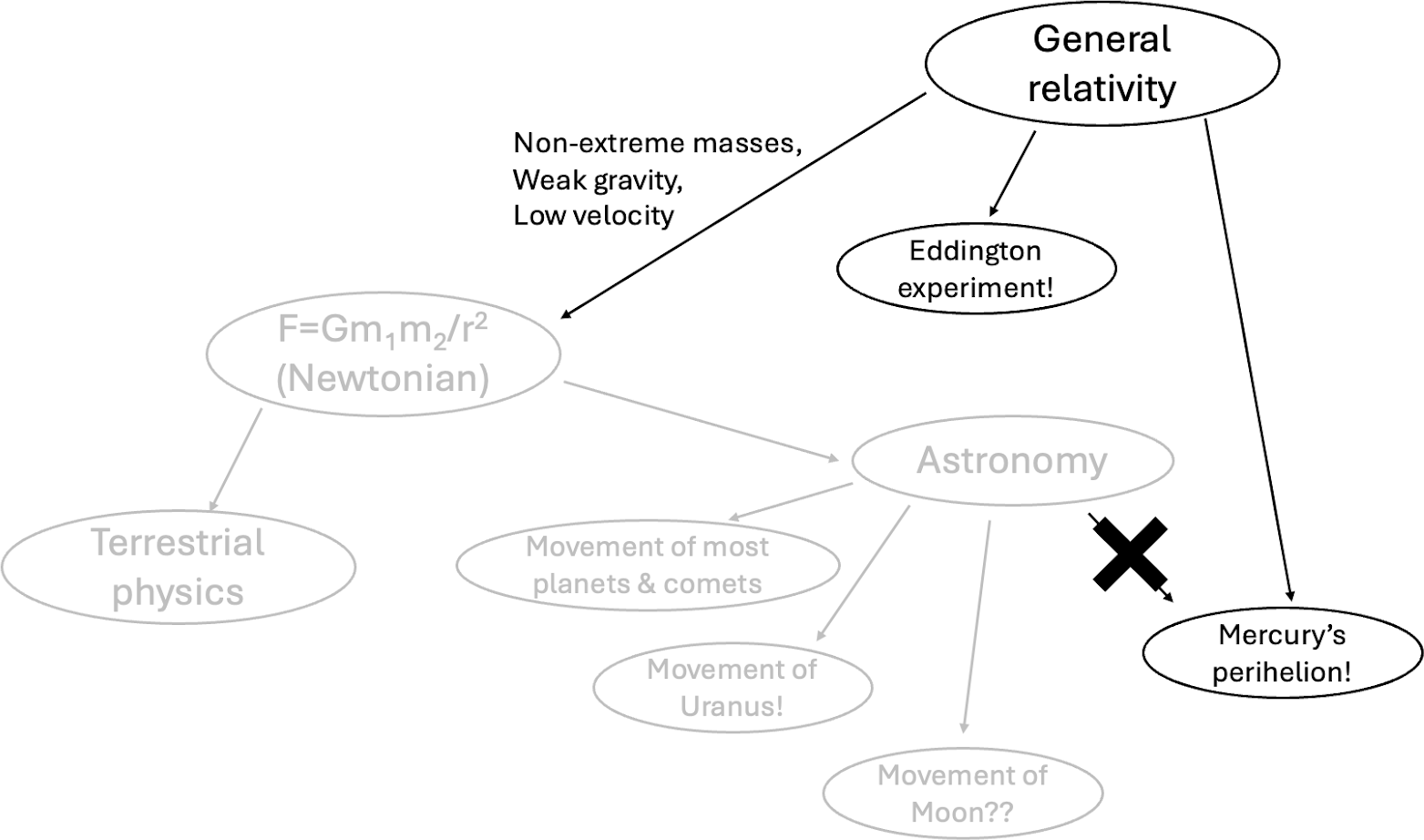
Theory of gravity following the general relativity revolution. An upstream node has been added.
A node has been added to the top of the heap! That’s a scientific revolution.
So throw away the gestalt shift psychobabble and I don’t totally disagree with Kuhn. I even considered naming this section “How I learned to stop worrying and love Thomas Kuhn.” But he still doesn’t get it quite right because he incorrectly binarizes a multilevel system into “scientific revolutions” and “normal science.”
Remember when I said “Normal science takes the paradigm for granted and aims to use the paradigm to solve specific problems within a field”? That was my paraphrasing of Structure. My description would be “Scientists solve problems in such a way to minimally disturb the DAG of scientific knowledge.” This is easily confused for Kuhn’s description but it’s different.
To show what I mean let’s look at a few examples.
Suppose you are a chemist and the only nucleophilic substitution reactions (where a “leaving group” gets kicked off a molecule and a different chemical group comes in) that have been discovered yet are SN2 reactions. A lot is known about nucleophilic substitutions: they show second order kinetics, they work best with a central carbon that is sterically unhindered (this basically means they’re mostly bound to hydrogens), and they always reverse the chirality of the molecule.
Then you discover that tert-butyl bromide can react with water to form tert-butanol. This is crazy, tert-butyl bromide is incredibly sterically hindered. Furthermore the reaction kinetics are first, not second order. Testing with some other compounds shows that nucleophilic substation with sterically hindered molecules randomizes chirality as opposed to flipping it.
There are many possible explanations for these observations. Here’s a vague sketch of the knowledge graph at play:
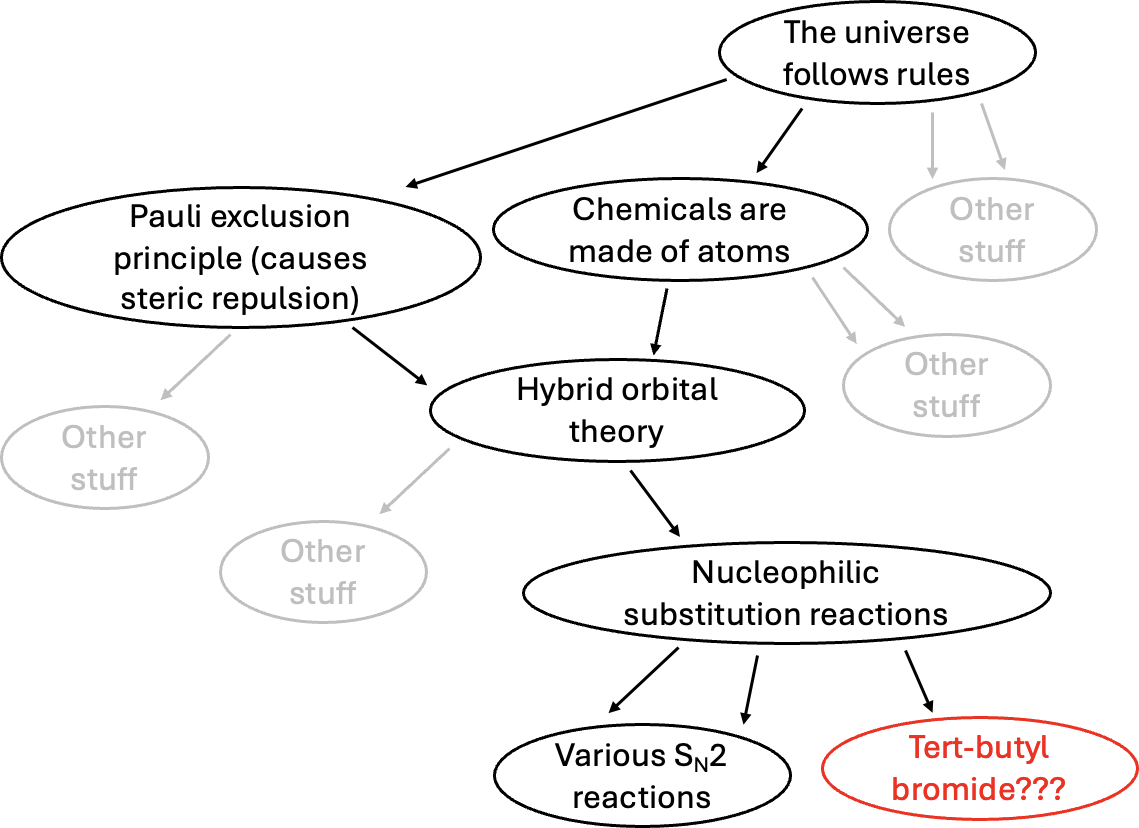
Something is wrong, and it’s probably not “chemicals are made of atoms”.
There are all kinds of reasons why tert-butyl bromide might behave oddly. Maybe the Pauli exclusion principle isn’t true so steric repulsion isn’t present. Maybe chemicals aren’t made of atoms. Maybe there’s another kind of nucleophilic substitution reaction.
Framed as a DAG it is clear which explanation is preferred: the one lowest down in the hierarchy. Nodes higher up like the Pauli exclusion principle and the atomic theory of chemistry explain a broad variety of things and modifying them threatens to destroy explanatory power in other domains, the grayed out “other stuff.” But adding a different kind of nucleophilic substitution reaction? Sure, why not! Eventually by looking at enough reactions, you hypothesize another kind of nucleophilic substitution reaction: SN1.
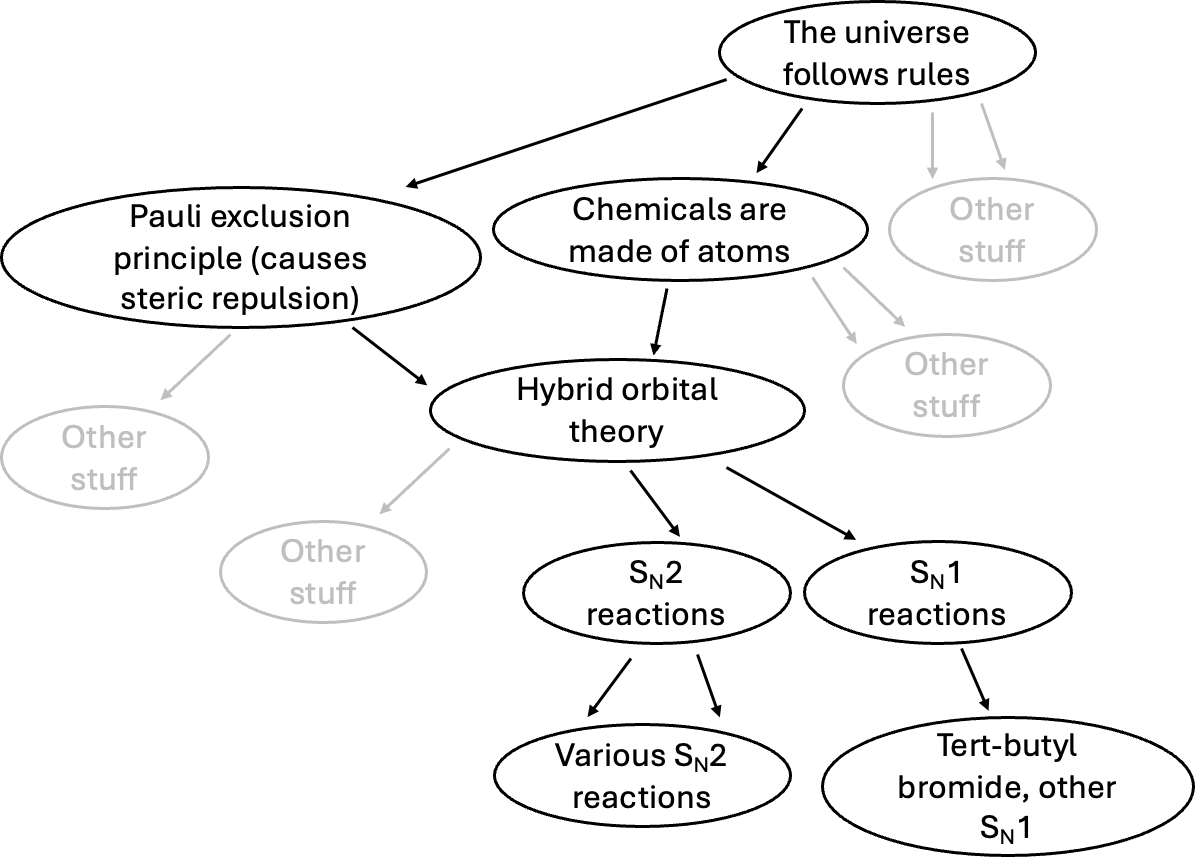
Now we’re talking!
Was the discovery of SN1 reactions normal science or a minor scientific revolution a la X-rays? Arguably yes: the study of nucleophilic substitution will never be the same. You’ve probably discovered in the process a whole new category of electron delocalization called “hyperconjugation” that frankly sounds dumb the first time you hear it (at least it sounded dumb to me) and would even modify something upstream of SN1 reactions. The concept of SN1 reactions is itself not a leaf node. But just as arguably no, it’s totally normal and non-revolutionary for new reaction mechanisms to get discovered and there remain nodes upstream of SN1.
More generally, where does normal science stop and a “scientific revolution” begin? Would you have to make a major modification to hybrid orbital theory? The Pauli exclusion principle? The idea that chemicals are made of indivisible atoms (consider the discovery of radioactivity for example)? Framed in this way it’s obvious that the question is silly. There aren’t two separate ways to do science, there is a sliding scale of “how far up the DAG do you have to go to answer a question.” The higher up you go, the bigger the implied alteration in the relevant field, the more you have to account for all the other stuff that the node affects, and the more evidence you require to prove the change is necessary. Your hypotheses will start to resemble what Kuhn calls a scientific revolution. But what Kuhn has identified is a sliding scale, not a binary.
Similar examples abound. Take RNA, for a long time believed to be a passive carrier of information like DNA while proteins do all the chemistry inside cells. Intensive research into ribosomes revealed that counter to all expectation, it is not proteins that catalyze peptide bond formation to synthesize more proteins; it’s RNA. This has revealed a whole new vista of RNA that does things: hammerhead ribozymes, self-splicing RNAs, microRNAs, snoRNAs, CRISPR guide RNAs, lncRNAs, etc. That’s a big deal! But was the discovery of functional noncoding RNAs different in kind from research into protein structure and function, and hence a revolution, or was it just a subset of finding out what different biomolecules do? Again, not a useful question.
VII. What does our new model of science tell us?
We’re now armed with the new IC/DAG theory of science. Let’s use it.
One minor point is that the IC resolves Kuhn’s question about what distinguishes science from other human endeavors like art. Boston City Hall is simpler than Wells Cathedral but it’s obviously not objectively better-looking. Technology can be distinguished from science by the different goals, as technology aims to accomplish a task regardless of how complicated the solution is—simplicity is usually desirable but is only one virtue among others.
Another stray observation we can make is about string theory, about which there is some debate whether it is really science since it doesn’t make falsifiable predictions (at least, not without a particle collider that is the size of the universe or something). Under the compression model of science we can make a clear ruling: if it provides a simpler description of the cosmos from which both gravity and the Standard Model naturally fall out, then string theory is science.[8] It’s also obviously a potential scientific revolution in (my interpretation of) the Kuhnian sense since there’s obviously nothing upstream of it. In fact if you’re a reductionist it’s maybe the last scientific revolution or next-to-last if you count M theory as a different thing. I’m going to stop talking about this now before I push my luck and say something deeply stupid about string/M theory.
Relatedly, another point is the end goal of science. Kuhn doesn’t think there is an end, because he views science as moving from not to, i.e. scientific revolutions can just continue indefinitely without converging on “the truth.” The IC potentially disagrees: somewhere within the infinite universe of theories could be one that describes the universe at a global minimum of information within theory space. This is, contra Kuhn’s denial of science ever approaching the truth, the capital-T True description of the world.
Two minor points here that I can at least sketch out. Could there be multiple global minima? In principle sure, in which case I’d have to bite the bullet and admit there are multiple True descriptions of the world. Could there be no global minima at all? It’s theoretically possible, but you can at least get arbitrarily close to a global minimum, see footnote if you’re inclined toward seeing a proof sketch.[9]
To be clear, if there is a single global minimum, that doesn’t mean we will ever get there. But that’s true of the Andromeda Galaxy too; doesn’t mean it doesn’t exist, or that it’s not a worthwhile goal to try to reach it.
Lastly, the IC resolves the question of underdetermination, that is, given any set of observations O there are many theories that can explain those observations so we cannot say which one is correct. But we can! It’s the theory that explains the observations with the fewest bits.[10]
To conclude, where do I land on The Structure of Scientific Revolutions? I’m glad I read it, I can see why it was a sensation when it was published, and it was very thought-provoking. If you found this review at all interesting, I think you will also find Structure to be worth your time.
I just don’t think you’ll find it to be correct.
Footnotes
- ↩
Phlogiston is basically negative oxygen. Per the theory, flammable materials have phlogiston that is released into the air during combustion, but air can only absorb a limited amount of it, so once air is saturated with phlogiston (we would say: once the air runs out of oxygen), combustion stops.
- ↩
All biology examples throughout are mine. As I’ve hinted at Kuhn doesn’t touch biology so I’m trying to be a little more balanced. The mutation theory of cancer is that cancer is caused by mutations that inactivate one or more “tumor suppressor” genes that limit abnormal cell growth (p53 and BRCA1 being famous examples) and hyperactivate one or more “proto-oncogenes” that drive cell division (KRAS, etc.), cells can grow out of control into a tumor. Mutations aren’t the full full story as other things like epigenetic disruption can drive cancer but mutations explain a hell of a lot.
- ↩
I’m not the first to point out that naive Poppperism has the issue that an experiment (almost) never falsifies one specific theory but rather a constellation of overlapping theories. See the Duhem-Quine thesis (I’d recommend Duhem personally since I can’t make heads or tails of Quine).
- ↩
This makes the corpuscular theory sound insane but per Kuhn it made sense at the time and Newton’s laws of motion were inspired heavily by the corpuscular paradigm.
- ↩
Same idea for the oxygen theory, which in contrast to phlogiston was initially less able to explain hydrogen combustion and features of carbon monoxide.
- ↩
Kuhn takes a pretty clean shot at people like me in his own footnote 3 here: “Historians of science often encounter this blindness in a particularly striking form. The group of students who come to them from the sciences is very often the most rewarding group they teach. But it is also usually the most frustrating at the start. Because science students “know the right answers,” it is particularly difficult to make them analyze an older science in its own terms.” It me.
- ↩
I could maybe be convinced there are two biological revolutions to be had: 1) understanding of consciousness, and 2) dissipation-driven adaptation as a generalization of the concept of life. But while admittedly only familiar with the broad strokes of the latter theory, I lean strongly toward putting it in the “incredibly cool but not exactly a change in worldview” category. Biophysicists have long thought of life in thermodynamic terms.
- ↩
I don’t want to get bogged down as I’m way out of depth here, but my understanding is string theory has another issue, the “string theory landscape” whereby there are > 10^500 possible sets of fundamental string theory parameters and we sort of randomly (??) ended up with one of them which is kind of unsatisfying and seems to present issues re the IC. Here I just want to point out that the unfalsifiability need not be damning.
- ↩
Consider the function f:TO→ℝ where TO is the space of theories that explain a set of observations O and f(tO) is the information required to specify theory tO (I’m including information required to specify initial conditions and correction factors within tO). Now let O be the whole universe U so our space is TU. Since information required to explain the universe is bounded below by zero, there exists a greatest lower bound (infimum) IUmin. If TU is compact and fU is continuous then fU must reach its infimum for at least one theory tUmin (i.e. f(tUmin) = IUmin) which is the true description of the universe. More generally, if these conditions don’t hold, we can still get arbitrarily close to IUmin, that is for any ε>0 there exists a theory tUε such that f(tUε) < IUmin+ε.
- ↩
Or in the parlance of the previous endnote, it’s the theory tOmin.