Content warning: Sexual and relationship practices from a thousand years ago, from a time and place with a very different morality than what you probably subscribe to.
The past is an alien civilisation
Around the year 1000, the Imperial Court of Japan in Kyoto was a world of opulence, aesthetics, and ambition. Isolated from the lives of regular commoners, every aspect of the lives of the elite were governed by complex etiquette rules, and relationships were thoroughly intertwined with politics and the ambition for power and wealth. High-ranking women and men lived lives so separate that they might have a passionate love affair without properly seeing each other’s faces.
It was in this world that Murasaki Shikibu, an intelligent and educated lady in Empress Shōshi’s court, wrote The Tale of Genji, which is widely considered to be the world’s oldest novel. It is an extraordinary masterpiece and a highly questionable soap opera, and I’ve never read anything like it.
Royall Tyler (2001) begins the introduction to his translation of Genji like this:
The Tale of Genji was written a thousand years ago in Japan, but anyone can read it today. The notes are useful but not required. So great a classic, written in an ancient language about a vanished world, has been studied intensively, but its characters’ thoughts and feelings remain as fresh as ever.
I disagree with Tyler, hard. The footnotes are critically important if you want to understand a world so completely different from the one we live in, and the characters generally behave, think, and feel in ways that are so outdated as to be completely unrelatable. In this review, I will walk you through my experience of reading Genji and learning about its world, so that you can judge for yourself whether Tyler is right and anyone can read it today.
Who is Genji?
The Tale of Genji tells the fictional tale of Genji, the son of the Emperor and one of his low-ranking concubines, throughout his life. A few things to know about Genji:
- He is incredibly beautiful. Men and women weep at the sight of him.
- He is magnificent. Monks and nuns weep when he leaves, distraught that someone like him has to live in this wretched world.
- He is better than others at nearly every skill that marks a sophisticated and educated man, such as composing poetry, calligraphy, playing music, singing, dancing, painting, and knowledge of Chinese literature. When he demonstrates these skills, everyone weeps.
- He dresses and behaves immaculately. Pretty sure someone weeps about that, too.
- He falls in love a lot, and is known for his numerous romantic conquests.
- He doesn’t have the official title of Prince, nor is he in the line of succession to become Emperor, and he has to work hard to advance his political career in the Court.
- But most of the story focuses on him longing after and pursuing various women, whether it’s a good idea or not, and often it’s not. Usually all involved parties weep.
- He often thinks about resigning his worldly life and becoming a monk, but, unfortunately, he has so many worldly attachments that it would be pretty difficult.
I will gladly admit I fail to relate to Genji and his struggles. The narrator and the other characters try to convince the reader of Genji’s absolute magnificence, while Genji himself is busy doing the opposite. Please enjoy the following reconstruction of my early days of reading Genji, as I kept interrupting whatever my partner was doing to tell them what Genji is up to:
“God, this book. Okay, so… the Emperor had a favourite… concubine, I guess? And he had a child with the concubine, and that child is Genji, but his mother died because… all the other women in the Emperor’s court were jealous and mean to her? Anyway, the Emperor took a new wife because she looks like Genji’s mother, and she is SIXTEEN. Genji is, what, twelve? And the Emperor wants the two of them to spend a lot of time together so that she can become a new mother to Genji. At sixteen. A mother to a twelve-year-old.”
.
.
.
“Welp, now Genji has fallen in love with his stepmother. His dad is just happy that he managed to find a new mother for him.”
.
.
.
“What!! You won’t believe this. Genji is hanging out on a mountain and comes across a house, and sneaks around peeping through holes in the walls and sees a lovely 10-year-old girl who reminds him of his stepmother. Then he finds out the girl actually is the niece of his stepmother, so of course now he wants to have her. He is 18. And he is imagining how great it would be to raise the child himself, so he could be sure to shape her into ‘the perfect woman’.”
.
.
.
“Oh good, the girl’s guardians think she’s a bit too young to go live with Genji, so he has to go back to Kyoto alone.”
.
.
.
“Aaand he just got his stepmother pregnant.”
.
.
.
“Aaand he went back and kidnapped the girl.”
It’s hard to imagine a world in which a female author writes about an idealised male character, and the male character is… this. But I’d also argue there are few historical human cultures more alien to a contemporary observer than the Heian-era Imperial Court, and you can’t understand Genji the novel or Genji the man without understanding how the culture was organised and what mattered within it.
And just to be clear, the story wasn’t just one writer’s insane fever dream; Genji was written as a serialised story that reflected a lot of the Imperial Court’s realities, and it was highly popular since its beginning. It’s likely that Murasaki Shikibu got her position in court to serve Empress Shōshi because she was a talented writer, and possibly specifically because her initial chapters of Genji were already popular. There are accounts of the story being read to Emperor Ichijō himself, who praised the author. Murasaki Shikibu complains in her diary that some unfinished chapters have been stolen from her chambers by overeager readers. It would be anachronistic but fitting to consider Genji an immediate bestseller.
Interestingly, as alien as this part of human history is, it’s relatively well understood. There are several surviving texts from the same time period by different authors explaining life in the Imperial Court, including The Tale of Genji and its author’s personal diary, and most translations of Genji contain a sizable section explaining the historical and cultural context in which the story was originally written and read. In the following sections, I will introduce a few key characteristics of the culture of the Imperial Court, which are commonly discussed as historical context to Genji, and about which there is significant scholarly consensus.
Aesthetics is everything
It’s impossible to overstate how important beauty and aesthetics in all their forms were in the world of Murasaki Shikibu. The Imperial Court was a highly isolated world where the elite lived in luxury and without having to worry about the struggles of normal people. Everyone lived and breathed arts in all their forms, and an individual’s aesthetic accomplishments played a huge part in their standing in society. In this world, it was almost a requirement to be beautiful. In fact, Genji is so beautiful from the moment he is born, that it is evident to everyone that he is destined for greatness. It seems aesthetics and morality went hand in hand, and for someone to be beautiful and produce beauty in the world is the same as them being a magnificent person. If a character is described as being physically unattractive, they are usually also deficient in other ways, such as being slow-witted, having clunky handwriting, writing unimaginative poems, or being unaware of proper etiquette.
And just like today, there were trends and fashions, and it was important to keep up with them. Not only were there strict expectations of what kinds of garments, colours, and patterns were appropriate for which person, occasion, and season, but those things kept changing, and it would have been embarrassing to be seen as unfashionable or outdated.
Of course, what’s considered beautiful is culturally determined, and some of their preferences were pretty unique. This is the time and place in human history when women blackened their teeth to be extra attractive, and also their eyebrows were plucked completely and drawn back on higher on the forehead. It was such a normal thing at the time that even though Genji contains ample description of women’s looks, black teeth are mentioned only twice. And of these two occasions, one of them is in the context of a girl whose grandmother was so old-fashioned that the girl’s teeth had not been blackened yet, and the other one is in reference to a six-year-old boy with tooth decay that made his teeth darker, which made the boy’s mother think about how beautiful he would be as a girl.
Hierarchy is also everything
The Imperial Court and its world was a place of extreme hierarchy. There was a highly complex rank system among the officials, and one’s standing was determined by factors such as birth and background, wealth, level of education and accomplishment, whether one had powerful supporters, and whether one was able to play their political cards right. Interestingly, the emperor himself held practically no power over what happened in Japan, and most of the high-ranking positions were also entirely ceremonial. Most of the actual power was wielded by powerful families like the Fujiwara, who were wealthy and solidified their position by supplying the Imperial family with wives and empresses over several generations. A Fujiwara man could not become an emperor, but he could become the father or grandfather of one, and many did. Meanwhile, Genji contains stories of emperors being unable to prevent their politically powerful wives from mistreating each other, including Genji’s mother, who is effectively bullied to death by his other wives and concubines.
Naturally, the higher in the hierarchy you are, the more people you have around you, taking care of everything you might need. When Genji travels, he has a huge procession of men with him, who make sure the road is clear, deliver messages on his behalf, and generally make themselves available for whatever he might need, day and night. However, if he chooses to travel in utmost secrecy, he might only bring four or five trusted men with him. Messages were often delivered by other people even if the sender and the recipient were currently in the same house. Aristocratic women would likewise always be surrounded by other women, both companions and servants, who don’t play a huge part in the story overall, except when a woman’s companion might be persuaded to help a man deliver a message to her mistress or convince her to meet him.
The hierarchy is everywhere in the story, including the language. The classical Japanese which was spoken at the time had a complex grammatical system that allowed for the precise communication of the relative statuses of everyone involved, which is largely lost in translation. Often it’s not obvious why something was offensive or that someone is trying to overstate their status, and sometimes the translator has to figure out who is talking to whom and about whom based on the politeness forms they are using in their speech. A lot of the time, characters behave in ways that can be difficult to understand without knowing their precise social standing. Why can that person not marry that other person? Why is that child given to this other woman to raise? Why is this man offended that this other man doesn’t want to marry his daughter? Why are these people upset? Why is everyone weeping?
Everything is fleeting and life is full of sorrow
There is a melancholy that permeates The Tale of Genji, which can be traced to the concept of mono no aware, or the sensitivity towards the fact that everything is transient and there is a sad beauty found in impermanence. This concept is still alive in present-day Japan, where cherry blossoms are viewed with the bittersweet knowledge that their beauty lasts only for a short while.
In Genji, nobody seems happy or even content, even as they live in relative luxury and privilege. A significant share of communication between lovers is lamenting how they must soon part, how much they will miss each other, and how the other person will probably forget them. Life seems to be continuous existential suffering, and many people dream of becoming a monk or a nun and devoting the rest of their lives to the service of Buddha, hoping for salvation after death.
In their world, spirits are a natural part of life, and there are complicated beliefs around what rituals and behaviours must be observed to be safe from evil spirits and the wrath of gods. Sometimes a person’s spirit can wander around doing bad things even while the person is alive and well, and without them being aware of what their spirit is up to. When a person is about to die, or has died, various rituals will help prevent them from becoming an evil spirit, and some particularly qualified monks might be summoned to conduct the rites if the dead person was important. To avoid untimely death or other dangers, people should be especially careful during yakudoshi or “years of trouble” which for women were the 19th, 33rd and 37th years of her life, and for a man his 25th, 42nd and 61st years.
A life behind screens
Another unusual feature of the world of the Heian Imperial Court was their nearly complete gender segregation. It was not proper for an aristocratic woman’s face to be seen by a man unless he was a lover or a close family member. Her face should be hidden even from her brothers once they reach puberty. In practice, she would spend most of her life either indoors or in private gardens, and if she left, even to visit a family member a few houses over, she would travel in a closed carriage with only narrow slits through which she could observe the world. Naturally, she would stuff her voluminous, multi-layered sleeves through those slits to communicate to the outside world that she is elegant, rich, and has an impeccable fashion sense.
And it wasn’t just her face that she had to guard. If a man paid a woman a visit, for example to pay his respects to her after the death of her family member, he would be seated well away from her, outside or in a different room, and one of the lady’s female companions would act as an intermediary in the conversation, passing their messages back and forth. If the lady came so close that they would be able to discuss directly, with only a screen separating them, that showed very high familiarity, and might be risky for the lady’s reputation. There is even an example in Genji where a woman is given the responsibility to raise a 12-year-old boy she is unrelated to, and she apparently does this from behind screens; it’s mentioned that the boy is surprised when he "happens to see a glimpse of his guardian” and discovers she’s not very beautiful, unlike the other women he’s seen before. But, the boy thinks, it would be wonderful to find a woman as kind and gentle as she is. So apparently she was able to play a significant role in his upbringing, even as she had to hide from his view.
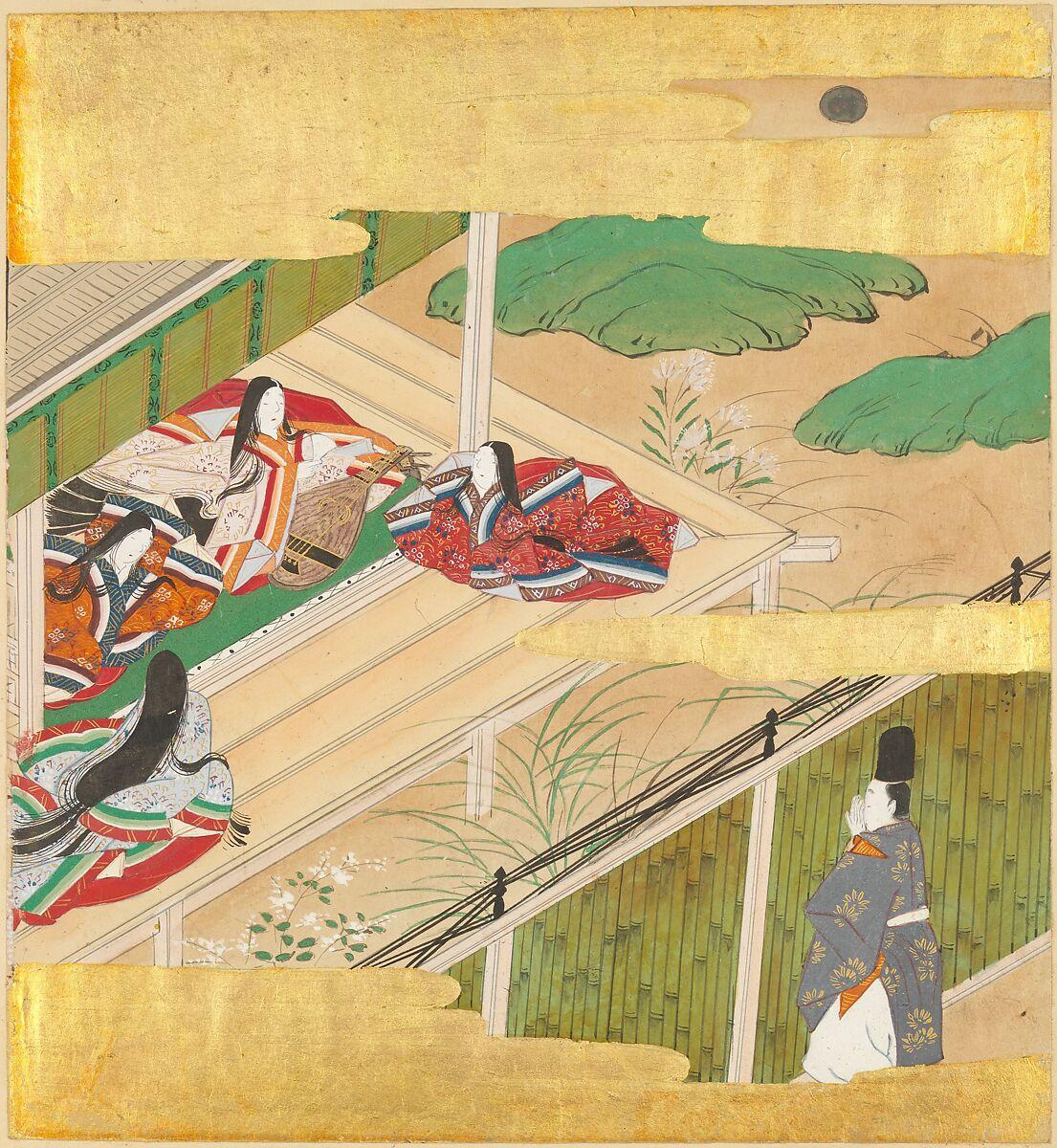
Heian women playing music on the veranda while a man peeps through the fence (Tosa Mitsusada, 1738-1806)
In the case that a man and a woman are having a secret relationship, he naturally has to sneak in at night, and he should take care to leave before sunrise. Such meetings would have been in complete or near-complete darkness, and it might take several meetings until the lovers would be able to see each other’s faces properly. Genji himself gets into a pickle by pursuing and spending nights with a lady who is quiet and bland, and when he finally sees her in daylight, she turns out to also be unattractive. Her nose, especially, is a disaster: unbelievably long, its tip drooping towards the floor, limp and red, like the trunk of an elephant. Our heart breaks for poor Genji for what he must endure.
In general, the hypocrisy of men was a constant, and it was seemingly impossible to correctly be a woman:
- A man doesn’t visit a lover for several years, and yet he expects her to remain faithful.
- A man might regularly force his way into women’s bedchambers, but will blame his lovers for letting other men do the same.
- A woman must have a pristine reputation, but if a man sends her an unsolicited love letter and she is not receptive to his advances, he accuses her of being cold and unfeeling.
- One man tells a woman she should come and talk to him directly through the screen, that it’s rude to have a servant mediate the discussion. When she does come closer and replies to him directly, he is shocked that she would reveal her voice to a man just like that.
- One man assaults a woman in her bedchamber, and gets into trouble for it later. He proceeds to blame her for not taking better care not to get assaulted.
If it seems the men in Genji are all cut from the same cloth, I initially also thought the female characters were quite boring and indistinguishable from one another. But when I was reading Norma Field’s The Splendor of Longing in the Tale of Genji (1987), which examines the story through the central female characters, I realised I hadn’t given them enough credit. The male characters seem to talk about most of the women in very similar ways, describing the beauty of each woman, how adorable and small and helpless she is, how long and shiny and black her hair is, how gentle her manner, how heart-wrenching her poetry, and they seem to generally prefer whichever woman they are currently with. But just because the men see the women that way, doesn’t mean that’s all they are. Thinking about it more, it’s clear that some of Genji’s women have way more agency than others, some are particularly skilled or educated, some are gentle and pliable while others are strong, some are helpless and others pragmatic. Some make ambitious political moves, some are bitter and vindictive because their ambitions failed. Some are jealous, some have no expectations. Some of them are passive in relationships, some actively pursue them, and others completely resist men’s advances.
A few concrete examples of women acting with agency in a world that mostly kept them hidden and passive:
- An empress seeks to solidify her son’s power by getting him married well, and works hard behind the scenes to secure a specific young lady as her son’s wife.
- A woman neglected by her lover sends her living spirit to possess his other lover and make her ill.
- A young woman goes into hiding from men who desire her, and chooses to become a nun so that she would be out of their reach. This was one of the few socially acceptable ways for a woman to avoid marriage or get out of an existing one, but often the woman needed her husband’s or a male relative’s permission to do so.
One could also consider women having agency in more indirect forms, such as working hard to learn skills that would help attract a desirable man or deciding which men’s advances to encourage and which ones to reject.
But how did affairs and romantic relationships even have a chance to begin, if women were always hiding? Let’s talk about…
Marriages and other forms of arrangement
Relationships of various kinds formed the fabric of life in the Imperial Court, and one of the most important relationships was the marriage. It was an incredibly powerful vehicle for solidifying relationships between families and gaining power and influence. It also enabled some degree of social mobility, especially for women who could marry up. It was common for women to continue living with their families even after marrying, and their husband would visit them. Aristocratic men could have multiple wives, though the wives’ relative status mattered a lot. If the man already had a wife from a powerful family (or if he was known to love and cherish one of his existing wives unusually much!), other families might be hesitant about him marrying one of their daughters, because he might neglect her and might not visit often. Pretty much all the marriages in Genji are arranged between families, with no reference to the personalities and preferences of the people getting married, or between the man wanting to marry and the family of the girl or woman.
However, the overall landscape of relationships was much more complicated. Relationships and affairs were generally considered private business, and were not policed very strictly. Short dalliances could become longer semi-formal relationships where the man provided for the woman and their children. Aristocratic households had female servants and companions who were by position expected to be sexually available to the men of the house, but these weren’t considered actual relationships and they didn’t threaten anyone’s power or position. The Heian aristocracy was sometimes surprisingly practical, and it was not impossible for a woman to leave a marriage she didn’t want to be in and even go on to marry someone else.
Here is a non-exhaustive list of reasons why the men in Genji fall in love:
- He hears a rumour that a woman is particularly beautiful.
- He hears a rumour that a man has brought up his daughter with particular care.
- He is sneaking about somewhere he shouldn’t be, and catches a glimpse of her exquisite hair, arm, face, or another enticing body part.
- He hears her play an instrument or sing beautifully.
- She has beautiful handwriting and is quick to compose sophisticated poems.
- He really wants a princess as one of his wives and she happens to be one.
- She reminds him of his mother/stepmother/sister/wife/former lover.
It’s harder to make a similar list for women, because in the story, most of the time women fall in love off-screen, somewhere in the process of courtship. Women do of course catch glimpses of men, and definitely know who is good-looking and refined and smells good, but they don’t start sending love letters without him initiating it. Courting, of course, was generally only relevant for relationships outside of marriage. Here’s a common approach, based on my impression after reading Genji:
- Man finds out about woman and falls in love for a reason such as the ones listed above.
- Optional: Man bribes the woman’s servants to give him access to her.
- He gets physically close to her and talks to her through a curtain or a screen.
- She says nothing at all, shocked and terrified.
- He keeps visiting and bombards her with letters.
- She has to reply to some of the letters so as not to be impolite and be considered emotionally cold.
- He gets more and more intrigued by her.
- Eventually he forces his way to her bedchamber and stays the night, sexual activity implied and consent dubious at best.
- Afterwards, she is horrified and disgusted.
- ???
- Somehow, relationship.
- If he stops coming, she is distraught and her tears are endless as she contemplates his coldness and unfaithfulness.
This is, of course, not what happens when Genji falls in love with and subsequently kidnaps the 10-year-old niece of his stepmother. Instead, he takes her to his own palace and gives her the western wing as living quarters. He brings most of her original caregivers along and provides for them as well. He spends a lot of time with her as a father would, entertaining her with pictures and stories and teaching her how to play musical instruments and compose poems, essentially providing her with a great education. He forcefully has sex with—and subsequently marries—her four years later, when she looks more mature and is “of marriageable age.” Interestingly, he properly marries her, observing the traditional rituals, before he even tells her father that he’s been hiding her. So while it surely doesn’t hurt that she comes from a powerful family, Genji is determined to marry her regardless of whether her father approves or not, which is not typically how marriages happen in the rest of the story. He subsequently considers her his principal wife, and he loves and cherishes her above all the other women he marries or has relationships with, until old age.
In case you were wondering how the hell he managed to get away with all this, the short answer is that it simply doesn’t seem to be a big deal to anyone else, and it tells us a lot that the author didn’t feel the need to explain or justify Genji’s behaviour to her audience. One interesting clue comes decades later from Genji’s half-brother, who is contemplating becoming a monk but also worried about who will take care of his then-13-year-old daughter. He wonders where he might find a trustworthy man who would cherish the girl and bring her up “like Genji brought up the daughter of the culture minister prince.” It seems what Genji did was broadly considered completely fine, even virtuous. In fact, the girl is seen as the main heroine rather than a tragic victim, and her nickname in the story, Murasaki, later became the pen name of the author herself (who, unlike the character, married only in her mid-to-late twenties).
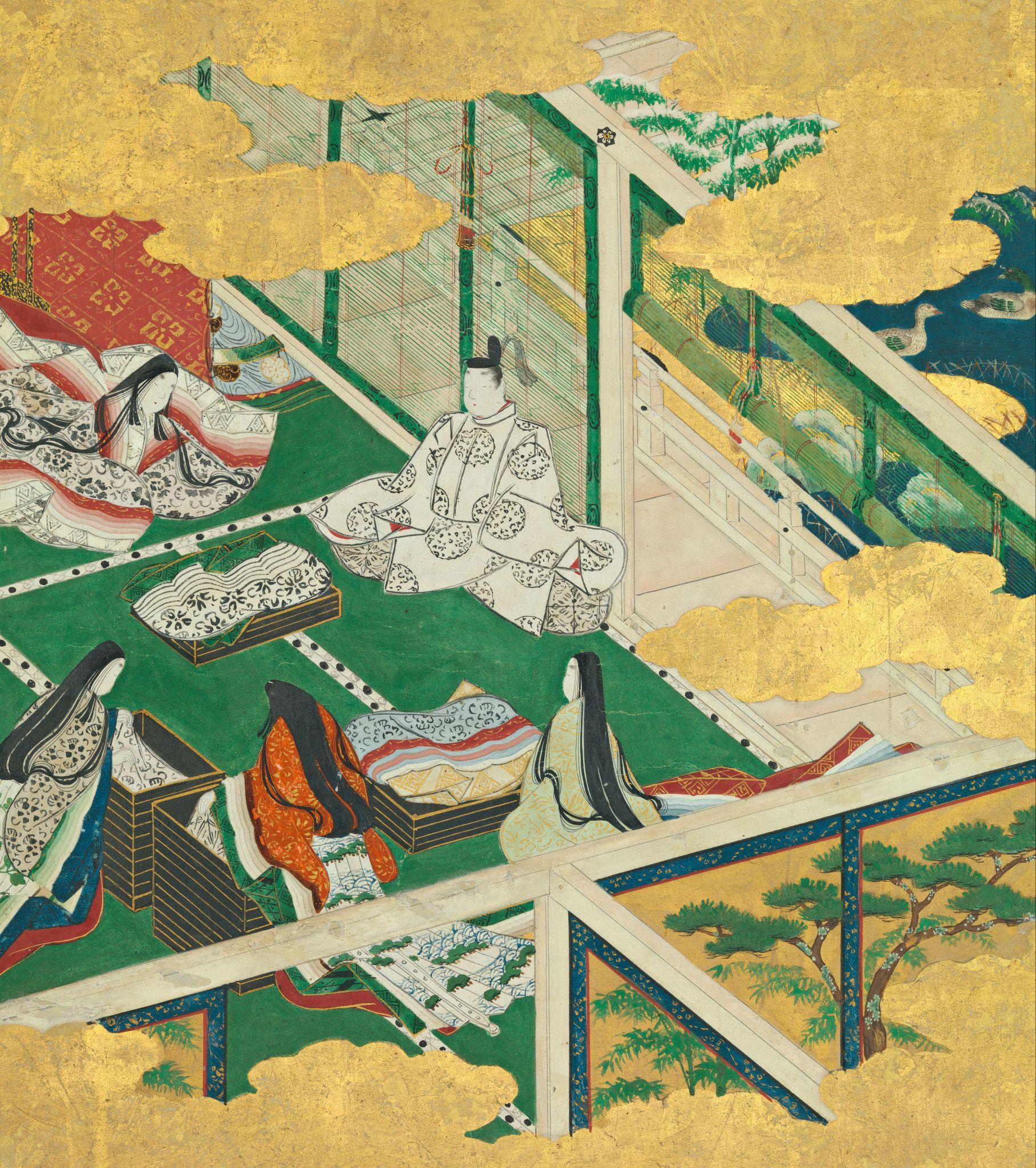
Genji and Murasaki together, selecting clothing to be sent as New Year’s gifts to all the ladies in Genji’s household, which the servant women are packing up for delivery. Murasaki is in charge of maintaining the household’s clothing storage, and she is uncommonly skilled at dyeing fabrics in vibrant colours. Genji thinks he couldn’t have found a better wife. (Tosa Mitsuyoshi, 1539-1613)
In a world with this level of relationship complexity, faithfulness was understood in its own special way. The impression I got is that for a man to be faithful to a woman, he should provide for her, put effort into writing her beautiful letters, and visit her often, and it’s less about whether he also does that with other women. Naturally there is jealousy, but it seems more motivated by her fear that he might start neglecting her if he has other partners he prefers. In that sense, Genji was always faithful to Murasaki, because he always loved her and took great care of her needs, even as he seduced or married other women during their time together. It wasn’t as acceptable for a woman to have multiple lovers, but it wasn’t always the end of the world if she did, and she might well be forgiven, if she is otherwise elegant and attractive.
Here’s a great example of how this plays out in Genji: A man is in love with a woman he is seeing. She lives in a distant place where he cannot visit as often as he would like. He starts getting suspicious that another man might be visiting her in his absence (he is right), so he sends her a poem making a reference to the pine trees of Sue. As we all know, the pine trees of Sue are a reference to a partner’s unfaithfulness, and in sending such a poem to his lover, he indirectly accuses her. She, of course, understands the accusation, but has to pretend she has no idea what he’s talking about. Her solution is to return the poem to the sender with the additional note that the poem must have been intended for someone else (implying it couldn’t possibly refer to her). The man receives the note and understands that this is highly sophisticated counterplay, and can no longer be angry at her.
Say it with a poem
While Genji is a work of prose, it contains nearly 800 poems, simply because that’s how people communicated at the time. Poetry was a critical social skill, and a person demonstrated their sophistication, education, intelligence, and aesthetic sensitivity by their skills of composing poems. And not only at poetry competitions and in private letters; people composed poems as a form of conversation.
Here’s an example of an exchange between a high-ranking man and a woman he has been seeing for a while, mostly in secret and definitely without him taking the relationship very seriously. Her parents are dead and her life is difficult, and the man visits her only rarely. She sends him the following poem in a letter:
Yes, ruin has come to the mountain’s rustic hedge, but now and again
O let your compassion touch this little pink with fresh dew!
The “mountain’s rustic hedge” means her difficult living circumstances and “little pink,” a wildflower, refers to their shared young daughter. Basically she’s saying: “I’m living in poverty, please help, don’t forget you have a child here.” He recognises this as a cry for help and goes to her immediately. Sitting in the untended garden with her, he consoles her by coming up with the following poem:
I could never choose one from the many colors blooming so gaily,
yet the gillyflower I feel is the fairest of them all.
“Gillyflower” refers to the woman he is talking to, and he implies that she is even more important to him than the child. In addition, he assures her that he will visit more often. In turn, she replies with another poem:
To a gillyflower brushing a deserted bed with her dewy sleeves,
autumn has come all too soon, and the sorrows of its storms.
Dewy, damp and wet sleeves are a very common motif in Genji, and it means weeping, since sleeves were used to wipe away one’s tears. A deserted bed means exactly what you would expect: her lover doesn’t visit often. Even though the woman is crying, the man thinks she doesn’t seem particularly angry, so he does what anyone would do in his situation: goes his merry way and doesn’t visit the woman and their daughter for a long time. In the meantime, she vanishes with the child without a trace. He thinks she should have acted more lovingly towards him when he showed up, so that he might have treated her better.
So what makes a good poem, in this world where everyone is a poet?
First of all, it should follow the correct structure, depending on the type of poem. The poems in Genji are waka, more specifically the tanka format, with five phrases in the 5-7-5-7-7 format, each phrase having a specific number of mora, which is a linguistic unit in Japanese similar to the syllable.
Second, waka poems often draw imagery and allegory from nature (trees, flowers, birds, insects), geography (mountains, rivers, specific locations), weather (storms, snowfall, wind), times of day and seasons (when the rooster sings, when the Moon is bright, spring morning, winter night). This imagery was used as an indirect way to talk about deep emotions, and many of them had well known associations, such as the fragrance of mandarin orange flowers, which was associated with longing and nostalgia. And if a lover sends you a poem referencing a broom tree, they’re unhappy; broom trees had a mythical reputation of being visible from afar but vanishing from view when you get closer, and therefore your lover would be saying: “I thought you loved me, but as I got closer to you, you turned out to be cold and unfeeling.”
Third, a sophisticated poem would often contain double-meanings, wordplay, or references to earlier stories, legends or poems, showcasing how educated its author was. Consider the following exchange: A popular and well-regarded but low-ranking woman has had a relationship with a higher ranking man, who has since married a highborn woman. They are briefly in the same house, and as she is about to leave to attend the procession of the Kamo festival, he sends her a note (poem in italics):
What is it they call the leaf we all sport today? There it is, I see,
yet such ages have gone by, I no longer know its name.
What a pity!
She sends back a quick reply:
As to that green leaf you sport merrily enough, ignorant or not,
surely he who won laurel could manage to know its name!
It takes a Doctor, I suppose.
Have a guess: What does this exchange mean? I’ll give you a moment.
.
.
.
Ready for some context? Let’s go.
The Kamo festival was held on the second day of the bird in the fourth month of the lunar year, and it involved a large procession of people moving from the Imperial Palace to the Kamo Shrines in Kyoto. It was traditional to decorate yourself (as well as your wagons, oxen, house, and gates) with the leaves of the aoi (hollyhock) plant. According to an old convention, aoi was written as “afuhi,” which also meant “the day of meeting” or “heart-to-heart.” Therefore, what the man’s poem is saying is: “It’s been so long since we met that I’ve forgotten what this leaf is called.” He clearly hasn’t forgotten the name of the leaf, since he’s actively making puns about it, so this is more of a playful way of reaching out to her.
In her reply, she mentions a laurel, another plant worn at the Kamo festival, but also “plucking the laurel” referred to passing the exam to become a court official, which the man had done. Her poem is saying: “You’re an educated man, you should know what the damn leaf is called.” But it’s also clear to her that he was making a pun and had not forgotten the name of the leaf, so her reply is perhaps better understood as a poignant acknowledgement of his message after a long time of not being in touch. He reads the reply and appreciates her wit in putting him in his place, and resolves to continue the relationship with her.
This is the Heian-era equivalent of:
He: “Wassup girl, long time no see”
She: “You remember me?”
He: “Oh snap. Wyd tonight”
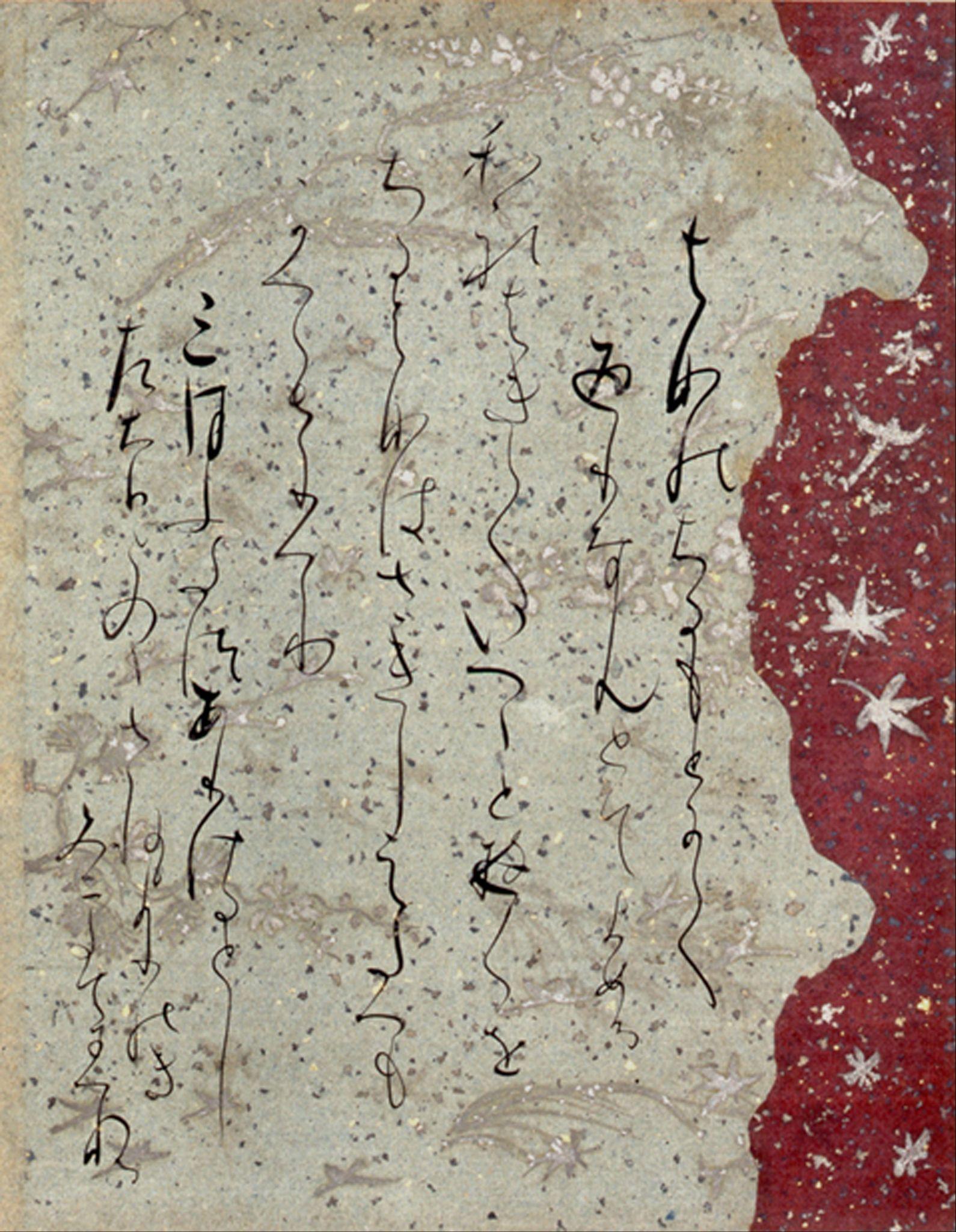
A Heian-era poem by Fujiwara no Sadanobu (1088–1156), showing calligraphy in the kana style similar to what would have been used in love letters and personal correspondence in The Tale of Genji.

Everything stands between the lines
It would be difficult to overstate the complexity of communication in Genji’s times. Everything was a context clue, especially when a lot of communication happened by letter. The colour and thickness of the paper mattered, since certain types of paper were associated with formal communications, some with love letters, and so on. It mattered how quickly you answered, or whether you strategically chose not to reply. The length of your letter, the effort you put into it, which incense you perfumed it with, which flower you attached to it, and the beauty of your handwriting all communicated about you, how you feel about the recipient, and about the topic at hand. All this before even considering the words you wrote.
My favourite example of why you can’t read Genji without footnotes is from one of Genji’s early adventures, when he is about 17 years old.
Let me set the scene. Imagine Genji, staying with his wife at his father-in-law’s place, lounging in his underwear, is suddenly reminded by servants that the Mid-God (Nakagami) has “closed their direction.” Nakagami was a deity who reigned over good and bad luck, and regularly descended to Earth, moving clockwise and spending 5-6 days in each of the eight directions, and one should avoid activities toward the deity’s current direction if at all possible. Unfortunately for Genji, both his wife’s home and his own palace are in the same unlucky direction from the perspective of the Imperial Palace where he had come from, and therefore he has to find somewhere else to sleep that night. One of the servants suggests the villa of the Governor of Kii, who is in the service of Genji’s father-in-law. Genji thinks this is an excellent idea and heads to the villa, essentially inviting himself to stay the night at someone else’s house. Turns out he can just do that.
Here comes the juicy part. When a room has been prepared for Genji, he says to his host, the Governor: “What about the curtains, then? It is a poor host who does not think of that!” And the host replies: “My lord, I have been told nothing about what might please you.”
What’s Genji’s deal with curtains? He’s just imposed on someone else’s hospitality on an extremely short notice, and he’s complaining about interior design? By now you can probably guess the curtains aren’t about curtains, and if you guessed the curtains are about sex, you would be correct. Genji is making a reference to a song whose lyrics are:
Curtains hanging from the ceiling
divide my house into rooms -
come visit me, prince,
I will make you my son-in-law.
What would go well
with wine?
Abalone? Turban snail?
You like sea urchin, right?
Abalone? Turban snail?
You like sea urchin, right?
The seafood items mentioned in the song are a symbol of female genitalia, and the curtains refer to a host offering his daughter to the honored guest. So when Genji complains about the lack of curtains, he’s actually complaining that the host hasn’t provided a woman for him. Good luck deciphering that without context.
Reading a book written in a dead language
Nobody can read Genji the way it was originally written by Murasaki Shikibu. This is because the original manuscripts have been lost, and the earliest versions are copies made more than a hundred years after the story was written. There isn’t even a scholarly consensus on whether all the chapters usually included in Genji are definitely written by the original author, and it’s very possible that some chapters have gone missing. Different versions of the chapters were circulated for centuries, and nobody can say which ones are closest to the original.
Even if we had the original manuscript, still almost nobody would be able to read Genji the way it was originally written. There are no more native speakers of the classical Japanese that Murasaki Shikibu spoke, nor are there any more native inhabitants of the culture she lived in, who could help us understand what’s written between the lines. These days, native Japanese speakers commonly read Genji as a translation into modern Japanese, including footnotes, and will need specialised study if they want to read the original directly. Although, based on my very informal check-in with a handful of Japanese people, it seems it’s pretty rare to read the whole Genji, and usually the few parts they are forced to study at school are enough — unless they are history or literature nerds.
How do the non-Japanese nerds among us read Genji?
Translating between unrelated languages is like creating a 2D map projection of a 3D globe, in that it’s fundamentally impossible to be 100% accurate, and something has to give. While the cartographer has to decide how much of shape, area, distance, and direction to sacrifice, the translator needs to consider factors such as formality, fluency, structure and, in my opinion the most fundamental decision, whether to try to preserve the literal meaning or the emotional impact of the original. These tradeoffs are especially painful when it comes to poetry, where it’s even harder to separate meaning and form. In poetry, the original form might have a specific number of syllables, or rhymes, or patterns of emphasis, which are necessarily tied to the language they were written in, such as the 5-7-5-7-7 structure of the traditional waka poem, and there is no objectively correct way to handle that in translation.
There are four well-known and mostly complete English translations of Genji, and each one makes different tradeoffs:
- Arthur Waley’s translation (1925-1933) takes loads of liberties and could be thought of as a creative interpretation rather than a faithful translation.
- Edward Seidensticker’s translation (1976) cuts down ambiguity and focuses on conciseness and readability.
- Royall Tyler’s translation (2001) maintains a lot of the ambiguity of the original, which means a hit to readability. It’s the most academic and involves extensive footnotes.
- Dennis Washburn’s translation (2015) is the longest and most verbose, baking a lot of the historical context inside the narration and focusing on readability. Washburn is the only one of the four that systematically renders the poems as verse rather than prose.
Full disclosure: I didn’t read any of these four. Instead, I read a recently completed Finnish translation by Martti Turunen & Kai Nieminen (2025), which strikes an interesting balance between academics and aesthetics. It comes in two volumes with a total of 1758 pages and a whopping 2422 footnotes, all of which I read. The footnotes mostly fall into the following categories:
- Explaining terms, concepts, religious rituals, beliefs, hierarchical ranks, and other necessary context for the reader to understand what’s going on.
- Clarifying who is who, related to whom, and where else the same character appears. Since there are approximately 400 different characters, and most of them are generally referred to by ranks or titles that keep inconveniently changing, the footnotes are critically important.
- Explaining references the characters make to other poems, stories, and legends, as well as double meanings in words that don’t come through in the translation. This is how I know that when Genji complains about curtains, he’s actually horny.
- Explaining ambiguity in the original text and how it’s been resolved in the translation.
Aesthetically, the Finnish translation is remarkable. Chapters 1 to 25 were originally published in Finnish in the 1980s, the prose translated by Martti Turunen, who is the first foreign-born member of the Japanese legislature, and the poems translated by Kai Nieminen, a renowned Finnish poet and translator. Since then, Nieminen has translated both the prose and the poetry of the remaining chapters (26-54), and the combined work was finally published in 2025. The philosophy of the work is to be a literary experience rather than academic, and despite the density of the footnotes, the prose is fluent and the poetry is translated in a way that preserves much of the original form.
For the purpose of writing this review, I also consulted the Tyler and Washburn translations to English and their sections on historical context, and I’m glad I did. Comparing the same passages and their footnotes in different translations really hammers home how differently the source text can be interpreted. To illustrate the difficulty of knowing what the original author might have actually meant, here is the same passage in three different ways.
Tyler:
The Gosechi Dancer, the daughter of the Dazaifu Deputy, felt that she was now over her secret, hopeless misery, and she had her messenger give Genji this, with a wink.
Washburn:
The daughter of the Assistant Governor General of Kyūshū—the lady who had once performed as a Gosechi dancer—felt her secret longing for Genji, which had been hopeless from the start, cool at last. She had a messenger deliver an anonymous letter on the sly with instructions that the man should give Genji a wink to provide a clue to the author’s identity.
Turunen & Nieminen, in my own translation to English:
The dancer daughter of the Deputy Governor of Tsukushi felt slight disappointment when Genji was again favoured by the Emperor and therefore out of her reach. As if to test, she sent Genji a letter, being careful not to reveal her identity.
It’s really interesting to see the different interpretations at play. Tyler’s philosophy of preserving the ambiguity of the original makes it much harder to understand what’s going on. What exactly is her misery? Why is she over it? Why the wink? Meanwhile, the other two translations resolve the ambiguity in very different ways. They both make it clear that the woman was longing for Genji, but only Turunen & Nieminen explain why he is out of her reach. Washburn thinks the wink means she wants Genji to guess her identity, while Turunen & Nieminen think the opposite, that she is trying to hide her identity. Based on this, I would guess the original mentions a wink but doesn’t explain it, and the original reader would have known what it meant, while we can only speculate.
When it comes to the waka poems, sometimes it’s hard to believe the translators worked on the same source material. Here’s an example of a poem written by Genji to a woman with whom he has had a brief affair more than a decade earlier. When their entourages pass one another on the road to the Ishiyama temple, Genji is able to get a letter delivered to her, even though they have no opportunity to meet.
The original poem in classical Japanese, written on a single line in hiragana like how it likely would have been written by Murasaki Shikibu:
わくらばにゆきあふみちをたのみしも なほかひなしやしほならぬうみ
The same, but each phrase rendered on its own line, to showcase the 5-7-5-7-7 structure, which the original reader would have been able to parse when reading it in a single line:
わくらばに
ゆきあふみちを
たのみしも
なほかひなしや
しほならぬうみ
Tyler’s take, in his characteristic two-line approach to translating waka:
I had little doubt that we would meet after all on the Ōmi road,
yet those waters were too fresh not to betray my fond hope.
Washburn’s take, in his equally characteristic three-line approach:
Though we passed by chance on the road to Ōmi
A name that promised us a tryst at Lake Biwa
In vain I searched for you beside its fresh waters
Nieminen’s take, following the 5-7-5-7-7 structure with Finnish syllables:
toivoin turhaan: ei
järvivedessä elä
simpukoita — niin
satuimme samaan paikkaan
sittenkään kohtaamatta
Nieminen’s take, translated into English by me:
in vain I had hoped:
in lake water there live no
saltwater clams —
we happened on the same place
but nonetheless did not meet
Let’s unpack the layers of meaning. First, the original poem contains the word “afumichi,” or “the road on which we meet,” which is read the same way as “oomichi,” or the road to Ōmi. Second, Lake Ōmi (also known as Lake Biwa) is a freshwater lake, so it has no saltwater clams, and the poem also contains the expression “kai nashi,” which can mean “pointless,” “in vain,” or “clamless.” Setting aside all the complexity, Genji’s poem means “Would have been nice to meet, but sadly it’s not happening.” In this case, the Finnish translation says this the most explicitly, but the reference to clams would make very little sense without the context of the wordplay. However, all of the translations contain some reference to hoping for a meeting, and that hope not being fulfilled.
As a side note, I have to say it was not straightforward to translate the Finnish translation into English. Finnish and English are not even remotely related languages, and English is in fact more related to Hindi than either of the two are to Finnish. Even for this one poem, I had to ask myself the same questions as the translators of Genji: Do I try to preserve the form (the 5-7-5-7-7 structure)? Do I try to preserve the exact literal meaning of the Finnish translation? How do I deal with fundamental mismatches in terminology between Finnish and English? The Finnish translation contained the word “simpukka” which can translate to clam, mussel or cochlea in English, so I had to do a little research excursion (thanks Claude) to understand which of these specifically would have been missing from Lake Ōmi and would match the wordplay. I also had to choose between “nonetheless,” “even so,” and “after all.” A more precise translation would have used “encounter” instead of “meet,” but I chose to prioritise the syllable count. So many decisions when translating a single poem between two languages I speak fluently, and where lots of resources exist for understanding the exact connotation of every word. This is why it takes so long to translate a work like Genji.
At the risk of overdoing it, I couldn’t resist checking how well LLMs would handle translating this poem, when given no other information than that it’s a poem in classical Japanese. A few observations:
- Both Claude Opus 4.7 Adaptive and ChatGPT 5.5 Pro independently identified both wordplays (road of meeting / road to Ōmi and pointless/clamless, though both chose to talk about shells rather than clams).
- Both of them chose to generate two versions, one a bit more literal and another that’s more poetic or tries to preserve more of the wordplay.
- Both of them did surprisingly well and were able to reflect something of the meaning of the original poem, in the sense that a desired meeting did not happen.
- However, they both missed the fact that the two people had been in the same place. This might be something requiring more context from the surrounding text, and might not be inherent in the poem itself.
- Neither of them divided the poem into the upper phrase and the lower phrase, where the first part of the poem sets the scene and the second part shifts the perspective to the poet’s internal world. All the human translators preserved this feature of waka poetry.
- LLMs seem to need in-depth thinking to identify the double-meanings; I tried ChatGPT 5.5’s Instant mode and it didn’t find either of the two wordplays.
My favourite of the LLM-generated translations, from Claude Opus 4.7:
Though I'd staked my hopes
on chancing to meet you there—
it came to nothing.
No shells wash up on the shore
of a sea without any salt.
Fine, so I’ve established that the translation matters, and the existing ones are pretty different from one another. Which one would I recommend?
- If you speak Finnish, read Turunen & Nieminen. But I wouldn’t recommend learning Finnish just for this purpose.
- Else, choose based on your preference and mental state:
- You value academic precision and are comfortable with ambiguity -> Get Tyler.
- You prefer a literary experience even if it adds a lot of subjective interpretation -> Get Washburn.
- You intend to hyperfocus on this specific topic for the next few months -> Get both and triangulate what the original author might have meant.
- You think modern humans are redundant -> Feed the original, classical Japanese text into your LLM of choice and hope for the best.
Is it really the world’s oldest novel?
I started this review by calling Genji the oldest novel in the world, and I bet a few readers raised an eyebrow, judging by how people reacted when I was initially reading Genji and telling people about it. The standard response format is: “But how about [insert your favourite ancient story]? That’s way older.”
The short answer is that the world’s oldest novel is not the same thing as the world’s oldest story.
The long answer is that there are a few defining characteristics that make a work a novel, and there is a surprisingly broad consensus that Genji is the oldest known work that qualifies. Those characteristics are:
- Fiction: Historical chronicles and religious texts are not considered novels.
- Written in prose: Throughout a lot of human history, stories were formatted as verse, especially before the invention of writing when they had to be passed down as oral tradition. Even when writing became a thing, poetry was still a common form of literature, including in Japanese literary tradition before Genji. And even though there are hundreds of poems in Genji, and they are highly relevant to the story, the prose stands in its own right. This one rules out the Odyssey, the Mahabharata, Gilgamesh, and Beowulf.
- Psychological depth: This is perhaps what stands out about Genji the most. I find that many old stories look at their characters from the outside, and rely on archetypes for readers to know what to expect. In contrast, many of the characters in Genji are highly complex, their private, inner worlds are explored in depth, and their thoughts and emotions develop in nuanced ways over the course of the story. Even the narrator seems to have complicated feelings about Genji, because even as he had been dubbed “The Radiant Prince” by other people, the narrator starts chapter 2 by pointing out that Genji did a lot that was contradictory to such a lofty title, that “his failings were numerous.”
- Long and cohesive narrative: Short stories and collections of short stories don’t count as novels. Even if the stories star the same characters, the stories are often more like fragments or self-contained episodes, where consequences and character development don’t span the whole work. This is what sets Genji apart from works like Satyricon and The Golden Ass; it follows a large cast of characters over decades while maintaining internal consistency regarding everyone’s age, their changing places in the social hierarchy, their relationships with one another, the information everyone knows, and the psychological impact of past events.
To summarise: Murasaki Shikibu wrote a fictional work that was truly innovative in its time, using long-form prose with a high level of internal cohesion and characters with significant psychological depth and development. I like to use “the world’s first novel” as a shorthand for that, but it’s fine if you don’t. Wikipedia plays it safe and calls it “the first novel written by a woman to have won global recognition,” and someone else might have an even stricter definition for a novel that would rule out Genji as well as older works.
What it’s like to read Genji
At the beginning of this review, I promised I’d walk you through my experience of reading Genji so that you can judge for yourself if Tyler was right in saying that the footnotes are optional, “the characters’ thoughts and feelings remain as fresh as ever,” and that anyone can read Genji. I believe I’ve said enough about the footnotes, so let’s examine the other two claims.
Regarding the freshness of the characters’ thoughts and feelings, on the surface level it makes sense to disagree with Tyler. It would be hard for most people to relate to thoughts and feelings such as
- “This girl is my stepmother’s niece; I must have her” or
- “My lover has forcefully assaulted another woman; now she must die” or
- “My husband wants to take our child away from me and give her to another of his wives to raise; this seems fine.”
But if you go up a level of abstraction, you find something much more relatable, or at least recognisable. The longing for someone you love but can’t have. The jealousy arising from your insecurity about your own position in life. A parent’s anguish at being separated from their child, while knowing the child will be better off that way. Making bad decisions while horny. Sacrificing your family for your career ambitions. And there is also my own absolute favourite moment which requires very little cultural translation: The narrator tells of a party, late at night, where Genji and a bunch of other men are taking turns composing poems at each other. The narrator first includes some of them, but then says the men got so drunk that it would torture the reader to include any more of the poems they came up with. I bet Murasaki Shikibu knew what it feels like to be sober in the vicinity of idiots drunk on their own brilliance.
But can anyone read Genji? Even if you read it at a level of abstraction where you are able to relate to the characters, there is one more aspect of the experience that might frustrate an unprepared reader that I haven’t mentioned yet. I know I said that narrative cohesion is one of the defining characteristics of Genji, which makes it a novel while others works are just collections of stories, but it’s not the kind of cohesion you might expect. The Tale of Genji is cohesive in the way that life is cohesive. There is significant cause and effect, people act on motivations that feel internally consistent to them, lots of stuff happens that builds on other stuff. But also, there is plenty of setup that leads nowhere, loose ends that don’t get tied, important events that are glossed over, insignificant events that seem blown out of proportion, people who behave in erratic and unexplained ways, and many things that happen for seemingly no reason. Just like in life, not everything ties to the grand plan, and in the end you wonder if there was ever a grand plan to begin with.
Genji doesn’t have a plot in the strict Aristotelian sense of having a beginning, a middle, and a satisfying and inevitable end, with every event in service of that structure. In fact, Genji himself dies before the novel ends, and the last part of the story moves on to the next generation and their bad choices. I debated internally about whether to include this bit of information, because you could call “the main character dies partway” as a pretty major spoiler. But then again, both Tyler and Nieminen mention Genji’s death on page 1 of the introductions to their respective translations. It seems nobody is expecting you to read Genji thinking it will be only about him, or that everything ties up neatly together.
In my opinion, you are more likely to enjoy reading Genji if you have the following: Interest in (Japanese) history, literature, poetry, philosophy, or aesthetics. Willingness to suspend moral judgement. Stamina. And importantly, tolerance for ambiguity. Read Genji not because you want to know what the point of everything is, but because you want to immerse yourself in an alien world and see if you can find moments of shared humanity with its inhabitants as they navigate their lives that don’t necessarily have any more point than ours.
There is a scene in which Genji talks to the women in his household about literature: “A story may not relate things exactly as they happened out of consideration for the circumstances of its characters. Yet there are moments when one wants to pass on to later generations the appearance and condition of people living in the present—both the good and the bad.” We might be reading this in Dennis Washburn’s words, but it gives us a glimpse into the mind of the original author and her philosophy. I can hear her saying: This is what life is like for us. It’s not all terrible or all great, but I want you to know.
To Murasaki Shikibu, I say: I see you, sis. I wouldn’t want to listen to drunk men and their poetry either.
Your message is stored now and emailed to the author after the contest ends. The author can reply to you, but their identity stays hidden unless they choose to respond.