When switching from a bad way of doing things to a better way, one ought to expect an improvement. Certainly, a transition from socialism to capitalism can only be a tale of prosperity and growth - look at what China achieved and it did not even transition completely.
Well, for some reason this is not what happened in Eastern Europe in the 1990s. This book review is about one such case, that of East Germany, or more specifically about the Treuhand - the state agency responsible for privatizing the East German economy after the end of socialism in 1990. The name of this agency (pronounced as if it were a guy named Troy Hunt, by the way) is usually not translated in English and no doubt the translators of Marcus Böick’s Die Treuhand would have done the same if only the book had been translated, so I will just use it as the title of this book review. When it began operations, the Treuhand controlled 8,000 enterprises with four million employees. Some called it the largest company in the world. The nature and scope of this task make this organization living on the edge between state and economy, socialism and capitalism, a fascinating object of study.
In more than 700 pages, Böick offers a very detailed history of the Treuhand. If you want to know the program of the “employee day” the Treuhand organized in November 1991, search no longer - this is your book! More generally, the author, a historian with a special interest in social history, conveys an impression of what it was like to work at the Treuhand. But if you are looking for statistics or economic insights, this might not be your book. Böick is interested in the historization of the Treuhand, i.e., claiming it as an object of study for history from journalists and politicians on the one hand and political scientists and economists on the other. While this is legitimate, it is at times frustrating for a reader more interested in the impact of the Treuhand on the outside world rather than its inner workings. Anyway I had already bought my copy and so, in what is best understood as an example of the sunk cost fallacy, here is its review.
A Very Brief History of East Germany
After losing the second world war, Germany got occupied by the victors. With their common foes gone, the Allies quickly discovered that actually they hated each other too, and the cold war ensued, leading to the founding of two new German states in the Western and Soviet occupation zones respectively, each aligned to one of the blocs. The German Democratic Republic (GDR) in the east wasn’t actually democratic, but a dictatorship under the rule of the Socialist Unity Party of Germany (or SED). The Western Federal Republic of Germany (FRG) was both democratic and had the stronger economy[1]. Because people do not actually like to live in dictatorships or be poor very much, many, about a sixth of the population, emigrated from the GDR to the west. This too was bad for the eastern economy, so the government pragmatically closed the border, culminating in the construction of the Berlin wall in 1961. From then on, the GDR remained stable until the peaceful revolution of 1989. Popular dissatisfaction with the political system, the economy and the complete lack of reforms under the aging dictator Erich Honecker (particularly in comparison with the Soviet Union’s Gorbachev, but also Poland and Hungary) had been growing before. Massive demonstrations and a new increase in emigration, now via the embassies of the Federal Republic in socialist brother countries such as Czechoslovakia, led in quick succession to the Politburo replacing Honecker, the fall of the wall and the establishment of an all-party government led by socialist reformers that should rule until the democratic elections of spring 1990. This is where the book begins[2].
The reformers that were now in charge were, unlike Honecker, willing to admit the problems of their economy and open to discuss solutions, among which the following measures featured:
- Abolishing central planning, price-fixing, and giving more autonomy to the directors of the state-owned enterprises.
- Promoting people to high management positions based on competence, instead of ideological loyalty.
- No longer striving for economic autarchy.
- Allowing joint ventures with western companies.
In the words of Minister for the Economy Christa Luft, the reformers wanted a decentralized “social-ecological market economy”. While they were willing to allow private property, they did not want to relinquish the state’s/the people’s property: it should either remain in the state’s hand or ownership of the enterprises should be transferred to their respective employees. In any case, the socialists could not actually implement any of their ideas themselves. It took the government until February 1990 to prepare a plan for the economic transition, which was supposed to be completed by 1993[3]. In the same month, the West-German chancellor Kohl (from the conservative CDU) proposed a plan for a monetary and economic union. In the East’s free elections one month later, the conservatives won and took up the plan of their Western counterparts. These events rendered the ideas of the reformers, who had only garnered 16% of the vote, obsolete.
The Monetary Union
With the wall gone, what had been a trickle of immigrants had become a flood, a flood of immigrants in shitty cars. The government of West Germany needed to act.
The government of West Germany also lacked a good plan for the events unfolding before their eyes, which had surprised them as much as they had most observers at the time. Also throughout the division of Germany, more attention had been paid to the political, rather than the economic developments in the East. After the foundation of the two German republics, when the trauma of division was still fresh and the government had to legitimize its actions while moving closer towards western alliances that were cementing the status quo, the matter of reunification occupied quite a large space in politics, but as time went on, its importance gradually faded. When it suddenly reemerged, people looked to the past for answers and found mainly one 1953 essay by Ludwig Erhard. Erhard had at the time been Minister for Economic Affairs and was celebrated as the father of the post-war boom.[4] He argued against any state planning of the reunification process in his essay. Instead, he advocated for harnessing free market forces, and in order to harness them quickly, he proposed an immediate monetary union, citing the success of his own monetary reform - the introduction of a new currency, the Deutschmark, together with the end to price-fixing in the western occupation zones in 1948. The positive reception of his essay also was furthered by the fact that he had been a member of the CDU, which ruled Western Germany again in 1989.
Independently, the people in the GDR were losing faith in their currency, which, to make things more confusing, was called Mark of the GDR. Now that the state could no longer control its circulation, they started using the Deutschmark as a shadow currency and calls arose for its official adoption. There were banners at the demonstration of the time reading:
Comes the Deutschmark, we shall stay;
Does it not, we’ll go away![5]
Due to these factors and general skepticism towards reform proposals in the East, which were considered too vague, too slow and difficult to pull off in a country where no one had any experience in a market system, Erhard’s idea was taken up by a working group in the chancellery and then proposed to Kohl:
The previous economic "restraint on our part," as officials judged, had “rather negative effects": "In this respect, we recommend that you position yourself [...] back 'at the forefront of the movement.'"
The opposition had by that time already presented their own proposals, including one for a monetary union. Hence,
with regard to the upcoming elections in the GDR, at the federal level, and in some states, it was crucial to be able to "present a concise, universally understandable concept for a rapid reconstruction of the GDR economy as soon as possible."
There had been different plans for a gradual transition in other branches of the government, but Kohl opted for this one. While Böick stresses the importance of the 1953 essay among leading government officials in coming to this point, Kohl might have been more impressed with its political implications. These concerned not just the migration issue, but also another matter, which Böick hardly discusses at all: German unification. While it had lost importance in the public mind, still the constitution stated that “the entire German people are called upon to complete the unity and freedom of Germany through free self-determination” and now that had become possible again. But it still required the consent of the allies, which might also have been one reason to proceed at high speed, as the future of Gorbachev, who seemed like a basically nice guy not into sending tanks to quash foreign rebellions, seemed uncertain.
The Foundation of the Treuhand
Kohl’s proposal sparked fears of a sell-off of the people’s property both among the socialists and parts of the opposition, which prompted a random group of six opposition activists to propose a trust holding that should privatize said property by distributing shares to the citizens. “Random” really does seem the best way to describe the group: they called themselves the "Free Research Council 'Self-Organization' for Knowledge Catalysis at Nodes" and consisted of a theologian, a physicist, another theologian[6]/engineer, a software developer, a philosopher and one economist/bank functionary. One of their goals was to stop what for them was not an immigration, but an emigration crisis: by handing out these shares only to citizens residing in the GDR. Since they mistrusted not just Kohl, but also the ruling classes at home, they furthermore demanded that the holding should recruit experienced Western experts.
One of their members, Wolfgang Ullmann, was also one of the non-socialist ministers in the all-party government, so he could advertise the concept and the idea of the Treuhand gained traction. Two weeks later, on March 1st, 1990, it was taken up by Prime Minister Modrow and the hero of this book review, the Treuhandanstalt, was born by way of an executive order (a law could likely not have been passed before the elections). Modrow was also able to staff the agency for the first time and staff it he did - with people from the central planning bureaucracy, some of whom should remain at the agency throughout its existence, without choosing anyone from the opposition. This sparked fears that an agency solely controlled by the government, would just enable its SED staff to enrich themselves, so, again two weeks later, the tasks and accountability to parliament were concretized by a second executive order, in order to appease the critics.
The property rights of the people’s enterprises were transferred to the new agency and it was tasked with assessing their value and transferring them to different types of legal entities. While the orders mentioned the right of the Treuhand to hand out shares to the citizens, they did not contain a provision to actually do so.
As already mentioned, the socialists lost the March elections and the CDU now governed (in coalitions with other parties) both Eastern and Western Germany, which meant that the Western proposal for a monetary union could be implemented. Both sides were under huge political pressure. The West wanted to prevent a cost explosion and stop the immigrants. The East wanted a favorable exchange rate for its currency - a topic we will explore in just a bit - and to preserve its social achievements, such as the right to employment. (If efficiency is of no concern in your economy, there is no unemployment. You just give everyone a job.)
Thus, the treaty that resulted from these negotiations added a social safety net to the fast implementation of a monetary and economic union that Kohl had proposed. As for the people’s property, the treaty said that it should first be used for structural reforms of the economy and the financial recovery of the public budget. Only then shares might be distributed. Here, Western concerns about increasing debts had prevailed. The treaty also enabled the free flow of goods between the two Germanies, which in practice meant mostly from West to East, where Western consumer goods were highly desired.
So now that you want to do a monetary union, what exchange rate do you set? The GDR, being a socialist country with little trade with capitalist economies, had set its own exchange rate of 1 to 1 and the Eastern Mark was not freely traded at currency markets. That rate was not realistic, however. Black market prices ranged from five to ten Eastern Marks for one Deutschmark[7]. Popular opinion in the GDR still favored an equal exchange rate of 1 to 1 because with that you get more Deutschmark and can buy more stuff. Politicians are elected to do popular things, so they (almost) did the popular thing in this instance. The new prime minister Lothar de Maizière insisted on the equal exchange rate, “lest the citizens of the GDR feel they become second-class citizens of the FRG”. In the end, a compromise was chosen, with distinct rates for salaries, rents, private savings, foreign holdings etc, resulting in an effective overall exchange rate of 1.6 Eastern Mark to 1 Western Mark. Importantly, the salaries were exchanged at a 1 to 1 ratio. If you were an East-German company at that time, that meant that your labor costs increased five times overnight. Even if your products were competitive yesterday, today they are probably not.
(You might be wondering whether East German products were competitive on the global market. At least some of them were, despite the massive economic problems as the government, desperate for foreign currency, had always been keen on enforcing export discipline. The success of these efforts was mixed. East German cars, for instance, had only gotten worse over time in comparison to their Western competition, but they were still sold to some countries outside the Eastern bloc.)
What did economists think of this reform? Now, Böick is not particularly interested in establishing what the economist consensus was, he merely quotes the government’s head sage[8] chief economic advisor, the director of the national bank, one more mainstream and one more leftist economist all vehemently opposing the plan at the time, and moves on. Well, we will see how that goes.
While it had a very different vision for the (economic) future of the country, the new Eastern government still needed someone to administer all the companies, so they decided to remodel the agency their predecessors had created for that purpose. This government had the time to write a real law, not just executive orders, have it passed by parliament. The upshot was that the central institution controlling all the companies should be somewhat decentralized, by establishing subsidiaries, each managing a subset of the companies. Instead of being run by socialist functionaries, it should operate according to entrepreneurial principles, led by people with management experience and in cooperation with consultancies and banks. The agency should be led by an executive board, whose actions would be overseen by a supervisory board.
Life and Times of an Agency
In the beginning, the new organization was very disorganized. My two favorite fun facts from that period were that in the first month, its early employees
would scour the press for articles that explained what the Treuhand was supposed to do to a broader audience in order to orient themselves by those
because there was no other guidance, and that for consultations with Western experts they would drive to West Berlin phone booths because the phone networks of East and West had not yet been connected[9].
So much for how they did things, but what were they doing? Remember, they had been mostly tasked with assessing the value of the people’s property and transferring the enterprises to different types of legal entities. As for the former, for some reason they had not been given even the most basic information, which must have existed somewhere in the bureaucracy, and were mostly busy building their own database with information like
what is the enterprise called, where is it located, how can we reach them, what do they do, what is their sector.
And as for the latter, ironically, that task was completed when the Treuhand Act converted the remaining enterprises uniformly according to their size, which rendered all the manual effort of the previous months kind of meaningless.
This tranquil phase came to an end with the entry into force of the monetary union on July 1, 1990, which coincided with the arrival of the first Western employees. The people at the Treuhand had anticipated that difficult times for the economy lay ahead and soon realized that they had been overly optimistic. Their new main task was organizing loans from Western banks to Eastern companies and handing out government cheques. But the government had only given them a limited budget, which did not cover all needs, so they gave each company 40% of what it had requested and told them to prioritize paying the salaries. Other financial obligations became of secondary importance. The situation also gave rise to a second new task: determining which enterprises were still in a relatively good shape and which were unsustainable and unsellable, so that they could support the former more and liquidate the latter. Directives for how to do this were written in parallel. During this time, the workforce was growing rapidly. Most people were hired through a top-down approach, where first the executive board was filled, and its members then hired the level below them and so forth, sometimes without knowing what the people they hired would work on.
The tenure of the first Western president of the Treuhand Reiner Gohlke, a manager who previously had been the CEO of the state railway, was more of an epiphenomenon of this period. It lasted from July 16 to August 20. In the book, he is described as quite a bit overwhelmed with his position and mostly focused on selling companies, while leaving the gigantic liquidity crisis to the care of others. Böick quotes a newspaper article from the time:
Continuously, Gohlke receives company representatives and business consultants in his office. They encounter a conversational partner who sometimes doesn't even remember the purpose of the conversation. Even well-known GDR companies are unfamiliar to him. The Treuhand chief often confuses the few companies that still have a chance of survival. "I have rarely seen such an overwhelmed person," one participant recounts incredulously after such a meeting.
Soon, he realized this himself and stepped down after one month. Gohlke was succeeded by Detlev Rohwedder, who had presided over the supervisory board before. Even before that, he had been the CEO of a steel company. Rohwedder seemed to have more of a strategic vision and initiated lots of organizational changes instead of trying to micromanage everything. As it had become obvious that not everything could be sold quickly, yet political pressure was mounting to not just close everything, rehabilitation became a new task. Companies that were not sold had to work out business concepts to determine whether rehabilitation was worthwhile. If not, they were closed. On October 2, one day before the reunification, the Treuhand announced the liquidation of its first company - not a good omen for the years to come. It was a company that produced cameras, which sold for 200 Deutschmark, but now cost 1,000 to make.
Ultimately, 30% of the total number of companies were closed and many people lost their jobs, often two-thirds of the workforce of a company. On average, the Treuhand estimated that there had been an overemployment of 30 to 50% in the GDR. Böick gives a combined rate of unemployment and short-time work of 40 to 45% for late 1991. Understandably, everyone became very upset and the Treuhand had to deal with lots of protests.
Not all reactions were understandable, though. On April 1, 1991, Detlev Rohwedder was shot dead by an extreme-left terrorist group. This was Easter Monday, not Good Friday, and he did not rise again. Rohwedder was succeeded by Birgit Breuel, who had previously been in charge of the subsidiaries. She was a politician with little business experience and was regarded as a determined proponent of privatization with originally showing less interest in rehabilitation compared to Rohwedder. However, in the next winter, when the economic situation in the East had worsened due to a global recession and a collapse in trade with Eastern Europe after the dissolution of the socialist trade organization Comecon, the government finally mandated a slowdown of the privatization. So Breuel had to oversee somewhat of a shift towards rehabilitation, promising the preservation of “industrial cores”. A number of companies that could not have been sold, but were deemed recoverable by politicians were split out to new sub-holdings that managed them for a few years until privatization was possible.
Some people at the Treuhand criticized this shift as they thought the dichotomy between rehabilitation and privatization to be a false one. They believed that private owners with more detailed knowledge would be better at managing the companies than the Treuhand from afar and said that they had tried to rehabilitate what they could not sell yet anyway. Others also welcomed the new developments as a long overdue strategic shift. In any case, the whole organization had been set up for privatization and would not lose its impetus. In fact, it only got faster in 1992, at the end of which year it had sold three quarters of the companies.
This leads to the question: How did the Treuhand actually privatize its assets? It did business with three groups. Firstly, there were West German (or sometimes foreign) investors who were buying the companies. Secondly, many companies were returned to the previous, pre-socialization owners or their families. This was not the favored option because these people would generally not be as solvent as an outside investor, so the Treuhand initially preferred to compensate them instead. However, once the demand dropped in 1991 due to a global economic downturn, these restitution efforts were intensified. Lastly, smaller companies were often privatized by way of management buy-outs. These transactions were handled at the discretion of the employee managing the company, with few opting for public tender. There were guidelines but these were only loosely enforced.
The book offers very few concrete examples of privatization, maybe the one described in most detail is the fusion of an Eastern with a Western potash mining company, which was one of the most controversial privatizations of the Treuhand. Treuhand and the buyer had agreed on closures and investments both at Western and Eastern production sites, affecting both at equal measure.
The complex contract structure, which Schucht [the responsible board member] justified with the tough competition, large overcapacities on the global market, the collapse of the eastern sales regions, and European cartel regulations, appeared from the perspective of the Treuhand leadership as the best business solution, which would enrich the German potash industry with a globally competitive major corporation.
The deal involved the loss of 1,744 jobs in the East, so the workers at one of the mines protested against its closure. They also found a new investor who promised to run the mine, but the Treuhand would have none of it as he demanded massive subsidies in exchange. The protests grew more intense, culminating in a hunger strike, but ultimately to no avail.
The new (or old) owners should not just close the company down and sell its assets, so the contracts contained clauses about new investments the buyer promised to undertake. These provisions also lowered the price, which in some cases was just a token amount or even negative. The review of these commitments only made it onto the Treuhand’s agenda relatively late. After initial efforts in 1992, it was not until the decline in sales figures in early 1993 that a separate department for "contract management" was established. Even though
only half [of these commitments] were legally enforceable, mainly because contractual penalties had not yet been fixed in the contracts of 1990/91,
the new department was very busy with 3,000 renegotiations. Only in less than 10% of cases were penalties imposed, though.
This brings us to the last year of the Treuhand’s existence, 1994, during which the leadership around Breuel planned the organization’s dissolution. Their own proposal for a group of commercially organized successor organizations was rejected by the government, however, and one large new agency, now without any of the commercial structures of the old Treuhand, was established after four years of complaints by federal auditors about the high salaries. With the beginning of the new year 1995, the Treuhand ceased to exist. In under five years, it had privatized an entire economy and had become the country’s most hated institution.
The Blame Game
Somehow, all of this was unexpected for the people at the time. The people’s property was valued at 650 billion East Mark by the creators of the Treuhand. Rohwedder later gave an even higher estimate of 600 billion Deutschmark. And even though this was more of an off-the-cuff remark, it had reinforced high expectations. In the end, the Treuhand generated a revenue of only 60 billion from privatization, while at the same time amassing debts totalling 204 billion Deutschmark (with one 1990 Deutschmark being roughly equal to 1.5 USD today). This is more than twice the 1991 GDP of East Germany of about 115 billion USD. It could not bridge the economic divide between both halves of the country and only created new political rifts.
So what went wrong? And who is to be blamed?
- The bureaucrats in the GDR with their impossible task of centrally managing an entire economy?
- The politicians with their impossible task of setting an exchange rate that must appease their constituents without distorting monetary realities?
- The Treuhand with its impossible task of rapidly privatizing a whole run-down economy?
Böick is not interested in participating in this fun game because it’s too much economy/politics and too little history, but as the protests influenced the Treuhand, where many contemporaries placed the blame, he at least describes the different perspectives. To get at least some outside view, that is independent of those contemporary perspectives, we can have a look at some data.
The per-capita GDP of other countries that transitioned around the same time as East Germany. If this plot seems kind of overwhelming, that is because it is. If you are really interested, you can have a closer look at them at the source, Our World in Data.
The same data, averaged. The long stagnation in the mean during the 90s is a mix of some economies stagnating, but it also hides that some were still shrinking, while others were already growing. It is also partly an artifact of poorer countries gaining independence later.
The ratio of per-capita GDP in East and West Germany, during and after socialism, combining two different data sets for the pre and post-revolution era, respectively.[10] You can see that the eastern economy quickly more than rebounded, but remains behind its western counterpart.
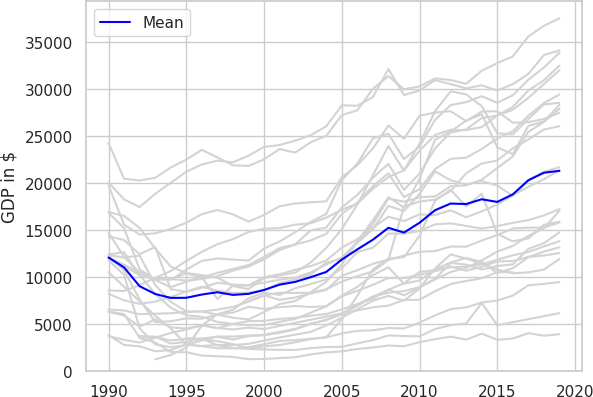
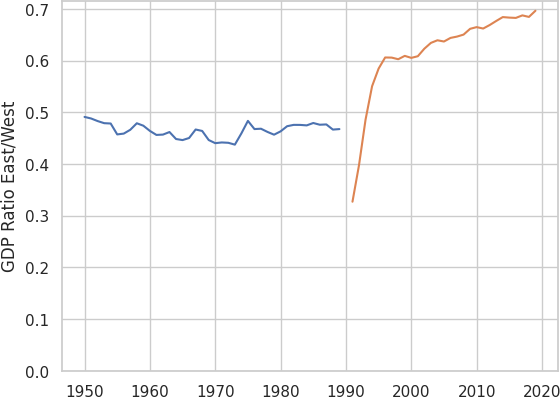
All the formerly socialist countries underwent an economic decline during these years and unemployment rose sharply everywhere, which strongly suggests socialism as the culprit. According to OWID, the decline of around 32% in the GDP of East Germany is in the same ballpark as the other countries. Some did better (e.g. Slovenia, Poland), some worse (e.g. Russia, Ukraine). However, it seems that the countries that I would assume were economically more similar to Germany did not see as big a crash as East Germany itself - at least initially. However, the GDP of East Germany recovered relatively quickly and reached its pre-crisis level again in 1993. This is faster than in most other countries, but it does not stop there: it shoots up even further, which does not happen anywhere else, until it plateaus and then starts growing again at a slow, but steady pace.
I believe these countries mostly transitioned at a similar pace, but due to the unification with the economically much stronger western part of the country, the situation in East Germany was very different. Generally, the possibilities that come with a government with well-established institutions (compare this to the authoritarian regimes established elsewhere or the wars in the Balkans), a large market and a lot of money to finance economic policies should mitigate the crisis and lead to a better outcome. On the other hand, we have seen how the monetary and economic union led to a dramatic increase in the costs for East German companies and at the same time completely opened their domestic market to a group of very powerful and market-savvy competitors. That cost situation was further exacerbated by unions that successfully demanded a raise of industrial salaries to western levels, so given how the unification was implemented, the initial effect might have been the opposite. Also after 1996, East Germany stopped growing faster than its neighbors.
Whether, on top of all of this, the Treuhand made matters better or worse, I find impossible to say. Comparing it to how other countries managed their transition is not in the book and would probably have made it twice as long. Neither can it be done with a few graphs. But at the very least, we can look at its strengths and weaknesses. The book paints a picture of a very hard-working workforce, who, for instance, really tried to sell the GDR’s auto industry, but could not find a buyer, whereas people at the time often claimed Treuhand employees were incompetent or corrupt. Depending on their political orientation, they would either blame the Eastern Germans at the Treuhand, who formed a large majority of the workforce (mostly in subordinate positions), many of whom had worked in the planning bureaucracy. They ended up at the Treuhand simply because they had the best available expertise on the businesses of the country. Or they blamed its western employees, who ended up being viewed as colonizers after initially being hailed as miracle doctors. These were mostly at the beginning or the end of their careers because the salaries the Treuhand paid as a state agency were not attractive to people whose careers were at their peak. Eventually, when the recruiters ran out of available senior executives, more and more young and inexperienced people were hired. Some of the older ones were “on loan” from western companies and worked in the same sector as their employer and were suspected of benefiting them. Then again, younger managers and external consultants were suspected of benefiting potential future employers or clients.
The Treuhand was quite a centralized institution. According to the Treuhand Act, the subsidiaries should have had a large degree of autonomy, but Rohwedder had protested against this and that part of the Act was never implemented. Instead, the board defined the roles of the subsidiaries themselves[11]. And centralized decision making is bad and was what brought us into this situation in the first place, right? It shifts the responsibility to people with little inside knowledge and no skin in the game. This is a valid point, I think. However, there are also counterarguments:
- Böick quotes more than one employee saying that “nobody read the guidelines”, so I think it was not as centralized as it seemed.
- When they were asked to write new business concepts, the replies from the companies were unsatisfactory both in quantity and quality, which could indicate a lack of initiative, which maybe had to be expected after 40 years of central planning. It could also indicate a lack of knowledge (or maybe the guidelines for writing these concepts were bad), but in that case they could have just bought Western expertise themselves.
- The Treuhand saw itself as a protector of capitalism-naive companies against acquisitions on unfavorable terms or unrealistic proposals as we saw in the case of the potash mine.
The Treuhand also had its share of corruption. We have seen how chaotic the early times were and it should come as no surprise that there was little oversight then. Managers were assured exemption from liability until July 1991. Only then, when the government did not want to prolong that exemption, more regulated processes were established, which in turn caused some managers to lament the increased bureaucratic burden. One of the largest corruption scandals happened not at the headquarters, but in one of the subsidiaries, so it is hard to say whether the Treuhand was too centralized and bureaucratic or not centralized and bureaucratic enough. Eventually, the German parliament estimated the damage done by corruption and fraud at between three and ten billion Mark, but that does not seem like a huge amount compared to the overall cost of the transition and I would also suspect that other countries saw much more corruption, though again this is beyond the scope of the book and its review.
There was one function the Treuhand served exceptionally well, that of a “lightning rod for politics”. Dissatisfaction was mostly directed at the Treuhand, not the parties and politicians that had set up the economic stage and the role the Treuhand had to play on it. Kohl was reelected in 1990 and 1994, before being finally voted out of office in 1998 after sixteen years in power. Ultimately, it is this function and the fact that it attracted nearly all the controversy around reunification that made me interested in the Treuhand, made me read the book and that makes you read this book review now.
Inconclusive Conclusion
I had to think a lot of How Asia Works when writing this review. If How Asia Works wants to teach us about a successful model of economic development, what lessons can we draw from the Treuhand? Don't do hare-brained monetary reforms. Maybe transition slowly from one economic system to another, which is a lesson we can also find in How Asia Works. But whether that would have been possible in this instance is left unanswered. If China and Vietnam offer a successful model for this transition - and whether they will go all the way, still remains to be seen - how could their model have been implemented in a revolutionary society with a rightfully impatient people demanding change now? Besides, this probably would have required extensive collaboration between the different economies of Eastern Europe, but that also would have been difficult given the past relations both between most of these states and what would soon be the former Soviet Union and among the group of nations that emerged from it.
One lesson that offers itself to me is a hard-to-pin-down mistrust of ideas on their own when no afterthought is paid to their implementation. First of all socialism, but we also saw Erhard’s 1953 essay, which might have made sense at his time, blindly taken up more than thirty five years later with not much attention paid to setting an exchange rate not from the realm of wishful thinking. We saw the Treuhand itself spiral out of control first by those who conceived and then by those who founded it. And we saw the (I’d say good) idea of the market economy failing to deliver its promise in an environment dominated by overblown expectations and political constraints.
Footnotes
- ↩
Mostly due to its capitalism and decentralization, though other factors might have played a role, such as the US support and the fact that it did not have to pay as many reparations.
- ↩
Okay, this is not where the book begins. The book begins with a rather dry introduction into the methodology and an overview of the sources.
- ↩
Interestingly, but ultimately not importantly, the opposition had generally received the plan favorably, while also criticizing it for being too vague.
- ↩
As basically all Western European countries experienced a post-war boom, the degree to which this perception is accurate is debated.
- ↩
Just in German and without any interpunctuation.
- ↩
The fact that two of its members were theologians points to the role that the protestant church played during the revolution.
- ↩
Here, I am really disappointed with Böick because he just does not care about what the true exchange rate would have been. He is focused so much on the historization of the Treuhand, that he does not care about explanations of the problems it was facing if they are somewhat beyond the limits of his discipline.I had to take the black-market exchange rates from Wikipedia.
- ↩
The members of the government’s Expert Council for the Assessment of the Overall Economic Development are just called economic sages by the Germans. In that sense, the council’s president is the head sage.
- ↩
The phone network in East Germany was very bad, with only one in ten households having a telephone.
- ↩
One dataset is again from OWID for the years 1950 to 1989, the other is from the statistical offices of Germany starting in 1991. Neither contains data for 1990. Looking at the ratio is a bit weird, but because these adapt for inflation differently and I did not want to worry about converting their numbers, I opted for this, because the ratio should hopefully be invariant under inflation. However, this does not change the fact that these two data sets might measure GDP differently. Luckily, the drop between 1989 and 1991 matches the number I found elsewhere (unfortunately, this article does not provide a source for its GDP numbers). All of this is further complicated by Berlin, which like Germany was reunified in 1990, and the statistical offices do not break down the Berlin data into East and West. Because the GDP of West Berlin was roughly one fourth of the whole GDR GDP (pun not intended), adding the Berlin GDP to East Germany would paint a very rosy picture, so I included it in the West instead. This slightly lowers the per-capita Western GDP, but that probably does not fully compensate for the fact that the eastern GDP post-1990 in this plot does not contain its largest city and appears a bit lower post-1991 than it should be.
- ↩
Eventually, all companies with fewer than 1500 employees should be managed by the subsidiaries, with the exception of, among others, circuses.