The Virality Project: A Misinformation Tragedy
The Revenge of the Real
In her 2024 book, Invisible Rulers: The People Who Turn Lies into Reality, Renee DiResta invokes philosopher Benjamin Bratton’s “revenge of the real” at the end of her chapter about the Virality Project. During the pandemic, “actual reality – tornado reality – confronted us, and yet many continued to operate in, or profit from, bespoke realities. And an untold number paid for it with their lives.” [1] For DiResta, Covid vaccine hesitancy was a modern tragedy. Thousands of Americans who could have saved their lives by getting a shot that was freely available to them chose not to do so because they had been misinformed. Instead of following the advice of public health experts who wanted to save their lives, they followed “invisible rulers” – social media influencers who manipulate public opinion from behind their keyboards to gain power, fame, and fortune -- to their doom.
While I agree that the unnecessary death of many Americans was a tragedy, I found another tragedy and another set of invisible rulers who suffered the revenge of the real when I reviewed the Virality Project’s efforts to protect Americans from mis and disinformation. Like the social media influencers that they opposed, the misinformation researchers who led the Virality Project were trapped in their own bespoke reality full of contradictions and catch-22s. They sought to defend scientific expertise from its critics, but they misdiagnosed the threat and prescribed remedies that exacerbated rather than lessened the crisis. They undermined faith in the scientific method by encouraging scientists to get out of their labs to join the meme wars on social media. They sabotaged trust in media companies (both social and traditional) by encouraging them to manipulate their audiences. Like the American officer during the Vietnam War who decided that it had become “necessary to destroy the town to save it,” misinformation researchers betrayed the scientific method and democratic discourse in their effort to rescue them.
Why Review the Virality Project?
After the first two COVID-19 vaccines received Emergency Use Authorization from the Food and Drug Administration in December 2020, the incoming Biden administration decided that vaccinating as many Americans as possible was the best strategy for ending the pandemic. They undertook a massive effort to produce, promote, and distribute Covid vaccines as quickly as possible. At first, the campaign was remarkably successful as many Americans like me rushed out to get jabbed as soon as we could, eager to rip off our masks and recover our social lives. By June 1, 2021, 45% of the population, 148 million Americans, were fully vaccinated. After June, however, the rate of vaccination plateaued and didn’t reach 67% until May of 2023. [2]
The government’s vaccination campaign merged with its fight against misinformation. According to a recent study by Andrew Lowenthal of liber-net, the federal government spent $1.5 billion between 2010 and 2025 on 900 awards to “counter mis-, dis-, and malinformation (MDM).” Anti-misinformation funding gradually increased after 2016 and peaked in 2021 when the government spent $209 million on 191 grants and contracts. Many of the awards went to organizations that promised to counter Covid misinformation.
From the beginning of the pandemic, public health organizations worried that misinformation would undermine compliance with interventions necessary for conquering the virus. In February 2020, two months into the pandemic, the director of the World Health Organization (WHO) claimed that “we’re not just fighting an epidemic; we’re fighting an infodemic. Fake news spreads faster and more easily than this virus, and is just as dangerous.” As US vaccination rates stalled in July 2021, Surgeon General Vivek Murthy echoed the WHO’s concerns. In a report on Confronting Health Misinformation, Murthy argued that:
Many people have had trouble figuring out what to believe, which sources to trust, and how to keep up with changing knowledge and guidance … Misinformation has caused confusion and led people to decline COVID-19 vaccines, reject public health measures such as masking and physical distancing, and use unproven treatments.
To help the public make better decisions, Murthy sought to “build a healthier information environment.” The NGOs, think tanks, and universities that received government anti-misinformation grants promised to help the Surgeon General in this fight.
The Virality Project (VP), which was hosted by the Stanford Internet Observatory (SIO) and led by DiResta, SIO’s research manager, was a key player in the pro-vax, anti-misinformation campaign. DiResta modeled the VP on a similar project that the SIO had run during the 2020 election called the Election Integrity Project (EIP). From January through August 2021, the VP monitored “anti-vaccine narratives” on several social media platforms including Facebook, Twitter, YouTube, TikTok, Reddit, and Instagram. Students hired by the VP coded social media posts into anti-vax themes and tropes. Then, VP researchers escalated some of the themes to the platforms to alert them to potential violations of their terms of service. While monitoring anti-vax narratives in real time, VP wrote 32 weekly project briefings summarizing the anti-vax themes of the week and sent them to public health organizations, government agencies, and social media companies so that they would be aware of trending anti-vax stories.
The VP collaborated closely with a wide network of organizations focused on fighting Covid misinformation. In addition to the SIO, three other academic centers, two NGOs and a private networking company are cited as authors in its final report.[3] The VP also had cooperative and collegial relations with social media companies as illustrated by the Twitter Files. Twitter’s content moderation staff corresponded with VP researchers about their weekly briefings and offered DiResta and her colleague Alex Stamos early access to an exclusive feed of COVID-related tweets (including an estimated 50 million tweets per day) back in April 2020.
Furthermore, the VP had a close relationship to Surgeon General Murthy who visited the SIO in July 2021 to promote his advisory on health misinformation. According to the VP’s final report, “the Office of the Surgeon General incorporated VP’s research and perspectives into its own vaccine misinformation strategy.” The tight and mostly cooperative connections between academic institutions, NGOs, technology companies, and government officials reflected the “whole-of-society effort” required to address health misinformation per Murthy and the VP.
I decided to review the VP because they sat in the middle of a vast Covid anti-misinformation network and extensively documented their efforts. By diving into their reports, briefings, and blog posts, I hoped to gain insight into the assumptions and world view that motivated the broader anti-misinformation campaign.
What Evidence Did I Consult?
28 of the 32 Virality Project Weekly Briefings, starting with #4 published on January 19, 2021 and ending with #32 published on August 3, 2021 are available in pdf format on the Stanford website as are 11 Rapid Response and 6 Policy Analysis blog posts published in 2021. The VP’s final report, Memes, Magnets, and Microchips: Narrative dynamics around COVID-19 vaccines was released in February 2022 and is available for download on the Stanford Digital Repository.
In 2023, the VP was featured in the Twitter Files after Elon Musk gave Matt Taibbi and other journalists access to the Twitter servers so that they could investigate the activities of pre-Musk Twitter employees. The VP was mentioned briefly in Twitter Files #18, “The Censorship-Industrial Complex,” published on March 9, 2023. The last of the Twitter Files #19, “The Great COVID-19 Lie Machine,” published on March 17, 2023 primarily focused on the VP. In his blistering critique of the VP, Taibbi quoted extensively from their published materials and released a few email exchanges between VP researchers and Twitter employees. The friendly emails confirm VP’s assertions that they had close and cooperative relationships with the social media platforms.
Largely as a result of the Twitter Files, VP was included in the Murthy v. Missouri court case in 2023 in which two states and several individuals sued the Surgeon General and other government officials for indirectly censoring them by pressuring social media companies to restrict speech on their platforms. Both the District Court judge in Louisiana, who ruled in favor of the plaintiffs, and the Supreme Court, who ruled in favor of the defendants, agreed that the VP could not be sued by the plaintiffs. Although the VP had close relationships with government officials and social media companies, the courts decided that it was a stretch to argue that the VP had acted on behalf of the government or that they controlled the policies of the companies. Nevertheless, there is interesting information about the VP in the court decisions and in the Amicus Brief filed on the VP’s behalf by Stanford lawyers.
DiResta’s Invisible Rulers, published after the Twitter Files and the court case, offers a vigorous defense of the EIP and the VP and describes how she got started in the misinformation business. For DiResta, Taibbi epitomizes the “invisible rulers” in her title. She claims that Taibbi got rich off of lying about her and the SIO because the Twitter Files drastically increased his paid subscribers on SubStack. (For partial disclosure of my priors, I had subscribed to Taibbi’s SubStack long before the Twitter Files came out, and first became aware of the VP through his writing.)
Although the VP transparently published much of its work, it would have been useful to have more information about the incidents that it reported to the platforms. According to its final report, the VP monitored 911 incidents in Jira, their project management software, and referred 174 of them to “platforms for potential action.” [4] However, there is no list (or examples) of the specific Tweets or Facebook posts considered serious enough to report. In the Twitter Files, Taibbi published one of the “escalation summaries” received by Twitter, but beyond that I don’t know which of the many incidents reported in the Project Briefings were considered actionable by the VP. Nor do I have information about what the platforms did with the incident reports that they received. In the EIP final report, the SIO noted that the platforms only acted on 32% of the posts that were reported to them, but I don’t know if the platforms acted on any of the issues sent to them by the VP or exactly what they did with posts that they did act upon.
The Twitter Files also provide little direct insight into what Twitter employees thought about the VP. For me, the most interesting aspect of the Twitter Files is the back-channel discussions between Twitter employees about the organizations trying to influence them. Twitter employees often were dismissive of the “flawed research methods” of other misinformation projects such as Hamilton 68. They only acted on the information provided by these organizations when they felt pressured to do so by politicians and the media who used misinformation reports to threaten Twitter with public embarrassment. With the VP, Taibbi didn’t publish any behind the scenes complaints by Twitter employees. Hence, I don’t really know if Twitter employees were as dismissive of the VP’s research methods as they were of some of the other misinformation researchers.
Vaccine Hesitancy is not Misinformation
As I read through the VP’s project briefings week by week, they increasingly struck me as odd in a way that I couldn’t put my finger on. As misinformation reports, they seemed strangely passive about the truth or falsity of the narratives that they reported on. Finally, it dawned on me that the VP was founded on a category error. Vaccine hesitancy is neither misinformation nor information; it is a state of mind, a practical judgment that may or may not be based on misinformation. In every project briefing, the VP described itself as a “coalition of disinformation research entities,” but its ultimate goal was to reduce vaccine hesitancy. Thus, there was a fundamental disconnect between the VP’s tools and its goals because correcting misinformation often has little influence on beliefs or behavior.
Suppose, for example, that I think that you really ought to try a new experimental drug, but you don’t want to because you think that it’s too risky. There are at least four possible causes of our disagreement:
-
One of us may be misinformed. If I show you a source that you trust demonstrating that the drug is safe, you might change your mind. Or if you show me new information about how risky it is from a source that I trust, I might change my mind. -
We may disagree about how to interpret the evidence we share. I think that an article that we read in the newspaper about the benefits of the drug is definitive, but you can’t ignore what happened to our neighbor who got so sick after she tried it. Maybe, I can still persuade you to change your mind, but it will involve arguments that go beyond simply debunking your evidence. -
We may disagree about who to trust. You think Doctor A is credible and knowledgeable, but I think that he’s a crank and that you should listen to Doctor B instead. Again, I may be able to convince you to change your mind or vice versa, but it will take a lot of persuasion that goes beyond correcting a few facts. -
We may have different values. Even if we completely agree about the risks and benefits of the medicine, we may disagree about what you should do about them. I may think that protecting your life is your highest duty, but you may be willing to take the risk because living with the side effects is more intolerable than death. In this case, showing you a few new facts avails me little. Persuading you to change your mind will require a much deeper argument.
If my primary goal is to persuade you to change your mind -- especially about something that will profoundly affect your future health and welfare -- correcting misinformation often will be of limited utility to me, and sometimes will be counterproductive. If you happen to believe that taking the drug will help you lose 20 pounds, I will be disinclined to disabuse you of that belief even if I know it to be misinformation. I may convince myself that a little white lie that ultimately saves your life is justified.
The VP faced a similar dilemma, and, to their credit, the VP researchers understood that simply correcting misinformation would have a limited effect on reducing vaccine hesitancy. In their reports and briefings, the VP identified four types of social media posts that tend to increase vaccine hesitancy although they are not necessarily false.
-
Anecdotes about adverse reactions to the vaccine. Because so many people are connected on social media, it would be impossible for fact checkers to verify every report that someone’s boyfriend, sister, or cousin got sick two days after getting vaccinated. Regardless of how many of these stories actually are true, their proliferation creates the false impression that the vaccine is more dangerous than it really is per the VP. <sup class="fn-ref" data-fn-id="5" id="fn-ref-5">[5]</sup> -
True stories or scientific reports that are “sensationalized or decontextualized.” Even when stories are accurate, they may include “hyperbolic, decontextualized, or misinterpreted facts.” <sup class="fn-ref" data-fn-id="6" id="fn-ref-6">[6]</sup> In other words, the problem is not the facts themselves but how they are interpreted. When information is interpreted by anti-vax authors in an anti-vax context, it may promote vaccine hesitancy even if it is accurate. -
Disagreement between experts. This can happen “in the absence of clear scientific consensus” or when a minority of “credentialed practitioners” disagree with the consensus view. <sup class="fn-ref" data-fn-id="7" id="fn-ref-7">[7]</sup> Although the VP considers doctors who disagree with the vaccine consensus “pseudomedical influencers,” not everyone agrees with the VP about who to trust, and the existence of credentialled experts with conflicting opinions makes it harder to overcome fears about the vaccine. -
Political beliefs that are inconsistent with vaccination. The “Medical Freedom” movement opposes government-imposed mandates and passports as a matter of political principle. Although the VP acknowledges that medical freedom claims are an expression of political values rather than a statement of facts, they see it as a strategy that anti-vaxxers often use to promote vaccine hesitancy without triggering fact checks or moderation on social media platforms. <sup class="fn-ref" data-fn-id="8" id="fn-ref-8">[8]</sup>
Because merely correcting the facts often is irrelevant when responding to anti-vax stories about who to trust or what to value, the VP broadened its focus. Instead of simply “attempting to fact-check individual incidents,” it sought to counter “misinformation themes and tropes.” [9] The VP’s researchers tracked any narrative trending on social media that encouraged vaccine hesitancy regardless of whether it was based on lies, unverifiable speculation, or facts.
If, in the face of these complications, the VP had abandoned the premise that it was an objective, scientific, misinformation research project, it might have been more coherent. As avowed partisans, the VP could have operated as an anti-vax opposition research agency similar to the firms hired by political campaigns. By finding anti-vax stories trending on social media, the VP could have helped other pro-vaccine advocates understand what they were up against.
Unfortunately, the VP abandoned its focus on identifying incorrect factual assertions without also abandoning the claim that it was “a coalition of disinformation research entities.” VP’s researchers hoped that they could be unbiased scientific observers at the same time that they were advocating for specific social policies, values, and institutions. The effort to do both led to internal contradictions that undermined the coherence and effectiveness of the project.
The VP’s flexible definition of misinformation narratives allowed it to deploy a classic motte and bailey strategy. When attacked, or facing a hostile audience, the VP could retreat to the motte and assert that everyone knows what misinformation is – false information. When writing reports for a friendly audience, they could move out to the bailey where a misinformation narrative could be anything that might cause vaccine hesitancy regardless of its accuracy. But the problem is deeper than a blurry, flexible definition of their project. It’s that the VP tried to fill two completely incompatible roles in the online discussion about vaccines. They wanted to be the neutral judge moderating the online debate while also serving as the prosecutor convicting anti-vax influencers for their crimes.
In Invisible Rulers, DiResta frequently complains that her opponents are “working the refs.” [10] In her eyes, misinformation researchers merely apply neutral rules of social media discourse that are the same for everyone no matter who they are or what they believe. She and other misinformation researchers are neither Republican nor Democrat, neither liberal nor conservative. Although Republicans often “use platitudes of censorship” to complain that misinformation researchers are biased because Republicans get penalized more often, the truth is that conservatives break the rules more often.[11] If they were better behaved online, they wouldn’t get charged with spreading misinformation so often.
OK but, but… even if I grant for the sake of argument that VP researchers were not biased against Republicans, the discourse that the VP studied was not a debate between Republicans and Democrats, at least not directly; it was about vaccines, their safety, necessity, and about mandates and vaccine passports. In that debate, it would be ridiculous to assert that the VP was neutral. They knew from the start which side they were on. They weren’t tracking any old misinformation; they weren’t interested in pro-vaccine misinformation narratives; they were specifically studying “COVID-19 anti-vax disinformation” as they state at the beginning of every project briefing. Nevertheless, they still saw themselves as unbiased refs.
It’s as if the Super Bowl referees got together before the game and agreed that Pat Mahomes obviously is a better quarterback than Jalen Hurts and that the Chiefs are a better team than the Eagles. To avoid amplifying malinformation, they would have to officiate the game to make sure that the Eagles wouldn’t win and contribute to the false narrative that Hurts is better than Mahomes. If Hurts complains after the game, he can be dismissed as a sore loser trying to work the refs.
Some readers may be thinking, OK but, but … even if we grant for the sake of argument that the VP was a biased ref, at least it was biased for truth, science, and health. As I acknowledged at the beginning of this review, maybe 200,000 Americans or more died unnecessarily as a result of the relatively low Covid vaccination rates in the US. [12] Studies consistently show that “states with higher levels of Covid vaccination coverage saw significantly lower Covid mortality.” [13] When faced with the Covid-19 emergency, America didn’t need a fair and even-handed debate between pro-vax scientists and anti-vax conspiracy theorists. Pro-vax advocates were saving people’s lives, and the refs were right to put their thumbs on the scales and push as hard as they could to make sure that the good guys won.
My counter-argument is that the scientific method and democratic discourse don’t work when the refs (in the government, or in the media, or in the academy) decide in advance who should win or that the debate shouldn’t happen at all. An unfair process that excludes or marginalizes dissenting voices generates suspicion and distrust even if the refs have correctly identified the good guys. And it’s impossible to be certain who the good guys are, especially in the middle of a new and unprecedented crisis. Today in 2025, we have some perspective, and I am confident in saying that the consensus expert opinion was largely right about the value of vaccines especially for those over 60 or who had underlying conditions. But it also seems obvious to me by now that the consensus public health advice about lockdowns, masks, and school closures in the US was disastrously wrong. [14] Sometimes, the cranks who reject the consensus are the good guys and the official institutions are the bad guys at least in terms of the consequences of their recommendations.
Anti-misinformation activists want to clean up our messy discursive environment for us. As Surgeon General Murthy argued in his anti-infomedic report, they want to “improve the quality of health information we consume” by eliminating the intellectual pollution that we encounter. But their model of our minds is flawed. Learning is messy and hard. Trying to make it smooth and easy risks preventing us from thinking at all. The VP’s simplistic and distorted model of the mind also weakened its own understanding of the Covid vaccine debates. A few examples of the strange thinking and contradictory advice that I found in the VP’s project briefings will illustrate the point.
CDC Counting
On May 14, 2021, when an increasing number of vaccinated people were catching “breakthrough” cases of COVID, the CDC announced that “COVID-19 cases among vaccinated people will only be counted if they require hospitalization or result in death, to maintain better data on ‘breakthrough cases’ post-vaccination.” In Project Briefing 21, published on May 19, 2021 the VP reported that this story was trending on social media amongst anti-vaccine activists who claimed that the “updated policy is intended to exaggerate vaccine efficacy by deflating case numbers.” Robert F. Kennedy’s website, Children’s Health Defense, published an article about the change, and it was popular with medical freedom accounts. The VP summed up its analysis of the story with this takeaway: “The decision to be restrictive in counting breakthrough cases is seen as hypocrisy and, among some communities, suggestive of a cover-up.” That’s it. The VP simply reports on how the story is seen. It makes no effort to evaluate whether CDC’s change really is a cover-up or to defend the CDC by offering an alternative interpretation of their decision.
To me, it looks like the anti-vaccine activists have a pretty good case on this one. It seems perfectly rational to suggest that the CDC was massaging their data to alleviate public concerns about breakthrough infections and effectiveness of the vaccines. When I go to the Children’s Health Defense website, their story about the CDC is not obviously sensationalized or decontextualized. Children’s Health Defense even included an editor’s note correcting an error that they made in the first draft of the article, suggesting an effort to be factually accurate. Why would VP include this story about the CDC in a weekly report on vaccine misinformation without offering any evidence that the story is false?
The odd way that the VP reports this story reveals how the VP researchers understood their mission. They were less interested in the accuracy of the narratives that they reported on than in their potential consequences. The VP scanned social media for any story that seemed to encourage vaccine hesitancy and included it in its weekly report. Unless the narrative was obviously crazy -- such as claims that the vaccines had magnets or microchips in them -- it wasn’t the VP’s charge to determine if the anti-vax narratives were true or false or to offer counter-arguments. The VP just sent them off to the government officials, public health communicators, and social media companies who read the VP’s reports because somebody should do something about them.
But it is often not clear from the VP reports exactly what public health communicators or social media companies actually should do about these trending anti-vax topics. In this case, should the CDC admit an error and change its counting policy to counter the appearance of hypocrisy? Or should the policy be better explained and justified to counter the assertions of anti-vax influencers? Or should the story be de-amplified on social media platforms so that it doesn’t escape from anti-vax echo chambers into the general public? Or maybe all of them? Clearly, the ultimate goal is not to correct misinformation but to limit the impact of anti-vax claims.
Natural Immunity
On May 23, 2021, Senator Rand Paul said in an interview that he would not get vaccinated because he had natural immunity due to a prior COVID infection. The VP reported that Paul’s statement started an influential anti-vax narrative that generated significant engagement on social media. On Instagram and Reddit, stories about Paul were the most liked vaccine posts of the week. But how did a story about natural immunity end up on a misinformation report? If a 21st century Rip Van Winkle who had fallen asleep in 2018, woke up in May 2021, he would have been shocked to learn natural immunity had become a controversial idea. Anyone with a casual understanding of how vaccines work – that they give you an attenuated version of a virus so that your body learns how to fight it – would naturally assume that Paul was correct to assert that catching and recovering from Covid-19 would give him similar protection as vaccination.
In their 2025 book, In Covid’s Wake: How Our Politics Failed Us, Stephen Macedo and Frances Lee tell the disquieting story of how natural immunity became problematic for public health organizations in 2020. After lockdowns, masks, and social distancing became the preferred response to the pandemic, the few public health experts who criticized the consensus view, such as the authors of the Great Barrington Declaration, were dismissed as “fringe epidemiologists” who threatened the social solidarity required to make lockdowns effective. Natural immunity became problematic because it was a central plank in the “fringe” critique, which asserted that young, healthy people, who were mostly resistant to getting severe cases of COVID, should go back to business as usual. Most of them would catch COVID, get sick for a few days, and acquire natural immunity. According to the dissenters, this would be the quickest way for the population to develop herd immunity and provide protection to weaker members of society who were more vulnerable to serious sickness from Covid.
In their rush to dismiss the alternative view as pseudoscientific nonsense, public health organizations de-emphasized the idea of natural immunity. Shockingly, Macedo and Lee show that the WHO suppressed “scientific understanding of the immune system” to promote their preferred public health policies:
In June 2020, the World Health Organization’s website reflected the standard scientific and commonsense view in defining ‘herd immunity’ as ‘indirect protection from an infectious disease that happens when a population is immune either through vaccination or immunity developed through previous infection.’ Both infection and recovery as well as vaccination contribute to herd or population-level immunity. As public health officials sought to discourage reliance on natural immunity, the WHO changed the definition of herd immunity on its website. By November 13, the website definition focused entirely on vaccination and read as follows: “‘herd immunity’, also known as ‘population immunity’, is a concept used for vaccination, in which a population can be protected from a certain virus if a threshold of vaccination is reached.” [15]
Because the idea of natural immunity might lead to questions about the wisdom of lockdown policies, the WHO decided to suppress it from their website so that the public wouldn’t get confused.
By May 2021 when vaccines were available, the VP worried that belief in natural immunity would contribute to vaccine hesitancy in two ways. First, it suggested that the many people who already had contracted Covid did not need to get vaccinated. Second, it had been adopted by influential politicians such as Paul and Ron Johnson, who had the “ability to sway mass opinion” against vaccination. In its May 25 briefing, VP didn’t say that natural immunity was false, but suggested that “experts still do not agree on how long natural immunity lasts.” At that point, public health communicators could still adopt a “better safe than sorry” strategy. Those who had recovered from Covid might as well get vaccinated because the effectiveness of natural immunity had not yet been verified specifically for Covid.
Unfortunately for the VP, the problem of responding to the natural immunity narrative became even more challenging by the time that it put out its next weekly briefing on June 2, 2021. During that week, two studies had been published showing that “Mild COVID-19 induces lasting antibody protection … that can last a lifetime.” The unsurprising confirmation that natural immunity worked for Covid-19 as it did for other viruses led to a bizarre VP takeaway that almost seems to blame scientists for publishing studies that advance an anti-vax narrative. The VP was seeing:
A shift in disinformation circles towards using more ‘legitimate’ and ‘scientific’ information. The use of decontextualized findings from this Nature article marks the ongoing tactic to spread anti-vaccine sentiment through new scientific information.
It got even worse two weeks later when another study by the Cleveland Clinic indicated that there was “no point vaccinating those who’ve had Covid-19.” At this point, VP’s reports betray increasing frustration that scientific research keeps supporting the wrong narratives:
More and more often, we are seeing “natural immunity” narratives be backed up by legitimate scientific findings that can be easily twisted to sow mistrust in American public health institutions and divert the general public from getting the vaccine.
VP’s panic and confusion on this issue results from the impossibility of holding together its double-mission of disinformation research and vaccine advocacy. When it became evident that public health institutions were themselves distributing misinformation to convince people to get vaccinated, the VP found itself grasping at straws. The best they could do was to remind their readers that the anti-vaxxers really were the bad guys regardless of what science happened to say in this instance.
Of course, if public health institutions really wanted to restore some trust in themselves at this point, they would have acknowledged that they screwed up by de-emphasizing natural immunity. They could have admitted, “yeah, our bad, Rand Paul was right on this one, and we were wrong. Now, let’s focus on vaccinating people who haven’t been infected.” But that’s precisely the approach that the VP’s emphasis on narratives precludes. From the VP’s perspective, admitting that the vaccine critics like Rand Paul were right about anything only contributes to the broader anti-vax, anti-expert narrative that Paul was promoting. The only viable option VP seems to offer its readers is to engage in an aggressive public messaging campaign to embed stories about natural immunity in a thick coating of pro-vaccine context in the hope that it won’t give people the wrong ideas.
The Fauci/Derbez Interview
On March 10, 2021, Mexican actor Eugenio Derbez interviewed Anthony Fauci about Covid vaccines on Instagram. Before starting the interview, Derbez acknowledged that he was skeptical about getting vaccinated himself and explained that Fauci’s office had reached out to him so that he could ask questions on behalf of other vaccine hesitant people in his audience. In the interview, Derbez politely asked several reasonable questions that reflected genuine concerns that his audience might have:
- Why do the vaccines only have Emergency Use Authorization instead of full authorization?
- Why are pharmaceutical companies asking governments to protect them from liability? Won’t that reduce their incentive to make sure that the vaccines are safe?
- If the vaccines prevent transmission of the virus, why are you asking people to wear masks even after they are vaccinated?
- If mRNA vaccines are new, how can you be sure that they are safe in the long run?
Although he was not perfect, I think that Fauci did pretty well in the interview. His answer about masking was convoluted because the official recommendations were convoluted (sometimes vaccinated people should wear masks and sometimes they could take them off depending on various complicated conditions that Fauci tried to summarize). [16] And Fauci’s answer about the liability of pharmaceutical companies was evasive. He twice assured Derbez that of course you can sue the companies if they do something that harms you, a response which fails to explain why they were seeking liability protection in the first place. Overall, however, Fauci was calm, thoughtful, and persuasive. I certainly wouldn’t have had any hesitancy about getting vaccinated immediately if I had seen the interview when it first aired.
By getting his message out to a large potentially vaccine hesitant audience -- the interview has been viewed over 2 million times on Instagram -- Fauci was following the recommendations that the VP gave to public health communicators. However, when the VP monitored the response to the interview, they decided that it was a disaster: “Despite intentions for positive public messaging among Spanish speakers, Derbez’s questions amplified vaccine hesitancy and had an overall negative effect on public discourse.” Derbez was interviewed on Univision and on Mexican media where he was allowed to explain why he was still vaccine hesitant without receiving much push-back from his interviewers. Most damningly for the VP, many avowed anti-vax influencers loved the interview. It was promoted by Del Bigtree, RFK Jr, and other anti-vax activists on their websites. Because the anti-vaxxers considered it a win for their side, the VP decided that the interview must have been a loss for public health.
Even if I accept the VP’s premise that anything that contributes to vaccine hesitancy is bad, I have doubts about the VP's confident judgment that the interview had a “negative effect on public discourse.” It’s hard to look into the minds of the millions who watched the interview to see if it increased or decreased their vaccine hesitancy. The VP worried that giving so much attention to Derbez’s skepticism surfaced concerns that hadn’t been widely discussed before, but what if those concerns – although previously ignored by the media -- were already in the minds of the audience. At least, the doubters got to hear a direct response to their questions from a famous public health official.
One could even argue that it was a coup for Fauci to get an interview posted on the anti-vax websites. If there were still-persuadable people who visited RFK’s site, Fauci got to make his case to them face to face through Instagram. For the RFK readers already convinced that Fauci was evil and the vaccines were poison, Fauci hardly could increase their vaccine hesitancy by talking to them. Who knows what ultimate effect the Derbez/Fauci interview had on population-wide decisions about vaccination? Why was the VP so quick to discourage Fauci from thoughtful engagement with public doubts?
The VP’s response to Fauci’s interview reflects magical thinking about what public health leaders can accomplish. In their explicit recommendations to public health communicators, the VP asks them to be honest, clear, and accurate -- good advice that’s hard enough to follow. But when the VP monitored the response to public health communication on social media, honesty and accuracy weren’t enough. Fauci can’t just participate in the public discourse; he must end it. Fauci must wave his magic wand and make all of our doubts and worries about the vaccine disappear. He must manage the discourse to make sure that the public does what it is supposed to do. That’s an impossible task, and it was Fauci’s attempts to achieve it by using his position to manipulate rather than inform public opinion that undermined his reputation during the pandemic.
Content Moderation Avoidance Strategies
Debate about content moderation on social media platforms often revolves around questions of censorship. Are social media companies censoring their customers by preventing them from posting what they want or are they exercising their own right of free expression by controlling what is allowed on their own platforms? Is the government using social media as an indirect tool of censorship when it tells Twitter and Facebook how they should moderate their sites, or are government officials simply exercising their own right to express their opinions? These questions are important, but they are not the only relevant questions about content moderation.
Regardless of whether Facebook, Twitter, and VP were conspiring with the government to stomp on our first amendment rights during the pandemic, their efforts to control misinformation on their platforms were maddening, unfair, and inimical to vigorous debate about important social issues. Like the VP, the social media companies served as Janus-faced cheerleader referees in the vaccination debates. They tried to make both sides follow the rules but they knew which side was supposed to win, and modified the rules if they thought that the wrong side was scoring too many points.
DiResta’s favorite argument about why labelling is not censorship illustrates the underlying contradiction. Per DiResta, a label is just another form of the counter speech that free-speech absolutists consider the best response to bad speech. [17] When an anti-vax influencer complains after Facebook slaps a label on his post that tells readers that they should go to the CDC for authoritative information, he’s just working the refs because Facebook is simply exercising its own right to engage in counter speech.
But are labels really counter speech? They certainly aren’t necessary for counter speech. Anyone on Facebook who thinks that the anti-vaxxer is an idiot can comment on his post or write their own post to tell readers that they should get their information from the CDC instead. When Facebook intrudes on the discussion with a label, they are not participating in a debate with their customers on equal terms; they are handing out a yellow card warning users that a violation of their rules of discourse has occurred. Conflating labels with counter-speech, as DiResta does, again conflates the role of a judge in the courtroom with the role of a prosecuting attorney in the hope that social media companies can play both roles at the same time.
The double-sidedness of the VP’s expectations about content moderation is evident in their advice to the social media companies to be consistent and transparent while also being flexible. In their recommendations to the platforms, VP stresses the value of transparent content moderation rules that are consistently applied. [18] Customers have to know exactly why they have been moderated and see that the same rules are being applied to everyone else. If vague rules are capriciously interpreted, and if Donald Trump gets away with stuff that no one else is allowed to do, social media customers will rightly complain that content moderation is unfair. As far as it goes, this advice makes sense although an obvious corollary is that content moderation on the basis of misinformation should be as light as possible. As soon as social media companies get into the business of deciding what is true and false, they open a Pandora’s box of philosophical controversy where they will look in vain for clear and consistent rules.
But the VP doesn’t really believe its own advice about transparency and consistency when it becomes inconvenient. VP researchers also worry about the “content moderation avoidance strategies” deployed by “vaccine-opposed communities.” Because clear, consistent, and transparent rules can be gamed by bad actors now who know exactly what they have to do to avoid them, the VP argues that content moderation policies also have to be adaptable. When vaccine-opposed groups modify their strategies to get their message out according to the existing rules, social media companies have to respond by modifying the rules. This is another of the VP’s catch-22s.
Critics may argue that I exaggerate the importance of this contradiction. In their blog post about content moderation avoidance strategies, the VP identifies simple lexical tricks that Internet users have long used to evade the spirit of content moderation. Influencers can evade detection by writing “v@ccine” instead of “vaccine,” or by posting non-machine-readable images with disfavored text, or by posting links to controversial material in the comments, which are less heavily moderated. By adapting to these strategies, one could argue that social media companies are not really being unfair to the anti-vax posters who use these tricks. They are just modifying enforcement tactics to make sure that their rules actually are followed as originally intended.
I have a couple of responses to this critique. First, the thorough control and monitoring required to catch all these little tricks on a platform would be chilling to vibrant discourse and almost impossible to apply equally to everyone. Some of the examples of content moderation avoidance that the VP includes in its analysis are so petty and trivial that they discredit the whole project. Here is one of the VP’s examples of using lexical variation to avoid detection on Twitter:
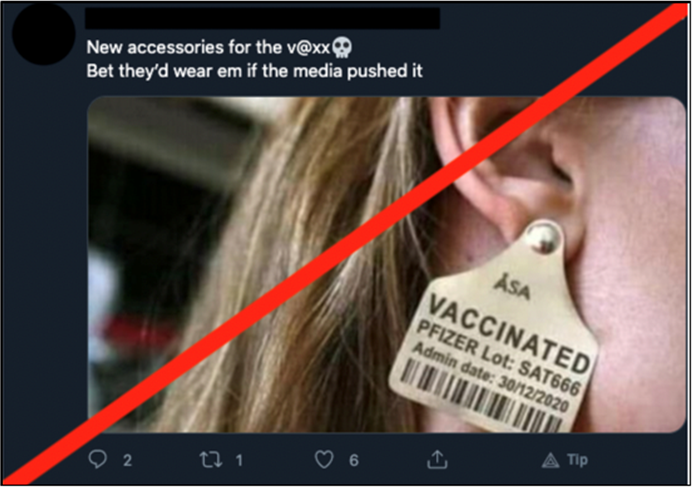
The VP complains that this joke-tweet with 6 likes and two quotes “is unlabeled, and, over a week after being posted, is still available on Twitter.” When I saw this, I had to remind myself that the VP had access to a Twitter feed that included 50 million Covid tweets per day. Was this really the best example of the dangerous misinformation flooding social media that they could find? Did they also expect Twitter to scour its site to remove all the mean jokes posted about the unvaccinated?
Here’s another example of the dangerous stuff that slipped through the cracks of Twitter’s content moderation:
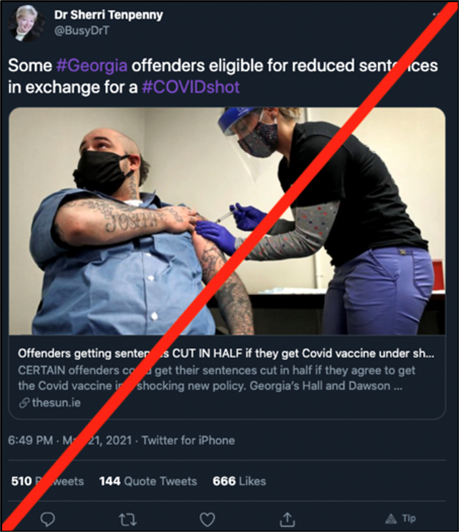
Per the VP, the problem with this tweet is that “prominent anti-vaccine influencer Dr. Sherri Tenpenny, uses a vaccine-neutral hashtag (#COVIDshot) in order to get her tweet which casts doubt on a vaccine program in Georgia to more users.” Again, is this one of the best examples that they could come up with? I read the tweet, the VP’s analysis of it, and looked up the story to confirm that it is accurate, and I still can’t figure out where the misinformation is. How is using a hashtag about vaccines to share a story about vaccines a devious trick to evade Twitter’s rules? Apparently, the VP knows that this tweet is misinformation only because it was posted by a “prominent anti-vaccine influencer.” If the same tweet had been posted by a pro-vaccine activist, it might have been read as celebrating a policy to get more people vaccinated. The VP’s own examples illustrate the impossibility of applying a misinformation based content moderation in an unbiased way.
My second response to the critic is that the content moderation avoidance strategies that worry the VP go far beyond lexical tricks. The primary avoidance strategy that concerns the VP is the Medical Freedom movement. Medical Freedom activists opposed governmental policies to control Covid by restricting individual freedom. They were opposed to vaccine mandates and passports and to lockdowns and mask mandates. The VP asserts that Medical Freedom became more popular online as the social media platforms cracked down on vaccine misinformation and argues that many anti-vax influencers shifted to posting about politics instead of medicine so that they could continue to get their message out to their followers: “Although these groups use freedom of choice as their primary framing and branding, much of their content aims to reduce vaccine uptake.” [19] The reluctance of social media companies to be more aggressive about suppressing the reach of Medical Freedom ideology was an ongoing source of frustration to the VP because they considered it an important source of vaccine hesitancy.
By suggesting that it was primarily a front for vaccine skepticism, I think that the VP completely misunderstands and underestimates the inherent appeal of the Medical Freedom movement in 2021. A useful resource for understanding the Medical Freedom movement is The Pushback, a film about the “Worldwide Rally for Freedom” held on March 21, 2021. The VP describes The Pushback as “an anti-lockdown, COVID-19 conspiracy film.” It was banned on YouTube, but was widely shared on alternative video platforms. I wasn’t aware of the film back in 2021, and I don’t think that I even heard about the Worldwide Rally for Freedom when it happened. The Medical Freedom philosophy was mostly ignored in the media that I consumed and of minimal interest to those in my social bubble as an academic in California.
But watching the Pushback in 2025 was a revelation for me. VP’s dismissive description of it as a Covid-19 conspiracy film is wildly inadequate. The film shows crowds gathering in parks and protesting lockdowns in several countries around the world. The crowd shots are interspersed with clips from lectures by several critics of the Covid consensus, including some of VP’s prominent anti-vax influencers. Yes, I did hear wild conspiratorial speculation. Many of the speakers on the Pushback thought that the government’s Covid responses were purposefully designed to undermine personal freedom as a prelude to dictatorship.
Yet, many of the alternative theories that the Pushback was pushing back in 2021 turned out to be far more correct than the official theories. The Covid lockdowns, mask mandates, and social distancing policies implemented by most governments around the world were largely ineffective in controlling the spread of the virus and were very damaging to many people, especially young and vulnerable children kept out of school. [20] I’ve only figured out recently how bad these policies were by reading some books, but the people at those rallies got it right long before I did. While watching the film, the sense of liberation felt by those crowds freed from their masks and joining together to assert their liberty was visceral to me, and I wished that I had joined them back in 2021 when I was cooped up in my condo drinking too much wine and watching the Game of Thrones.
While I remain highly skeptical of the idea that Biden administration was trying implement an Orwellian state during the pandemic, it is easy to understand why someone who was unnecessarily locked down for a year, who had lost his business or job, and whose children were suffering from distant learning and social isolation might start to think that the government was doing this to him on purpose. And, if the same government that had pointlessly constrained his life for the past year now told him that he needed to take a new vaccine to save his life, why should he believe them?
The VP is probably right to suggest that a pre-pandemic anti-vaccine, Medical Freedom movement took advantage of the pandemic to increase its influence. But the VP is wrong to believe that a savvy social media disinformation campaign was primarily responsible for their success. Instead, it was the flawed, freedom-restricting response to the pandemic by the government, the media, and academia that made Medical Freedom so attractive to many. Responding to their protests by suppressing and dismissing their views as pseudoscientific misinformation was a remarkably backwards strategy for restoring trust in public institutions.
To their credit, the social media companies resisted going all the way in restricting alternative political viewpoints. The VP acknowledged that it would be impossible to moderate Medical Freedom away because the platforms “consciously chose to avoid moderating the political debate about vaccines.” [21] Even the VP was reluctant to push too hard to censor the Medical Freedom movement. I believe DiResta is sincere when she says that the VP was doing its best to balance the freedom of political expression with the suppression of dangerous ideas about vaccines. But the VP didn’t really know what else to do with the Medical Freedom movement. Because misinformation researchers started with the false premise that distrust of the vaccines was primarily caused by online misinformation, suppressing or correcting misinformation was the only tool available to them for increasing trust. Unfortunately, it was a tool perfectly designed to do the opposite.
The Revenge of the Real II
The court documents in the Murthy v. Missouri decision offer a fascinating glimpse into reality’s revenge on the anti-misinformation coalition. On July 16, 2021, as vaccination rates continued to lag behind the administration’s goals, Biden “told reporters that social media platforms were ‘killing people’ by allowing COVID-related misinformation to circulate.” At the same time his Covid advisors were aggressively pressuring Facebook and Twitter to expand the scope of content moderation behind the scenes. [22] In public, Facebook made nice with the administration, but the social media companies grumbled in private that the administration was blaming them for its own failures. Despite Facebook’s promises to be even more assertive about policing misinformation going forward, vaccine hesitancy didn’t go away after July 2021, and vaccination rates never reached the levels that the Biden administration had promised.
The infighting between the government and the tech companies about who was to blame for the persistence of vaccine hesitancy is the kind of finger-pointing that happens when a team sees that it is losing. Whether the participants knew it or not (perhaps they didn’t figure it out until November 2024) the mutual frustrations in 2021 revealed that the anti-misinformation battle was already lost. Between 2015 – 2021, a billion dollars had been spent on an anti-misinformation strategy to restore trust in government institutions and experts, but it wasn’t working and wasn’t going to work no matter what Facebook, Twitter, the government, or public health communicators did.
How did this failed campaign get started? I don’t know the whole story, but I see part of it in DiResta’s origin story as a misinformation activist. In Invisible Rulers, DiResta explains that she first became aware of the dangers of social media influencers in 2014 when she joined a campaign in support of SB277, a bill in the California senate that sought to make it harder for parents to opt out of MMR vaccine requirements. DiResta was shocked by the fervor and vitriol of the online anti-vax campaign against her. She was doxed, harassed, and called a medical fascist. A picture of her son in a Halloween costume was shared on social media to portray her as a devil worshiper. The anti-vax activists were a small minority – 85% of Californians vaccinated their children in 2014 and 67% supported SB277 – but they were much more dedicated and networked online. Per DiResta, they used harassment and intimidation tactics to try to make supporters of the bill give up. Eventually, DiResta’s side won this battle when the bill was approved in the California senate, but DiResta worried about what the online campaign that she had been subjected to portended for the future of American politics.
I sympathize with DiResta’s experience and agree that online harassment and cancel culture mobs are detrimental to our political culture, but one of the lessons that she took from her experience was flawed. DiResta complained that most public health experts declined to join her in the online battle for SB277 in 2014: “They believed that what happened on social media didn’t matter. As a CDC employee put it to me at the time, ‘Those are just some people online.’” [23] One could argue that the CDC employee was right in this case. Despite the fervent online anti-vax campaign, most of the public wasn’t swayed, and the law passed by a wide margin in the senate. But DiResta worried that social media was the future and argued that public health institutions would have to join the fray instead of remaining aloof from it. The experts’ lack of social media skills and their plodding communication style would allow fanatics to implant crazy conspiracy theories in the public mind before the experts could issue their boring reports. If the experts failed to join DiResta on the social media front lines, scientific expertise would cease to be relevant to democratic debate.
Eight years later in the VP’s final report, DiResta and the other VP researchers still were complaining that the public health community was too slow to get involved in the online battle. According to the VP, efforts by social media platforms to respond to Covid misinformation by privileging “content from leading public health institutions, such as the CDC and WHO” backfired because:
Institutional sources did not always produce particularly timely content for platforms to surface, particularly in areas in which consensus took time to develop. Sometimes, in fact, institutions such as the CDC and WHO were reticent to take early positions on pressing COVID-19-related questions that the public wanted answers to, creating a data void; the early debate about masks was one such issue. [24]
According to this analysis, the lack of authoritative answers to pressing public questions at the beginning of the pandemic left a void that got filled with conspiracy theories. If only the public health agencies had been faster to fill the void with their expertise, they might have saved the public from so much confusion.
This analysis is totally upside-down for two reasons. First, public questions that don’t have definitive answers are less dangerous to democracy than the VP supposes. On the contrary, John Dewey, the greatest philosopher of American democracy, argued that the “quest for certainty” was a threat to democratic culture. Democracies don’t need top-down authoritative answers to end debate and impose consensus. They need to be open to a plurality of conflicting voices and to see their political choices as provisional, subject to critique, and open to change. Second, public health officials were not too slow but too fast to rush in and try to fill the data void. On masks, officials like Fauci sowed confusion and mistrust not because they were too reticent but too eager to offer authoritative answers backed by their credentials instead of scientific evidence. Our public response to Covid was not undermined by a confusing void filled with crazy ideas but by a brittle consensus held together by groupthink and a frigid, frightened culture of suppression.
In the Palisades fire in the LA foothills in January 2025, one of the tragedies was that the water pressure in the system got too low. Because the water couldn’t reach the hydrants at the top of the hill where the fire was, firefighters had to wait for water tanks to be filled up elsewhere and then driven up the hills. I’ve been imagining DiResta as a fire captain at the top of the hill yelling at the water tankers that she can’t wait for them to fill up their tanks. They have to drive up and join the fight immediately. But when empty water tanks get to a fire, they have nothing to offer the firefighters except more hot air. Doing good science requires patience, an open mind, and a willingness to evaluate new evidence and different theories regardless of where they come from. Practicing these intellectual virtues may make it harder to win online meme wars, but you can’t save science and democracy by abandoning them.
Perhaps fewer people would have gotten vaccinated if public health experts hadn’t flooded the void with unearned certainty while suppressing dissenters with anti-misinformation campaigns. Or perhaps more people would have accepted a jab without the hard sell. I don’t know. But the public reputation of scientific experts and institutions would have been healthier than it is today.
Footnotes
- ↩
DiResta, Renee. Invisible Rulers: The People Who Turn Lies into Reality. PublicAffairs (2024), p.365.
- ↩
See Our World in Data, for Covid Vaccination statistics. https://ourworldindata.org/covid-vaccinations.
- ↩
Memes, Magnets, and Microchips: Narrative Dynamics Around COVID-19 Vaccines (2022). The other organizations are listed on the title page:
- ↩
Memes, Magnets… p. 30.
- ↩
Memes, Magnets… p. 129.
- ↩
Memes, Magnets … p. 130.
- ↩
Memes, Magnets … p. 1.
- ↩
Memes, Magnets … p. 129.
- ↩
Memes, Magnets … p. 3
- ↩
For example, see DiResta p. 147: “Howling ‘censorship’ —a word with bad moral connotations—has become a favored tactic for working the refs.”
- ↩
DiResta, p. 295.
- ↩
It is complicated to estimate a counterfactual and estimates vary widely. This paper estimates that between 178,000 and 302,334 lives could have been saved depending on how many more people got vaccinated: Zhong, M., Kshirsagar, M., Johnston, R., Dodhia, R., Glazer, T., Kim, A., Michael, D., Nair-Desai, S., Tsai, T. C., Friedhoff, S., & Lavista Ferres, J. M. (2022). Estimating Vaccine-Preventable COVID-19 Deaths Under Counterfactual Vaccination Scenarios in the United States. medRxiv. https://doi.org/10.1101/2022.05.19.22275310
- ↩
Macedo, S., & Lee, F. E. (2025). In Covid’s wake: how our politics failed us. Princeton University Press., p. 156.
- ↩
Two recent books offer thorough and devastating critiques of the non-pharmaceutical interventions (NPIs) deployed during the pandemic. Macedo and Lee cited above and Zweig, D. (2025). An abundance of caution: American schools, the virus, and a story of bad decisions. The MIT Press.
- ↩
Macedo & Lee, p. 279
- ↩
Of course, Fauci was largely responsible for the convoluted masking policy that he was trying to defend. Macedo & Lee do a good job of documenting how the prevailing political winds, instead of new scientific evidence, caused the twists and turns of masking policies during the pandemic.
- ↩
DiResta, p. 149.
- ↩
Memes, Magnets … p.144.
- ↩
Memes, Magnets… p.130.
- ↩
Again, I am relying on Macedo & Lee and Zweig in making this assertion.
- ↩
Memes, Magnets … p.130.
- ↩
The pressure campaign is summarized in detail in Terry Doughty’s decision in the State of Missouri et al. versus Joseph R. Biden et al. (July 4, 2023), https://ago.mo.gov/wp-content/uploads/missouri-v-biden-ruling.pdf
- ↩
DiResta, p. 8.
- ↩
_Memes, Magnets …_p.133.