AI-generated image of the Flame of Tar Valon and the Dragon’s Fang.[1]
There are no beginnings or endings to discussions of Robert Jordan’s fantasy series The Wheel of Time, but this is a beginning. Yes, we’re looking at all four million words and change.
My goals for this review are below. We’ll devote one section to each:
- Help readers decide whether they should read the series or not.
- Briefly note the basic, overt themes of the series.
- Go in depth in examining the topic Jordan really cares about.
- Look at The Wheel of Time in light of Scott’s post “The Psychology of Fantasy.”
Section 1 will be spoiler-free. Sections 2-4 will contain spoilers, though I will try to limit them to general thematic content and not rehashing specific plot events in detail. My intent is that they still be readable for someone who has not read the series but would like to do so, provided they are not particularly sensitive to spoilers. I take no responsibility if they have more spoilers in them than you personally would like, though.
After Robert Jordan’s death Brandon Sanderson completed the final three novels of the series based on his notes. For my purposes here I’ll mostly speak of Jordan throughout.
1. Should I read The Wheel of Time?
It’s over four million words long. That’s over five times longer than the entire Bible. This will decide the answer as “no” for most of you, I think. Look at this shelf:
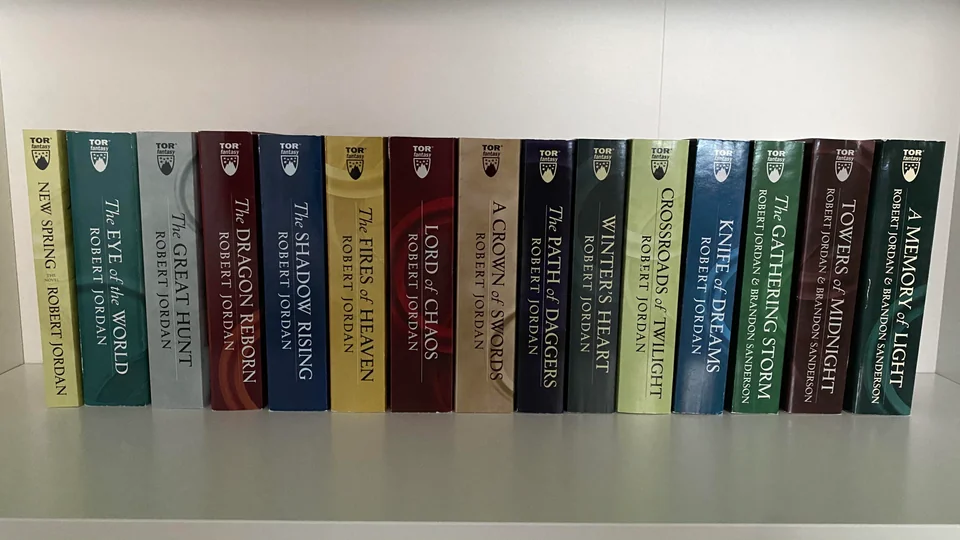
The whole thing took me the better part of a year reading fairly regularly for about an hour most days.
I definitely enjoyed it. If you like reading, and you like reading fiction for fun, and you like reading fantasy fiction for fun, and you want something that will last you a long time, it might be a fit for you.
As we’ll dive into more later sections, it does not feel like “just another generic fantasy.” Jordan does not just try to wow you with fantastic imagery, set pieces, and magic; in most of these ways his world would be quite generic. That stuff is there, certainly, and it’s important to the fantasy setting, but it’s not unique. Most of the word count in the story is devoted to an enormous cast of characters each pursuing their own agendas as they weave together like yarn on a spinning wheel into a larger tapestry.
Books 7-11 or so definitely slow down to the point that you can tell advancing the plot isn’t Jordan’s primary concern (see section 3 for what the primary concern is). When Brandon Sanderson takes over in books 12-14 the plot really moves forward again—the proliferation of new characters and factions and subfactions largely stops. It’s probably better for the series that Sanderson finished it, really. This whole inconsistency in pacing is one of the larger problems many people have with the series.
The meme culture around the series is well-developed, if that is a consideration for you.
On the whole, I’d recommend it, but I wouldn’t consider it a must-read unless you’re a fan of the genre.
2. What are the books’ basic ideas and themes?
SPOILERS START HERE!
The basic conceit of the series is that time is circular and the same events happen over and over again with slight variations. The spinning Wheel of Time weaves the fabric of the ages in a sort of Nietzschean eternal recurrence. The specific events of the series are basically Arthurian legend in an alternative past-future.
The main character, Rand al’Thor, is Arthur. He becomes a king later. He is also the Chosen One, which in this world is known as the Dragon Reborn (c.f. King Arthur Pendragon). He is initiated into his epic journey by a wizard Moiraine (Merlin) and taught swordplay by Lan (-celot). One of his potential love interests is Egwene al’Vere (Guinevere). al’Thor-Arthur later pulls the sword Callandor-Excalibur[2] from the Stone. He rules in Caemlyn-Camelot for a while, and it all ends in a big Last Battle, Tarmon Gai’don-Armageddon against the forces of darkness ending the Arthurian age (like Camlann for Arthur).
The most overt theme of the series is the Yin-Yang duality of things (the symbol is a frequently used image throughout the books). Magic is split in two—there’s a male half and a female half, and when the Dark One was sealed away thousands of years ago the male half was tainted such that all male wizards become violently insane. The Aes Sedai, a college of female magicians, supposedly have a monopoly on the arcane. They bring in any woman they find with sufficient magical talent into their fold and neuter men with magical potential before they explode. Yet the Dragon Reborn himself is a male channeler, and he forms a rival Black Tower of male mages. Ultimately, neither the male nor the female alone is able to resist the Dark One’s forces and the main characters and the institutions behind them learn that men and women must work together as halves of one whole. In the end of the story our hero even comes to the realization that Light and Dark themselves must exist in a balance.
In accordance with all this a great deal of the story is about gender politics. Jordan loves nothing more than inventing a huge cast of characters, which of course is why the series is capable of snapping the average shelf in half. Among these characters we see all sorts of relationships: men wearing the pants in relationships with women, women wearing the pants instead of men, men and women enslaving each other, hating each other, loving each other with the balance of power on one side or the other, and so on. There is a recurring gaffe where every time one of the three young male protagonists becomes entangled with a woman he wishes he had one or both of the other two around to help him—they are the ones who really understand the opposite sex, you see.
That’s all fairly surface level. You’re beat over the head with the fact that there is the Male and the Female and that proper relations between them are difficult but meaningful and powerful.
3. What does Jordan really love to explore in his fantasy world?
Jordan’s interest goes beyond just gender politics, however; that’s an integral part of the fantasy world he constructs, but his real fascination is politics more broadly. Look at how many kinds of power structures exist among female magicians alone:
- Aes Sedai have authority based on how much magic power they have.
- Windfinders have authority based on the importance of their assignment and their clan’s standing.
- The Kin yield to more senior members.
- Wise Ones defer to sheer force of personality.
- Black Ajah Aes Sedai operate in small cells, in principle obedient to a central authority but each constantly looking to advance by backstabbing.
- Sharan channelers obey one emperor or empress of their number absolutely.
- Seanchan damane (slaves) are chattel with no authority at all.
The author loves to take characters from one of these factions and dump them into another in order to watch them struggle with culture shock. The reader gets a good giggle when snobbish Aes Sedai are forced to submit Aiel Wise Ones and made to run around as their apprentices and conversely feels horror when a heroic Aes Sedai in training is forced into damane magic slavery.
A natural question is “which of all these institutions are effective?” Which sorts of rules and forms of hierarchy are effective, as Jordan writes them?
Some forms seem obviously weaker than others. The Kin’s gerontocracy, for instance, seems somewhat tenuous as soon as it is introduced because much of the power in the organization is wielded by an only-a-hundred-or-two-so-not-that-old organizer with great charisma. The Wise Ones seem quite capable, but they do not actually rule in their society and in a splinter group of Aiel where the Wise One faction does rule we see a lot of bickering and infighting. The Windfinders have a disciplined organization, but it really only works in the context of living on boats and there is no potential for innovation or initiative in ways that don’t involve living on boats.
Monarchy comes out looking pretty good, given that several major protagonists are monarchs. The principal one is Andor, which generally appears well-governed by two capable queens over the course of the story. Jordan shows us two of its failure modes: first when the queen is brainwashed by evil magic and second when there is a succession crisis. You can easily find an analogous situation to the former even in nonmagical democratic governments—perhaps a Bush has a Cheney, perhaps a moderate politician has to make concessions to the more extreme wing of the party. Or maybe Korean cultists are really in control of your elected officials. It happens. Succession crises, too, aren’t uncommon. While many democracies manage peaceful transfers of power frequently, even in the U.S. we had a near-miss in January 2021.
These problems aside, strong central authorities end up looking good in other institutions too. The White Tower of the Aes Sedai goes through a number of Amyrlin Seats or presidents, each of which has to work with the Hall (i.e. the Aes Sedai senate) to pass their agendas. The greatest danger to the faction as Jordan presents is the danger of inaction, backstabbing, and internal politics interfering in meaningful directed action. The two legitimate Amyrlins are both heroines and the second’s rise to the seat (and more importantly, her cementing her power) is always presented as good and necessary. While Jordan likes this, he does show that a check on authority is critical to avoid a turn into tyranny. We see this in the case of the illegitimate[3] Amyrlin, who makes a mess of things when the equivalents of Hufflepuff, Gryffindor, Ravenclaw, and Slytherin don’t coordinate or cooperate at all due to distrust seeded by the large number of evil cultists within the Tower. The powers granted to the executive are not too great, really, but the Hall is too splintered and weak to act as a meaningful check. Even going back to Jordan’s monarchies we see strong but not absolute power; ruling house Trakand must make alliances and coalitions with other major houses, and so on.
This is the form of government the main protagonist tends towards as well. Rand happens to get a few nations under his control by fulfilling a few prophecies but he is initially very suspicious of anyone seeking to advise him, fearing to be controlled. Even well-meaning Moiraine has to swear allegiance to him before he will continue to listen to her, and when she disappears he is very hesitant to listen to anyone. He gradually turns into a heartless figure and something of a tyrant before coming around and realizing he cannot do everything himself; he needs a good network around him to keep him in check. Ultimately he governs as a nonabsolute monarch whose underlings have real authority, the same form we see elsewhere.
One reason Jordan seems to like the strong executive is that he seems to have a real disdain for petty politicking. The noble class’ maneuvering among itself by subtle moves of intrigue, espionage, and social climbing is graced with the name of Daes Dae’mar, “the game of houses.” It is made to look stupid constantly. Minor characters frequently examine the lowborn heroes’ actions to find some hidden agenda or meaning behind them when they really are as simple as they appear on the surface. One secondary protagonist becomes a lord of his own realm and his brusque, direct manner wins him acclaim from every other faction he deals with. Similarly, the Aes Sedai Cadsuane is treated as a living legend among her colleagues, but she eschews living in the White Tower for its meaningless politics and perpetually lives on the road in order to effect meaningful change. Her direct style confounds every mainstream Aes Sedai she encounters; she demonstrates how a strong leader cuts through inaction.[4]
All of this stuff ends up having a bit of American flavor to it. The best government is a President with a Congress beneath him or her, nobility shouldn’t receive special legal privileges (Rand abolishes a two-tiered justice system the first time he is in power), a we-don’t-bother-with-your-aristocratic-nonsense attitude, etc. Perhaps this is not surprising given that Jordan was a Vietnam vet and nuclear engineer for the U.S. Navy. The Americanness of the series is even intentional—the protagonist unites the northern half of the continent against a rising faction in the southern half which relies on slave labor. Sound familiar? Of course, Rand doesn’t conquer the South but instead makes a treaty with them. The Dark Lord’s forces are a bigger threat, and that’s a great political lesson in keeping with the series’ theme of balance. Sometimes you have to accept a lesser evil to deal with a greater; there’s trade-offs in every domain and a leader’s job is to identify what these trade-offs are and what choices will best align with his objectives and strategy.
Stepping beyond the books we find that Jordan described himself as a “libertarian monarchist.” I think after what we’ve observed above we can see what he might mean by this strange descriptor; it’s something in the American liberal tradition but with a lord. Not King George but King George Washington.
An aside about what Jordan is certainly not interested in exploring in his four million word series about the forces of the Light fighting men and women who have sworn their souls to the Shadow—he hardly says anything about why anyone would fall to evil (politics of the soul?). It becomes a great big gaping hole as the series progresses and more and more evil characters are introduced. Dostoyevsky writes whole novels about how individual morality walks the edge of a knife and sin is at hand every moment; the most detailed fall to the Dark Side Jordan gives us—and it’s in the Sanderson books, so Jordan doesn’t even do it himself—is a character who says they learned a bit too much about an evil covenant and was pressured into joining and making the oaths, but never really gave their soul to evil and was working as a double agent for the good guys all along. That’s it! It’s not even a fall to evil except in name! All of the dozens of evil characters, every one of whom endorses murder and backstabbing and treachery, might as well have just been born that way. I suppose there’s also the falls where someone is magically turned evil by force, possibly by killing them and animating their bodies with pure evil, but that’s not very psychologically convincing either. Even the thirteen powerful Dark Apostles only effectively get one word explanations for their long-ago falls, things like “he was jealous of the Chosen One” or “she wanted power.” Now, I tend to like the Dostoyevsky approach. I liked reading The Brothers Karamazov and seeing the means, motive, and opportunity for a murder align and feeling the tension as I wondered if the character would really do it. I’m not saying that should have been present for all of these evil characters, but if even one convincing example had been given of a character’s slow fall into wickedness by subtle seduction and relatable intentions the series would have greatly benefited from it.
He also hardly discusses religion at all. The cosmos is assumed by every character to be a sort of clockwork universe put in motion by a Creator outside of time who is now totally absent. Why does everyone believe this? Is it even true in-universe? Unclear. Jordan does no more than allude to the existence of theological discussions among the nerdiest of wizards, and this in a world where the Devil is real and very interested in your suffering. In interviews he says this is because there is not much of a question of faith in a world where magic is real and demonstrable; it seems to me like he just prefers political to speculative philosophy.
4. “The Psychology of Fantasy” and The Wheel of Time
Scott writes about the hypothesis that “each part of the [maximally generic] fantasy universe has a load-bearing psychological function; if you altered it, it wouldn’t perform the function as well” and concludes that “every part of the [generic] fantasy universe is optimized to justify why a person with no special ability or agency can save the world.” You should read the whole post for the details about how the specific tropes of the fantasy genre support this psychic objective.
The Wheel of Time, on its surface, is extremely guilty of this. The main character, and actually a lot of the main characters, just happen to have been born as more powerful magicians than have been seen in hundreds or thousands of years. No agency involved there. And you have to be born with magic, you can’t learn it, you can’t change how much magical potential you have, nothing. And the main character Rand al’Thor is the literal Chosen One by happening to be the reincarnation of the previous Age’s Chosen One. And everything starts out in a totally agencyless way, “oh no orcs Trollocs are attacking your hometown, you kids better come with me on a dangerous journey to Hogwarts.”
But then everything changes.
Rand becomes a real agent and takes it to the extreme. Sure, he happens to have had a head start in the “being important” department by virtue of his birth and being destined to die in the Last Battle with the Dark One, but he really leans into it. Not only does he not allow himself to be a puppet of the institutions that would control him, he also does not sit back passively and just react to events. Starting in book 3 he drives his own course. He abandons his companions to go get the magic artifact, he sets traps for the Thirteen Dark Apostles of Evil, he founds multiple institutions for both mundane and magical science, he rules nations, issues policy, passes judgement, decides killing innocents is cool and valid, and so on. (He gets better about the innocents thing.)
In the generic fantasy setting “they bound the Dark Lord 999 years ago so that the solution to the Dark Lord problem can be ‘go on a quest to the Tower of Binding and tighten the screws’ rather than the normal solutions of ‘raise a giant army’ or ‘discover new anti-Dark-Lord technology yourself’. The latter are solutions that require a competent agentic person.” Rand, on the other hand, spends the entire series raising a giant army for Armageddon and dealing with the many political skirmishes involved in doing so. That’s basically what the entire series is about. He also discovers new anti-Dark-Lord technology, too, when he implements his plans to do something about the tainted male half of magic.
This all makes reading the series feel a bit different than the truly generic fantasy. Rand’s agency makes him more than just a candidate for self-insertion into the story. He’s a real character.
The flip side of this, though, is that it’s hard to write a whole fantasy story with a really agentic hero.
Scott notes that “the way to become [the agentic hero] John Wick is to practice shooting, every day, again and again, more obsessively than anyone else” and that this is “boring to watch”: “the movies don’t show it, and if they did it would be a short training montage.” And sure enough, when Rand is at his most agentic he frequently leaves the page. There are some books in this series where Rand is almost entirely absent until the end. It’s hard to write in tension for an agentic character; there’s not much drama in “man sees problem, man makes plan for problem, man implements plan, problem is solved.” Tension comes for free in a nonagentic context—having no control is inherently a tense situation. To remedy this, Jordan often writes Rand’s agentic arc as “man sees problem, ???, man implements surprising plan for problem, problem solved.” That’s Rand’s arc in the Aiel Waste, Far Madding and Shadar Logoth the third time, etc.
Then to write up a whole doorstopper story you need other stuff to fill the ??? above. Most of the other characters in The Wheel of Time have much less agency. There’s a lot of “your mission is to go do X” for Nynaeve, Egwene, Mat, Perrin, and others, and a lot of situations beyond those express orders where these characters are basically shoehorned into a particular course of action (it’s not like Perrin really has a choice about whether to rescue his wife, and so on).
I think the series represents an interesting experiment of how far one can introduce agency into a fantasy novel. As I see it, Jordan is hugely successful at introducing stakes, depth, and weight to his novels this way. It adds a ton of value and is a big differentiator for them in the genre. But ultimately the agentic parts of the story can only make a relatively small (still huge in absolute terms) fraction of the total page count. Things can be pushed about this far, but not much further, I think, for narrative and dramatic reasons.
There are no true endings to the turning of the Wheel of Time, but this is an ending. Thanks for reading.
Footnotes
- ↩
The black half should be pointing down and the white bit pointing up to be book-accurate, though.
- ↩
Excalibur is not the Sword in the Stone in all versions of the Arthurian legend, but you get the idea.
- ↩
If you’re picky, Elaida is actually the legal and legitimate Amyrlin Seat as far as the law goes, but she’s the “illegitimate” Amyrlin for the purposes of the story. One of the lessons of this story arc is that legitimacy and illegitimacy aren’t just decided de jure but also de facto. The “rebel” Amyrlin becomes de facto leader and her de jure installation follows.
- ↩
Some fans of the series might take offense at me seemingly praising Cadsuane, who many see as possessing the bad traits of the other Aes Sedai. She does share a lot of their flaws but in my estimation she is relatively good, as far as the faction goes.