Arnold Schwarzenegger walks out onstage at the Sydney Opera House, and starts to flex his incredible physique. Cameras flash and the adoring crowd reacts with amazement to his size and shimmering muscles. It is the 1980 Mr. Olympia competition and Arnold is returning after a 5-year hiatus from bodybuilding competition. He's kickstarted a hugely successful career as an action star on the big screen, and has come back just after filming for Conan the Barbarian. Arnold is competing with 15 other professional bodybuilders who were on stage during the night.
At the end of the competition, the judges confer, and Arnold is announced the winner of Mr. Olympia 1980. Roughly 40% of the 2,000-strong Sydney crowd erupted in boos. Runner-up Chris Dickerson shouted "I can't believe it!" as he immediately jumped off stage. The mood and reception to the show were so poor that the CBS film crew who were covering the event decided to not air footage of Mr. Olympia that year. The 2023 Netflix documentary Arnold conspicuously omits the 1980 Mr. Olympia event entirely. After a reordering of the judging rules was decided following the competition, it had gone down as the most infamous Mr. Olympia of all time.
So what happened? Why was the crowd's reception so poor? Wasn’t Arnold the greatest bodybuilder in the world? Arnold was the greatest—before, from 1970 to 1975. Arnold dominated the Mr. Olympia prior to retiring and pursuing acting. Now by 1980 after five years away from professional bodybuilding and facing a more competitive field, Arnold Schwarzenegger's physique did not compare favourably to some of his competitors or even to his own physique five years prior. Arnold was not the favourite to win. Arnold wasn't even pre-registered for the competition! He showed up unannounced to the competitors the day before and registered to compete. The organisers of the event, the International Federation of BodyBuilders (IFBB) had to bend the rules to allow Arnold to enter the competition. The CBS crew had refused to produce the recordings, because in their view the contest had been rigged in Arnold's favour.
The fans booing in the Sydney Opera House had shown up to see a new generation that had risen since Arnold's retirement — Chris Dickerson, Tom Platz, Casey Viator; a generation that included men training by radically new methods.
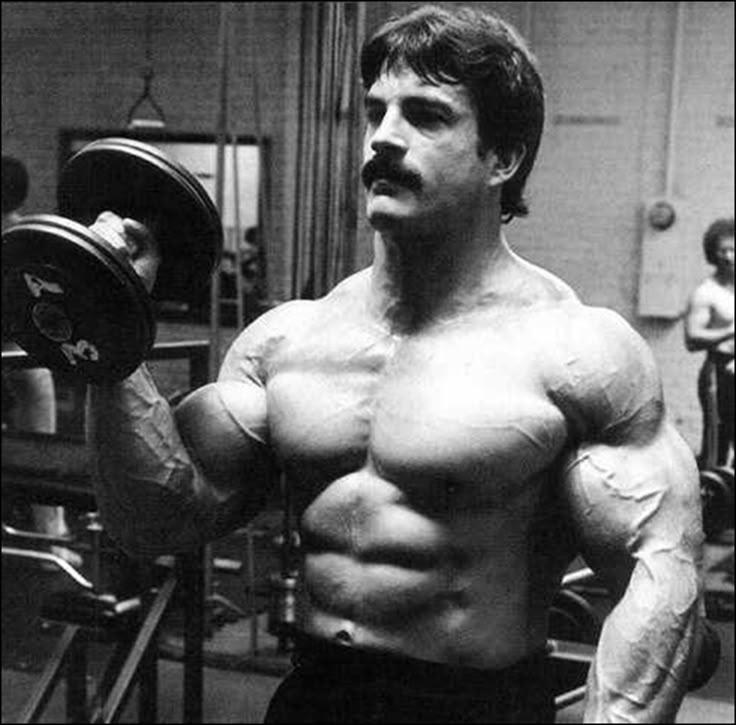
One bodybuilder pegged as the-one-to-watch coming up to the Mr. Olympia was Mike Mentzer. The 29-year-old possessed an absolutely mind-boggling physique, weighing in at 225 lb incredibly lean. Mentzer was not only riding a huge wave of popularity from his previous win of the Mr. America competition with the first and only perfect score. Mike was also cut from a different cloth than other pro bodybuilders; highly analytical, with a strong interest in philosophy and science. Mentzer was not only challenging Arnold in the Mr. Olympia, but he had also been challenging his training methodology by writing numerous articles in the muscle building magazines of the time: promoting a clean, straightforward 'objective' system that mirrored his personal interest in Ayn Rand's Objectivist philosophy.
The biggest difference between Mentzer and his competitors was his approach to muscle training volume: bodybuilding legends such as Arnold Schwarzenegger and Franco Columbu advocated a 'high volume' training approach — going to the gym 6 days a week, two hours a day for a total of 12 training hours a week or more. In contrast, Mentzer was training 3 hours a week in the run up to Mr. Olympia. How could someone training one quarter as much as other pros reach the absolute peak of competition and be in the running for top bodybuilder in the world? This is the story of the battle of those training philosophies and Mike Mentzer’s attempt to create an objective and scientific approach to bodybuilding.
The King with No Crown
Mike Mentzer's genetic potential was clear from a young age. By age 15 he had bench pressed 370 lb (170 kg). Later on, Mike would be very open about the importance of genetics (and performance enhancing drugs) in bodybuilding.
This followed his initiation into weight lifting at age 12 when he received his first barbell set as a gift for Christmas. He spent the whole Christmas break lifting in his garage. Mentzer's interest was sparked that year when he came across a photo of a 'muscle man' in a magazine while shopping with his mum, and immediately decided he wanted to become a bodybuilder. Mike had a natural athletic ability expressed in fast sprinting ability and success in football, but he would ultimately focus his efforts on bodybuilding.
Mentzer had also shown a proclivity for intellectual interests from an early age; reading and achieving straight As in school. While Mike continued his weight lifting in high school, his young brother Ray who shared the same genetic predisposition towards spectacular muscle growth and an interest in the bodybuilding world followed suit.
In his early days, Mike Mentzer followed the weight lifting methodology that was popular in the muscle building magazines of the time: a 'high volume' approach meaning a high amount of total work, specifically a greater number of sets and reps in the gym. Achieving this volume would involve mammoth two or three hour sessions in the gym, training up to six days a week. These methods were promulgated in the magazines, many of which were owned by Joe Weider, a Canadian entrepreneur and creator of the Mr. Olympia competition and the International Federation of BodyBuilders (IFBB). Mike attended the first ever Mr. Olympia competition at age 13 where legend Larry Scott won his first Mr. Olympia in 1965. Mentzer later recalled "The 1965 Mr. Olympia contest was an almost religious experience for me".
When young Mike came home from the Mr. Olympia he took out his latest copy of the Muscle Builder magazine and wrote out his future career milestones on the inside cover:
- 1972 (Age 20): Mike Mentzer - Mr. America
- 1974 (Age 22): Mike Mentzer - Mr. Universe
- 1976 (Age 24): Mike Mentzer - Mr. Olympia[1]
Early Career
This early ambition to conquer by bodybuilding was matched by Mike's strong work ethic and order-seeking personality. Mike would log all of his weight lifting sessions meticulously, with goal weights and reps written out before the beginning of every session. This same methodology and numbers-based approach would be promoted by Mike later when he created his pamphlets and video guides under his own 'Heavy Duty' label.
Mentzer continued to train diligently in school, competing in swimming, track and field, football, and baseball. However Mentzer's preoccupation with bodybuilding over other more conventional sports caused a rift with his father. This rift would only be fixed ten years later when Mentzer won the Mr. America.
After high school, Mentzer joined the Air Force and won his first amateur bodybuilding contest one year later: Mr. Lancaster County, Pennsylvania. This win was followed quickly after by a win of Mr. Pennsylvania and Mentzer's first use of steroids (Dianabol).
By 1971 Mentzer was near a breaking point.
Prior to that time I was training up to 3 hours a day, 6 days a week making little or no meaningful progress. I had finally reached a point where I was about to forsake my bodybuilding goals. I couldn't justify spending 4 hours a day in the gym
That year Mentzer competed in the Mr. America competition, placing a disappointing 10th place. 19-year-old Casey Viator swept the competition. Viator noticed Mentzer's incredible genetics and pulled him aside and gave him the contact information for Arthur Jones, an exercise machine entrepreneur and pioneer of High-Intensity (HIT) Training. Viator said Mentzer had potential and should call Jones. Mentzer called Jones and was introduced to HIT training:
At that time I was fortunate to make the acquaintance of Arthur Jones who, during a lengthy phone conversation, explained to me in the most scrupulously objective language imaginable the theory of high intensity training... I recognized almost immediately that it was true... In fact, I came to realize I knew almost literally nothing of value about the subject of exercise.
The High-Intensity training involves performing training once to the point of muscular failure e.g. one all out set of bicep curls until can't do any more. The workouts are short but very intense.
Armed with Jones’s high-intensity principles, Mentzer's career continued. The brief but brutal workouts allowed him time to complete his routine and continue to gain strength and size. In 1976, exactly four years behind his childhood schedule Mentzer captured the Mr. America title, finally reconciling with his father. Two years later, he won the 1978 Mr. Universe with the first perfect 300 score in history. By 1979, Mentzer was a professional, placing a controversial second at his Mr. Olympia debut. It was in the run-up to this debut that Mentzer began amphetamine use for productivity.
The 1980 Mr. Olympia
Mike Mentzer prepared for the 1980 with a determination and ferocity that put his previous run-ups to shame. While the competition would be held in the Sydney Opera House in October, Mike began his dieting in February - much earlier than his usual 12-week run-up dieting. While Mike was giving himself plenty of time to recover and wasn't spending excessively long periods of time training, he was keeping an absolutely strict diet and pushing the limits of the level of lean muscularity the human body had achieved up to that point.
Mentzer was pushing himself to such an extreme with dieting, training intensity, and a work schedule including writing for magazines and running his mail-order "Heavy Duty" business at the same time. Some days Mentzer would wake up feeling 'on death's door,' unable to lift an arm due to the fatigue. Even with the fatigue, Mentzer had achieved a level of muscularity and leanness far above his shape in the previous year and felt ready for the Olympia:
I looked my best, but I didn’t feel at my best. It just didn’t feel like a normal contest; no one was being their usual self. There was a strain and tension in the air all the way through
Mentzer was in Sydney along with fourteen other professional bodybuilders ready to compete. One surprise came as a shock to all of them: Arnold Schwarzenegger announced he was competing. He had come to the competition ostensibly for promotion for his new movie Conan the Barbarian. Reactions among the competitors were mixed. Frank Zane and Boyer Coe expressed pity that Arnold was going to return in the shape that he was in, lose and tarnish his legacy. Arnold was described as not being sufficiently 'conditioned' which is bodybuilder-speak for high bodyfat percentage not being low enough.
Besides the shock announcement, the competitors were already petitioning the organisers for a change to the structure. The Mr. Olympia competitions between 1974 and 1979 had been split into two weight classes: those over and under 200 lb (90 kg). The winners from each weight class would pose against each other where the overall winner was decided. 15 of the 16 bodybuilders competing had signed a petition asking to abolish the weight classes in the competition. Rather than have a light weight and heavy weight division whose winners subsequently faced off, all bodybuilders would compete on an open weight class. The only competitor who disagreed was Arnold.
Arnold Schwarzenegger was no stranger to using psychological warfare against his opponents to knock their confidence before a competition. The IFBB's bending of the rules to allow Arnold to compete, along with his known use of joking or intimidation before the competition had raised suspicions among the competitors.
The competitors met to discuss the petition to abolish the weight division. The room was filled with 16 enormous muscular men, all dieted down to an extreme level of leanness for the competition. Tensions were high. Boyer Coe, one of the professionals competing asked in a friendly manner if he could explain why he wanted to keep the two weight divisions. Arnold responded by calling Boyer Coe a "big baby". This raised the hackles of Mentzer, who the day before had been stricken with one of his 'death's door' days of fatigue. Mentzer backed up Boyer, saying he had only asked a reasonable question.
Arnold goaded Mike "Oh come on Mentzer, you know that you lost last time because of your big belly". Mike became irritated to say the least. Mentzer crossed the room toward Arnold, who sat down and avoided eye contact as Mentzer wagged his finger at him.
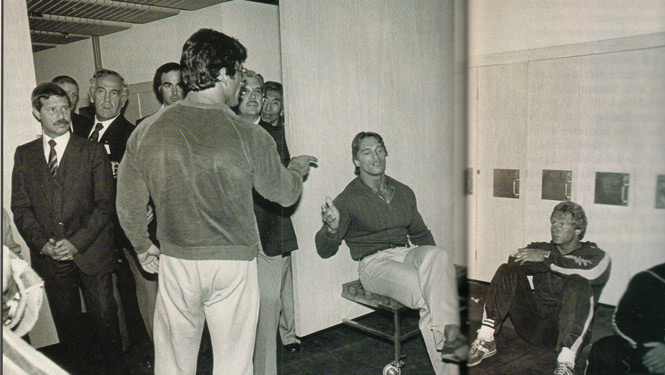
Eventually the fracas was broken up and the bodybuilders split ways to prepare for the competition. The weight class system was agreed to be abolished for the 1980 Mr. Olympia and has never returned.
In the evening, the competition began with each competitor showing off their physique. From The Wisdom of Mike Mentzer:
From out of the darkness, music was heard, a stirring and soulful string section: "Siegfried's Funeral March" by the renowned and controversial classical composer Richard Wagner. A lone spotlight hit the center of the stage into the ring of illumination appears Mentzer. A collective gasp issued from those attending; he had not even hit his first pose and already the Mentzer physique was magnificent
Mentzer's routine was being well received:
the crowd roared their approval as Mentzer slowly turned to reveal his back. In perfect syncopation, the music changed to Aaron Copland’s Fanfare for the Common Man, and Mentzer raised his arms again, this time allowing the audience to see his shoulder muscles snap to attention. What appeared to be small explosions of activity in the deltoid muscles gave way to wave upon wave of intricate muscular detail that coursed through the width and breadth of his back: traps, rhomboids, teres, and erectors—all undulating and rippling like waves across the surface of a pond. These were images that Mentzer could freeze at any time, posing several different muscle groups at once until his back looked like a bronze relief map. . . .
The audience was still seated in stunned appreciation when the music played again, and Mentzer raised his arms fully out to the side, flexing his biceps, triceps and forearms and causing his phenomenal lats to flare out like a manta ray as they tapered into a wasplike waist.
As other competitors prepared for posing onstage, Arnold told jokes to break their concentration and jumped out of line to strike poses - behaviour that would normally get penalised but which was excused for Arnold. He was excused for repeatedly ignoring calls from judges to change poses and stepping forward from formation. By this point, confirmation that Arnold was competing had gone public and the audience was ecstatic. Arnold made up for his lack of conditioning with charisma. "Arnold hit a most-muscular pose as he left the stage to which the crowd roared".
After all the presentations were complete, all competitors were waiting on stage of the Opera House waiting for the judging. Arnold was announced as the winner. The audience booed at the results. Runner-up Chris Dickerson jumped off stage yelling "I can't believe it". Zane reportedly walked off stage and threw his trophy at the wall. Later on, CBS executives refused to air the footage after returning to the US - they believed the contest favoured Arnold unfairly. For a major American broadcaster to decide a sporting event was too corrupt to show was an extraordinary message.
Those calling the event corrupt had evidence to point to. The judging panel was filled with individuals who had personal ties to Arnold:
- Reg Park was a close friend and bodybuilding idol to Arnold since he was nineteen
- Albert Busek was a close friend of Arnold's from his time in Germany
- Mits Kawashima was a friend of Arnold's from Hawaii who regularly brought Arnold there to guest pose
All three gave Arnold the highest possible score (20) in the first round. The show's promoter Paul Graham was also Arnold's good friend. On the physique side, Arnold's condition was said to be below his last appearance in 1975, especially his legs. Competitor Boyer Coe stated Arnold 'had legs that looked like they belonged in a chicken nest'. In an increasingly competitive field, it appears unlikely Arnold would have won on the merits of his physique alone.
In the aftermath, multiple top competitors including Zane, Coe, and Mentzer vowed to boycott the 1981 contest. After receiving fifth place, Mentzer would never compete in bodybuilding again. New rules regarding judging were set in place by the IFBB removing promoters’ ability to select judges. Joe Weider later said to Mike Mentzer that Arnold was on cocaine that day. He had an unusually stressed look.
Aftermath of the 1980 Mr. Olympia
After the fiasco of the 1980 Mr. Olympia, Mentzer retired from bodybuilding never to compete again. The Olympia loss was a devastating blow to his life, which until then had been on clear tracks to fulfil the goals he had written for himself on the inside of his Muscle Builder magazine. This was the beginning of a difficult decade for Mentzer.
By 1982 Mentzer's income streams had collapsed, going from $200,000 a year down to zero. He believed he was blacklisted by the IFBB and had trouble finding work. Mentzer's own magazine Workout for Fitness folded around this time. He was devastated.
In addition, Mentzer was entering a spiral of decaying mental health. In 1979 he had started taking amphetamines to give him extra energy for writing for magazines, often going days without sleep and its effects were starting to take a toll on Mentzer's body and mind. By the middle of the 1980s he was entering a five-year spiral of multiple institutionalizations, periods of suicidal ideation. He stopped writing entirely, with no presence in the muscle magazines for four years.
Tom Platz was another Mr. Olympia competitor and friend of Mentzer's. He recalled walking to Gold's Gym in Venice, California, where he used to train with Mentzer among others. He saw Mentzer lying unconscious in the gutter outside Gold's Gym. Later he watched him come into the gym to take down his photos from the walls.
By the early 1990s, Mentzer had managed to recover to a better state of mental health. Although he didn't physically train, he began coaching clients and also started a productive phone coaching business - often advising young men to stay away from anabolic steroids and recommending they pursue business and academics as their primary path rather than bodybuilding 4.
Death
In 1999, Mike's younger brother Ray began kidney dialysis for Berger's disease. Mike offered to be a donor, but discovered he had a serious heart problem of his own. In 2001, Mike moved in with Ray to look after him. On 10th June 2001 Mike died in his sleep of a heart attack, aged 49. Two days later, Ray died. The two brothers who looked like clones in their prime died within forty-eight hours of each other.
Heavy Duty Ideas
It is worth remembering how niche a hobby weight lifting was in the 1960s and 1970s. Today, the normalisation of lifting culture is complete: Track and field athletes weight train, militaries furnish their gyms with weight lifting equipment, medical doctors recommend weight lifting even to elderly patients for health and longevity. This is a far cry away from a time when Muscle Men puffing up their muscles was an eccentric hobby with a small number of total practitioners. I asked Claude for a current hobby whose number of participants is comparable to 1970s bodybuilding: it came up with Historical European Martial Arts (HEMA) or competitive pinball today.
Bodybuilding is an unusually influential discipline on the diet and exercise methodologies followed out in the wider world, far outsized for bodybuilding's number of actual competitors or sports revenue. For example, when Navy SEAL D.J. Shipley was stationed in a forward operating base in Iraq and was regularly engaging in night-time raids and combat the most common training routine followed by SEALs early in the war wasn't an Olympic weight lifting routine, or a lifting programme designed for soldiers - it was Arnold Schwarzenegger's The New Encyclopaedia of Modern Bodybuilding. These were elite special forces soldiers, in Iraq, and they were taking exercise selection, training technique, and volume recommendations from the man who played Kindergarten Cop because he was the most famous bodybuilder.
So while bodybuilding was a niche hobby, the debates that took place in the muscle building magazines would set the foundations of practices followed by hundreds of millions of people today. A bit like how maybe debates on HEMA forums in the 2000s on the proper way to use a sword or spear would be really influential later on if a zombie outbreak happened.
The Wisdom of Mike Mentzer was written by John Little, a fitness writer and bodybuilding advocate who knew Mike Mentzer personally. Along with this, he has written Mike Mentzer: American Odysseus, the only biography of Mentzer published to-date. The purpose of The Wisdom of Mike Mentzer is to explore Mentzer's philosophy of bodybuilding training, both in philosophy and exercise science.
Mike Mentzer's big idea for bodybuilding was that the stronger you get, the more intense the demands on your body get, and therefore the period of rest and recovery needed before you train again gets longer. According to Mentzer a gym newbie may have the potential to increase strength by some 300% of a natural maximum, but the body's recovery ability can only increase 50%. It was this idea that Mentzer tried to popularise throughout his career:
As you grow stronger and bigger you don't do more exercise you do less because the stresses are growing greater. In other words, a beginner is too damn weak to overtrain. But as you grow bigger and stronger and you're handling 500 lb squats you can overtrain very easily.
In practice, this means that a bodybuilder looking to progress should not add in more workouts or make pre-existing ones longer. Instead the way to progress is intensity. HIT practitioners emphasize training intensely above all else; the decrease in volume is made up by a corresponding concentration of pain and effort in the smaller number of sets that are performed. HIT practitioners 'train to failure' — that is, working out one muscle group until you couldn't do one more rep even if someone had a gun to your head. HIT is essentially the Ikken hissatsu of bodybuilding, the one punch kill. If you want an idea of how hard, think of the Gom Jabbar test in Dune:
Dorian put forth so much effort; this 275-pound monster was shaking from his head to his toes and grunting like a bear trying to make those last reps.
John Little described Mentzer putting an English bodybuilder through his one-set per muscle group routine:
Yates gritted his teeth and summoned all the energy he could muster to keep that weight from coming down; his forearms bulged as he gripped the handles of the machine and his pecs looked like they were about to explode through his sweatshirt! ... Sweat was now pouring freely down Dorian's face, and his arms shook until he could no longer contract against the resistance
HIT advocates also point out that the marathon length workouts promoted by Arnold are not beneficial for those with a normal complement of hormones. Only those with superior genetics and who take steroids can continue to make progress with the high-volume workouts lasting hours, while normal people will become exhausted and demotivated making no gains. HIT workouts are better for pro bodybuilders, but they are especially effective for normal people seeking to gain muscle and strength.
So was Mentzer right?
The first challenge comes from tradition: If HIT advocates claim this method works for both strength and hypertrophy, why hasn't it been discovered before? Why didn't militaries or sports teams discover this in the preceding centuries or millennia? Looking to tradition, the oldest example of progressive resistance training is Milo of Croton, a Greek wrestler who trained every day by carrying a calf until it was full-sized; a routine that is not incorporating resting days or low volume. The HIT advocates respond that in essence, civilization was stuck in an inadequate equilibrium. Previous training philosophies were hidebound by tradition and using methods inherited optimised for a mixture of strength, speed and endurance all at the same time.
Mike Mentzer fans and low volume training will point to Dorian Yates as a successor who vindicated the high intensity, low volume approach. Yates was the Hayek to Mentzer's von Mises. From Yates' Wikipedia:
Dorian Andrew Mientjez Yates (born 19 April 1962) is six-time Mr. Olympia champion who dominated professional bodybuilding during the 1990s. He won the title consecutively from 1992 to 1997 and became known by the nickname "The Shadow" for his discreet approach to competition, often appearing at major events without prior public confirmation. Between contests, Yates maintained a low public profile. This also contributed to his distinctive reputation within the sport. Known for his impressive conditioning and wide and thick back, he is regarded as one of the greatest professional bodybuilders of all time.[2][3][4][5] Influenced by the concepts of Mike Mentzer, Yates is credited with popularising high-intensity training (HIT) in the 1990s.
Yates had been inspired by Mentzer's low volume approach as a teenager. By 1992 Yates was doing two sets to failure for each muscle group. Mentzer coached Yates in 1992, and convinced the already enormous bodybuilder to drop his volume even lower. Yates only trained one set per muscle group in the run up to his first Mr. Olympia win. It was in this period the grainy photos of Dorian Yates' physique were released in Flex Magazine which people found it hard to believe were real - he had taken bodybuilding to another level and was comfortably the best bodybuilder in the world. Yates maintained his low volume approach, continuing to win until his retirement in 1997. So while traditional bodybuilding approaches had competitors training twice a day, six days a week — Yates had become the most muscular (while very lean) human that had ever existed up until that point, all by training intensely just a few hours a week. This is strong evidence in favour of the low volume camp.

However, that was 1992 - 97 and further champions have come since and not all following the low volume approach. Yates was followed by Ronnie Coleman who reigned as champion 1998 to 2005 and had the opposite approach to Yates's in almost every dimension: a brutal training routine six days a week, high number of reps, high number of sets, all adding up to roughly 12 to 15 hours of weight training per week. If Yates had vindicated Mentzer, Coleman had un-vindicated him - or at least muddied the waters on what the optimal training volume is 2. Other champions like Phil Heath (seven titles 2011-2017) also won with a high-volume approach.
So what is the take-away if both Yates and Coleman can succeed as some of the greatest bodybuilders ever with diametrically opposed styles. Does the style of training not matter? It is all about genetics, drugs, exercise selection, or pure determination?
At this point it's worth pointing out a huge confounding variable: performance enhancing drugs. Every professional bodybuilder without fail is using performance enhancing drugs such as anabolic steroids 3. These drugs can not only increase the strength and muscularity of users, they also increase recovery ability. This is a key factor: one of the reasons Arnold could train twice a day, six days a week was because of a super recovery ability aided by dianabol (methandrostenolone) and testosterone. This means that if evidence is mixed among the pro bodybuilder population, it may tip more in favour of lower volume when non-enhanced athletes are considered.
Perhaps another way we can investigate the question is to look at how the top bodybuilders train today compared to the 1970s or 1990s and see if competition has selected for one type of training style. Do the modern bodybuilding champions of today train like Schwarzenegger or train like Mentzer?
We can look at Chris Bumstead a.k.a. CBum for an example of a modern bodybuilder. From his Wikipedia:
After placing second in the Mr. Olympia Classic Physique category in 2017 and 2018, he earned six consecutive wins from 2019 to 2024, the longest in the history of the competition.[3][4] He is widely considered the greatest Classic Physique bodybuilder of all time.[5][6][7] His popularity is often credited for bringing mainstream attention to the sport of modern bodybuilding on a global level
So is Bumstead a Mentzer low-volume fanatic, or a high-volume Schwarzenegger style lifter? Bumstead would train 3 days on, 1 day off in an 8-day rolling cycle. He would train each muscle group with 15 to 20 sets per week, a lot less than Arnold's 25 to 30 but several times more than Mentzer's 1980s recommendations and 15 to 20 times more sets than Mentzer's later recommendations! In terms of frequency of each muscle group, training each muscle group once every 8 days is quite Mentzerian and unlike Arnold's training a muscle group twice a week. So the answer is a nice boring middle ground between the two approaches.
After studying the history and the champions it's probably worth checking out if sports scientists have answered the question: A relevant paper is Krieger (2010) 'Single vs. Multiple Sets of Resistance Exercise for Muscle Hypertrophy: A Meta-Analysis'. The headline finding is that multiple sets are associated with 40% greater hypertrophy effect sizes than single sets, in both trained and untrained subjects. Another relevant paper is Schoenfeld (2016), which finds that training twice a week had superior hypertrophic outcomes than training once a week, but whether training more than twice-per-week is more effective remains to be determined. Findings like these have been a knock against the stricter HIT advocates and the field has generally moved away from advocating for single-set programmes.
HIT advocates will respond, saying that having the ability to achieve such complete, exhausting physical failure in a small number of sets requires a good level of strength and mind-muscle connection to achieve the proper level of effort (the teeth chattering, eye bulging kind of effort) - so they argue that studies on a bunch of university undergrads performing one set of leg extensions does not do the training style justice. However, this point has been refuted by further studies on trained college athletes who have advanced level strength but still see better results with multiple sets per muscle group.
After considering the developments in sports science and standard practices in modern competitive bodybuilding, it's fair to say that Mike Mentzer has only been partially vindicated. His approach was a step in the right direction, but it's actually his earlier routines he followed in the early 1980s that sit closest to the scientific consensus. His later 'Heavy Duty II' approach of one set per muscle group veered away from the sweet spot. So Mike Mentzer's iconoclastic breaking with bodybuilding tradition was a step in the right direction, especially for those of us who don't want to take performance enhancing drugs or spend 12 hours per week in the gym. It's still corrective to people who think you need to train every day, or who are intimidated by starting lifting weights because they think it's a huge commitment. The benefits of lifting weights are quickly diminishing with increasing volume; put another way you can reap most of the benefits of weight lifting with a small time investment!
The Productive Genius
Mentzer's rise in bodybuilding can be viewed as a test case not just for the low volume training method, but also as a philosopher and thinking man's attempt to reach the top. Where Schwarzenegger followed a more instinctive approach going by vibes or tradition, Mentzer sought to apply a fully systematised philosophy to exercise and become some kind of incredibly muscular philosopher king. This aligns with Mentzer's promotion of learning and philosophy, especially Objectivism. Mentzer shared a relevant anecdote:
Just a few days ago, while explaining to one of my local training clients the reasons for working out only once every 4 to 7 days, a man in his mid-30s had apparently overheard my explanation and intoned, "Mr. Mentzer, what you just said about training so infrequently sounded intelligent and logical. But if I don't train every day, what else am I going to do with my time?"
I might suggest a number of things for your consideration: Read a novel, Learn the laws of logic, Why you might even study neuroanatomy and physiology! Or take up a trade. Enroll in a class. Go to the movie. Take walks in the park. You might even learn about the true nature of romantic love
Mentzer wasn't just a believer in Objectivism. He is a case study in the cognitive type: high-systematizing, intolerant of ambiguity (there's a correct machine and a correct rep range to use!), binary categorization, and the conviction that every question has one correct answer that can be 1,000% answered with logic from sound first principles. Just start with A = A, and from there, it's just logic.
Similar to how Ayn Rand 'solved' philosophy with a unified philosophy for living that is now officially closed, Mentzer propagated the one valid theory of exercise. If people didn't agree with the philosophy or the training method, Mentzer could heap scorn on those who didn't see the light. Just as Immanuel Kant was "evil" because "he set out to destroy man's mind by undercutting his confidence in his reason", bodybuilders who followed a high volume approach had "defaulted on their fundamental philosophic responsibility".
Once Mentzer adopted Arthur Jones’s low-volume approach, he would experiment and make his own changes over time — but on the central issue of high vs low volume it was like a ratchet that can only be cranked in one direction. Over time, Mentzer's approach to low volume training became more and more extreme. Mentzer was training three days a week in 1980 with multiple sets per body part in the run up to Mr. Olympia. After his retirement from bodybuilding, his recommended routine decreased to one set per body part and resting 4 to 5 days before the next session by the 1990s. John Little reports that eventually by the end Mentzer was discussing potentially training once per fortnight as an optimal approach - something which essentially no one treats as a defensible position.
This is a pattern among innovators who break with a tradition, make a genuine contribution and then have trouble reconciling new theories or updated data with their big idea. Consider Florence Nightingale: her medical innovations of ventilation and cleanliness in military hospitals along with use of statistics and graphing make her a pioneer in modern nursing. However as the discoveries of Lister and Pasteur were spreading across Europe, the then-famous Nightingale laughed at the "germ-fetish" and thought more good could be done focusing on the value of fresh air via open windows.
It is tempting to view Mentzer's adoption of the all-encompassing Objectivist philosophy as a poetic tragedy; Mentzer took the bargain and was motivated to achieve Olympia heights of individual success in competition and business while pursuing his rigid philosophy. But eventually when confronted with the corruption of the real world he burned out like Icarus.
However, contra the romantic image of Mike Mentzer as champion bodybuilder powered by objectivist philosophy, the timeline is backwards. I could find no evidence that Mentzer ever read or espoused Objectivism until after his retirement from bodybuilding - in the mid to late 1980s. Mentzer was already an exceptional bodybuilder and hardworking businessman first, then a frustrated and drug-addicted retiree, and only later a public evangelist for Objectivism. This suggests that Objectivism was a mental framework for Mentzer to apply order to his life after his plans had fallen apart. It didn't fuel his fire while he was a young up-and-coming competitor. Objectivist ideas offering a total philosophy, including the notion that any endeavour including bodybuilding can be made totally objective served as a coping mechanism for Mentzer after his loss and his mental unravelling.
The second point that deflates the tragedy of Mentzer as Tragic-Objectivist-Bodybuilder is that Mentzer's mental health issues look to be caused primarily by more mundane factors namely stimulant psychosis. He began using amphetamines in 1979 to power through writing deadlines5, often staying awake for days and by the mid-1980s he was displaying the classic symptoms of a chronic amphetamine user: paranoia, grandiosity, and bizarre public behaviour with otherwise preserved lucidity. The Mentzer estate's own account attributes his collapse partly to 'a progressive mental illness inherited from his mother', though Mentzer himself blamed the amphetamines and grief of losing both parents.
Mentzer's spiral from success does offer a silver lining showing a reversion to more normal life was possible. After being institutionalised multiple times across five years, suicidal ideation, and public meltdowns Mentzer managed to get clean, started a successful phone coaching business, gave lucid interviews and was living productively caring for his brother until his heart gave out at age 49. Mentzer's lowest moments were not at the end of his life
Legacy
Mike Mentzer is more famous now than he ever was in his lifetime, featured in thousands of TikTok and YouTube videos 6, but has he made a lasting legacy on bodybuilding and sports science more broadly?
At an elite level, the sport has not adopted true Heavy Duty / HIT training principles. But the sport and culture more broadly have absorbed his better points. Mentzer did not invent high-intensity training, but he did more than anyone to popularise it. The principles he hammered on are now part of how serious people train: progressive overload, meticulous log-booking, recovery as the limiting factor, intensity over duration.
Even Mike's critics think he was a major upgrade. Professor Mike Israetel, an exercise scientist who advocates the high-volume approach at the opposite end of the spectrum from Mentzer, says the field of bodybuilding is "eternally indebted" to Mentzer's philosophy for trying to "make some goddamn sense out of the lifting world".
Conclusion
I would skip The Wisdom of Mike Mentzer by John Little if you want a manual for weight lifting aligned with the newest science and practice. Sports science has moved on and currently does not favour the strict low volume Heavy Duty approach. The book's advice would still be of some use for gaining strength and size, whether for health or aesthetics. This is true especially for someone with a tight schedule who is willing to train intensely.
Mentzer’s story is a reminder of some simple lessons: for instance, do not take copious amounts of amphetamines. At the same time, his story shows how a personal philosophy can shape both how you train and how you respond to the events of your life.
I would recommend the book if you want an insight into the training method and philosophy of a fascinating and tragic character who successfully challenged the orthodoxy in bodybuilding. Mentzer’s history shows how tiny groups of weird, dedicated hobbyists can make cultural innovations that go out and conquer the culture more broadly. If your aunt decides to take up weights to keep her muscle as she ages, it's quite likely she will use some techniques and machines invented by weird Muscle Men of the mid-20th century.
Your message is stored now and emailed to the author after the contest ends. The author can reply to you, but their identity stays hidden unless they choose to respond.
Footnotes
- ↩
For the uninitiated: Mr. America (founded 1939, AAU) was the top amateur title in the United States. Mr. Universe (1948, NABBA) was international. In 1965 Joe Weider launched Mr. Olympia which is for professional bodybuilders and open to international competitors.
- ↩
Ronnie Coleman was also one of the strongest bodybuilders ever, squatting 800 lb for two reps. Coleman also served as a police officer in Arlington Texas until retiring from active duty in 2000 after two Mr. Olympia wins. Coleman had to get tailor-made uniform to accommodate his 22" biceps and complained no one would be willing to fight him on patrols.
- ↩
Some competitions, such as the PNBA, are dedicated to 'naturals': drug-free athletes who are strictly drug-tested. However, these events enjoy significantly less popularity than competitions which allow drug use.
- ↩
e.g. Andrew Huberman, a former phone coaching client of Mentzer's in the 1990s, relayed that Mentzer advised him to keep training hard but avoid steroids and pursue academic study. Huberman is now an associate professor at the Stanford School of Medicine and podcaster.
- ↩
Curiously, Ayn Rand the creator of Objectivism also took amphetamines to help her writing. Rand started her 30 years of amphetamine use with benzedrine in 1952 to meet a deadline for The Fountainhead. Rand eventually burnt out, only publishing four novels in her lifetime.