In 2008, Jonathan Blow released Braid, a puzzle videogame involving the manipulation of the flow of time, to critical and commercial success. He then proceeded to turn around and pour all profits from that release, four million dollars at the time, into his new project, The Witness.
The game ended up releasing 8 years later, in 2016, with a final development budget estimated at around six million dollars. A lot of this was due to Blow’s exacting requirements for the game; practically all of the technical foundation, development tools, artwork, and sound assets were developed entirely from scratch in-house, something very rare at the time for independently developed 3D games and rarer still today.
So, what is the game about?
You Should Really Just Go Play It
Blow seems to dislike people’s attempts to produce short explanations of what a piece of art is.
In his eyes, these are necessarily lossy compressions of the complex, high-dimensional idea(s) any given piece is trying to express. After watching a show or movie with friends, he says he prefers to avoid all discussion of it after the fact, that he may sit with his own brain’s undisturbed attempts to make sense of what he’s seen. Of Braid, he’s said:
If I could write a 5-paragraph essay telling you what [the game] is about, then why wouldn't I just write that essay and post it on my web page?
It probably doesn’t help that audience and critic reactions to Blow’s work specifically tend to range from oblivious to outright hostile and anti-intellectual. Even the handful of reviews that touch on his games’ actual ideas tend to, in my view, be quite surface-level, miss large chunks of what the game is trying to express, and/or heavily weight the game’s nature as an entertainment product over any artistic/philosophic expression when making value judgements.
On that last point, it’s perhaps a testament to The Witness’s quality as an entertaining puzzle game that it still managed to sell hundreds of thousands of copies, but that’s not what I’ll be focusing on in this review. I want to bring the perspective of someone from this community to the game’s ideas, which touch on topics like observing one’s own thought processes, tools and frames for interpreting reality, the value of science and reductionism, how and why to change your mind… things that should sound familiar. I first played this game 8 years ago, in my late teens, right around when I was reading the Sequences for the first time, and I was shocked to find years later that quotes that I had in my mind attributed to the latter were actually from one of the game’s many scattered audio logs. Hopefully that works as enough of an endorsement that you’ll keep reading, despite me so far writing a 5-paragraph essay mostly not telling you what the game is about.
Anyway, in spite of his misgivings, Blow has been obliging enough to provide some explanations, but before we get to those…
Walkthrough
The following will be a quick summary of what the average playthrough of The Witness might look like. If you’ve already played the game through to the “true” ending, feel free to skip to the next heading. If you haven’t, be advised that reading this will largely ruin much of what you’d be able to get out of the game, as it relies on you going in almost blind to get its fundamental ideas across. If you have any interest at all in experiencing the game for yourself, now’s your last chance to stop reading and do that.
Upon booting the game, you are immediately thrown into the world with full control, without so much as a title screen. The game lacks any sort of explicit direction, but the first few minutes of gameplay put you in a constrained environment and introduce you to the game’s central mechanics: drawing lines.
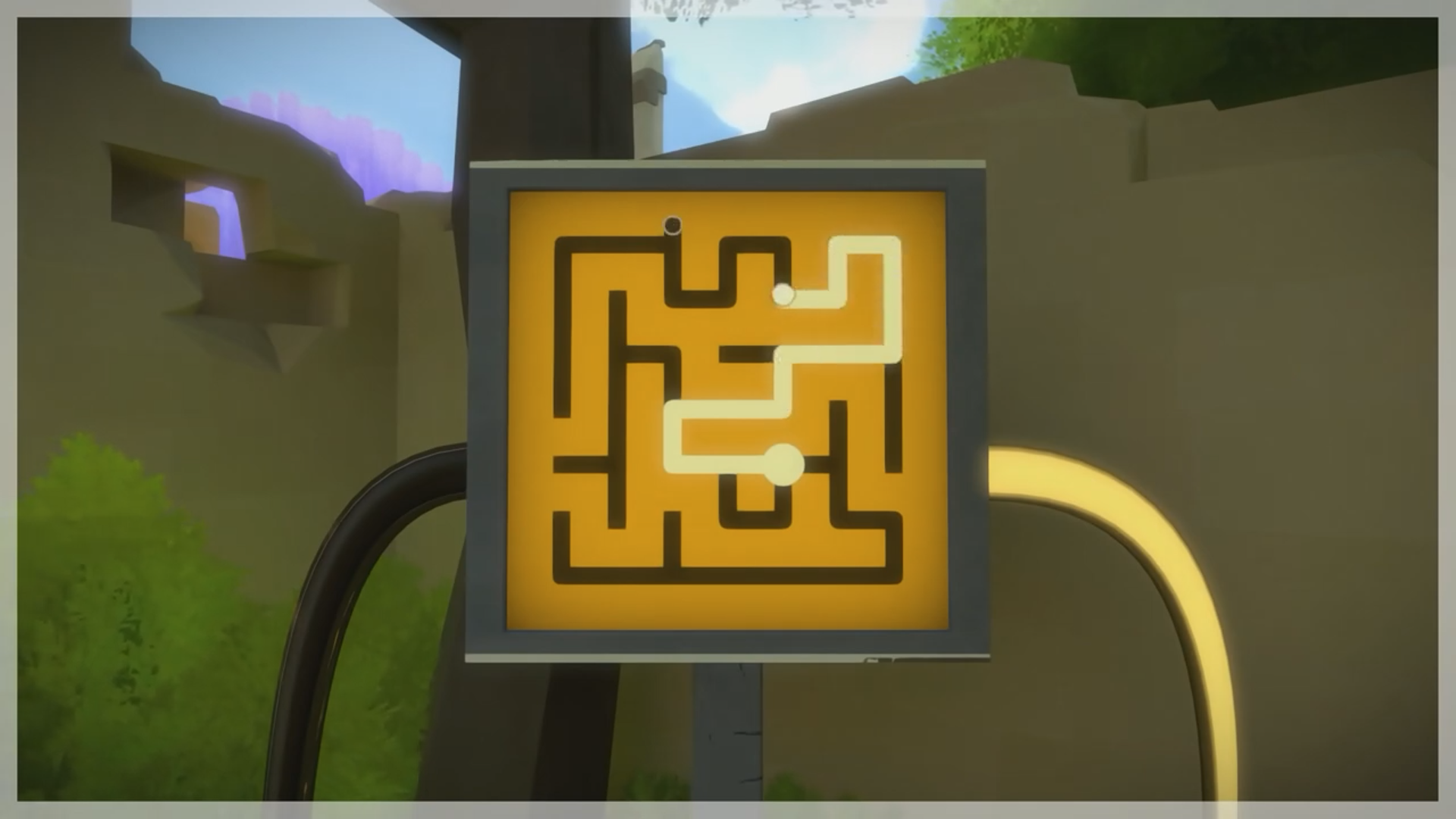
The game primarily involves walking around a 3D world and discovering these panels. Each is a self-contained (or so it seems at this point) puzzle that involves drawing a line from the circular starting point to a rounded end point. Solving these panels unlocks more panels, and so on and so forth.
And I mean unlock pretty literally here: the game has a physicality to it, as if it wants you to feel that this world and these panels could be replicated in real life. Wires extend from the panels, activating new ones, opening doors, unlatching gates, shifting drawbridges, and so on.
Soon, you lower the gate out of the starting garden, pictured here, and begin exploring the wider world.
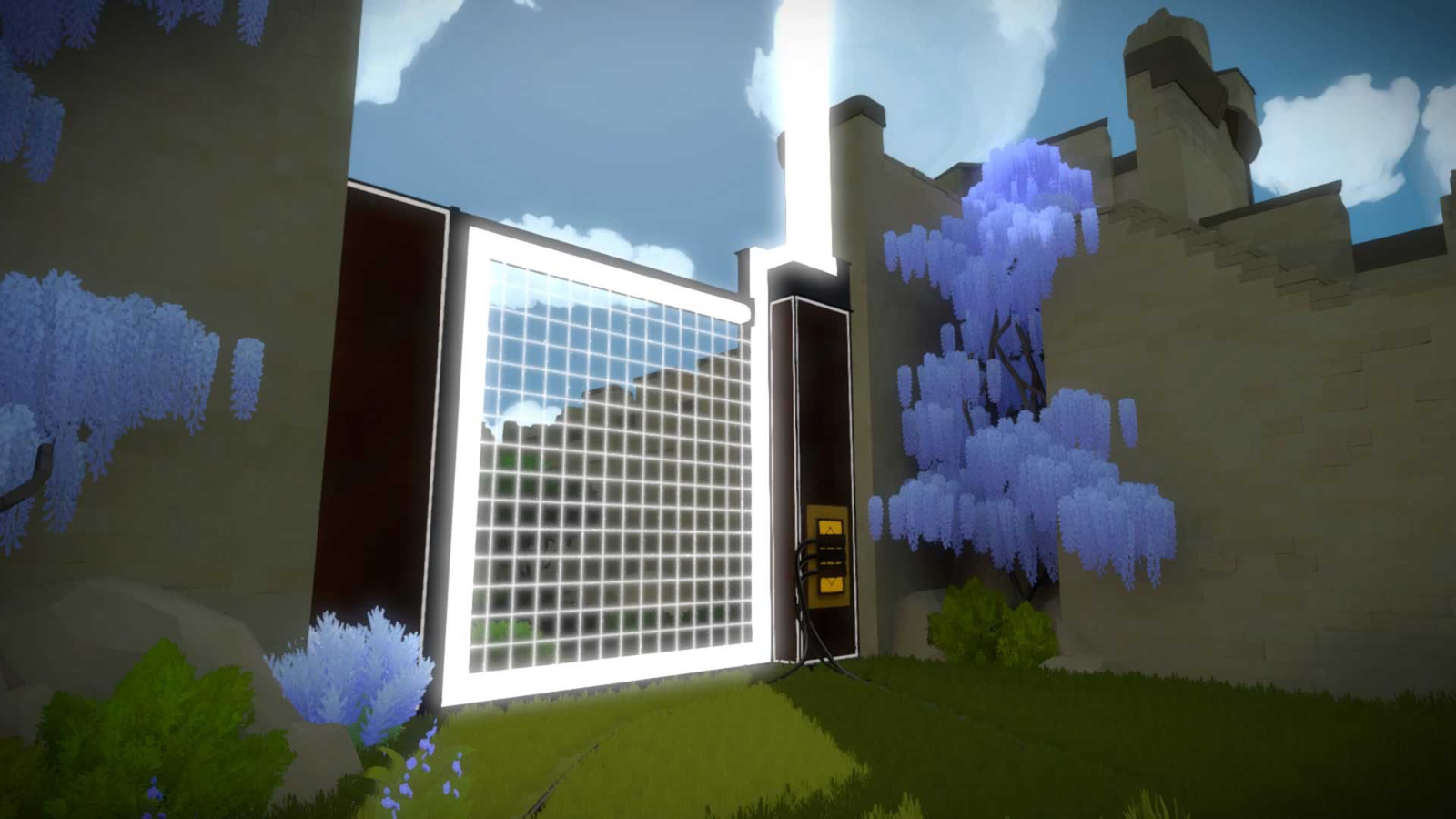
You find yourself on an expansive island, with puzzle panels in every direction. The island is divided into several areas, seamlessly connected, each containing a set of themed panels (though you find some scattered, often very difficult panels that don’t seem tied to any particular area), and you are free to tackle each area in any order you please.
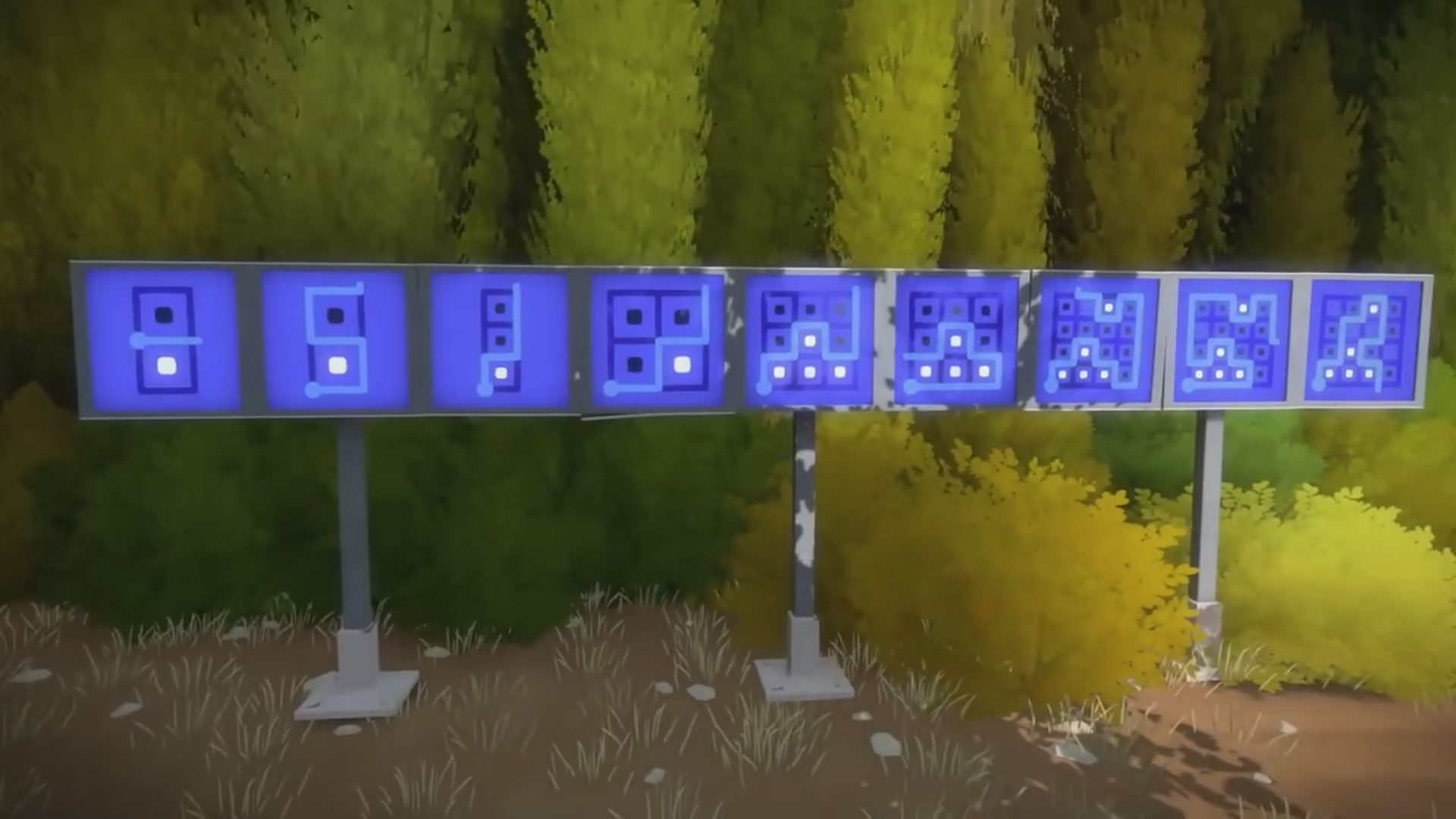
Panels start introducing new patterns and rules that you must decipher yourself by solving puzzles of gradually increasing complexity. Here’s one of the first series of panels you run into, solved. As you may be able to tell, the rule here is to draw the line such that it separates the white dots from the black.
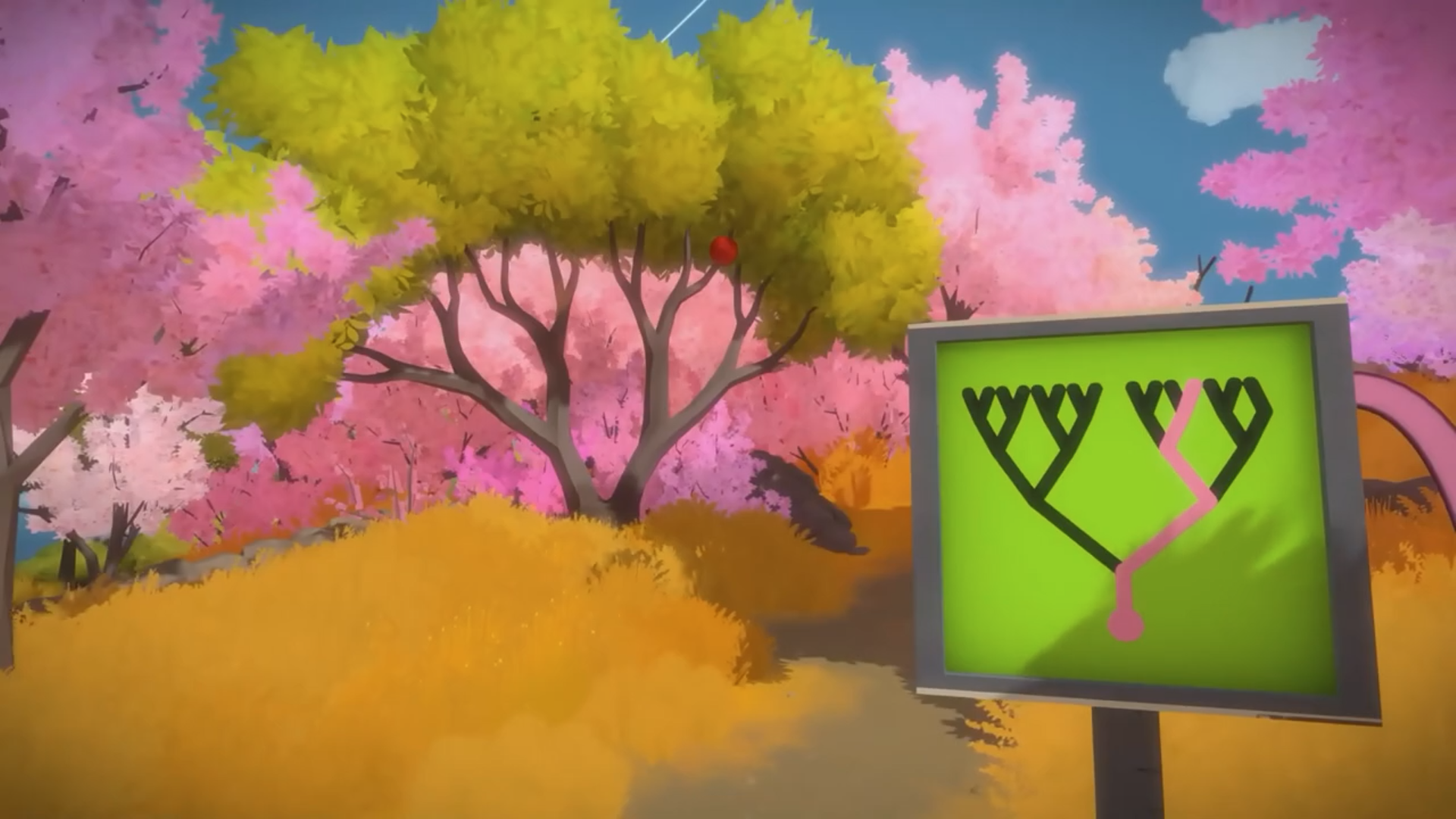
Puzzles also begin to involve the environment outside of the panels. In the orchard, another area near the starting garden, you need to trace lines to match nearby trees. Each panel is nearly identical, and only the trees change to up the difficulty, forcing you eventually to map their more complicated 3D structure onto the panel’s 2D diagram.
And the environmental puzzles get quite diverse and creative, involving things like tracing shadows cast on a panel, lining up window frames and tinted glass to reveal solutions, reflections in water, listening to audio cues, and even getting realistic glare to reflect off a panel in just the right way.
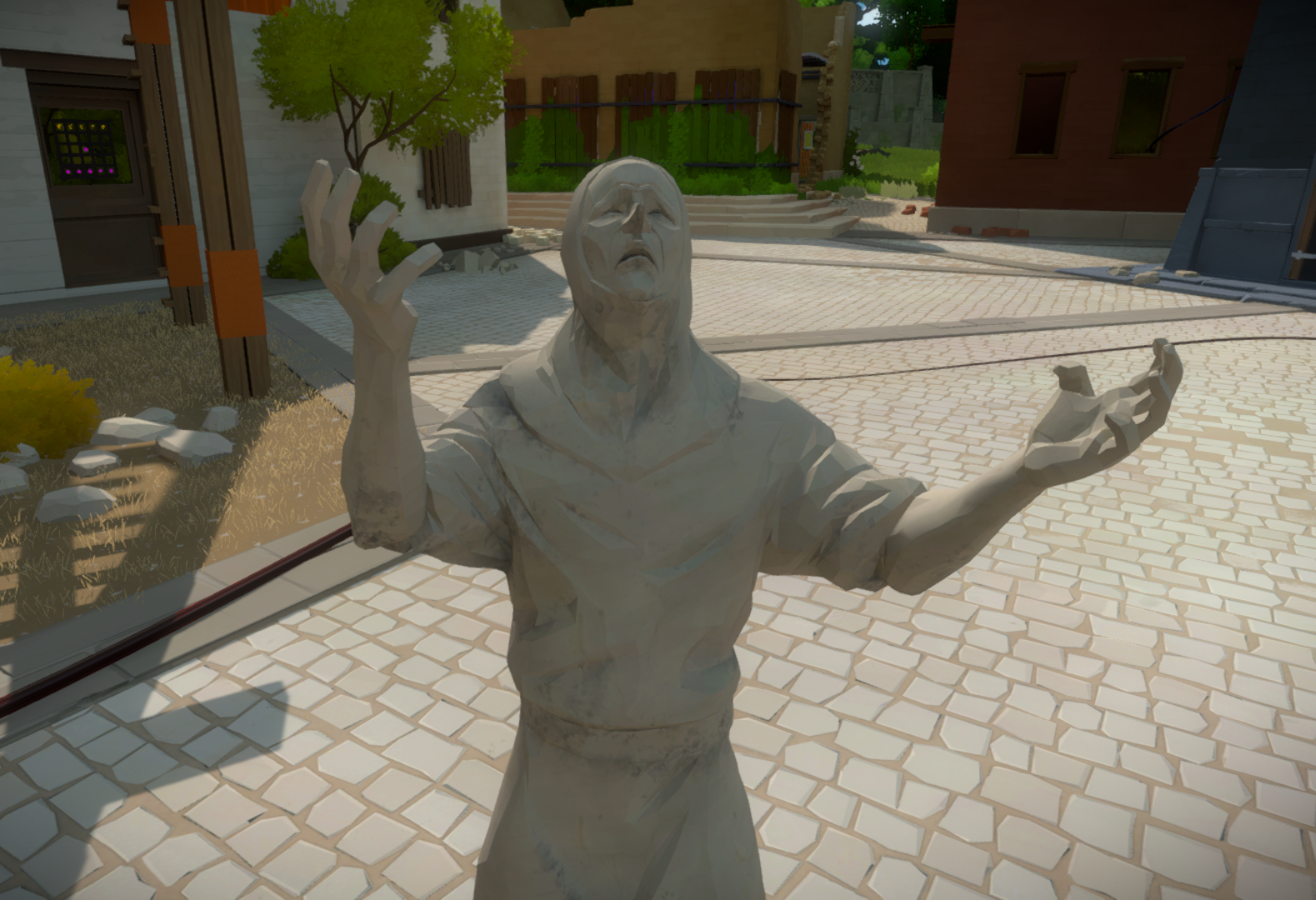
Throughout your explorations, you’ll also run into various oddities, such as these strange statues scattered throughout the island:
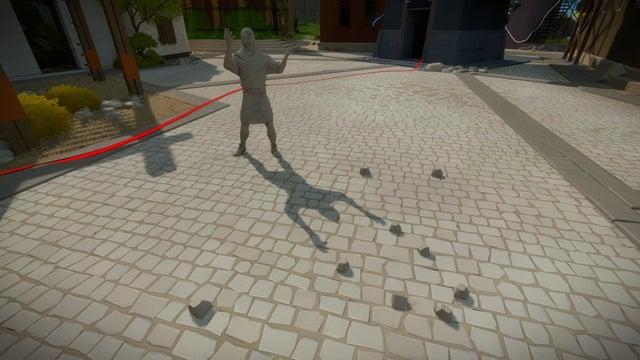
You might even discover one of the neat perspective easter eggs scattered throughout the game that they’re often used in:
You may also find one of the game’s many scattered audio logs. The purpose of these is also unclear, but they all seem to be short quotes from various famous thinkers. I found sitting and pondering them and their relation to what I was doing can be quite pleasant, though I might have been in the minority in this regard, more on that later.
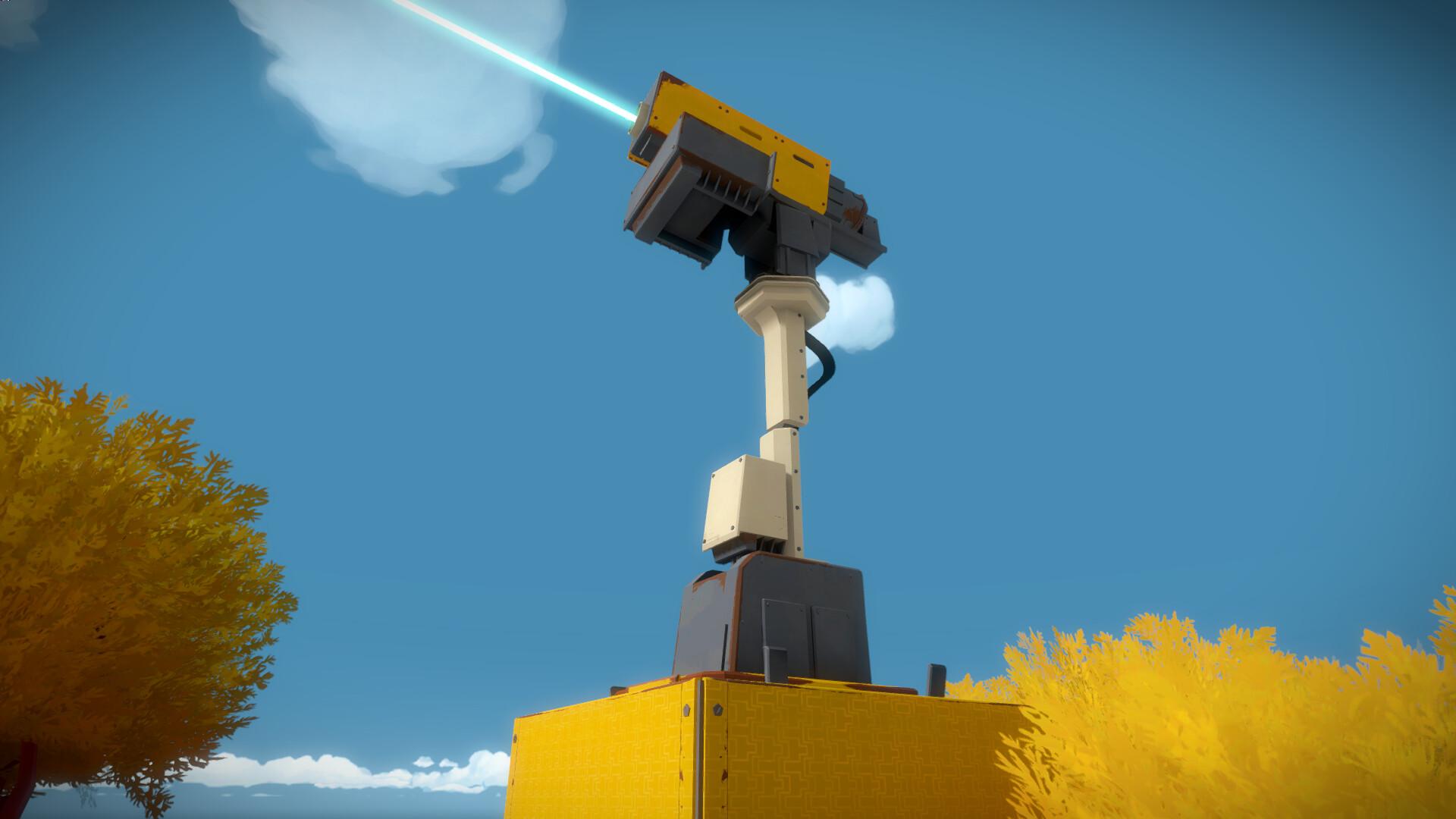
Eventually, you’ll reach the end of one of the island’s areas, and activate one of these giant lasers:
As you activate more and more, it becomes clear that they all point to one place: the island’s central mountain.
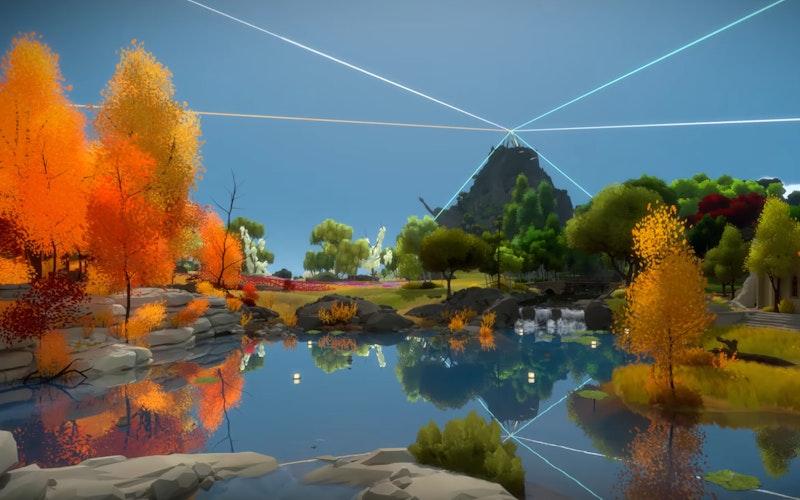
You can visit this mountaintop at any time, where you’ll find a locked door, and more statues.
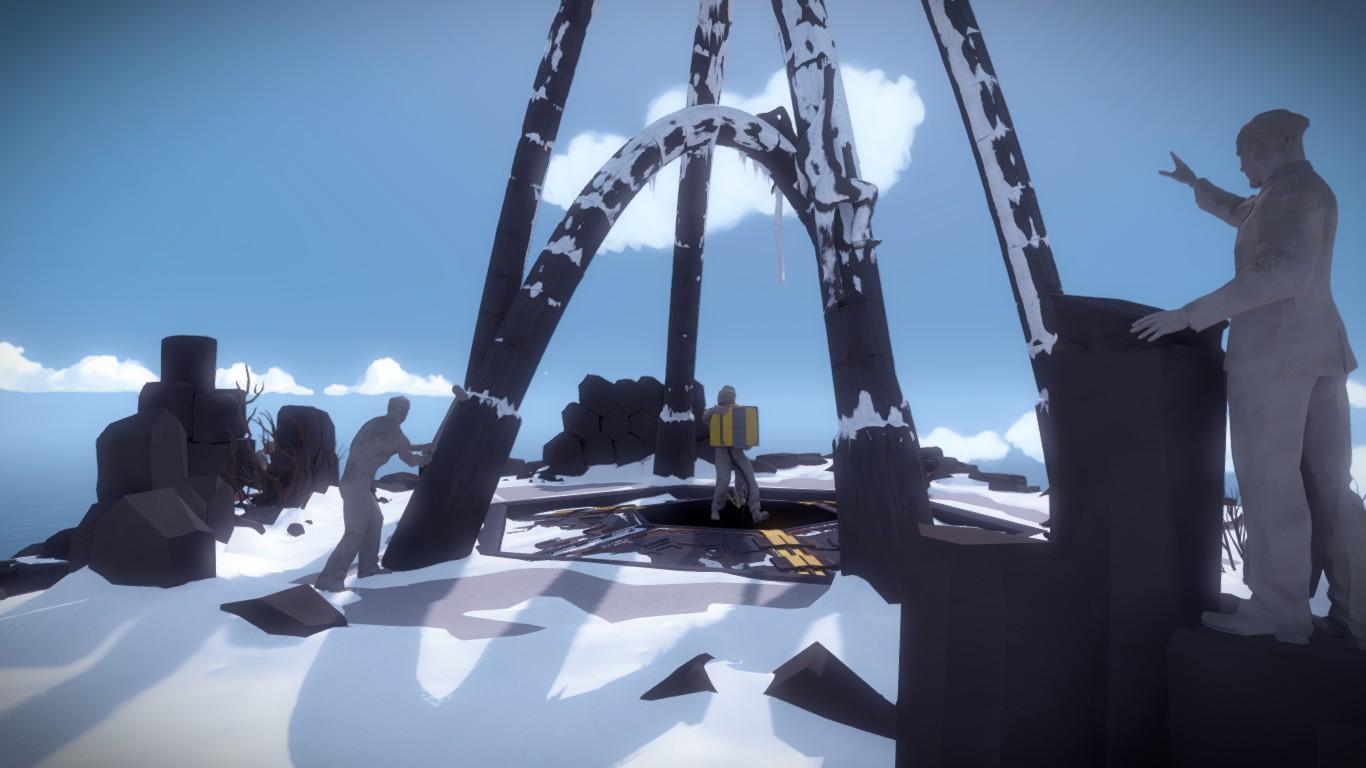
Unlocking this door requires activating at least 8 of the 11 lasers in the game, granting you access to the final area, but that’s easier said than done. As you venture further from the starting area, puzzles start to ramp up in difficulty. The main game is roughly 20 hours long, longer still if you try to take on more or harder areas, and unless you’re some bizarre puzzle masochist you’ll start to take breaks.
Away from the game, your subconscious begins to assimilate the patterns as it tries to break down the last puzzle you were stuck on, and when you return you find that progress comes quicker, easier, but you also begin to notice something else: the lines. In the river, in the footpaths, in bits of paint and moss…
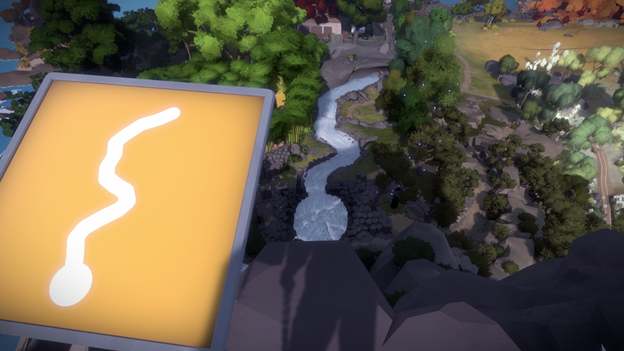
At first, you think it’s just a neat motif, a bit like the perspective easter eggs. And one day, you decide to try it. It’s likely during one of the periods of downtime between puzzles that the game forces on you, walking from one area to the next, or taking the boat around the island, or waiting for a bridge to extend; all encouraging you to slow down and take in the environment. You take your cursor, touch the circle and…
The game reacts. The heavens roar, the line begins to glow. You trace it to the end, and a sound like thunder plays, sparks flowing from the line, collected in the nearest mysterious obelisk. And suddenly, everything changes. Your brain starts hunting. You begin to find the lines everywhere. In the flowerbeds, in the rivers, in bits of wood and metal, when you line the clouds up just right, in the negative space between trees. You start getting false positives, just some misshapen wood grain, or an odd shadow. You start seeing the lines in real life, an example of the well-known Tetris Effect.
At this point, you’ve likely completed enough of the game that the mountain is now open to you. You decide to take it on, and after a series of grueling puzzles, you reach a magical elevator. Turning it on, you are at once whisked back to the start of the island, every laser deactivated, every panel reset.
What?
No, impossible. You must have missed something, gotten a bad ending. You probably had to do all the lasers, but damn, this feels a little unfair. No, it’s too much, probably just happens no matter what. A little unsatisfying as an ending, but hey, at least the journey was enjoyable. Maybe you’ll go check out the stuff you missed. You step out into the starting garden and-
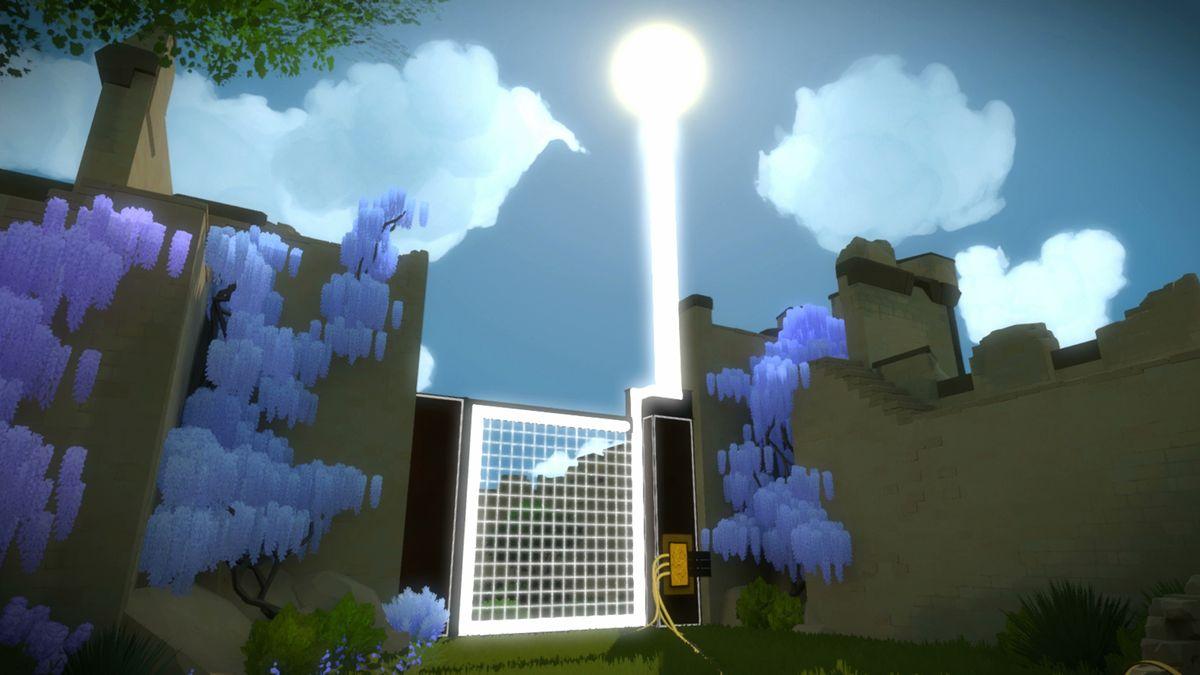
No way.
You trace the path.
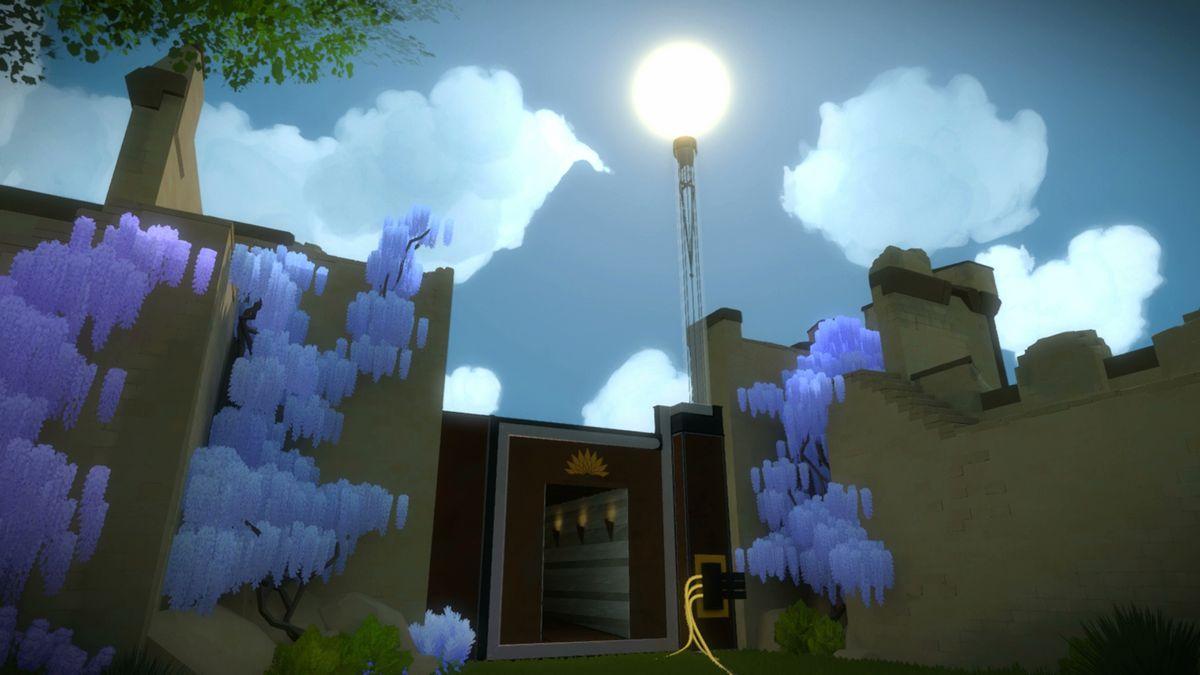
Stepping into the corridor reveals a reception area that overlooks the whole island. Voice recordings in the area reveal the nature of the island as a simulation, designed to induce some sort of enlightenment. Reaching the end plays a video from the perspective of a man, presumably the player character, unstrapping himself from the simulation and demonstrating the same Tetris Effect-y pattern-recognition that you have surely experienced for yourself by now.
And that’s it! For the main game at least. The one last major secret to find, if you fully complete the game (including a brutal time-constrained randomly-generated puzzle gauntlet), is a projection room with six videos ranging from a few to, uh, very many minutes long. These are all clips from external media, related to the game’s ideas, and seem to play a similar role as the audio logs.
A Game About Looking at Things
I won’t be talking about the game’s design too comprehensively here, that’s been covered quite well in other places. What I’m more interested in are the ideas the game is ultimately trying to convey, and how its design succeeds or fails to express them.
With that said, let’s finally get into what Blow says about his own game. Since the game itself refuses to drop any kind of explicit explanation of its own themes, the following quotes are largely taken from various interviews recorded after the game’s release.
When asked point blank to summarize what the game was about, Blow gave this response:
What the game is about, at least in part- it's a very complicated game, we had a lot of stuff in it, so this is gonna be a massive oversimplification of one piece of the idea- but it's about having that taste for looking at the world and trying to understand the world. Which is a very noble pursuit, one where I think that while there's been a long history of very respectable
people who put their two cents into the bowl like “I've worked really hard for my life
at understanding the world and here's the best that I have to tell you”, at the same time I feel like we're in a society that doesn't value that idea very much or is very cynical about the idea that you could understand the world.
I mean, in a relatively shallow sense we have that, science and engineering have been very successful especially in terms of understanding small parts of the world, so if you want to build a bridge, man, we can really build bridges today, we can do a great job at that. A computer is an insanely complicated thing, we can do a great job at that. But there seems to be a nihilism in (at least) American culture and in much of the West if you try to expand the scope of that understanding up to anything bigger than a particular subcategory, and so part of what the game is trying to do is be an exploration of “hey, if we're really just trying to look at the world and understand the world how do you even do that?” How do you take these little things and put them together into a better picture, and how do you do that without just being a wacko and going off and believing a random thing that's totally wrong and dumb which is something that a lot of people do.
Ok, so it’s a game about proper truth-seeking writ large. In particular, this explanation seems related to the concept of Separate Magisteria, or the idea that the rules of good thinking apply everywhere, not just in specific STEM-coded subdomains.
Mentioned in the previous section, the game includes a selection of (rather infamous) audio logs that I believe supports this interpretation. They contain quotes from thinkers across history that express different, often (deliberately on Blow’s part) incompatible frames for viewing the world. There’s an intent here to communicate that this process of shifting perspectives, both abstract and literal, is a big driver of comprehending the world and the ability to apply that comprehension. The game invites you to take those skills you’ve been developing to solve puzzles (unearthing the rules, lining up disparate elements, breaking false assumptions, etc.) and apply them with and to this morass of philosophies in order to dig up your own nuggets of valuable real-world understanding.
To expand a bit on the skills point, many of the puzzles in the game are designed to force the player to adopt a scientific mindset:
From [the player’s perspective] the puzzles are about engaging in a process of investigation. There's symbols that tell you what the answer is, but not really, not to a fresh new player in the
game, because they're they're completely non-linguistic symbols that have, as best as I could
manage, no previous associations with things that you would recognize in the world. They're very abstract, and so part of what happens is you have to engage in a little bit of a preliminary experimentation to try and figure out what works. The puzzles start off very simple where there's only a few things that you could possibly do, and you try them and maybe one of them is right and the other ones are wrong, and then you start to engage your pattern-understanding mind. “Why was that one right and why were the other ones wrong?” And you form an idea and then you see if that idea holds up through the next few, and it might hold up for a couple and then turn wrong and you're like “Wait, I thought I understood what was going on! Why!?”
So it's a process of developing an understanding from something very simple to something very
complex actually, and in some of these sequences in the game there's hard left turns where you think you fully got it and then just something totally random is in there out of left field and you have to change your understanding of the system.
“Epiphany” comes up a lot in discussions of the game.
You're always problem solving on at least two levels. You have your very straightforward rational mind that's like “A means B and B means C and I'm if-thenning in my head”, but part of your mind is just working very hard in a subconscious nonlinear way on problems. And so what happens very often with this game is people are stuck, they don't have any idea what to do, and they go just take a break to do whatever they're doing in life, or they go to sleep and wake up the next morning, and then they just suddenly know the answer to the problem! And that happens a lot to many people who play the game. I don't know exactly how to invoke that experience for sure, but from a design standpoint there's criteria that I stick by to try and encourage the
possibility of that. And that to me is a really interesting experience, so one of the other things that the game is about.
There's this feeling of epiphany that happens where it's just like bam, right away you understand something, and it's an instantaneous transition where a minute ago you really had no idea, and
now you know.
This treatment of the concept is probably not particularly fresh to anyone reading this, but I find appealing the idea that one can design for it, that people can and have produced things capable of inducing that feeling almost on demand. And this seems separate from wireheading, the epiphanies you obtain relate to a real, albeit toy system. How well can you learn to produce real epiphanies by practicing with these toys, or by taking those design criteria and applying them more widely?
One thing I’ve practically never seen mentioned elsewhere is how the game’s art style plays into these themes. Most games, past and present, opt for either a hyper-stylized/cartoony art style, or the most photorealistic graphics possible. In contrast to both of these, The Witness employs a (phenomenal) stylized impressionist style that nevertheless ends up feeling more realistic in ways than the common attempts at photorealism. How can this be? Well, big budget games tend to optimize for looking as close to a real-life photo as possible, but in doing so use a mountain of hacked together tricks and techniques that usually create something that looks spectacular at first glance but which contains several subtle incoherences which ultimately corrupt the effect. By contrast, The Witness’s style doesn’t even try to be hyper-real at first glance (in fact, the designers deliberately toned down the visual complexity a lot so as to not distract from the puzzles), but the game’s aforementioned physicality, and the creators’ careful modeling and replication of phenomena such as reflections, light, acoustics, etc. all come together to make the details feel right.
How does this play into the themes? Well, in conjunction with the carefully thought-out placement of virtually every object in the game, it gives a constant sense that things, ultimately, make sense. That just like in real life there is an underlying order to the world, phenomena behaving according to underlying rules which can be sussed out with careful observation.
And the funny thing is that this is true in a deep sense. Maybe not quite as poetically as that last sentence might imply, but remember, Blow and his team did write every line of code here from scratch, with intention. Just as the placement of the 3D models was determined by a designer to create the game’s puzzles and perspective tricks, so too were the very rules of light and sound. Blow has said that, for him, the one big difference with games compared to other mediums is that they force the author to actually, mathematically model whatever it is they’re trying to depict as part of gameplay. This philosophy is on full display here (related: it’s no coincidence that a big chunk of the audio log quotes are from eminent physicists).
As we’ve touched on, “perception” is an obvious theme here, even just going by the title alone. Fun tidbit, the first idea for the game came from Blow thinking of a player sat on a mountain, and noticing, then tracing, a secret pattern in the landscape below (and, you might recall, this idea did make it into the final product). But anyway, we’ve already covered the game’s treatment of perceiving the world and the abstract rules undergirding it, but Blow seemed to also want to engender a level of self-perception:
The puzzles [are] not trying to make you be smart. Some of them are harder, some of them are easier, but they're about communicating, they're about exploring some process of form going through iterations and you as a player seeing the interesting things that can happen there. That's one of the many levels at which, to get back to the title, the game has a mode of encouraging a witnessing presence. I would say (to the extent that a game can do that kind of thing) it's a game about looking at things and seeing them and knowing that you're looking at things and seeing them. It tries to add a level of self-referentiality to that process of seeing things and of asking the question “what is it like to be in a world and walk around and be seeing things and be hearing things?”
Some have made the connection from this to various meditative practices, mindfulness being perhaps the most available in the modern west. This seems not wrong, but maybe a bit obvious. To me, the more interesting connections from this idea are ones you can draw to the game’s other themes, of scientific thinking and treating the world like a puzzle (from the inhabitant’s seat, but also the architect’s, which Blow was in when developing these ideas in his own mind). There’s something I find extremely valuable about this combination mindset, of trying to notice reality very directly, how reality in turn affects those perceptions, and how it might be solved to improve your experience in the present. Meditation, I find, often emphasizes a sort of passivity, promising you that proper arrangement of thought will render “you” unaffectable by outside circumstance (as oversimplified as that explanation is). Other forms of coping with the world often involve shutting oneself away from reality, repressing, distracting, and dulling your outward perception. But the mindset you take on playing The Witness differs from these. Passivity has its place, there is ample time to stop and take in data from the world around you. But then it’s right back to solving puzzles, ordering the world around you through rigorous applications of logic (hm. Probably not a coincidence that Blow is an accomplished programmer). What would the world be like, if more people refused to shut off their perceptions out of a will to eventually not have to, because they shaped their environment into a place that no longer demands it of them? North America probably wouldn’t be such an urbanist’s nightmare at least.
Did it succeed?
It’s difficult in hindsight to say how much this game really affected my thinking; how well I internalized its ideas after playing. As mentioned, I played it for the first time right around the time I was reading the Sequences, as well as other works with a lot of philosophical overlap (including the SSC backlog), so attribution gets a bit muddy. Did each prepare me for the other in different ways? Perhaps. I will say that I’ve always felt the sense that games have most improved my thinking in allowing me to actually practice modes of thought and develop intuitions about real-life systems in a legible, graded, yet low-stakes setting, and The Witness is no exception to this. While I’d always been someone sensitive to my environment, my experience with the game probably helped shape my taste for the more explicit understanding of details I developed later in adulthood. But when it comes to actually having noticed and reflected on my patterns of thought and perception in the moment…
Most people go almost their entire lives without any sort of deep observation of their own thoughts. It was perhaps bold of Blow to assume that people would engage with his work with that sort of self-reflection in mind, without any explicit prompting. To be fair, he has stated that he wanted people to be able to enjoy the game without necessarily grokking everything immediately, gaining a deeper understanding upon subsequent revisits (like I’m doing now), comparing it to Gravity’s Rainbow in this regard. But if the objective was, even in part, to get people to pay close attention to the way their thoughts behave while playing the game, having most people end up forced to do so in retrospect to me seems like a small failure.
Though, when it comes to this sort of prompting, I suppose the audio logs do serve this purpose to some extent, making a connection to real-world thinkers thinking about… thinking. I certainly got something like that out of them. But as you might have guessed from that description, a lot of people came off with the impression that they were just a clumsy and pretentious attempt to “elevate” the work. It’s tough to say who failed who here, between Blow and his audience. Listening to what Blow has to say about them quickly dispels the idea that they were put in as a shallow signaling attempt. From the end of that excerpt:
Really, I was just interested in looking at the world, we’re trying to understand the world, and what conclusions can we come to. And then again, it’s very easy to maybe be a little bit pompous, or talking down to people. So I, for the most part, tried to curate pieces that had meant things personally to me. Some of the more modern pieces in the game are either things that at some time in my life I had seen and were important to me, or that I was present personally at a particular event at a particular time.
This is a flaw and strength of Blow’s games. In his desire not to compress his ideas too much, he ends up including, unfiltered, all the most important bits of thinking he sees as having brought him to those ideas in the first place. There is no flaw inherent in this, for a philosophic work it’s practically routine, but without the edifice of conventions and expectations that surround such works in other mediums it’s clear why many in his audience came away with betrayed expectations, and why most of those who might have gotten much more out of the work lack exposure to it. It’s hard to blame Blow too much here though, simply declaring your game a serious and valuable philosophic work probably isn’t gonna help you beat the pretentiousness allegations. And it’s easy to see how one might end up feeling a bit bitter at the lack of a proper space for these sorts of works, as someone who both plays and makes videogames myself the lack is certainly felt.
Bonus
I’ll leave you with an interesting story I learned about by coincidence as I was writing this review.
Around 1860, english naturalist Alfred Russel Wallace (most famous for having independently proposed evolution via natural selection around the same time as Darwin) published a curious observation based on his travels in the Malay Archipelago: the fauna of the north and south varied radically (the north was typified by asiatic species, while the south seemed dominated by species of Australian origin), with no obvious connection to the layout of the islands. It was in part thanks to these observations that Wallace went on to father the subfield of Biogeography, studying the distribution of ecological features to inform our understanding of the Earth’s geological past.
Thanks to our modern understanding of plate tectonics, we today understand that this division arose mainly due to the top and bottom half of the Malay Archipelago having split off from Asia and Australia respectively only somewhat recently in evolutionary history. But at the time, Wallace and his contemporaries could only mainly rely on one technique: tracing a hidden line in the landscape.