The Zoologist's Guide to the Galaxy, by Arik Kershenbaum
Will aliens look like us? The study of extra-terrestrial life is not as speculative as you might think
What is the point of books?
Firstly, no-one reads them. With the exception of celebrity memoirs and once in a decade best sellers, most books do not repay their advance. Most sell less than 2k copies. For comparison, Astral Codex Ten has around 80k free subscribers and 6k paid subscribers. Publishers’ revenues mostly come from their backlist (repeat best-sellers). A substantial proportion comes from all-time classics, titles like the Bible, or the Very Hungry Caterpillar. These revenues are used to fund ‘vanity projects’ - the vast majority of new books which cost more money than they make. This is an open secret in the publishing world, so shouldn’t be surprising for aspiring authors.
It is particularly the case for Big Idea books. How many non fiction books have you read in the last year? Be honest. (I’ve read none!) For scientists, the scientific paper is the primary currency of communication. No scientist finds new ideas in books. Even popular science books, ostensibly for mass consumption have a fatal flaw - they didn’t have to be books. By this, I mean that the Big Ideas can be communicated more succinctly. Dare I say it, most popular science books could have been blogs.
Think of past winners of this book contest. I still remember Erik Hoel’s the gossip trap from 2022, though I can’t, off the top of my head, remember the book it was about. I certainly didn’t go out and buy it, did you? It was valuable for Hoel to outline the main ideas of the book in a readable blog post. (Cards on the table, I won’t be doing that here).
Instead, I’d like to introduce to you The Zoologist’s Guide to the Galaxy, by Arik Kershenbaum. It is one of the few Big Idea books that can not be compressed to a blog post, or podcast appearance, or review. Similar to Richard Dawkins, perhaps because of the richness of evolutionary biology, Kershenbaum’s ideas expand to the space of a book. It is a book I have read more than once.
So I will not be summarising the book here, sorry. This will not be a typical Astral Codex Ten book review submission. I will not by writing a 10k word essay. I respect your time too much. (I don’t have time to write a 10k word essay). This will actually be a somewhat more traditional book review. I’ll lay out the Big Idea and hint at the implications. I’ll put in some quotes to show that Kershenbaum’s prose values clarity and avoids hyperbole. But really I won’t do it justice. Thinking about aliens really needs a zoologist. Or at least an evolutionary biologist. Of which, I’m neither! I will try my best to convince you to buy his book. This will be a challenge as, we now know, no-one buys books these days.
Premise
The book is built upon a premise. Really a series of premises. We need the premises to be true for their implications to be taken seriously. They are the foundation on which the book is built. If you accept these premises, it becomes clear that it is possible to predict what aliens will be like. Kershenbaum convinced me on each of these, so I’ll try to convince you too.
1. Extraterrestrial life exists
This is the first one, and a biggie. There’s no point speculating about aliens if they are unlikely to exist. Since we first started looking directly for exoplanets two decades ago, over 4000 have been discovered, with the number doubling every 27 months. Many of these are gas giants but a minority are earth-like: rocky and in the habitable Goldilocks zone. Given the vastness of the universe (approximately 200 billion trillion stars) surely the conditions for life exist elsewhere. Assuming that life evolving on earth wasn’t a complete fluke, we would expect life to evolve again and again.
Not everyone buys this premise. There is the Fermi paradox: where are all the aliens? If life has evolved elsewhere why haven’t we found it. Why hasn’t it found us? Is there a great filter at some point in the chain between life starting and interstellar communication. My (reviewer’s own) favoured explanation for the apparent silence of the universe is the dark forest hypothesis. This supposes that many alien civilisations exist throughout the universe but they are both silent and hostile, maintaining their undetectability for fear of being destroyed by another hostile and undetected civilisation.
That aliens exist is probably the biggest hurdle to overcome. If you’re with me on that, the next premises should follow naturally.
2. Life evolves through natural selection
Evolution through natural selection is the universal process by which complex life has developed on earth. It is the central, and perhaps only, biological law. Evolution explains how life, which began as single-celled organisms, can produce complex creatures like you and me.
“At its simplest level, natural selection is easy to understand. Beneficial traits accumulate. Some new features will survive, other innovations will not, but good ideas developed by previous generations are not forgotten.”
It requires two properties, heritable variation (the offspring of individuals will show variation in the traits they inherit) and differential fitness (rates of survival and reproduction will vary between individuals). These two properties have resulted in the richness of life on earth. Each generation will show variation from the last. Traits that result in the reproduction of offspring, will be more likely to propagate than traits that do not. Over time (and by this I mean a lot of time, evolutionary time) this non-random propagation of traits gives rise to complex life.
The cumulation of traits that are useful for survival and reproduction eventually result in organisms like us. Evolution through natural selection is the process by which we are generated; it is the blind watchmaker, the designer of all lifeforms. It is not just the mechanism of life on earth, it is the only mechanism we know of that can produce complex life. As Kershenbaum puts it:
“In the case of natural selection, however, it is remarkable that apart from a few deeply unsatisfying and non-scientific explanations for the existence of complex life, there are no serious alternative contenders.”
3. Laws are universal
The laws of nature are not provincial; by definition, they should be universal. Physical laws are not confined to one part of space. Everything we know suggests they apply throughout the universe. This has important consequences for how we think about life. Exoplanets may be different in a number of ways, but they will have the same laws of physics. No matter where it arises, life will be subject to the same universal laws to us here on earth. It will be subject to gravity, electromagnetism, the laws of motion, thermodynamics.
However, there’s more to universal laws. Any life in the universe will be subject to the same laws of evolution by natural selection. We know, and can imagine, no other process by which complex life could evolve:
“Natural selection is not just the only mechanism we know for creating complexity out of simplicity (if we reject the explanation of a divine force pushing complexity to develop), it is also an inevitable mechanism, not just restricted to the planet Earth, or to ‘life as we know it’. If we see complexity in the universe – complexity of the kind that we would call ‘life’ – it is because natural selection has been operating.”
The beauty of evolution is not limited to the biological systems we are familiar with here on earth. It only needs those two properties: heritable variation and differential fitness:
“It’s a very likely (although perhaps not universally accepted) assumption that any system showing these properties – heritable variation and differential fitness – will experience natural selection. That is, natural selection is inevitable, even in non-biological systems like computer programs, internet memes, religious beliefs and so on, but especially in biological systems. There seems no doubt that organisms on other planets experience natural selection in this broad sense, because there is no other mechanism we know that can spontaneously produce and maintain the kind of complexity that we call life.”
This is a huge claim to make. If you are on board with Kershenbaum, all life in the universe will be subject to the same process, the same rules, the same principles as those set out in 1859 by Charles Darwin. Life being subject to these universal principles means that there are parts of life that will be predictable, no matter where they arise.
What’s more, evolution isn’t specific to the biological life we have here on earth. It isn’t specific to DNA or carbon-based lifeforms. We don’t need to know the biochemistry make-up of aliens to think they will be subject to natural selection. We already have a test-case of natural selection predicting traits in organisms. Life independently evolving similar features due in different parts of earth - convergent evolution.
4. Convergent evolution
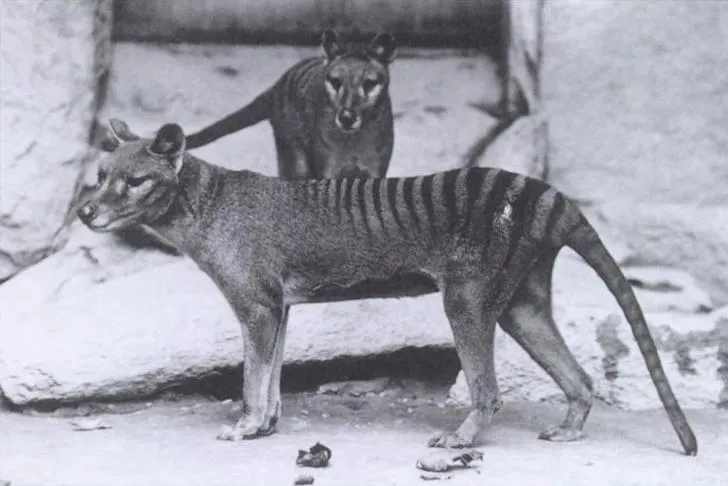
Take a look at the creatures above, thylacines. They are now extinct but were known as Tasmanian wolves. They had powerful jaws, sharp teeth and raised heels. At a glance you might mistake them for dingos or jackals - a peculiar breed of dog. However, they are actually marsupial, complete with a pouch for carrying its young. They evolved completely independently from canines. It is no more related than a dog is to a bat. The likeness in form is a result from similar selection pressures in their environments. What is useful to survive in one environment, will evolve similarly under the same environmental pressures.
Convergent evolution isn’t a curiosity - it isn’t just mistaking a marsupial for a canine. On earth it is the rule. We have birds and bats independently evolving wings from appendages, we have sharks and dolphins evolving streamlined swimming bodies. We have complex light sensors evolving in vertebrates and cephalopods, we have camouflage evolving in species subject to predation.
Given variable heritability and differential fitness evolution will find similar solutions to the problems in sustaining and reproducing life. But, as we have found, as a universal law, convergent evolution will not be provincial. It will not be limited to terrestrial life, it will be seen across the universe.
Putting it together (the big idea)
Are you still with me? Let’s try to pull these premises together. Firstly we assume life is out there somewhere. We assume that life evolves through natural selection and the laws governing this are universal. On this basis, evolution will solve problems elsewhere, as it does on earth.
We have now arrived at Kershenbaum’s Big Idea. If those premises hold, we are able to predict what aliens will be like, based on our understanding of physics, evolution and life on earth. If aliens are subject to gravity, they will develop mechanisms to defy it (flight). If they live in a world exposed to photons, they will develop a camera to detect them (eyes). Like life on earth, they will likely eat each other, so will develop defence (camouflage, speed, poison), and attack (sharp weaponry, venom, tools). To manipulate their environment they will have appendages, like almost every creature on earth. They will probably move and as a result, they are likely to be symmetrical (this is most efficient). Alien life will probably develop ways of communicating with each other, though the exact mechanism may depend on the atmosphere in which they live.
Kershenbaum makes an effort not to over-extrapolate beyond these key principles. He doesn’t presume that extra-terrestrial life has DNA or is even carbon-based. He makes clear that it is more difficult to speculate on the appearance of aliens than their behaviour (although form follows function, so we can still speculate about how they will look).
The premises are covered within the first two chapters. Their implications are the basis for the rest of the book. There is so much more I haven’t said about aliens. I could speculate as to whether they have sex, whether they cooperate in groups. How intelligent they are, how their societies are structured. All these features are predictable and are discussed by Kershenbaum.
Instead I would implore you to actually go and read this book. If I haven’t quite convinced you to do this, you can listen to Kershenbaum on Sean Carroll’s podcast, but like this review, it only scratches the surface. Why does this idea warrant more depth than a blog or podcast? Maybe because, at its heart this isn’t a book about aliens. It is a book about the idea that gives rise to the richness, the diversity of life itself. It is a book about evolution. There is something about evolution that warrants more detail than a blog can provide.