Unsettled: What Climate Science Tells Us, What It Doesn’t, and Why It Matters by Steven Koonin
(review by J S)
Climate is changing, that much is known. But what that means, what exactly we know, how much is caused by human activity, and what we should do about it, are subjects of great debate. Are hurricanes becoming more destructive? Are the hottest days getting hotter? Will climate change wreak havoc on the economy? Or have we been misled by politicians, the media, and scientific institutions? These are some of the questions explored by Steven Koonin in his book Unsettled: What Climate Science Tells Us, What It Doesn’t, and Why It Matters. He claims that much of what we “know,” have heard, and possibly even told our friends about climate change, is not so.
I’m not a climate scientist, but I wanted to review this book for my own edification. I went into it with what I would consider the “mainstream” view of climate change, one that any average newspaper reader would have. I believed that climate change was a significant risk to society, but if there were counter arguments to this belief, I wanted to hear them.
I was not disappointed by the amount of education Koonin provided. Throughout the book, I learned about various aspects of climate change, from rising sea levels to changing hurricane activity. He clearly explains the fundamental principles of climate science and presents the chaos of climate in a way that is understandable without being simplistic. But as well as providing clear descriptions of climate science, he also makes claims that fly in the face of my understanding of climate change. He claims that things aren’t as bad as we’ve heard and humans have had a small impact on the climate. I found many of his claims surprising. It made me want to dig into the climate reports he cites to understand the full picture.
This review is the result of that research. It contains aspects of the book I found most interesting, as well as deep dives into climate reports and primary source material to further understand Koonin’s claims. I couldn’t cover the entire book at that level of detail, so I primarily focused on his claims about hurricanes and touched on other topics at varying levels of detail.
How to Think About This Book 3
Sources of Information for Climate Change 5
Global Warming and What it Means to Be Hot 6
Climate Modeling and Thinking About Uncertainty 11
Hurricanes and the Deep Dive into Scientific Literature 16
Disentangling Human-caused Climate Change from Natural Variability 17
Tornadoes and the Weirdness of the Climate 35
Precipitation, Drought, and the Hydrological Cycle 37
Wildfires and the Ways Humans Affect the Planet 40
Sea Levels and the Anthropogenic Contribution 40
Summarizing the State of Climate Science 43
Alternatives to Carbon Reduction 55
Closing Thoughts on Climate Change 58
Appendix A — List of Acronyms and Abbreviations 62
How to Think About This Book
Broadly speaking, Koonin’s book fits into the category of “climate skeptic” books, books that take the position that, roughly speaking, the mainstream narrative is overstating the impact of climate change. He does so not by arguing that climate science is wrong, but that the common understanding of climate change is not consistent with the published science. The goal of this book is to bring the current published science to the attention of the masses (like me!)
Writing a climate skeptic book is a difficult endeavor. Firstly, by definition, it’s going against the grain of the mainstream, which is never an easy task. Secondly, and more to the point here, climate change has such a significant potential impact that it's important that people who read Koonin's work gain a full understanding of climate change. He argues that the media has gone too far toward climate alarmism, so he pushes back on that. This is a reasonable and important thing to do; highlighting examples of overreach is valuable. However, in doing this, it’s easy to paint a picture that underplays the dangers of climate change, which would also be an unfortunate result. There’s always the potential for someone to point out conflicting evidence that, while it complicates the general public’s understanding, doesn't actually refute it. Going into this, two things were in my mind:
- Does he state his case and back it up with evidence?
- Is he careful not to overstate his case beyond the evidence?
What Is Unsettled?
I want to start with the title of the book: “Unsettled: What Climate Science Tells Us, What It Doesn’t, and Why It Matters.” Koonin is not clear about who is claiming things are "settled." Are they saying that in scientific reports? Or is he talking about nonscientific pieces in the media? This is central enough to his arguments to require clarification. I found that most official climate reports, even in their Summaries for Policymakers, do an excellent job of being upfront with their uncertainty and how “unsettled” certain issues are. Here’s a sample paragraph from the Synthesis Report Summary for Policymakers of the 2014 IPCC Assessment Report 5, a document Koonin cites many times (my bolding):
It is virtually certain that global mean sea level rise will continue for many centuries beyond 2100, with the amount of rise dependent on future emissions. The threshold for the loss of the Greenland ice sheet over a millennium or more, and an associated sea level rise of up to 7 m, is greater than about 1°C (low confidence) but less than about 4°C (medium confidence) of global warming with respect to pre-industrial temperatures. Abrupt and irreversible ice loss from the Antarctic ice sheet is possible, but current evidence and understanding is insufficient to make a quantitative assessment.
The report's authors express levels of certainty ranging from “virtually certain” to “low confidence.” Based on this and reports like it, I don’t think it would be fair to claim that the scientific reports have overrepresented how settled the science is. That doesn’t mean that there aren’t examples of mistakes or overstated confidence, but these reports do attempt to show their uncertainty.
But I, like Koonin, have heard the phrase, “The science is settled” many times regarding climate change. In particular, I hear it used by nonscientific media outlets. And it's understandable why. The media needs a simple, clear phrase to greatly simplify the situation. They've chosen this phrase as a pithy and imperfect approximation of, “experts in this topic are in near-consensus on X.” Insofar as Koonin is referring to the media, I agree with his assertion. But I think the scientific community should be commended as to how it has presented varying degrees of certainty, and that's an important distinction that Koonin failed to make.
Although a lot of what Koonin writes is focused on what is “unsettled,” he certainly believes that some important aspects of climate change are settled. He is entirely convinced that greenhouse gases emitted by human activities are causing the world to warm, as he clearly states a few times throughout the book:
There is no doubt that this rise [in CO2] is, and has been, due to human activities, primarily the burning of fossil fuel
I don’t know of any expert who disputes that the rise in CO2 concentration over the past 150 years is almost entirely due to human activities, since there are five independent lines of evidence supporting that conclusion.
There is no question that our emission of greenhouse gases, in particular CO2, is exerting a warming influence on the planet.
Can’t we call that settled? Maybe to Koonin the anthropogenic cause of global warming is too well-accepted to highlight, but it's important to note that some significant parts of climate science are settled. “The science” is settled, insofar as the world is warming and human activity is a cause of it. Granted, there’s a lot more to climate science than just warming and much of that is not settled. I propose a more precise title: “Somewhat Unsettled: Some of climate science is settled, but there's more uncertainty here than you think.” Yes, that would have resulted in a collapse of book sales, so consider it an opening counteroffer.
OK, with that out of the way, let’s talk about climate science as it’s explained in Koonin’s book.
Climate Science
What Is Climate Change?
It’s important to have clear and precise language when discussing technical topics. In this case, that starts with a definition of “climate change.” Koonin provides the definition from the UN Framework Convention on Climate Change, which is:
…a change of climate which is attributed directly or indirectly to human activity that alters the composition of the global atmosphere and which is in addition to natural climate variability observed over comparable time periods…
To be extra careful to avoid ambiguous language, Koonin uses terms like “human-caused climate change” to refer to climate responses to human activity. I will do the same in this review. Two things excluded by this definition are worth emphasizing:
-
Much of human behavior is not included in this. If people spread dry brush everywhere which causes a huge increase in wildfires, that would not be attributable to “human-caused climate change'' by this definition.
-
Natural climate change is not included. There is natural variation to the climate that generally moves much more slowly than human-caused climate change (except when an errant asteroid or unruly supervolcano interferes). Sea levels have always gone up and down throughout history. So if sea levels are rising today, it’s not necessarily because of human-caused climate change. If, however, human influences are causing sea levels to rise more (or less) quickly, then that is considered an effect of human-caused climate change.
Sources of Information for Climate Change
Throughout this book, Koonin cites information from primary research and official climate reports. Before we dig into the information, it’s a good idea to briefly summarize these sources. Among the most important are the National Climate Assessments (NCA) and the UN Intergovernmental Panel on Climate Change (IPCC) Assessment Reports (AR). The National Climate Assessments are congressionally mandated reports written by the U.S. Global Change Research Program about climate change, primarily focused on the U.S. Perhaps the most authoritative of all reports are the IPCC Assessment Reports. These reports are split into multiple parts published at different times. Roughly speaking, Working Group 1 summarizes the state of climate science, Working Group 2 takes that report and summarizes the impact of it, and Working Group 3 uses those to look at our response and options. In addition, each working group produces a Summary for Policymakers, which is a high-level summary of the reports. Finally, there’s also a synthesis report, which combines information from all of the others to create a more holistic report.
Koonin cites heavily from the 5th Assessment Report which was the most recent one published when he wrote the book. Here’s how Koonin describes the assessment reports:
The assessment reports literally define The Science for non-experts. Given the intensive authoring and review processes, any reader would naturally expect that their assessments and summaries of the research literature are complete, objective, and transparent — the “gold” standard.” In my experience, the reports largely do meet that expectation
In addition, the IPCC also publishes special reports focused on a specific topic, such as the 2012 IPCC Special Report on Extreme Events (SREX) or the 2018 IPCC Special Report on Global Warming of 1.5 °C (SR15). In case anyone gets confused about which report (or other acronym) is which, there’s an appendix at the end with all the abbreviations and acronyms.
Since Koonin’s book has been published, the first and second working groups have published their part of the sixth IPCC Assessment Report. I have incorporated some of it into this review to measure his claims against the test of time.
Global Warming and What it Means to Be Hot
I have this little ritual I do every New Year’s Day where I make predictions for the upcoming year. Every year for the last ~10 years, I’ve been predicting that the upcoming year will be the hottest on record. I’ve been right in my prediction about half the time, pretty good for predicting a new world record. I do this in the hopes that when I meet someone who doesn’t believe global warming is real, I can tell them how accurate my predictions have been, and, logically speaking, they will either 1: believe global warming is real or 2: think that I’m endowed with precognition. Either way, it’s a 100% guaranteed fail-proof method to reach a great outcome. For some reason, it has never worked in practice.
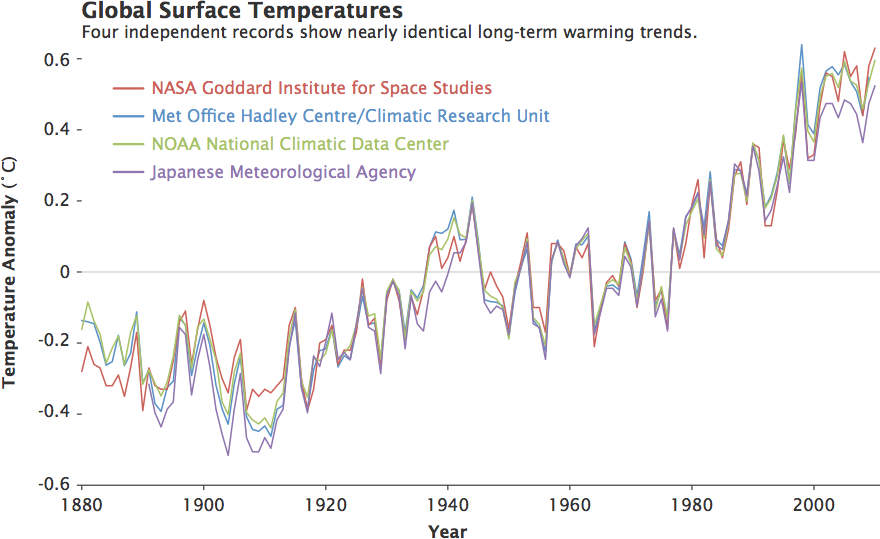
Anyway, the point is, the globe is warming. Koonin says as much and includes a graph of global surface temperature anomalies that shows several independent analyses indicating warming temperatures which have impressive agreement. Below is a version of this graph from climatecentral.org:
There is, however, more nuance to this than I had realized. I had always assumed everything was getting warmer — hotter days, less cold nights, etc. However, Koonin points to a figure in chapter 6 of the 2017 Climate Science Special Report (CSSR) (reproduced below) that shows that it’s actually only cold days that are getting less cold. The warmest temperatures haven’t been increasing, and they were higher in the 1920s, 30s, and 40s.
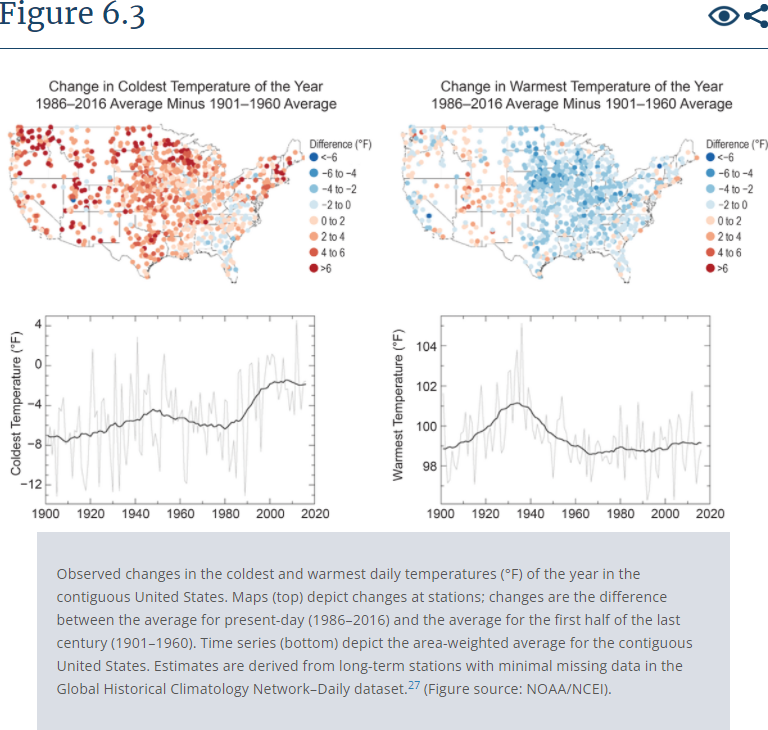
The notion that hot days are getting hotter is probably one of the most commonly repeated “facts” of human-caused climate change. I certainly thought it was the case. But Koonin shows that that isn’t completely true. I’ll admit, what I “knew” about warming temperatures was not so. The science of a warming globe is more nuanced than I had realized.
Extreme Temperatures
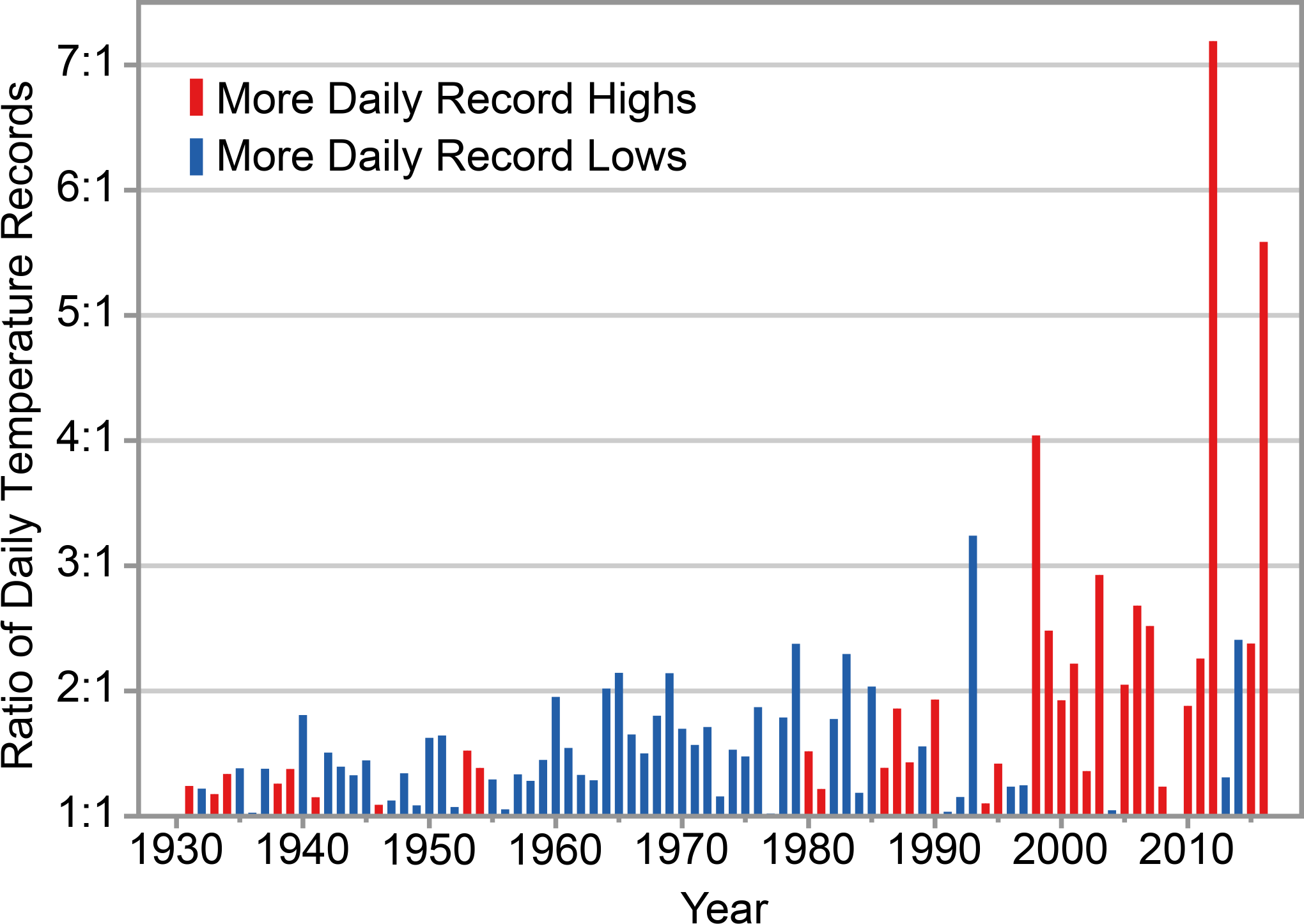
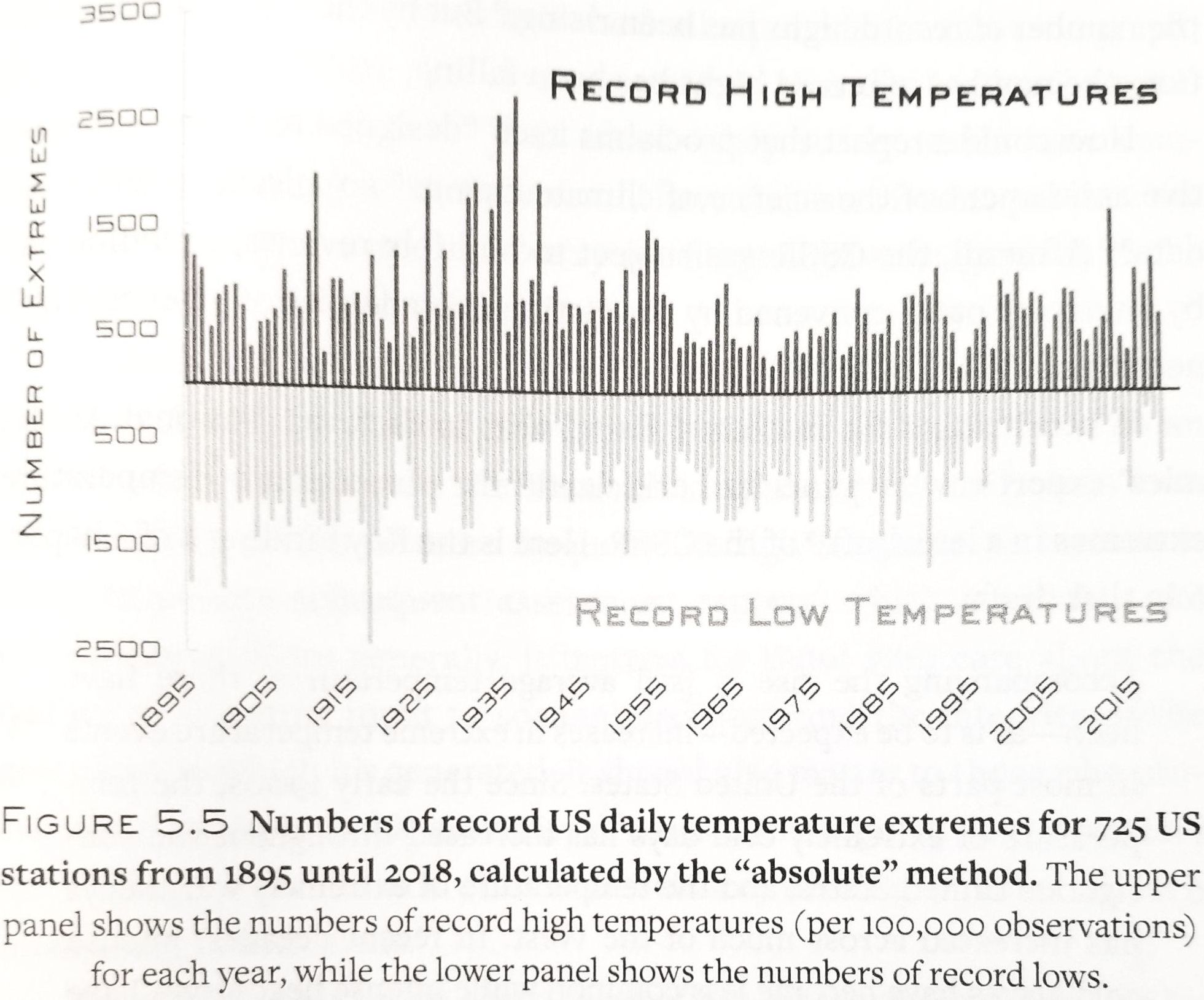
However, this only tells the story of the averages. Are we having more extreme temperatures — both highs and lows? He says there is a public perception that it is true, but it’s not. He says “record low temperatures have indeed become less common, but record daily high temperatures are no more frequent than they were a century ago.”
This means when you look at the ratio of record highs to lows, it appears to be increasing, but that’s because of the decrease in record lows. This is exactly how it was represented in the 2017 CSSR figure ES.5 (shown below). It uses running averages and looks at the ratio, which results in a graph that appears to suggest that more extreme high temperatures are happening when they aren’t.
He and climatologist John Christy did their own review of record high and record low temperatures and found that the number of record high temperatures doesn’t appear to be increasing. He shows a graph of this in the book (shown below), but, unfortunately, it doesn’t seem like they have published it in any peer-review scientific journals. Also, these are only U.S. temperature records and it’s not clear that global records would show the same.
How Much Warming Is Anthropogenic?
I was curious how much of the recent warming was anthropogenic. I couldn’t find where he directly discusses this. The closest seemed to be when he said the following:
Humans exert a growing, but physically small, warming influence on the climate. The deficiencies of climate data challenge our ability to untangle the response to human influences from poorly understood natural changes.
This statement seems to imply that we can’t tell how much of the warming is caused by human influences, even though he admitted that the increased CO2 is due to human activities. But I don’t think that’s correct. The synthesis report from the fifth IPCC assessment report states (italics in the original):
It is extremely likely that more than half of the observed increase in global average surface temperature from 1951 to 2010 was caused by the anthropogenic increase in GHG concentrations and other anthropogenic forcings together.
This is an important point and I don’t think Koonin should have omitted it.
Climate Modeling and Thinking About Uncertainty
Koonin does a good job of walking readers through how climate modeling is done. He presents the concepts clearly and succinctly. After explaining the fundamentals of the process, he goes on to highlight some of the problems with climate models. He raises important points demonstrating the limitations of the models and explains why creating predictive climate models is so difficult. Nearly every aspect of climate modeling faces challenges of insufficient historical data, inconsistent historical data collection, high natural variability, and a plethora of confounding variables.
At a high level, climate modeling works through an iterative process. The atmosphere of the Earth is divided into three-dimensional boxes over the entire planet. Over land, each box is about 100 km X 100 km and stacked in a pile 10–20 layers deep. Over water, the boxes are smaller, - typically 10 km X 10 km and stacked up to 30 layers high. Because the part of the atmosphere that affects weather is much less than 100 km high, each box is much longer and wider than it is tall, so the pile looks like a stack of pancakes. To start the modeling, scientists set the initial conditions of every box and use the laws of physics to calculate what the world will look like at the next step, which could be as small as a 10-minute increment. They do this a million times and voila! — they’ve got a climate model. The image below from NOAA shows a notional schematic of this process.
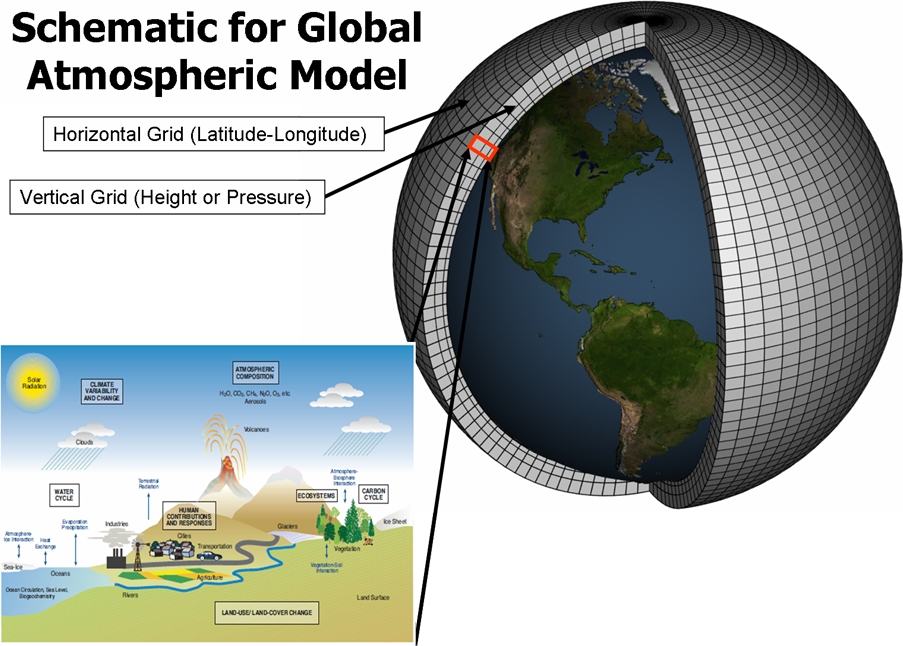
Although this is the state-of-the-art in climate modeling, its flaws are immediately apparent. Firstly, the grid sizes are huge — a single grid is almost as large as Connecticut. This is a problem because many important phenomena, such as clouds, storms, and tornadoes, are far smaller than a single grid, so they can’t be modeled with this process. Even things like temperature and humidity aren’t going to be a single value for such a large area.
Another problem is that applying the laws of physics isn’t as simple as it sounds. There are so many variables, and values are required for all of them. Many of them will be nothing more than best estimates. But even seemingly insignificant factors come into play. Koonin points to the U.K. Earth System Model UKESM1 where researchers decided to adjust the value for how much dimethyl sulfide is produced by microorganisms on the ocean surface.
They also need to know the right initial conditions, which would require them to know things like exactly how much snow was in a specific tile at the model’s start time (usually around 1890 for models that feed into IPCC reports).
All these variables give the modelers lots of little knobs to tune. This might make them better able to fit historical data, but it also raises questions about how well these can be predictive of the future.
Researchers know their models have flaws, so they try to correct for all of these sources of error by ensembling results from many different models running many different simulations in the hopes that the errors roughly balance out. Koonin points to a figure, shown below, from a paper on climate models that shows 26 different CMIP6 models running a total of 127 simulations and smoothed with an 11-year running mean. You can see both that the individual models roughly track the observed data (black lines) but that they also vary rather widely, by about a degree. This certainly backs Koonin questioning our ability to predict temperature changes at the required level of precession.
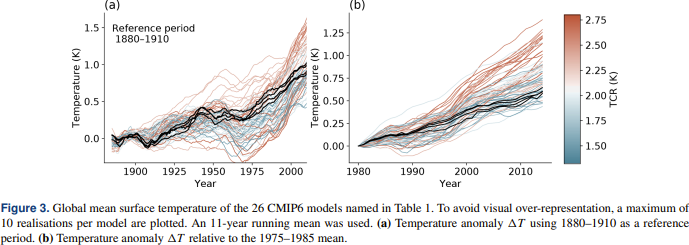
By explaining how modeling is done, Koonin instilled in me (what I hope is) a healthy skepticism for climate models. However, I think he goes too far when he says “Projections of future climate and weather events rely on models demonstrably unfit for the purpose.” So although I agree that many models are not as good as we’d like, I have many caveats.
Although I accept most of Koonin’s criticism of the modeling, that doesn’t mean the models are meaningless. The question isn’t if the models are right, but if they are useful. I’m pretty convinced these models have some value. They’re in the ballpark of being right and past studies have found them to be effective. For example, a study on Evaluating the Performance of Past Climate Model Projections analyzed “the performance of climate models published between 1970 and 2007 in projecting future global mean surface temperature” (GMST) and found that models were “skillful in predicting subsequent GMST changes''. Admittedly, this is only surface temperature and not extreme weather, which to me appears more difficult to model, but it is something.
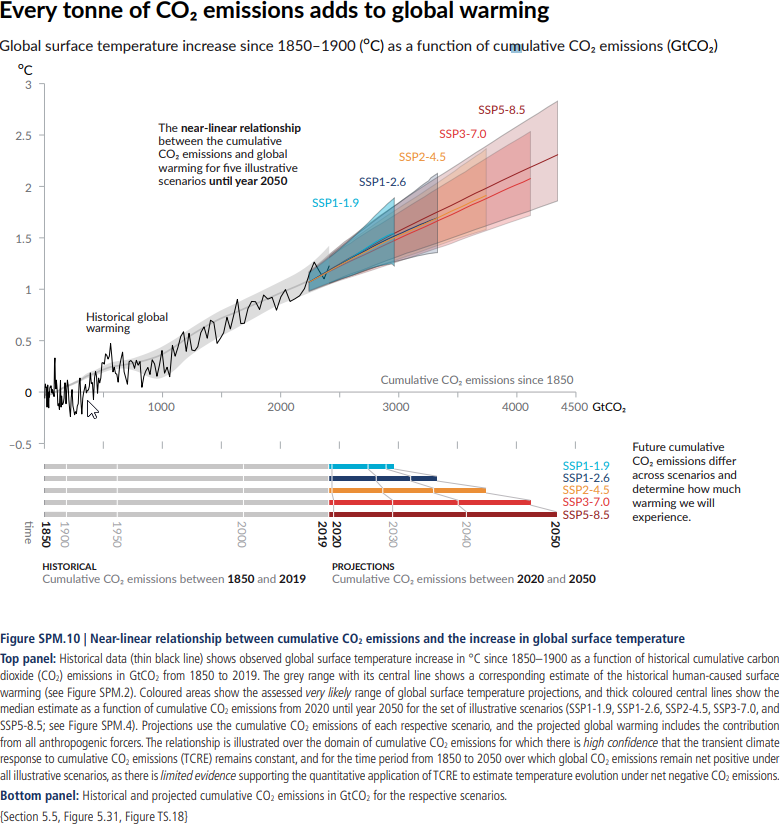
Also, how precise do these models need to be? Look at the IPCC’s graph of global surface temperature increase by CO2 emissions in the AR6 (Figure SPM.10). If you say the models are garbage and your 5-year-old nephew could do as well, I say break out the crayons and ask him to start making projections — it doesn’t take much insight to see that it’s going to keep going up.
Another important climate model is that of sea-level rise. For many reasons, it’s very difficult to model, but take a look at this graph from the U.S. Global Change Research Program. We can debate the merits of various modeling methods, but the same applies here — we should all agree on what the overall trend is.
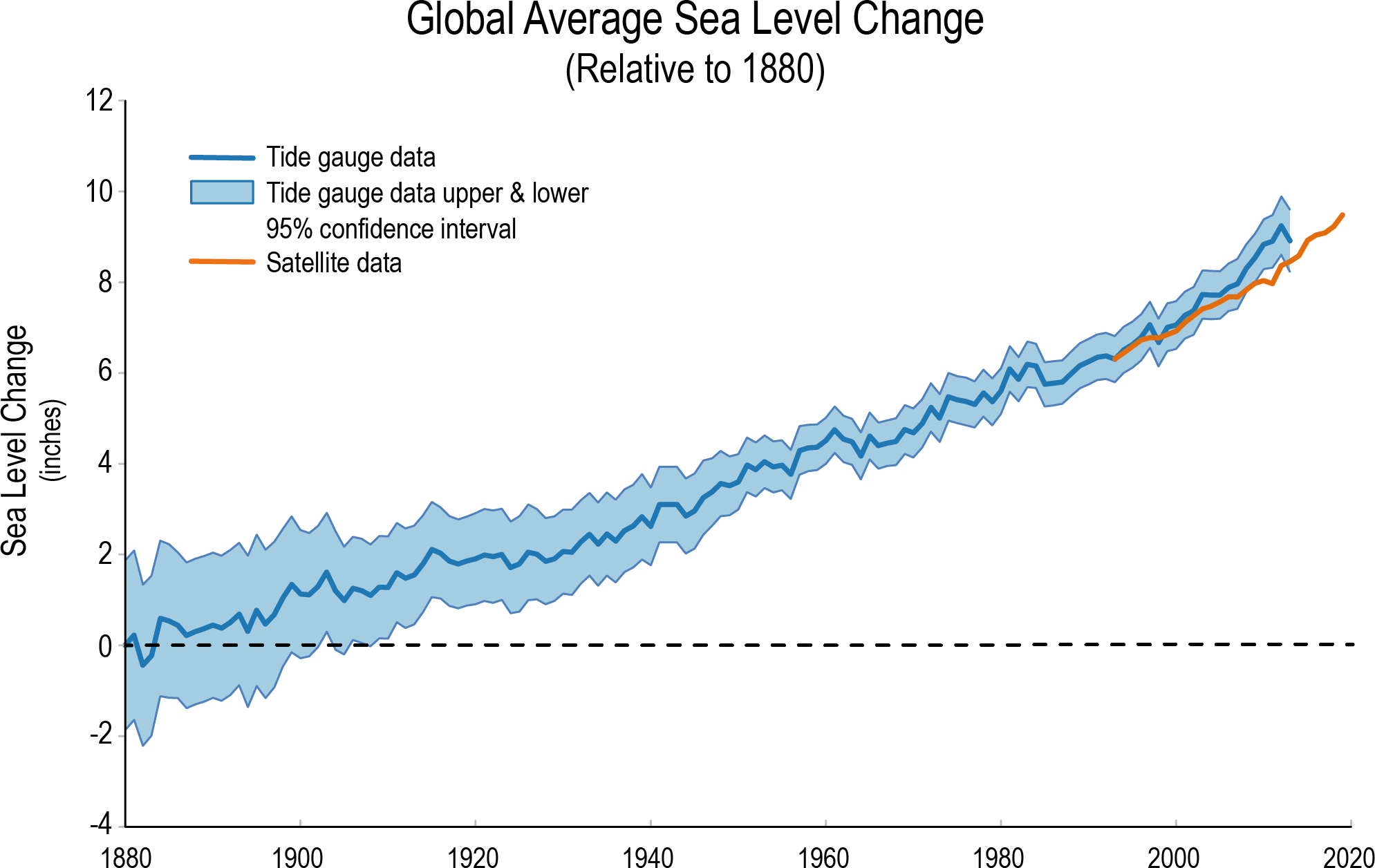
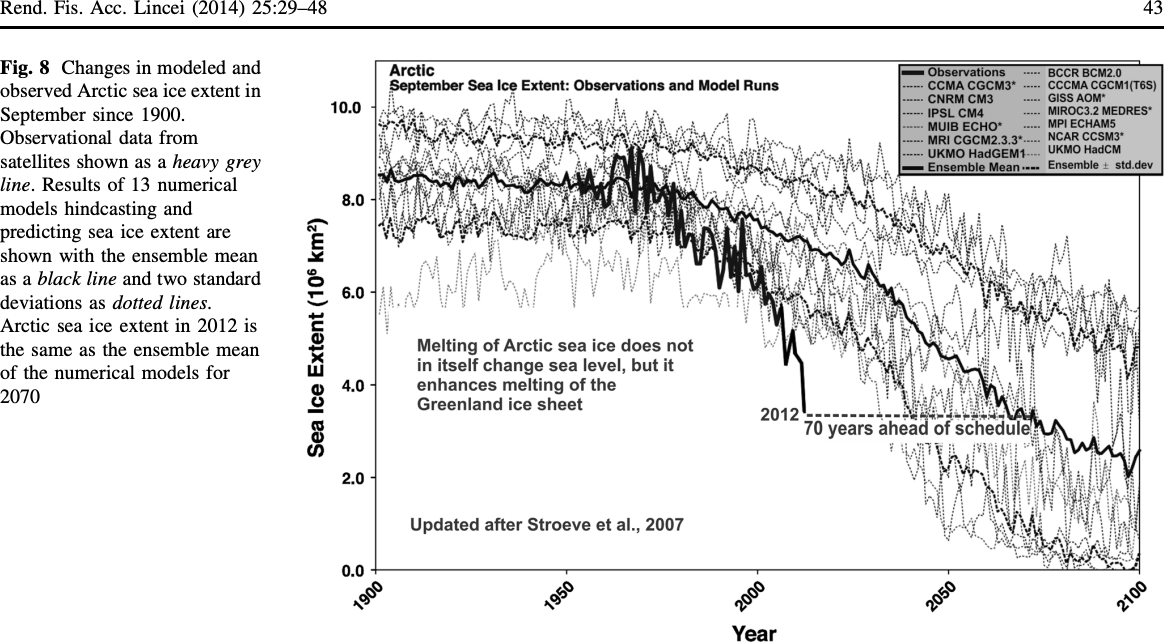
It’s important to note that just because the modeling is flawed, doesn’t mean that bad effects aren’t going to happen. They could be as predicted, worse, better, completely different. We just don’t know for sure. For example, in a 2014 paper about The accelerating rate of global change the authors show how a specific prediction of sea ice extent was wrong. The true result was that the sea ice melted 70 years ahead of schedule, which shows that sometimes the models can _under_estimate the severity of climate change.
Hurricanes and the Deep Dive into Scientific Literature
I was particularly interested in Koonin’s thoughts on hurricanes. I wanted to know how much effect human-caused climate change is having on them. The media makes the connection but I’ve always wondered how real it was. Koonin had a lot to say on the topic and it gave me an excuse to dig deeper into the scientific literature.
Koonin’s Claim
His main claim is about how much impact human influences have had on hurricanes. He says:
“hurricanes and tornadoes show no changes attributable to human influences”
This statement surprised me. I’ve heard over and over how human-caused climate change is making hurricanes worse. I had expected Koonin to be skeptical of some of the claims, but this statement was much stronger than that. And his claims go further. He also says that the assessment reports “present summary ‘spin’ inconsistent with their own findings.” For future projections, he says that while they might get worse in the future, it’s nothing that could be described as catastrophic.
To really understand, I had to look not just at the assessment report summaries, but also the full text and even the primary literature. In this section, I split off from simply discussing what I learned from Koonin to reading the primary research and seeing how his claims stand up. If a deep dive into scientific literature on hurricanes isn’t your cup of tea, feel free to jump to the Hurricane Conclusion.
Background on Hurricanes
Before we get into it, we should start with a clarification on terminology. It’s important to know that hurricanes, typhoons, cyclones, and tropical cyclones are all essentially the same thing — they’re just called different things in different places. “Tropical cyclone” is the most generic term (e.g. hurricanes and typhoons are both tropical cyclones) so that’s the term you’ll see in a lot of the climate studies that I quote here. They’re called “typhoons” in the western Pacific and “cyclones” in the Indian Ocean. They’re called “hurricanes” when in the Atlantic Ocean or the eastern Pacific Ocean and that’s the term Koonin uses so I do the same. At different times I’ll be citing research that uses one term or the other — just know that they’re mostly interchangeable.
Disentangling Human-caused Climate Change from Natural Variability
As we move forward, we have to be careful of how we evaluate the evidence. It’s important to remember that hurricane behavior is always changing through natural cycles and variations. For example, chapter 6 of the 2019 Special Report on the Ocean and Cryosphere in a Changing Climate (SROCC) says:
Patterns of storm activity across TC [tropical cyclone] basins show variations through time that appear to be correlated with El Niño-Southern Oscillation (ENSO), North Atlantic Oscillation (NAO), and changes in atmospheric dynamics related to changes in precession of the sun (Toomey et al. 2013; Denommee et al. 2014; Denniston et al. 2015).
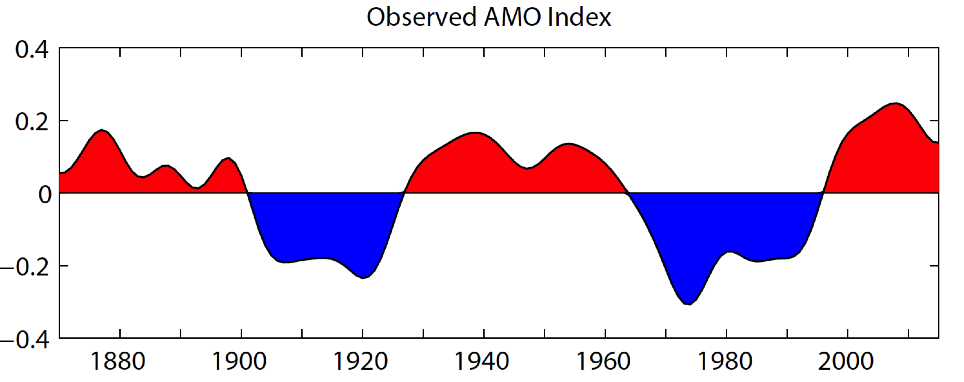
Just to dig into one such cycle for a moment, take a look at the Atlantic Multidecadal Oscillation (AMO) in the figure below. It shows that there is a natural warming and cooling cycle in the Atlantic Ocean with a period of 60–80 years. The AMO and other natural cycles have significant effects on hurricane activity. This means that we can’t just look for changes in hurricane data and attribute them to human-caused climate change. We’ll have to look for patterns of behavior that are outside of natural variability.
Investigating The Claim
Background
Koonin says when he was researching climate change in 2016, he “turned to the (then most recent) National Climate Assessment” of 2014. He found the following summary of hurricane behavior, Key Message 8, quite alarming:
The intensity, frequency, and duration of North Atlantic hurricanes, as well as the frequency of the strongest (Category 4 and 5) hurricanes, have all increased since the early 1980s. The relative contributions of human and natural causes to these increases are still uncertain. Hurricane-associated storm intensity and rainfall rates are projected to increase as the climate continues to warm.
However, he dug deeper into the report and found contradicting statements “buried in the text of Appendix 3,” which he quotes:
There has been no significant trend in the global number of tropical cyclones nor has any trend been identified in the number of U.S. landfalling hurricanes.
Noting the apparent inconsistency, he got curious and dug into what he considered the NCA’s main paper on the topic, a 2010 paper titled Tropical cyclones and climate change. He “found it stated quite explicitly that there are no significant trends beyond natural variability in hurricane frequency, intensity, rainfall, or storm surge flooding.”
This is where I went off Koonin’s text into the scientific literature, starting with the study he referenced. In that study, Koonin seems to be keying off of this sentence:
Therefore, it remains uncertain whether past changes in tropical cyclone activity have exceeded the variability expected from natural causes.
However, the study goes on to discuss model-based projections as well. The next two sentences are:
However, future projections based on theory and high-resolution dynamical models consistently indicate that greenhouse warming will cause the globally averaged intensity of tropical cyclones to shift towards stronger storms, with intensity increases of 2–11% by 2100. Existing modelling studies also consistently project decreases in the globally averaged frequency of tropical cyclones, by 6–34%.
I think it’s important to note that the authors do expect human-caused climate change to affect hurricanes, though they hadn’t found a clear signal at the time of that writing.
In total, I do think Koonin’s assessment of this report is accurate. My main objection is that this study was in 2010. Since then, we’ve continued to learn a lot about hurricanes. What does the latest research say?
Aspects of Hurricanes
There are a lot of different aspects of hurricanes that humans could be affecting — I guess as many as one could measure. But I saw the same three coming up in study after study, so those are the three I will focus on: frequency, intensity, and amount of precipitation. Because he referenced both current data as not showing an effect and future projections as not being catastrophic, I wanted to look at both for each aspect.
I find evaluating the quality of scientific research very difficult and time-consuming, even in my own field. And as I said before, climate science is not my field. For topics that are outside my field, I often look to meta-analyses and survey papers. Fortunately, one of Koonin’s sources was just such a survey paper for climate science that I relied on for helping me understand expert opinions on the various topics.
The survey, “Tropical Cyclones and Climate Change Assessment: Part I: Detection and Attribution,” was co-authored by 11 hurricane experts and published in 2019. From my outsider’s perspective, it seems to be an excellent study. It’s done by 11 climate scientists looking at all the evidence in two different ways: One through the lens of trying not to overstate any anthropogenic effect (type I errors) and then a second time through the lens of trying not to understate any anthropogenic effect (type II errors). This approach is important because many times scientists try to “reject a null hypothesis,” which is a good approach but has its flaws. The "null hypothesis" approach is like saying if they don't have evidence to be sure of something, they will default to a "nothing is happening" explanation. The problem is that with weak evidence, they might fail to conclusively reject a null hypothesis even if the balance of evidence suggests an alternative hypothesis is more likely. But looking at it through both lenses gives both a conservative and aggressive bound for the problem.
In addition, the same authors published “Tropical Cyclones and Climate Change Assessment: Part II: Projected Response to Anthropogenic Warming” in 2020, which contains projections of future activity. This research looks at model projections of hurricane behavior assuming 2°C of anthropogenic global warming. To get a sense for the timeline that these projections would be relevant for, we can again use the study that projected I found research published in January of 2022 that looked at this and put their conclusions right in the headline: “Plausible 2005–2050 emissions scenarios project between 2 and 3 degrees C of warming by 2100.” They found a median of 2.2°C of warming by 2100, so the projections from the hurricane survey could be said to roughly correspond to a little under 80 years away. I'll be referring to these studies throughout this post as Part I and Part II of the 11-expert assessment.
Frequency — All Hurricanes
Present
Part I of the 11-expert assessment surveyed the literature for changes in global hurricane frequency. They concluded:
global TC and hurricane frequency since 1970 … [shows] no strong evidence for trends.
I wanted to look at the data myself and fortunately, the author of the primary research the assessment cited, maintains a site, climatlas.com, which keeps an up-to-date graph of global hurricane frequency over time. Here’s what it shows:
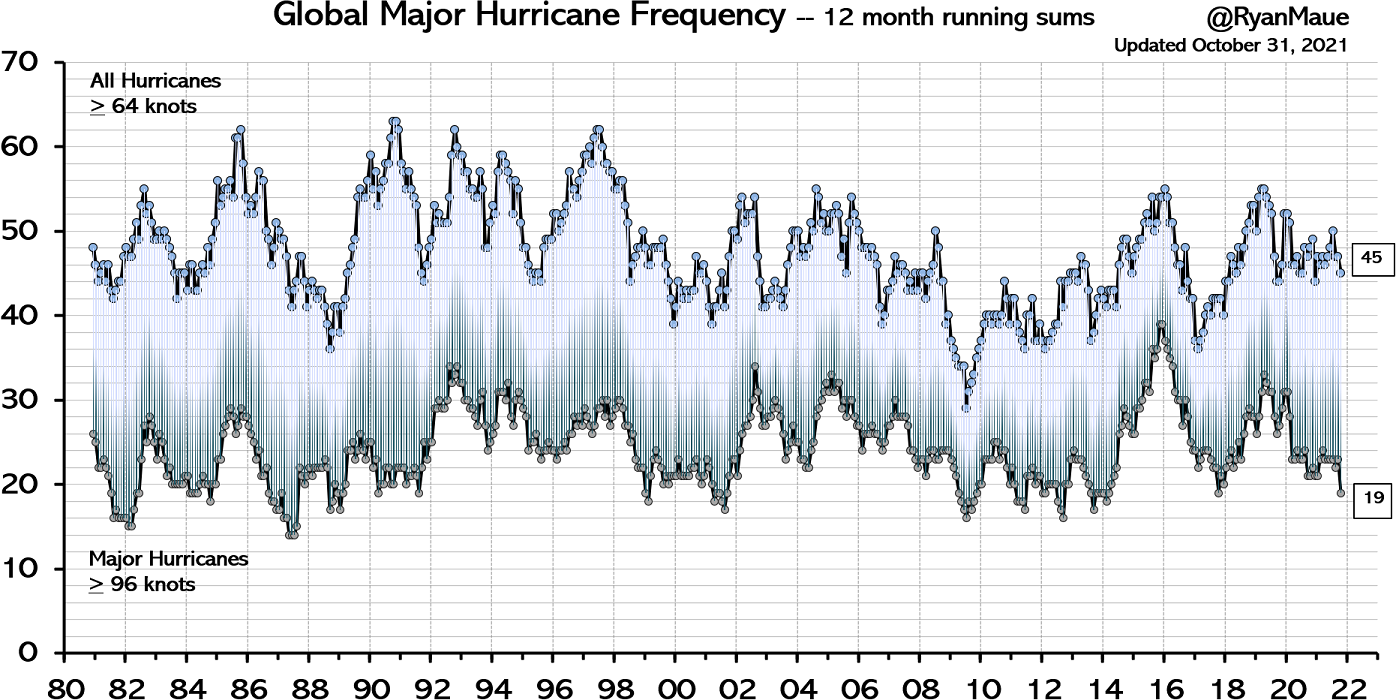
In this graph, “Major Hurricanes” refers to categories 3–5 on the Saffir–Simpson scale (5 is the highest possible score), and “All Hurricanes” contains categories 1–5. It’s pretty clear that there are cyclical trends in the data here, but I don’t see any obvious overall upward or downward trend.
Future Projections
But what about future projections? Many reports have made projections for future changes in hurricane frequency. The 2012 IPCC Special Report of Extreme Events states that (italics in the original):
It is likely that the global frequency of tropical cyclones will either decrease or remain essentially unchanged.
Following on that, the 2019 SROCC says (my bolding):
IPCC AR5 concluded that there was low confidence in any longterm increases in TC activity globally and in attribution of global changes to any particular cause (Bindoff et al. 2013; Hartmann et al. 2013). Based on process understanding and agreement in 21st century projections, it is likely that the global TC frequency will either decrease or remain essentially unchanged
We can also look at part II of the 11-expert assessment for their projection. Here’s Figure 1 from that paper:
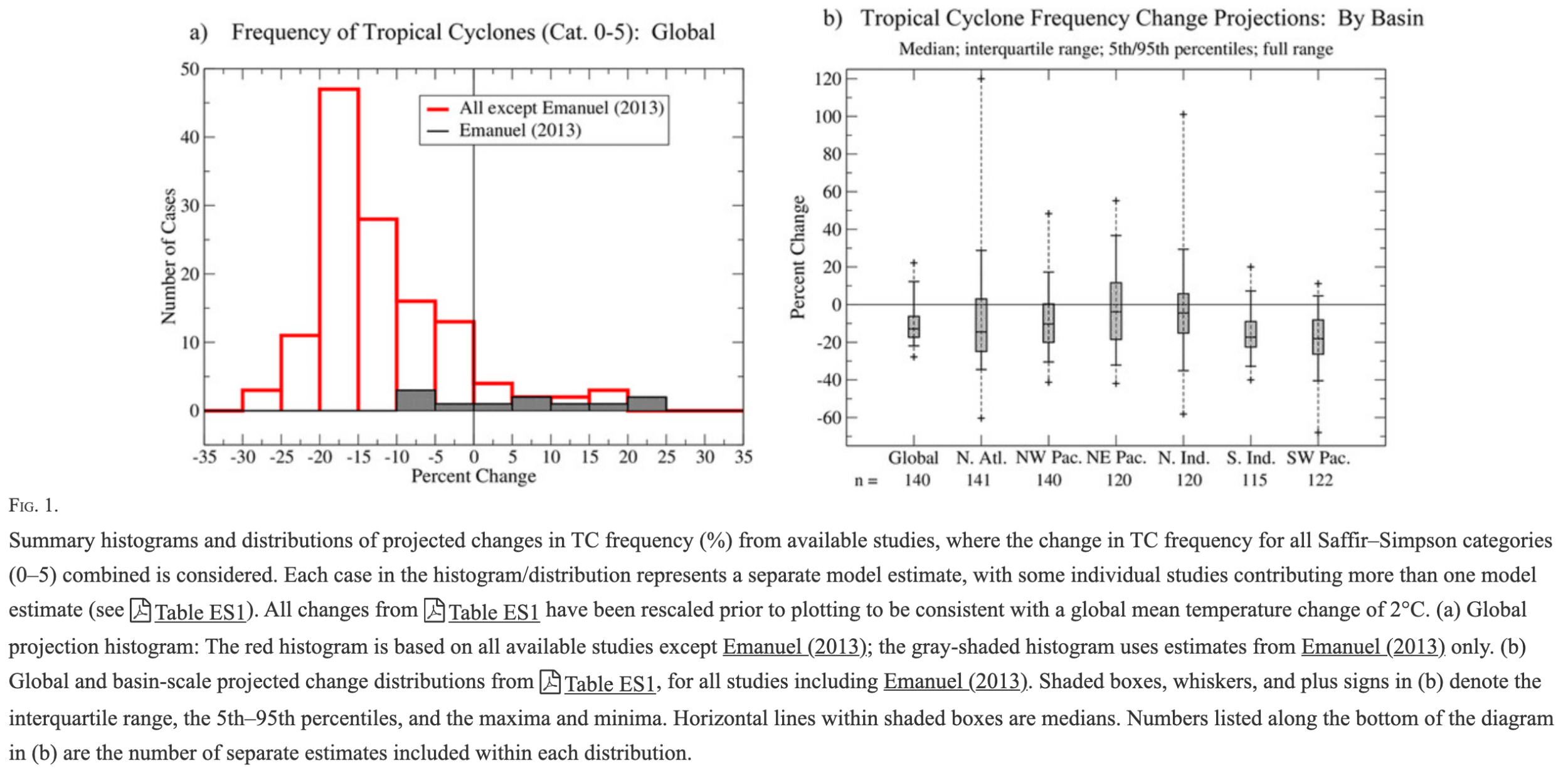
The first thing I noticed is that the ranges are incredibly large. The range in every basin overlaps with 0% change, indicating that it’s possible absolutely nothing is changing at all in terms of frequency. And the uncertainties for the North Atlantic and North Indian basins are incredibly large. In both of those cases, the median change is a decrease, but there could also be an increase, and there’s about a 5% chance that the frequency doubles. It’s also interesting that the median value for global percent change is noticeably negative, somewhere around -15%. So it seems likely that hurricanes will decrease globally, but there’s a good chance they remain essentially unchanged.
Frequency — Intense Hurricanes
Present
What about if we focus solely on the most intense (and therefore destructive) hurricanes — are they becoming more frequent? It seems the evidence here is more mixed. I found a study from 2005 called “Changes in Tropical Cyclone Number, Duration, and Intensity in a Warming Environment” (full text available in this homework assignment) stating that:
hurricanes in the strongest categories (4 + 5) have almost doubled in number (50 per pentad [five year period] in the 1970s to near 90 per pentad during the past decade) and in proportion (from around 20% to around 35% during the same period).
However, it doesn’t seem like this analysis has held up very well. The 2010 paper Tropical cyclones and climate change mentions this study and states that “Other studies contested this finding, based on concerns about data quality and the short record-length relative to multidecadal variability in the northwest Pacific” (references to these disputes are provided in the 2010 paper).
Looking at the graph of Global Major Hurricane Frequency and focusing on the lower line for major hurricanes, again, I don’t see any clear upward or downward trend.
Future Projections
There has been some evidence from modeling that there could be an increase in the frequency of the most intense hurricanes. For example, from the 2018 IPCC Special Report on Global Warming of 1.5 °C (SR15):
Tropical cyclones are projected to decrease in frequency but with an increase in the number of very intense cyclones (limited evidence, low confidence).
Looking at part II of the 11-expert assessment again, it seems there’s a greater chance that these are increasing than there was for all hurricanes, but the median value is basically right at 0%. Looking at all the regions, it’s not at all clear that these values are changing.
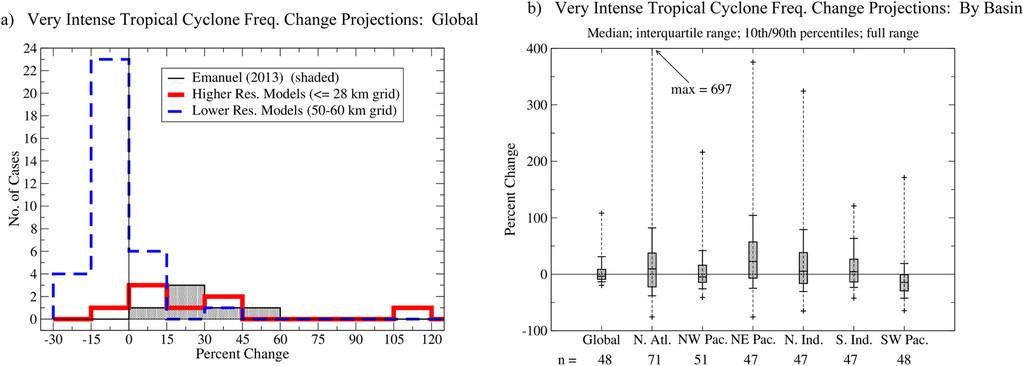
It was also interesting to see how the experts from the survey were divided on this issue. The paper said:
In summary, author opinion was divided on whether the global frequency of very intense (e.g., category 4–5) TCs will increase or not, with the confidence in an increase ranging from low (three authors), to low-to-medium (two), to medium (one), to medium-to-high (four) to high (one).
My takeaway is that it seems more likely than not that there will be around a 15–30% increase in very intense hurricanes, although this is quite uncertain.
Intensity
Present
A 2013 study on “Trend Analysis with a New Global Record of Tropical Cyclone Intensity” looked at changes in hurricane intensity. They found that the evidence was suggestive of an increase in global hurricane intensity, but the data wasn’t statistically significant. However, they followed it up in 2020 with more recent data and found that there was a statistically significant increase.
But remember, we’re not just looking for change over time, but change due to anthropogenic factors. Although it’s consistent with the theory that human-caused climate change has caused this, there is a myriad of other factors, and as Koonin notes, the study did not distinguish between them (my bolding):
Ultimately, there are many factors that contribute to the characteristics and observed changes in TC intensity, and this work makes no attempt to formally disentangle all of these factors. In particular, the significant trends identified in this empirical study do not constitute a traditional formal detection, and cannot precisely quantify the contribution from anthropogenic factors. From a storyline, balance-of-evidence, or Type-II error avoidance perspective (e.g., refs. 6 and 45), the consistency of the trends identified here with expectations based on physical understanding and greenhouse warming simulations increases confidence that TCs have become substantially stronger, and that there is a likely human fingerprint on this increase. Given the well-understood impacts and risk that increasingly powerful TCs carry with them, strict adherence to Type-I error avoidance could be considered overly conservative.
So it seems like hurricanes might be getting more intense, but the effect is small. It’s not clear that this is caused by climate change, but experts think it is likely.
Future Projections
The 2010 Tropical cyclones and climate change paper stated the following:
future projections based on theory and high-resolution dynamical models consistently indicate that greenhouse warming will cause the globally averaged intensity of tropical cyclones to shift towards stronger storms, with intensity increases of 2–11% by 2100
The lead author on that paper works at NOAA’s Geophysical Fluid Dynamics Laboratory and keeps this excellent site up-to-date on global warming and hurricanes. On it, he said the following:
Tropical cyclone intensities globally are projected to increase (medium to high confidence) on average (by 1 to 10% according to model projections for a 2 degree Celsius global warming). This change would imply an even larger percentage increase in the destructive potential per storm, assuming no reduction in storm size. Storm size responses to anthropogenic warming are uncertain.
The Part II of 11-expert assessment (of which the above author is a member) looked at 15 global estimates for hurricane intensity based on 2°C of anthropogenic global warming and found them all to be between 0–10% increases.
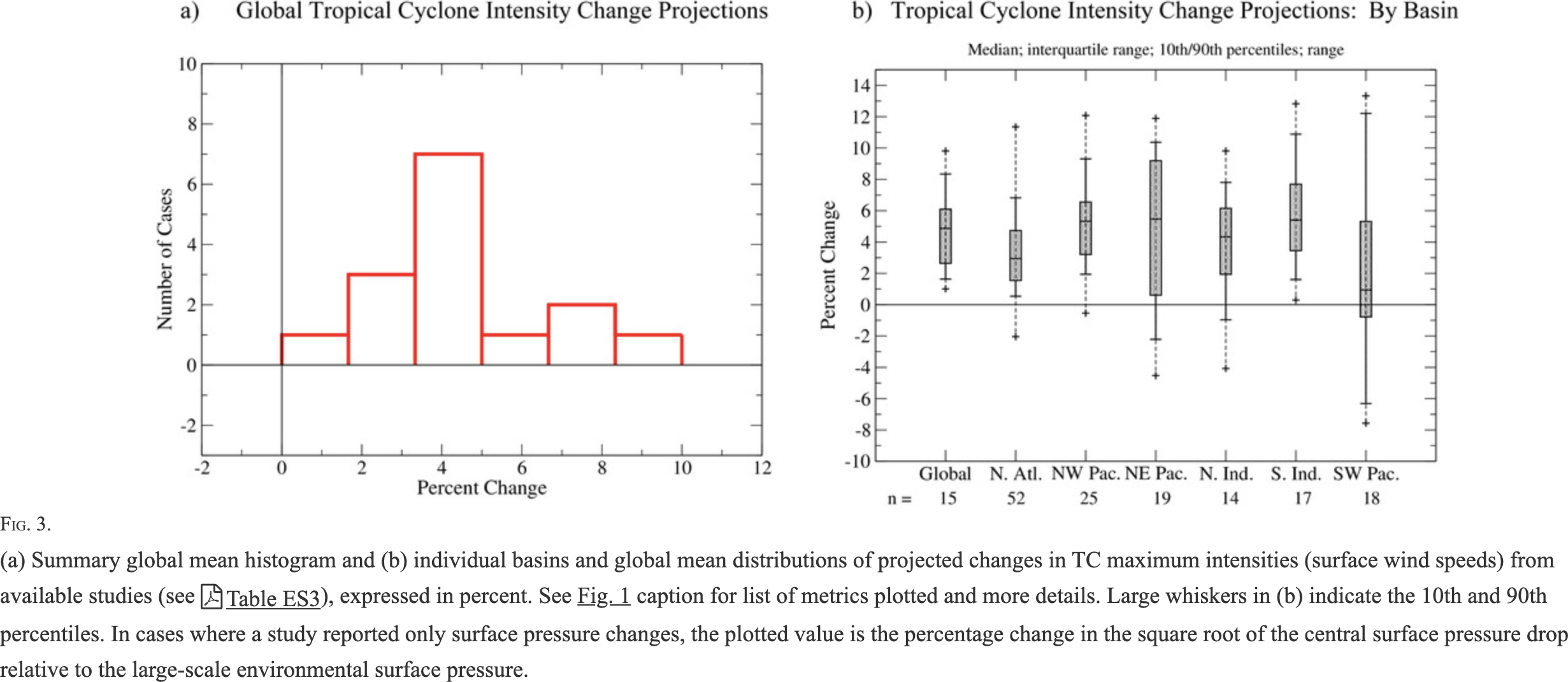
The modal value here is a 4% increase. My takeaway is that a 4% or some other single-digit percentage increase in intensity over the next 80 years seems like our best guess.
As far as Koonin’s claim goes, he was referring to changes that had happened up to the present, not future projections. Also, he was referring to changes “attributable to human influences,” which the study that found an increase in hurricane intensity did not find. My takeaway is that I don’t believe there is convincing evidence that human-caused climate change has made an impact, which is consistent with his claim.
The Atlantic Exception
But given all of the above, how did we get the alarming statement from the 2014 NCA? I printed it at the top, but I’ll repeat it here:
The intensity, frequency, and duration of North Atlantic hurricanes, as well as the frequency of the strongest (Category 4 and 5) hurricanes, have all increased since the early 1980s. The relative contributions of human and natural causes to these increases are still uncertain. Hurricane-associated storm intensity and rainfall rates are projected to increase as the climate continues to warm.
It was paired with this alarming graph of increasing Power Dissipation Index (PDI). PDI is an aggregate of hurricane frequency, intensity, and duration into a single index — you can think of it like total hurricane power over a season.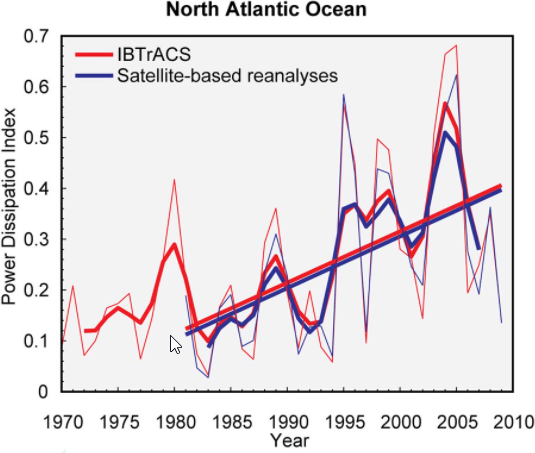
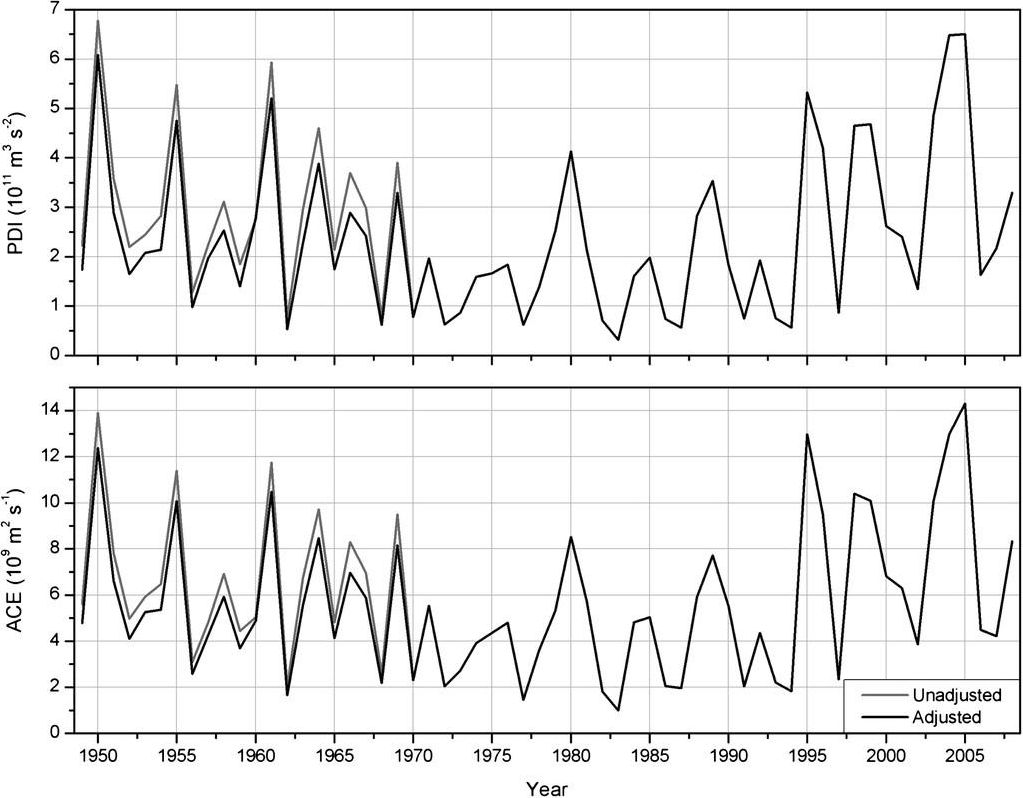
Koonin says that the graph shown in the 2014 NCA is misleading. The graph of increasing PDI is just a subset of the graph from this paper, except that it has zoomed in on a specific region to highlight the increase. With the historical context, the growth in PDI seems to be within natural variability.
When I first read the NCA statement, I had assumed that they were focusing on North Atlantic hurricanes because it’s a U.S.-based report and North Atlantic hurricanes have the largest impact on the U.S. I had also assumed that global trends were roughly following a similar trajectory. I realized now that that assumption is not correct — Atlantic hurricane behavior is quite anomalous compared to global trends.
Part I of the 11-expert assessment split hurricane activity into regions, and you can see the different behavior for North Atlantic hurricanes here:
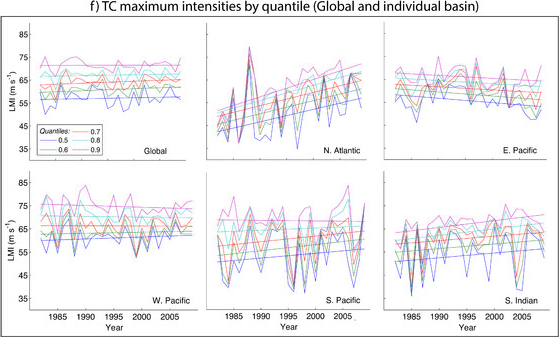
You can see the increase in Atlantic hurricane intensity here, but the various trends don't match my intuition for an effect driven by global warming. My thought is that if global warming were causing more intense hurricanes, they would be more intense everywhere (within some variability), not just in the Atlantic. But it seems that hurricane maximum intensity is decreasing in other basins and that there’s no clear overall trend. In terms of isolating human-caused climate change, this doesn’t seem like a clear signal to me.
There is a section in the full text of the Sixth IPCC AR, which came out in 2021 (after Koonin published his book), that specifically addresses hurricanes in the Atlantic.
there is still no consensus on the relative magnitude of human and natural influences on past changes in Atlantic hurricane activity, and particularly on which factor has dominated the observed increase (Ting et al., 2015) and it remains uncertain whether past changes in Atlantic TC activity are outside the range of natural variability
The contrast between this sentence (which I felt was rather hard to find on page 2862 of the full report) and the headline from the 2014 NCA is striking. And it’s not that the evidence has gotten weaker, because the statement from the 2021 AR6 is nearly identical to the statement from Tropical cyclones and climate change nearly a decade prior that was mentioned before: “Therefore, it remains uncertain whether past changes in tropical cyclone activity have exceeded the variability expected from natural causes.” As Koonin points out, if we don’t know that hurricane activity has changed beyond natural variability, then how can we even begin to say that it’s being caused by human influences?
It does seem like hurricanes in this basin got more intense from the 1980s to 2010. (I haven’t been able to find the same graph that includes the last decade). However, I don’t think it is clear that this is a result of human-caused climate change. The fact this increase is only happening in the Atlantic basin makes me think it’s more likely to be associated with natural variability, although I have low confidence in all of this. This also means it’s hard to say what will happen in the future.
Precipitation
Present
Unlike some of the other effects, there’s a relatively simple mechanism behind the climate’s effect on hurricane precipitation. As the air is warmer, it holds more water vapor, and an atmosphere with more water vapor leads to more precipitation. In addition, the amount of precipitation that falls on a single area is a function of how long the hurricane is above that area. Thus, slower hurricanes dump more water on a specific region than faster ones. So there are multiple reasons precipitation may change as the climate changes.
There was a lot of recent research about climate change and hurricane precipitation from Hurricane Harvey, so I’m going to start there. Hurricane Harvey was a Category 4 hurricane famous for flooding Houston, Texas in 2017. It produced record-breaking rainfall over three days in Houston. The National Hurricane Center Tropical Cyclone Report on Hurricane Harvey says that Harvey was responsible for “at least 68 direct deaths.” Fortunately for us, it was also a well-studied hurricane, and many researchers were looking into how much human-caused climate change affected it.
As we’ve seen, it is really hard to determine how much of a change in hurricane behavior is due to human-caused climate change versus other factors. However, studies that link disasters directly to human-caused climate change have started appearing. These are known as “attribution studies.” They rely on counterfactual models of the world. That is, asking the question “What would have happened in a world without human-caused climate change?” Attribution studies are hard — Koonin says this, climatologists say this, everyone seems to agree about this. As Koonin says, the whole basis of science is the ability to check your results against real data. We’re not able to do that in counterfactual models. That doesn’t mean we throw them all out, but it does mean we should be less sure of them. As Koonin points out, even the World Meteorological Organization warns against attributing a single event to human-caused climate change.
any single event, such as a severe tropical cyclone, cannot be attributed to human-induced climate change.
However, these attribution studies are trying to do just that. For example, one study on the economic costs of Hurricane Harvey estimated the anthropogenic influence of climate change. Here’s what they found:
In this paper, we use a probabilistic event attribution framework to estimate the costs associated with Hurricane Harvey that are attributable to anthropogenic influence on the climate system. Results indicate that the “fraction of attributable risk” for the rainfall from Harvey was likely about at least a third with a preferable/best estimate of three quarters. With an average estimate of damages from Harvey assessed at about US$90bn, applying this fraction gives a best estimate of US$67bn, with a likely lower bound of at least US$30bn, of these damages that are attributable to the human influence on climate.
One study on Attributable Human-Induced Changes in the Likelihood and Magnitude of the Observed Extreme Precipitation during Hurricane Harvey found the following:
We find that human-induced climate change likely increased the chances of the observed precipitation accumulations during Hurricane Harvey in the most affected areas of Houston by a factor of at least 3.5.
Another study looking at Hurricane Harvey concluded this:
we conclude that global warming made the precipitation about 15% (8%–19%) more intense, or equivalently made such an event three (1.5–5) times more likely.”
Another study had this to say:
The 60 member ensemble simulations suggest that post-1980 climate warming could have contributed to the extreme precipitation that fell on southeast Texas during 26–29 August 2017 [that’s Hurricane Harvey] by approximately 20%, with an interquartile range of 13%–37%.
I don’t know how much weight to put on these studies. The ranges of increased precipitation seem to overlap between the studies, so that gives me higher confidence in these results. I’m sure the exact numbers can be debated, but this is evidence that human-caused climate change has changed hurricane behavior in a way that led to billions of dollars of additional damage. I expect that because they are attribution studies is part of the reason Koonin doesn’t mention them.
But if we don’t put any weight into model-based studies like these, I’m not sure how we would ever tease out how much impact human influences are having in any useful timescale. If better data were available, we could throw out the weaker data and just rely on the good stuff. But other than waiting 100 years for enough data, I don’t think there is better data available. So we’ve got to accept model-based data, and we’ll have to weigh it appropriately (which is not 0 but also not 100%).
I did look for studies that modeled Hurricane Harvey and found no effect from human-caused climate change, but I didn’t find any.
All of these studies fed into the Sixth IPCC Assessment Report (AR6), which concluded:
There is high confidence that anthropogenic climate change contributed to extreme rainfall amounts during Hurricane Harvey (2017) and other intense TCs.
Given what I had read and the fact that AR6 stated they had “high confidence” in this, I was feeling like the case was pretty strong at this point. So I started looking for counter-evidence from other methods, or at least other opinions. And I found some. In particular, the 11-expert assessment had reviewed the evidence that human-caused climate change increased Hurricane Harvey’s precipitation as well. Here is the conclusion from their section on Hurricane Harvey:
In summary, from a type I error perspective, the author team had low confidence that anthropogenic influence specifically on hurricane precipitation rates has been detected. Alternatively, from the perspective of reducing type II errors, all authors concluded that the balance of evidence suggests that there has been a detectable long-term increase in occurrence of Hurricane Harvey–like extreme precipitation events in the eastern Texas region, and that anthropogenic forcing has contributed to this increase.
That’s what we’re left with. The “balance of evidence suggests” anthropogenic effects. So it seems like it is the case that we have enough evidence to suggest Hurricane Harvey was worse because of human-caused climate change, but how much worse is not possible to quantify, and even this evidence isn’t a slam dunk.
Future Projections
We can also look at future projections from part 2 of that survey in this graph.
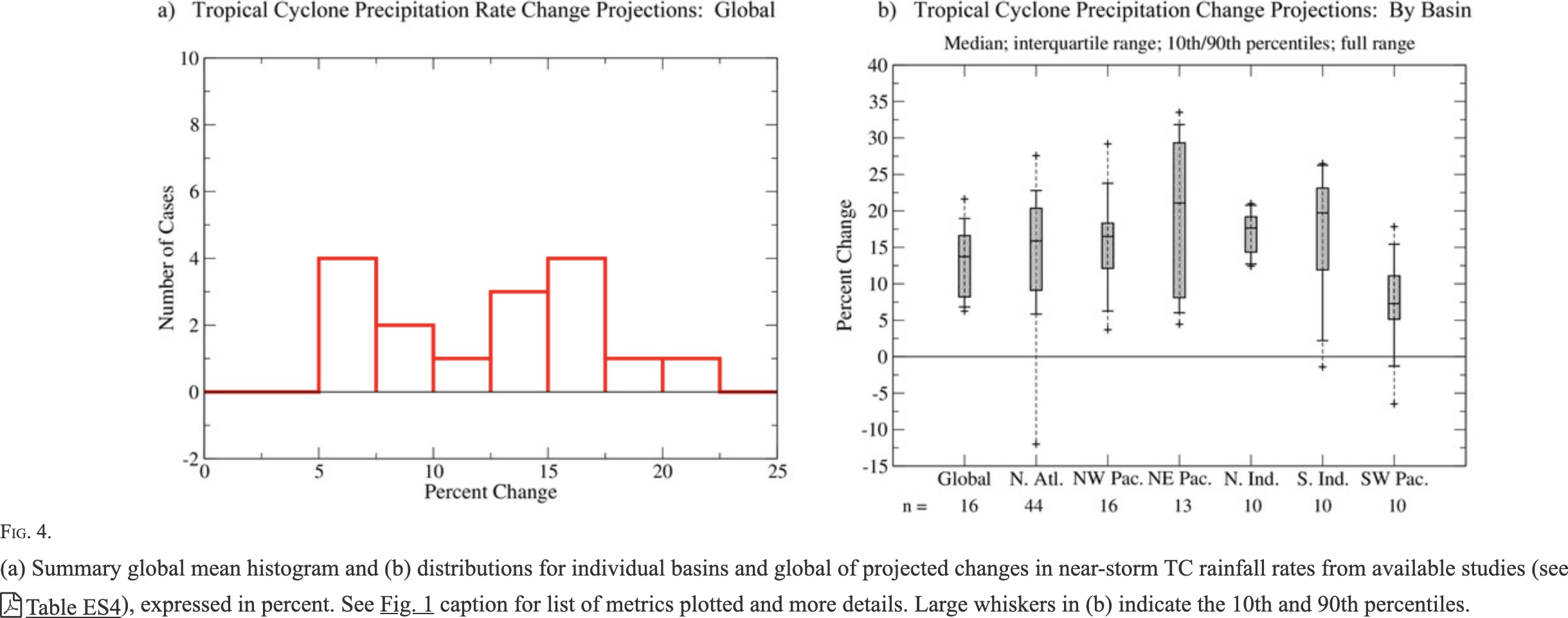
Similar to the present case for increased precipitation, this is the strongest evidence for a future projection we’ve seen so far.
Other reports, such as the 2019 SROCC, also expect precipitation rates to increase (italics in the original):
There is medium confidence … that average TCs precipitation rates (for a given storm) will increase by at least 7% per degree Celsius SST [Sea Surface Temperature] warming, owing to higher atmospheric water vapour content
Because the evidence for increased precipitation seems the strongest, I was curious about how much it mattered. How significant is precipitation in hurricane damage? So I found a study on the cause of death in the United States directly attributable to Atlantic tropical cyclones, 1963–2012. They show that storm surges, which are the temporary rises in water levels generated by a storm, are the most significant factor. But right behind them is rain, causing 27% of total deaths in the U.S. from hurricanes.
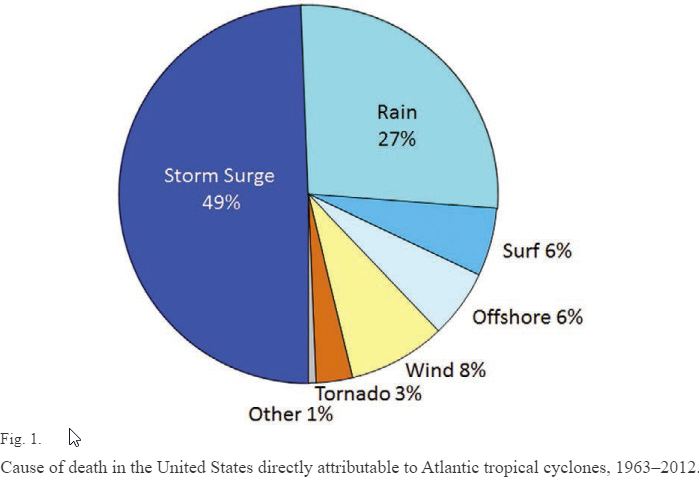
So any change in either total precipitation or the distribution of the precipitation should be taken very seriously.
The Long Tail
But it’s not just the median we should be aware of. As well as understanding the more likely outcomes, we need a sense of what the worst outcomes could be and how we’ll know if we’re on or near that path. We have to be concerned about long-tail outcomes. We need to understand how bad they are and how to know if we’re getting too close to them. To understand the worst case scenarios, let’s look at hurricanes again. One thing we've seen is that the concern about increasingly destructive hurricanes stems from model-based projections of their behavior, not changes we’ve seen so far (remember, there’s not even consensus that hurricane behavior has changed beyond natural variability). This is important to keep in mind for several reasons. One is that the projections of worse hurricanes are not guaranteed to happen. Another is that it means we are possibly headed into a world where hurricanes are far more destructive, so the current data may not be useful for predicting the future.
Still, even though the bad scenarios are unlikely, we still have to consider them and continuously evaluate their probability. To see what the bad scenarios would look like, take a look at (a) in the figure below. This is from the website Global Warming and Hurricanes, which is maintained by the lead author of the 11-expert assessment and the 2010 article “Tropical cyclones and climate change.” This is the type of thing that worries me.
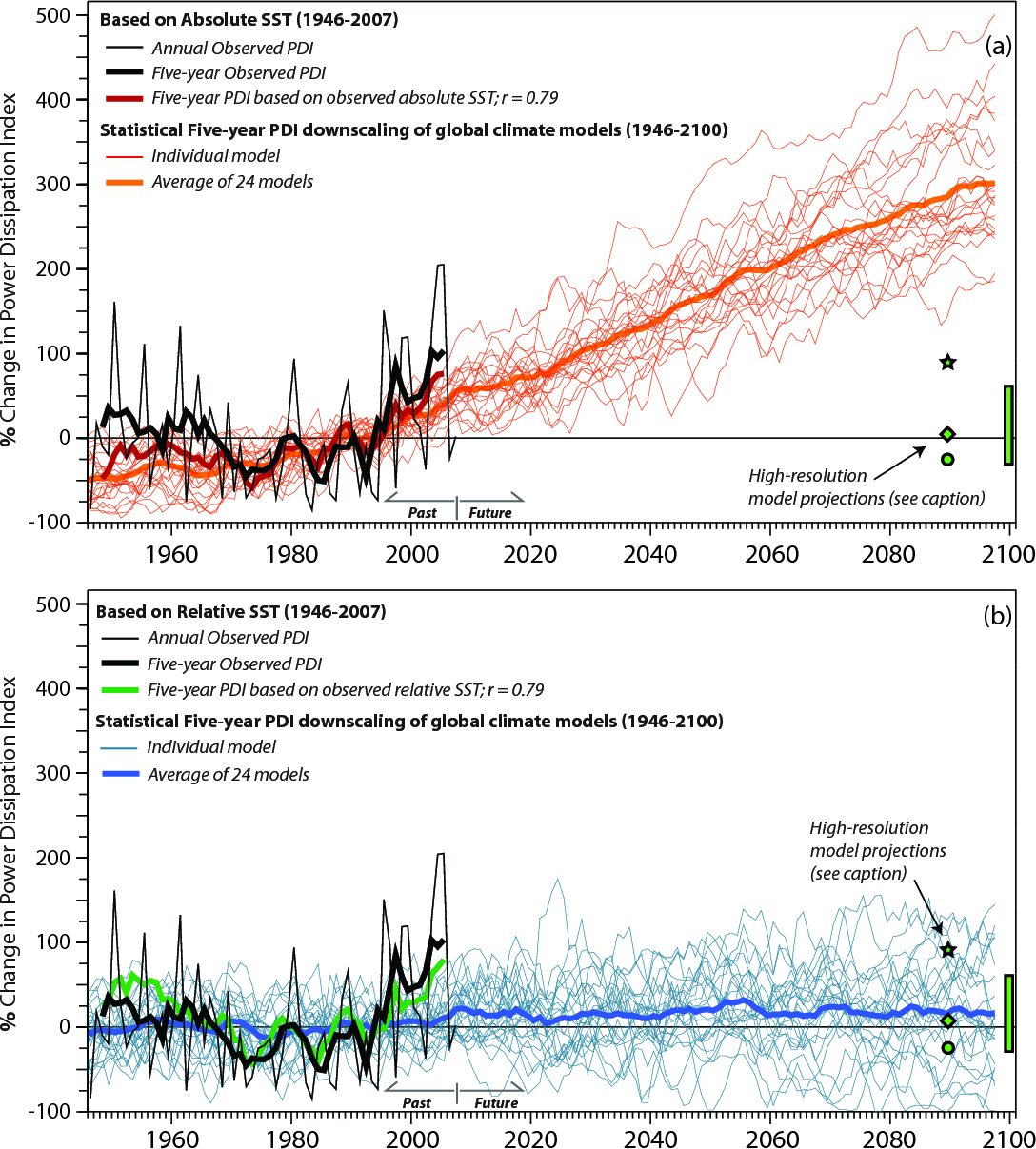
The top graph shows hurricane PDI dramatically increasing, ending up with a 300% increase by 2100. How concerned should we be about this? Here are two paragraphs from the site that discuss this:
Model-based climate change detection/attribution studies have linked increasing tropical Atlantic SSTs to increasing greenhouse gases, but proposed links between increasing greenhouse gases and hurricane PDI or frequency has been based on statistical correlations. The statistical linkage of Atlantic hurricane PDI to Atlantic SST suggests at least the possibility of a large anthropogenic influence on Atlantic hurricanes. If this statistical relation between tropical Atlantic SSTs and hurricane activity is used to infer future changes in Atlantic hurricane activity, the implications are sobering: the large increases in tropical Atlantic SSTs projected for the late 21st century would imply very substantial increases in hurricane destructive potential–roughly a 300% increase in the PDI by 2100 (Figure 1a).
On the other hand, Swanson (2008) and others noted that Atlantic hurricane power dissipation is also well-correlated with other SST indices besides tropical Atlantic SST alone, and in particular with indices of Atlantic SST relative to tropical mean SST (e.g., Figure 1b from Vecchi et al. 2008). This is in fact a crucial distinction, because while the statistical relationship between Atlantic hurricanes and local Atlantic SST shown in the upper panel of Figure 1 would imply a very large increases in Atlantic hurricane activity (PDI) due to 21st century greenhouse warming, the alternative statistical relationship between the PDI and the relative SST measure shown in the lower panel of Figure 1 would imply only modest future long-term trends of Atlantic hurricane activity (PDI) with greenhouse warming. In the latter case, the alternative relative SST measure in the lower panel does not change very much over the 21st century, even with substantial Atlantic warming projections from climate models, because, crucially, the warming projected for the tropical Atlantic in the models is not very different from that projected for the tropics as a whole.
Ultimately, it comes down to a question of how much increased greenhouse gases will affect Atlantic hurricane PDI. We know there is a tight connection between greenhouse gases and global mean temperature. The underlying physics is (relatively) straightforward and the evidence is solid. But that’s not the case for greenhouse gases and Atlantic hurricane PDI. Take a look at the graph below taken from the same site and compare how Global Mean Temperature changes over time to that of Adjusted Hurricane Counts (it’s adjusted to correct for changes in our ability to detect hurricanes):
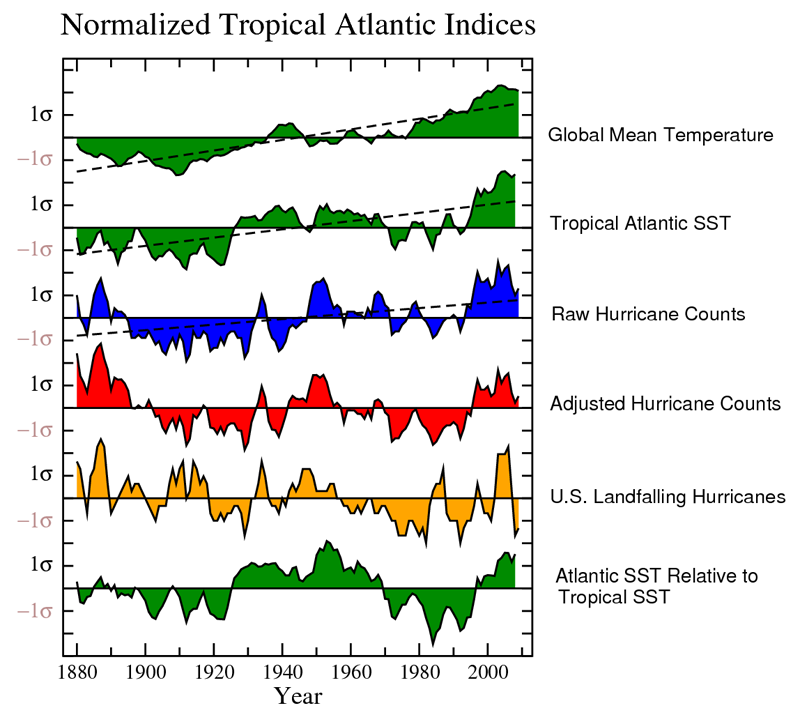
Global Mean Temperature is clearly rising, but to my eyes, the Adjusted Hurricane Counts isn’t. It was at a high point recently, but that looks entirely within natural variability to me. The website goes into more detail, but the summary is (bolded in the original):
In short, the historical Atlantic hurricane frequency record does not provide compelling evidence for a substantial greenhouse warming-induced long-term increase.
This drives the point home for me. The current amount of climate change has not clearly changed hurricane frequency.
Hurricane Conclusion
Whether you skipped the science to get here or went through the deep dive with me, let's look at our takeaways and what they mean about Koonin's book. Koonin’s statement that “hurricanes and tornadoes show no changes attributable to human influences'' is not entirely accurate. In particular, there is fairly strong evidence that precipitation has increased because of human-caused climate change, with research on Hurricane Harvey providing the bulk of the evidence. As precipitation is a significant factor in the number of deaths and destruction a hurricane causes, I think Koonin was mistaken to overlook it.
One surprising thing is that his statement, as broad and general as it was, only became clearly wrong in the last few years. Overall, other than in precipitation, the past changes in hurricane activity, even those in the Atlantic, seem more like natural variation. There may be an effect from human influences there, but if so it’s small enough not to easily stand out.
The median projections for hurricane changes with 2°C of anthropogenic global warming are: around 0% change in frequency, around a 5% increase in intensity, and just below 15% increase in precipitation. Although these are significant, I think Koonin is right to say the projected changes are not catastrophic.
Tornadoes and the Weirdness of the Climate
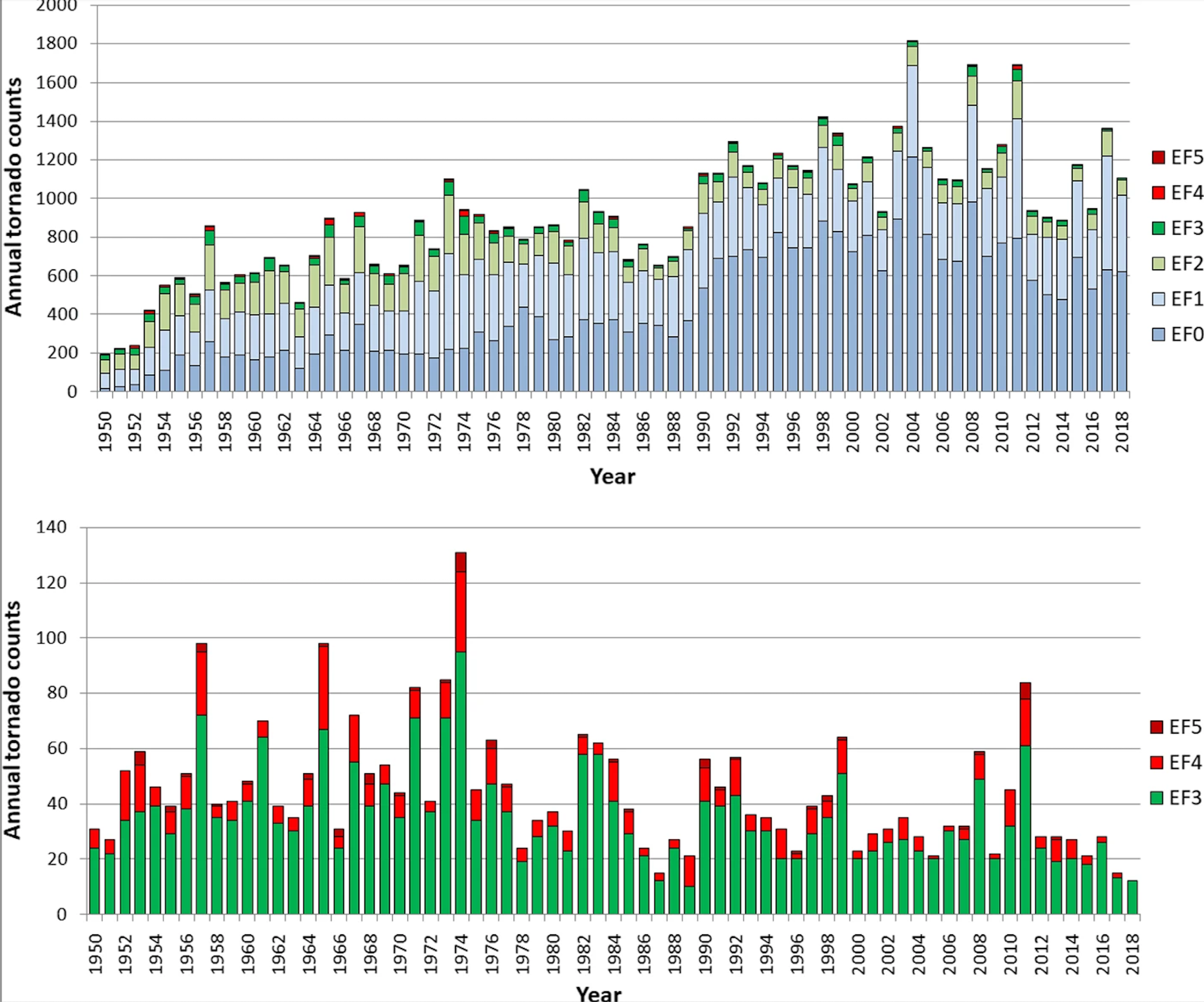
According to Koonin, the situation with tornadoes is entirely unclear. NOAA has been recording more tornadoes in recent years, but Koonin makes a convincing argument that this is due to improvements in our ability to detect weak tornadoes and not to an actual change in the frequency of them. In 1950, the weakest tornadoes (EF0 on the Enhanced Fujita Scale) were 20% of the total. Today, we are able to detect them even in unpopulated areas with radar, and they account for 60% of all tornadoes. As these graphs from this paper published early in 2022 show, the increase in tornado frequency completely disappears when looking at tornadoes of EF1 or higher. In fact, the strongest tornadoes appear to be becoming less frequent.
One thing Koonin does a wonderful job of is helping readers appreciate how weird the climate is. For reasons that are not yet clear, there seems to be a trend in tornadoes leaving the Central and Southern Great Plains and shifting towards the Midwest and Southeast. There are all sorts of counterintuitive effects going on. For example, he showed Figure 9.3 from the 2017 CSSR (reproduced below):
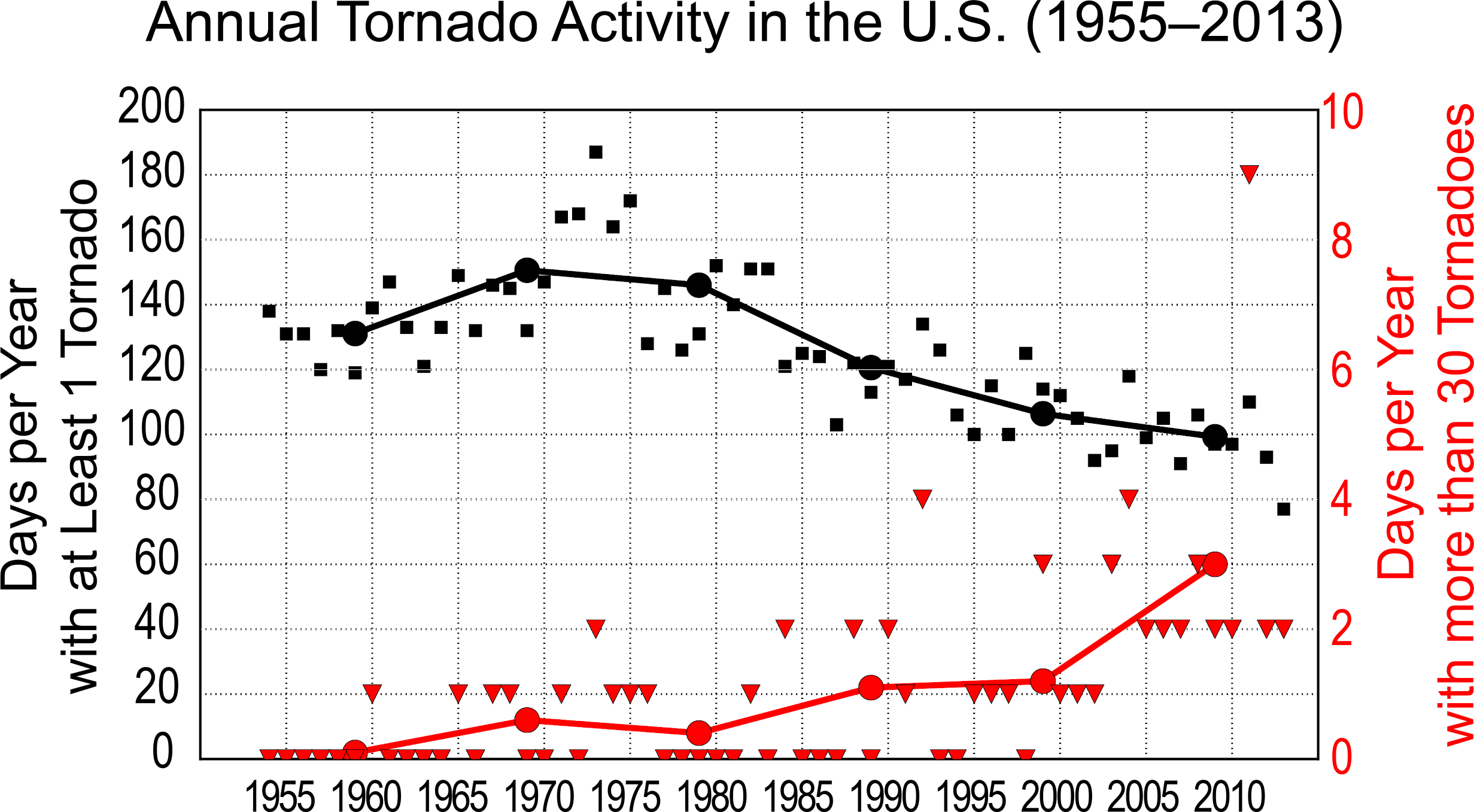
What’s the takeaway here? As the climate has warmed, fewer days have tornadoes. But those days are having more tornadoes. So, are the same-day tornadoes connected in some way? Is climate change causing tornadoes to travel in groups now? (What’s the group noun for a bunch of tornadoes? Herds? Caravans? Is it a whirlwind of tornadoes? Or are they more like lemurs — a conspiracy of tornadoes? OK, I’ll stop. But anyway, based on this figure, we need a word for it.)
It seems that the current state of climate knowledge about tornadoes is that it’s really unclear what is going on. For example, Koonin points to this statement from the 2012 IPCC Special Report of Extreme Events:
There is low confidence in projections of small-scale phenomena such as tornadoes because competing physical processes may affect future trends and because climate models do not simulate such phenomena.
I think there’s an important point here. There are some things, like the graph we saw in the modeling section of CO2 emission and global warming, that tell a relatively straightforward story. But there are a lot of times when the data don’t conform to any simple story. Temperature increase reduces tornado days? Hotter tornadoes come in flocks? I don’t know, but that alone is an important takeaway from this book. Climate is complex and it’s not clear what “changing” it will do!
Precipitation, Drought, and the Hydrological Cycle
There is clear evidence that the hydrological cycle is changing as the climate changes. Koonin says “The hydrological cycle is expected to intensify as the globe warms.” This means that dry areas will become drier and wet areas wetter. This can lead to both more flooding and more droughts. Many of these effects will be local, so global averages won’t tell the entire story. Koonin provides a graph similar to the one below from the EPA, where you can see that although the U.S. annual precipitation has gone up 0.6% per decade, it is small compared to the yearly fluctuations.
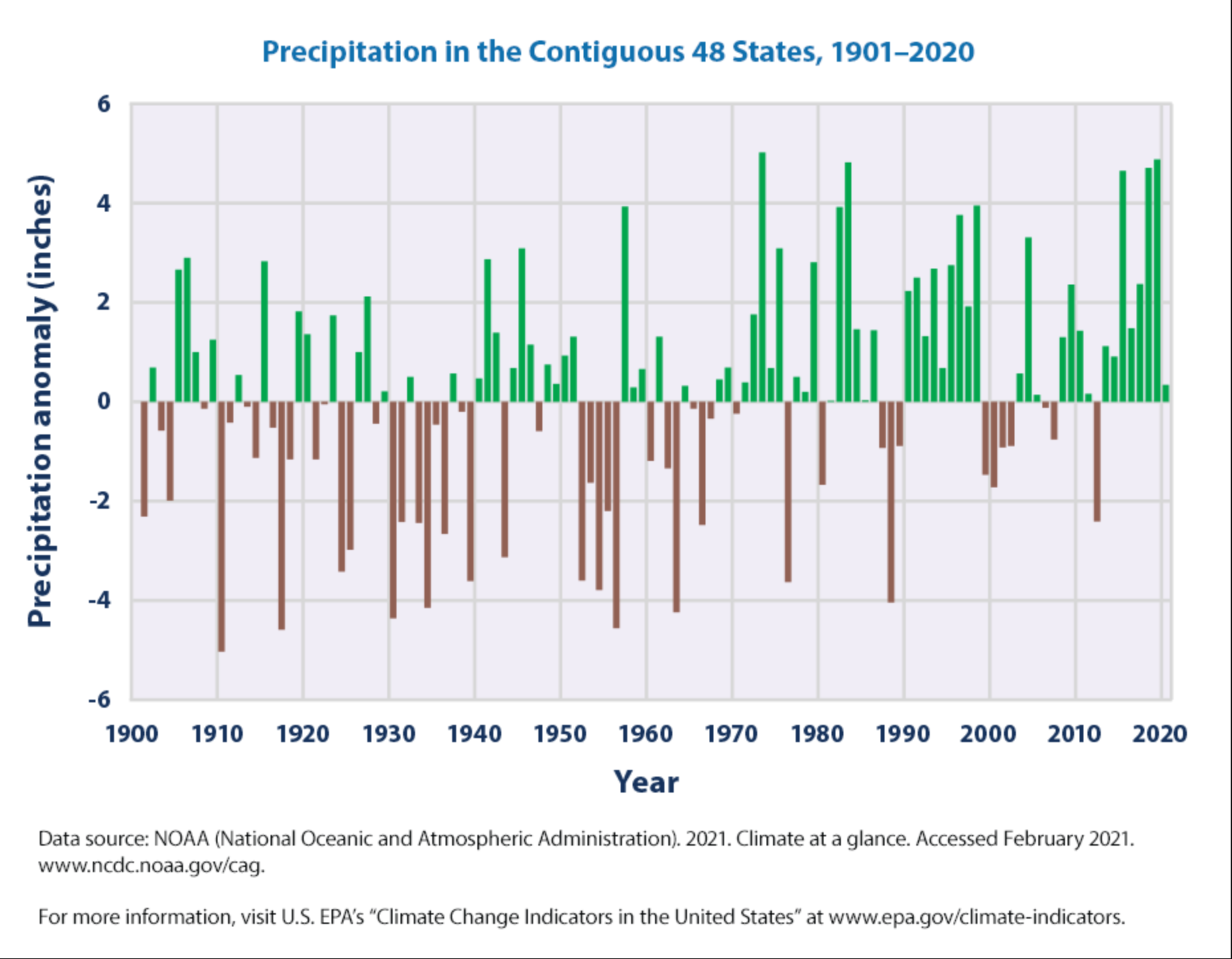
But even this covers up regional variation. Since 1901, precipitation has increased in the Northeast, Midwest, and Great Plains while it has decreased in the Southeast and Southwest. Due to all of this, Koonin concludes that it’s “hard to draw any solid conclusions about the relative roles of human influence and natural variability.”
However, we have seen precipitation get, as Koonin says, “lumpier.” A higher proportion of total precipitation comes from intense rainfall. More and more places in the U.S. are being hit with larger single-day precipitation. Another notable trend is the decrease in snow cover in the northern hemisphere (where 98% of the snow is). The drop is most noticeable from the 1970’s to the 1990’s and seems mostly flat since then.
Drought is also something that isn’t happening on a national scale, but is certainly happening in some regions. Koonin points to the EPA’s drought indicator to show that, when averaged across the contiguous U.S., there’s not a clear trend. However, he says “drought is a serious issue for regions within the US, as it has been for millennia.”
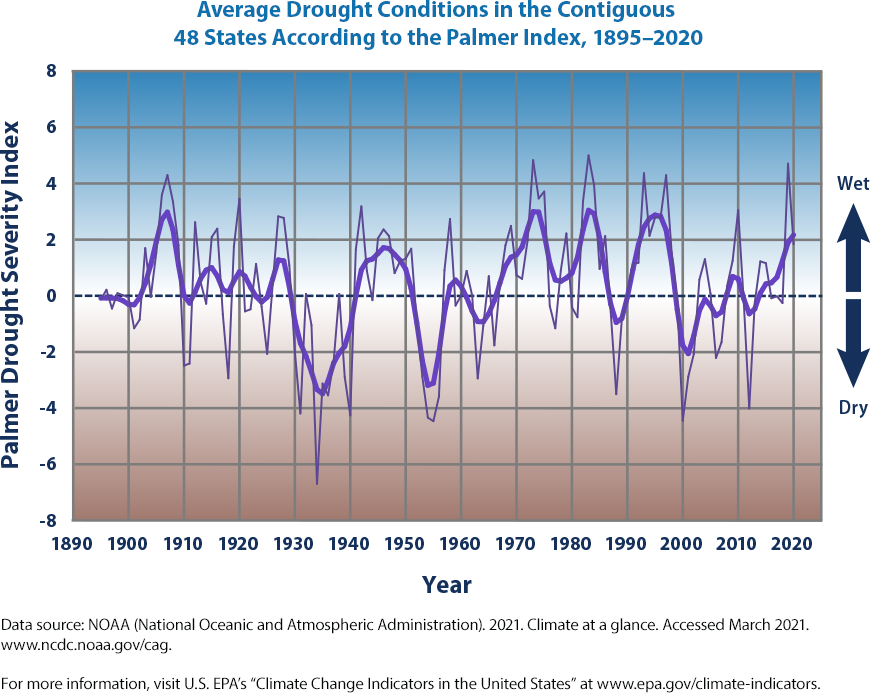
His main counter to the narrative that droughts are getting worse is that droughts have also been very bad in the past. So if the lumpiness of precipitation is causing droughts to become worse, it’s not worse in a “never before seen” way. Indeed, he quotes the IPCC AR5 as saying:
There is high confidence for droughts during the last millennium of greater magnitude and longer duration than those observed since the beginning of the 20th century in many regions.
Regarding California, where droughts have been particularly prominent in the news, Koonin says “the state has moved toward drought since 2000; it remains to be seen whether that will persist in the coming decades.”
Wildfires and the Ways Humans Affect the Planet
Koonin is broadly skeptical of the claims that there has been an increase in wildfires, and in particular, claims that these can be attributed to human-caused climate change. He admits that the drier conditions caused by climate change will lead to more fires, but lays out a convincing argument that this isn’t the most significant factor. He concludes:
Whatever influence a changing climate might have had on wildfires globally in recent decades, human factors unrelated to climate were dominant.
My takeaways were that the wildfire data is messy for a broad variety of reasons, so it’s hard to say exactly what is causing what. My overall reading of the evidence Koonin laid out is that there probably is an effect due to human-caused climate change, but it seems to be dwarfed by effects due to other human activity.
I took a positive message from this chapter. Stopping human-caused climate change will be incredibly difficult, in part because it requires global cooperation. But reducing wildfire seems so much more solvable — the most significant factors are all local. I particularly agreed with his final point about how we talk about wildfires:
By making the conversation about wildfires only one of unavoidable doom due to “climate change,” we miss an opportunity to take steps that would more directly curtail these catastrophes.
Sea Levels and the Anthropogenic Contribution
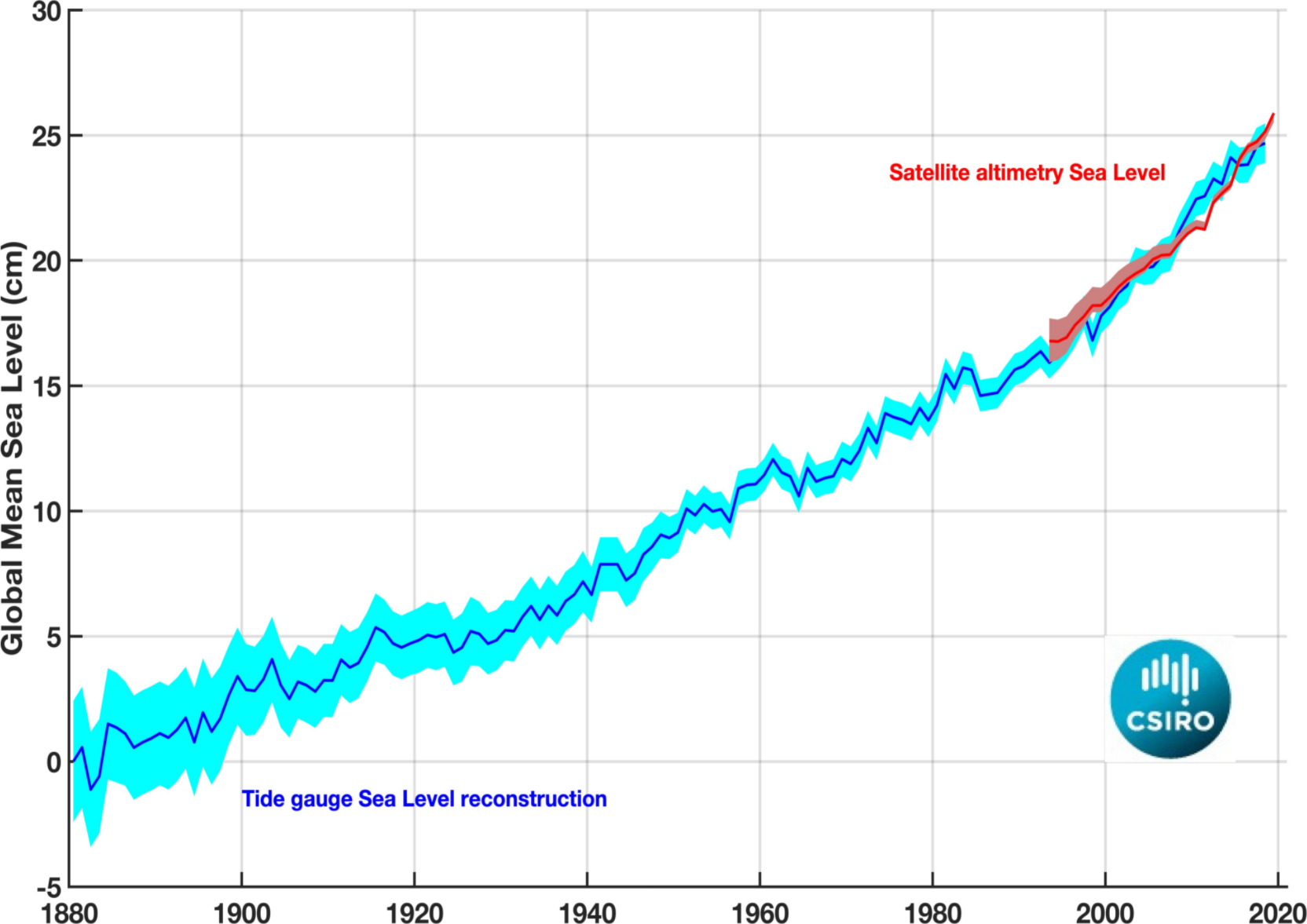
Sea levels are rising. Koonin says the continuous rise of sea levels is clear and shows it in a plot of Global Mean Sea Level.
But Koonin says the cause for the rise is not as clear:
The question is not whether sea level is rising — it’s been doing that for the past 20,000 years. Instead, what we want to know is whether human influences are accelerating that rise.
Koonin claims that measuring sea level rise is difficult and disentangling effects is not easy. One aspect that makes it hard is that sea level changes by different amounts in different places. He says that sea levels around Eugene Island on the Gulf Coast are rising 9.65 mm per year while sea levels around Skagway, Alaska are falling at a rate of 17.91 mm per year.
He says it’s not clear how much effect humans are having and how sea level rise will change in the future. He thinks some of the climate reports, specifically the 2017 CSSR, present a picture of sea levels rising at an increasing rate as the planet has warmed, but it’s not clear that this is causing the high rates. To see the trend more clearly, Koonin points to a graph of estimates of GMSL trends from IPCC AR5.
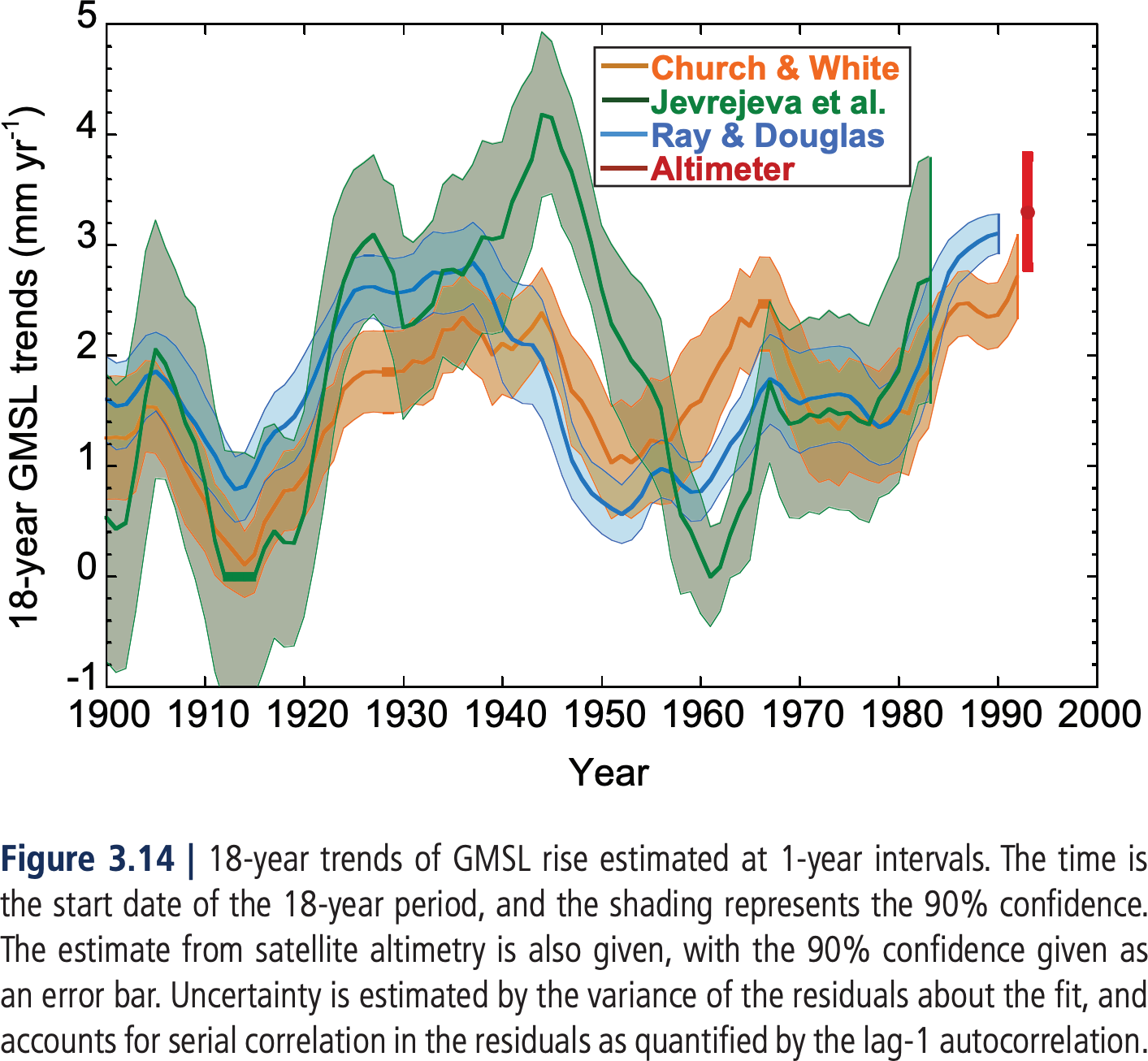
I agree with Koonin that there isn’t a clear pattern of the rate increasing as carbon emissions have grown. He says the sea level trend rises and falls with the Atlantic Multidecadal Oscillation (AMO), which has about a 60-year cycle. We’re at the top of a cycle right now, so he believes that it is “reasonable to expect that the rate will decline again during the next few decades.” I see his point but I think it’s hard to predict anything with confidence.
His summary is:
We don’t know how much of the rise in global sea levels is due to human-caused warming and how much is a product of long-term natural cycles… There’s little doubt that by contributing to warming we have contributed to sea level rise, but there’s also scant evidence that this contribution has been or will be significant, much less disastrous.
This was one of the parts where I understood where he was coming from but had a difference in emphasis. I do agree that it’s important to know if the rise is based on human influences. Primarily because if it’s not, we completely decarbonize the economy overnight, it’s not going to stop sea levels rise. But for me, the important takeaway of sea levels is that they are rising and not only that, the rate that they are rising has been going up in recent decades and is far higher than what it has been through the time period we have precise data for. We’re not sure exactly how much is due to a warming planet, but basic science tells us that it will contribute at least some amount.
Summarizing the State of Climate Science
Koonin provides a tremendous amount of information in this book. For the parts I checked the references, I generally agreed with his interpretations. My biggest disagreement with him lies in what to emphasize when compressing all of this information into a useful, scientifically-accurate summary. Koonin offers the following summary of the state of climate science (my bolding):
The earth has warmed during the past century, partly because of natural phenomena and partly in response to growing human influences. These human influences (most importantly the accumulation of CO2 from burning fossil fuels) exert a physically small effect on the complex climate system. Unfortunately, our limited observations and understanding are insufficient to usefully quantify either how the climate will respond to human influences or how it varies naturally. However, even as human influences have increased fivefold since 1950 and the globe has warmed modestly, most severe weather phenomena remain within past variability. Projections of future climate and weather events rely on models demonstrably unfit for the purpose.
Although I agree with some of his summary, I object to a few aspects:
- The use of the word “small” to describe human influences. The warming due to human influences might be small on some scales, but it’s not small relative to the amount that could cause disasters. For example, a 5°C temperature difference might be small compared to, say, the daily temperature variation, but it would be enough to significantly change the climate. Small implies insignificant, but human influences are significant. So maybe we could compromise with “small yet significant”?
- Our observations and understanding aren't entirely insufficient. As we saw in the hurricane section, models suggested that we should see an increase in average hurricane intensity, and in 2020, we did. That certainly suggests these models are useful. Other studies have found that historical models have made good estimates as well. I think Koonin is painting with too broad a brush when dismissing all climate models.
- He thinks about uncertainty in a way that I think is unwise given the subject matter. He highlights the uncertainty around an effect occurring, which makes it seem insignificant. But I think it’s better to highlight the uncertainty around the future state, i.e. whether the planet will continue to be comfortable for humans to live on. It’s much more significant that we don’t have certainty about the future state of the planet than whether a specific effect is occurring or not.
Cost of Climate Change
Impact on the Economy
In his book, Koonin also addresses the impacts climate change will have on the economy. He claims that “Global warming won’t have much impact on the economy.” To make his point, he presents this graph from chapter 29 of the 2018 NCA that shows how much impact various temperatures will have on the U.S. economy (note that these are in Fahrenheit, so 2–3 degrees Celsius would be 3.6–5.4 degrees Fahrenheit).
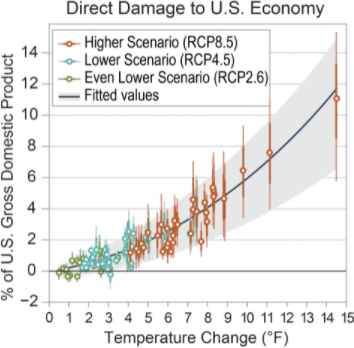
This graph shows estimates of the damage to U.S. GDP based on temperature change. To think about this in context we can again use the study that projected between 2 and 3 degrees C of warming by 2100.
But Koonin examines more of a worst-case scenario estimate — imagining temperatures increased by 5°C (9°F). According to this chart, there would be a 4% decrease in U.S. GDP.
How significant would this be? It’s certainly billions of dollars, but Koonin suggests we look at this number in context. The U.S. GDP today is about $20 trillion. Projecting U.S. growth out to 2100 is highly uncertain, but estimated 2% annual growth. I thought some people might object to that so I added 1% growth as well. Here’s what U.S. GDP would look like under four scenarios:
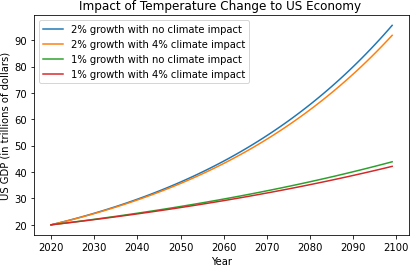
Looking at this graph, the total impact of climate change, even though it’s in the billions of dollars, looks small. As Koonin points out, another way to think about this is in terms of delay. With 2% economic growth, the U.S. will reach $95 trillion in GDP, 4.75 times more than today. If U.S. GDP is decreased by 4%, then it will eat up two years of economic growth, so we wouldn’t reach that level until 2102. Some people might object to a projection of 2% economic growth, so I added 1% growth, in which case GDP would be about $44 trillion and the impact of climate change would cost about four years of economic growth.
Koonin seems to have confidence in these projections, but I’m more skeptical. It seems to me that economic damage happens sporadically, and the most significant factor is human decisions, not climate. The most economically impactful weather event recently was the winter storm of February 2021 in Texas. After days of heavy winter storms, the Texas power grid shut down, which left 4.5 million homes and businesses without power and caused 246 deaths. The city of Austin wrote an after action report that listed the total economic damage at $195 billion dollars.
This is an incredible amount of money, but how much is due to human-caused climate change? Did human influences make this more likely? Or would a warming planet make this less likely? If there is a connection, that doesn’t make it easy to tease out the damage. Say human-caused climate change made this event 5% worse than it would have been otherwise, would that make the economic damage 5% worse? Certainly not, because the relationship between severity of weather events and amount of destruction is highly nonlinear; all effects up to a certain point are minor until something reaches a breaking point and then, bam, suddenly the levee breaks resulting in billions in damages. So, if there was a definite connection, maybe we should attribute nearly all of the economic damage to human causes.
But all of this misses an even more important aspect – human decisions. The Texas Tribune reports that “Texas leaders failed to heed warnings that left the state’s power grid vulnerable to winter extremes, experts say.”
Texas politicians and regulators were warned after the 2011 storm that more “winterizing” of power infrastructure was necessary, a report by the Federal Energy Regulatory Commission and the North American Electric Reliability Corporation shows. The large number of units that tripped offline or couldn’t start during that storm “demonstrates that the generators did not adequately anticipate the full impact of the extended cold weather and high winds,” regulators wrote at the time. More thorough preparation for cold weather could have prevented the outages, the report said.
So how much of the damage should we chalk up to human-caused climate change? I have no idea. But in a book where Koonin questions so many numbers, I thought he should have been more skeptical of these.
There are other ways to look at this. By examining the hurricane data, we can see why the economic damage is occurring. It’s commonly said that economic damage from hurricanes has increased dramatically. And for good reason – a 2012 study on economic damages of hurricanes found exactly that. However, Koonin points out that there’s a detail here that many people have missed. Here’s an excerpt from a 2012 study on economic damage from hurricanes:
In recent decades, economic damage from tropical cyclones (TCs) around the world has increased dramatically. Scientific literature published to date finds that the increase in losses can be explained entirely by societal changes (such as increasing wealth, structures, population, etc.) in locations prone to tropical cyclone landfalls, rather than by changes in annual storm frequency or intensity… The evidence in this study provides strong support for the conclusion that increasing damage around the world during the past several decades can be explained entirely by increasing wealth in locations prone to TC landfalls
I found a 2018 study that looked at this. Here’s an excerpt from their abstract:
Continental United States (CONUS) hurricane-related inflation-adjusted damage has increased significantly since 1900. However, since 1900 neither observed CONUS landfalling hurricane frequency nor intensity shows significant trends, including the devastating 2017 season… Growth in coastal population and regional wealth are the overwhelming drivers of observed increases in hurricane-related damage. As the population and wealth of the United States has increased in coastal locations, it has invariably led to the growth in exposure and vulnerability of coastal property along the U.S. Gulf and East Coasts.
So, every new decade we should expect more economic damage, not because hurricanes are getting worse, but rather because we have more people who have more nice things that can get damaged (and a predilection for placing those things on beachfront property). I don’t think this is what people think when they hear that hurricanes are causing more damage every year.
It’s not just in the U.S., but worldwide, the numbers don’t look that different. Koonin points out the Working Group II contribution (which focuses on impacts of climate change) for the fifth IPCC Assessment Report (the most recent that Working Group II had completed). They looked at estimates of net global impact from rising temperatures. Here is their estimates of the total impact of climate change from chapter 10 of their report:
Estimates agree on the size of the impact (small relative to economic growth), and 17 of the 20 impact estimates shown in Figure 10–1 are negative.
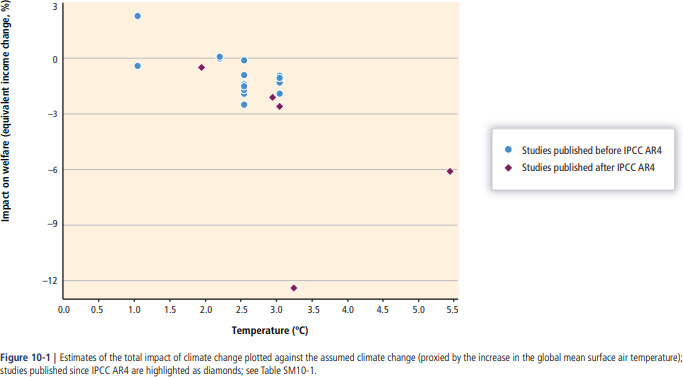
The impacts are negative, but let’s think about these numbers. All but a couple of outliers predict less than 3% impact on welfare. This was, again, smaller than I had expected. I find it interesting that a couple of studies found a small amount of warming would have a positive impact on the economy. Koonin cites economist Richard Tol suggesting that a small amount of warming will have a benefit up to about 2.25 degrees Celsius.
One concern I have about this analysis is his reliance on GDP. We have to be cautious when applying it, especially in cases like this. The ugly truth about GDP is that the deaths of massive numbers of poor people is a great tragedy but has minimal impact on GDP. If climate change causes tremendous suffering among the world’s poor and has a relatively small impact in richer nations, GDP will continue to rise, and therefore relying on GDP to measure the impact of climate change will mask a tremendous amount of human suffering. That's exactly what could happen here. A study on The Economic Impacts of Climate Change found that “Negative impacts will be substantially greater in poorer, hotter, and lower-lying countries.” Even within a country, it’s pretty obvious that wealthier people can avoid the worst impacts of climate change, but the poorest can’t. We need to always keep this in the front of our minds when we assess the impact of climate change.
In Koonin’s defense, he’s certainly not the only one to use GDP and I’m not sure what a better metric would be. I would like to use expected lives lost, as it’s much more important, but that’s so dependent on our actions — early warning systems, emergency famine relief, and so on — that it wouldn’t be a good measure by itself either. So maybe GDP is the best single metric, but we don’t have to use only one metric, and we should be skeptical when we see it.
Impact on Food
If GDP alone isn’t the best measure, perhaps to better understand the situation for the world’s poor, we should also look at food prices. Koonin searched the 2019 IPCC Special Report on Climate Change and Land and found the following in the Summary for Policymakers section A.5.4:
In SSP2, global crop and economic models project a median increase of 7.6% (range of 1–23%) in cereal prices in 2050 due to climate change (RCP6.0), leading to higher food prices and increased risk of food insecurity and hunger (medium confidence).
Koonin suggests we look at this in context. He points to the U.S. Department of Agriculture’s Economic Research Service, which graphed crop prices over time.
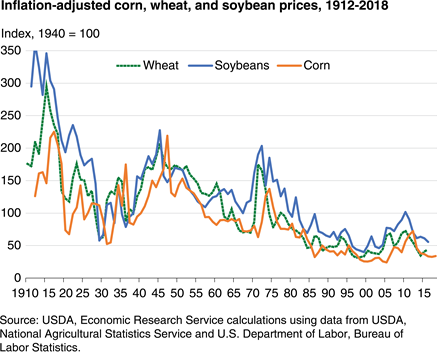
Even if you think about the highest estimate of 23%, it looks like the prices have dropped by more than that in the last decade. I agree with Koonin that the larger context is useful. The summary from the report appears alarming, but imagine if it had instead read “leading to higher food prices and increased risk of food insecurity and hunger, like it was in 2010.”
Koonin also points out that there’s a clear downward trend for all crops in the graph. That’s not because climate change has made things cheaper, it’s because other technologies have made farming cheaper. So even if the impact of climate change pushes prices upwards, it seems entirely possible, even likely, that this overall trend will continue and people will never pay higher prices for these crops.
Public Opinion
Koonin argues that the scientific understanding of climate change does not support the grave outlook of public opinion. We’ve talked a lot about climate science; now let’s look at public opinion. In 2021, a survey of 10,000 young people (ages 16–25) in ten countries was published in The Lancet. This survey was released after Koonin’s book was published, but I think it’s relevant here because it illustrates a point he was getting at. The survey asks a variety of questions about climate anxiety, and I’ve highlighted a section below.
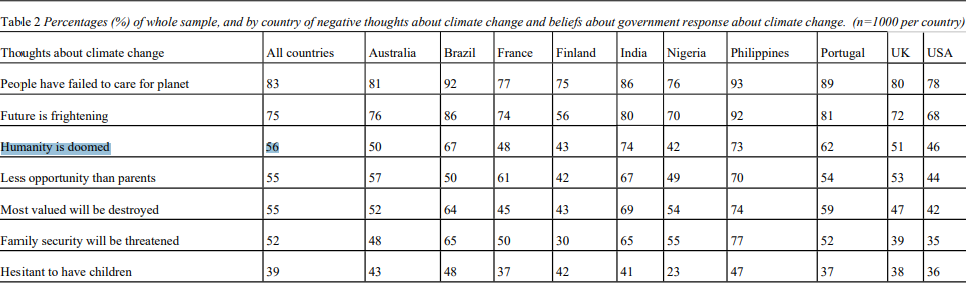
In the survey, 56% of respondents reported that “humanity is doomed.” I find this both terrifying and sad that so many people believe this. I also think it’s shocking that 39% of people are hesitant to have children because of climate change. It’s prudent to be skeptical of polling data, but even given healthy skepticism, these numbers seem incredibly high to me.
Understanding public opinion is difficult. I’m having trouble reconciling these results with those from the Yale Climate Opinion Maps 2020, which says that only 55% of adults believe “most scientists think global warming is happening.”
The evidence for global warming is overwhelming. The evidence for humanity’s certain doom is nonexistent. Perhaps most of the difference can be chalked up to the generational difference in the survey population. Whatever it is, these are the concerns and misunderstandings that Koonin is attempting to combat again with this book.
Why Do We Get It Wrong?
Koonin argues that the state of public understanding of climate change is in bad condition. His argument seems bolstered by the Lancet survey. This naturally leads to a question: Why do we get it wrong? Who’s to blame? Koonin lays out the culprits as follows: the media, politicians, scientific institutions, scientists, activists and NGOs, and the public. Naturally, these disparate elements all intermingle and influence each other in complex ways. Although there is no single “mainstream position on climate change,” elements from these various players combine to create what could be called the mainstream position, or, what Koonin somewhat derisively calls, “The Science.”
Every organization or group on Koonin’s list has its own incentives, and these incentives are not always aligned with determining the truth. Koonin starts with the media, where he claims:
Whatever its noble intentions, news is ultimately a business, one that in this digital era increasingly depends upon eyeballs in the form of clicks and shares. Reporting on the scientific reality that there’s hardly been any long-term change in extreme weather events doesn’t fit the ethos of If it bleeds it leads.
He also says:
For some [journalists], “climate change” has become a cause and a mission — to save the world from destruction by humans — so packing alarm into whatever the story is becomes the “right” thing to do, even an obligation.
Koonin says that politicians are in the business of “arousing passions” and have a tendency to misrepresent science to push for their political objectives. Scientific institutions have been pushing The Science even when science tells a more nuanced story. He says even scientists are in some ways to blame — they face conflicting incentives as well because, in their role of determining scientific truth, they face pressure to generate press and secure grant funding. Reporting that there isn’t sufficient data to make a strong conclusion isn’t going to end up on the front page or get more funding.
He says that NGOs have internalized the notion of climate change being bad, and that “the ‘climate crisis’ is their raison d’etre.” Even the public gets apportioned some blame. He says even though it’s understandable that people are concerned about extreme weather, talking about climate change has become a "political minefield," and when he tells people what’s in the IPCC Assessment Reports, people ask if he’s a Trump supporter (to which he says “no” and I say “it’s irrelevant”).
Koonin doesn’t try to solve the problems of the media or our politics, only to illuminate the impacts of them. The solutions to these problems are far outside the scope of the book and, for the most part, Koonin doesn’t dwell on them.
The one solution he does propose is “Red Teaming” the climate reports. This is the practice of having a separate, adversarial group of scientists challenge the climate reports before they are released to reveal any errors or oversights. While I’m not opposed to this idea, it feels like a triflingly small fix given the size of the problem. In general, the problem seems to be the public understanding of the climate reports, not the reports themselves.
Our Response
Although Koonin lays out a strong case that the most alarmist rhetoric around climate change is unfounded, he acknowledges that there is still clear evidence that the climate is changing in some ways that will cause harm. This naturally raises the question, can we prevent it? This is the goal that was enshrined in the 2015 Paris Agreement. The central objective of which is Article 2.a, which commits nations to:
Holding the increase in the global average temperature to well below 2 °C above pre-industrial levels and to pursue efforts to limit the temperature increase to 1.5 °C above pre-industrial levels, recognizing that this would significantly reduce the risks and impacts of climate change;
Can we reach that goal? At what cost?
Carbon Reduction
Koonin, quoting the IPCC, lays out what we need to do to reach the Paris Agreement (italics in the original):
according to the UN’s IPCC, if the goal is to limit warming to 2°C, global carbon dioxide emissions must vanish by 2075; if the goal is a rise of no more than 1.5°C, this date becomes 2050
To get a sense for the feasibility of eliminating CO2 emissions, Koonin looks at the trends in global CO2 emissions using a graph similar to the one below. The graph he shows is cumulative but both tell the same story: The 20th century contained explosive growth in CO2 emissions that does not appear to be slowing down.
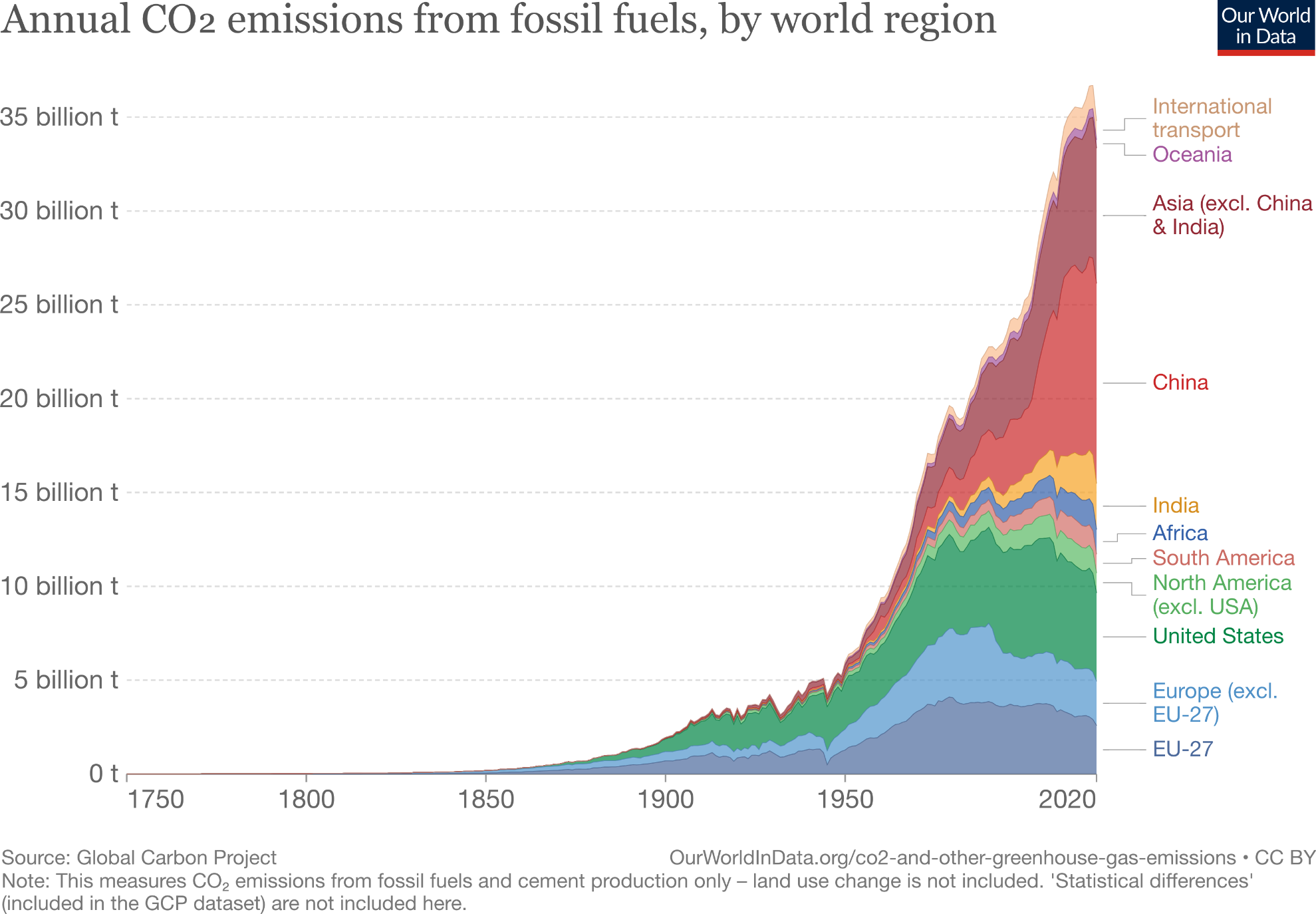
It’s hard to look at this graph and think it’s going to go to zero by 2050. In fact, it doesn’t even look like it’s flattening out anytime soon. But we have more than idle speculation — Koonin points to the U.S. Energy Information Agency (EIA), which projects continuing increases in global energy consumption.
This is total energy, which is not necessarily CO2 emitting. The EIA also separates consumption by energy source, which shows that even if renewables continue to increase at a rapid rate, we will still consume even more carbon-emitting forms of energy in 2050 than we do today.
He provided another fact that starkly demonstrated how much of a chimera, to use his word, ending carbon emissions is. The COVID-19 pandemic created the biggest shock and reduction in economic activity in decades. It shut down restaurants, bars, and activities across the world in a way that no government policy ever would have been able to (at least in a democracy). But despite all of the restrictions and reductions to our way of life, global CO2 emissions in the first half of 2020 were only down 8.8 percent compared to the same period in 2019.
Based on these factors, Koonin concludes that we will not be able to wean ourselves off of carbon-emitting fuel sources anytime soon. What’s more, he’s concerned that forcing carbon-free policies into a world that is not ready will do more harm to the world’s poorest (italics in the original):
All else being equal, it might be a good thing to eliminate, or even just reduce, CO2 emissions. But all else isn’t equal, so decisions must balance the cost and efficacy of mitigation measures against the certainties and uncertainties in climate science. And where your interests come out in that balancing act will depend in part upon what country you’re in, how wealthy you are, and how much you care about (or whether you’re a member of) the forty percent of humanity that doesn't have access to adequate energy.
The notion of a carbon tax has been debated for quite some time. Richard Tol, writing in “The Economic Impacts of Climate Change,” found that “the optimal carbon tax in the near term is somewhere between a few tens and a few hundreds of dollars per ton of carbon.” Tol, who points out the positive net impact of climate change up to 2.25°C, still thinks there’s an optimal climate tax of $25/tC (or $7/tCO2). Koonin, however, doesn’t think highly of carbon taxes:
I’m less bullish on “forced and urgent” decarbonization, either through a price on carbon or by way of regulation. The impact of human influences on the climate is too uncertain (and very likely too small) compared to the daunting amount of change required to actually achieve the goal of eliminating net global emissions by, say, 2075. And for me, the many certain downsides of mitigation outweigh the uncertain benefits: the world’s poor need growing amounts of reliable and affordable energy, and widespread renewables or fission are currently too expensive, unreliable, or both. I would wait until the science becomes more settled—that is, until the climate’s response to human influences is better determined, or, failing that, until a values consensus emerges or zero-emissions technologies become more feasible—before embarking on a program to tax or regulate greenhouse gas emissions out of existence or to capture and store massive amounts of carbon dioxide from the atmosphere.
I don’t know exactly when he would consider the science to be “more settled,” and I’m not expecting a consensus on human values, so I don’t like these constraints. I don’t know what a complete solution will look like, but I imagine it will involve some reductions in emitting carbon. It seems to me that we should think about this on the margin — human-caused climate change likely has negative impacts at the levels of warming that are projected, so we should act to counter it. He still hasn’t convinced me what’s wrong with the following argument: Burning carbon for energy creates negative externalities. One of the best ways to correct for a negative externality is a tax. Therefore, we should tax carbon emissions.
Compared to the amount of detail he went into in other sections, I found this argument underwhelming. I think proposals for a carbon tax deserved a more detailed analysis from him.
Alternatives to Carbon Reduction
Due to the challenges in reducing greenhouse gases, Koonin grew interested in alternative ways to respond to climate change, which he calls “Plans B.” There are two forms of geoengineering that Koonin examines: Solar Radiation Management (SRM) and Carbon Dioxide Removal (CDR). Both approaches have their pros and cons and while Koonin isn’t entirely optimistic about either, he thinks their potential usefulness justifies further study.
Solar Radiation Management (SRM) is essentially putting something in the atmosphere to create stratospheric haze that reflects more sunlight. Even a small amount of added reflectance could have a big impact. He says (italics in the original, p. 46):
If the average albedo were to increase from 0.30 to 0.31, say because of a 5 percent increase in cloudiness, that additional reflectivity would largely compensate for the warming influence of doubling the atmosphere’s CO2.
Although this may sound drastic, it will disperse within a year or two and Koonin says health impacts would be minimal, so any effects, both good and bad, would be temporary. This is both a plus and a negative. On the plus side, geoengineering is an unproven field, so it’s a good thing to be temporary in case it has unforeseen negative effects. On the negative side we’d have to keep doing this year after year, and when we stopped the temperature would rise again.
And SRM will change the climate. Although it’s relatively understudied, Koonin says climate change models suggest it will change precipitation patterns. This is problematic, because changes in precipitation patterns will affect different regions differently, creating winners and losers. That begs the question: Who gets to choose? The answer to this is both surprising and concerning. Despite how crazy the idea might sound, it’s actually not that expensive. Koonin says “a single small nation, a subnational organization, or even a wealthy individual could ‘just do it.’” Although technically feasible, Koonin expects SRM to be very difficult politically. This isn’t surprising; SRM is, as it sounds, intentionally changing the climate to avoid climate change. Also, Koonin doesn’t mention this, but it seems to me that SRM only counters warming, and there are other aspects of increasing atmospheric CO2 that are cause for concern, such as ocean acidification.
The other option Koonin mentions is Carbon Dioxide Removal (CDR). Koonin says this is easy to do, but runs into problems of cost and scale. It costs about $100 to capture and compress one ton of CO2. This may sound cheap, but in order to be meaningful, we would need to remove about ten billion tons of CO2 a year to make a significant impact. So that means we would need to spend a trillion dollars per year. And once that’s done, it’s not clear what we would do with the compressed CO2 once it’s removed. We would need to come up with a way to sequester billions of tons of CO2 into either the ground or underwater which, again, would be difficult at scale.
Koonin also mentions the natural solution to capturing carbon — planting trees. This may also involve genetically altering plants to store more carbon, although this would raise other concerns. Koonin doesn’t entirely dismiss the idea of planting more trees, but his main concerns are about matching the speed and scale (some proposals call for a trillion trees) required for this to play a significant role quickly enough.
Adaptation
Koonin doesn’t think we are going to stop emitting CO2, doesn’t think SRM is politically feasible, and doesn’t think we can do enough CDR to make a difference — so what’s the plan? Here, Koonin makes a clear distinction between what we could do, should do, and will do. Koonin thinks that adaptation will be the primary response to climate change. He likens it to how he, a Californian, deals with earthquakes. He has adapted to it through measures like bolting shelves to the walls, storing a few days worth of food and water, and drilling his children in earthquake safety. There are also community-level adaptations as well, such as earthquake-resistant building codes and early warning systems.
Fortunately, he thinks adaptation will be effective. Unfortunately, he’s unable to come up with a detailed plan or even a price tag. For example, what does mitigation look like for island nations? Koonin says there hasn’t been sufficient study of adaptation:
[There is, as yet, no framework for] laying out the methods, costs, efficacies, and policy levers of various adaptation measures. Rather, the discussion of adaptation is, at best, a dog’s breakfast of anecdotes and possible strategies — more verbiage than content. Policy analysis of adaptation is relatively underdeveloped
Unfortunately, I thought this was one of the weaker parts of the book, especially given its importance. There’s something deeply unsettling about analyzing all of the responses to climate change except for one (adaptation), seeing that the analyzed methods don’t work, and using that to select the one that’s left.
Missing Sections
One drawback of the book is that there are aspects of climate change that Koonin fails to address. I admit it would have been impossible to cover all aspects of climate change in sufficient detail in a popular science book. However, some are important enough to have deserved his attention.
For example, he didn’t spend much time talking about damage to natural ecosystems. I’ve heard lots about ocean acidification, coral reef bleaching, species extinction, and Arctic sea ice loss, but he doesn’t cover these. The evidence for decline in Arctic Sea Ice seems well-established. What should I conclude about the aspects he doesn’t cover? Is the public’s concern appropriate for these? Or have these also been overhyped?
I would have liked to see more discussion on alternative solutions and especially a more detailed plan for adaptation. And, even assuming adaptation was our primary response, what would the best combination of responses be? He concluded that CDR wasn’t enough to solve our CO2 emissions problem, but should it play a role in our response? He didn’t discuss combining the solutions and how that could mitigate some of the impacts. I was also curious what role he thought nuclear energy could, should, and will play, but he doesn’t go into detail about it.
While the lack of these discussions is a detraction from the book, it’s also a compliment to the author. He has insightful takes on a lot of topics, and I would have liked to hear his thoughts on these issues.
Recommendation
I thoroughly enjoyed this book. It takes the reader through the fundamental building blocks of climate science and helps them develop an appreciation for the wonder and complexity of the climate. Anyone who isn't an expert on climate change will come away with a much better understanding of the topic.
I recommend this book to others. In particular, if you believe humanity is doomed because of climate change, or you despair about the future because of climate change, please read this book. You don’t have to agree with everything, but there’s valuable insight in it. I’m grateful to him (and especially all the climate scientists whose back-breaking research went into the papers and reports that are covered in the book) for increasing my knowledge about the topic.
I know from personal conversations and a few Google searches that there’s a lot of opposition out there to this book. Unfortunately, climate change has become a contentious, even tribal, issue. Koonin doesn’t dispute that the climate is changing — sea levels are rising, snow cover is decreasing, and temperatures are warming across the globe. These will create major problems for societies and negatively impact people across the globe. He doesn’t even dispute that humans are having an impact on the climate. But it seems almost heretical when Koonin points out that these impacts don't seem existential. For those of you who, perhaps, tend against recommending a “climate skeptic” book, take a long look at the Lancet survey. Do you think these people have an accurate sense of the current state of climate science? If not, do you think reading this book would do them well?
Closing Thoughts on Climate Change
Although this section is not strictly about the book, I thought it might be useful to describe how I think about climate change after reading it. (If you think it’s not useful, then congratulations! You’ve finished the review). As I said in the beginning, I had an average level of knowledge about climate change and a general assumption that the mainstream narrative was in the ballpark of correct. After reading this book, I’ve updated my thoughts.
It’s interesting to reflect on what I thought was going on with, say, hurricanes before I did this research. Based on the constant drumbeat of alarming climate news, I had assumed that there was overwhelming evidence that hurricanes and other extreme weather events were becoming many times worse than they have been in the pre-industrial world. I didn’t have specific facts or figures in my head, like “hurricanes will be X times more intense.” It was just a general, poorly-defined notion that they were going to be much worse in the future. I had also assumed that their destructiveness today was far beyond their historical range.
But after researching it, I was surprised by how weak or non-existent the evidence for changes in hurricane behavior due to anthropogenic climate change is, especially for catastrophic changes. I do think that hurricanes have, and will continue to, get worse. They will be more dangerous in the future, primarily because rising sea levels will lead to worse storm surges, and increased precipitation will cause more flooding. But a projected 4% increase in intensity is nowhere near the catastrophe that I feared was awaiting us. I wonder how many other people would be in the same situation when confronted with the data.
Saying that hurricane changes are still within natural variability sounds like the “climate denier” position, but I’m not sure what else to conclude when a 2018 study on “Anthropogenic influences on major tropical cyclone events” opened with “There is no consensus on whether climate change has yet affected the statistics of tropical cyclones, owing to their large natural variability and the limited period of consistent observations.” The Sixth IPCC Assessment Report, which is the most recent version of the most important climate report, stated, “it remains uncertain whether past changes in Atlantic TC activity are outside the range of natural variability.”
I agree with Koonin about the disconnect between what the climate reports and scientific literature say about climate change and the public understanding of it. Koonin has convinced me that although climate change is a real and significant concern, it’s not an existential threat. We need to keep the challenges posed by climate change in perspective. There is nothing contradictory about thinking of climate change as being significant but not threatening the existence of our species.
I disagree with Koonin’s conclusions about climate modeling. The worse we are in modeling the future climate (and Koonin argues we’re pretty bad), the more careful we have to be. I think any scenario with greater than a 1% chance of extinction, or even civilizational collapse, should be taken extremely seriously. You wouldn’t get on a plane that had a 1% chance of crashing, right? If a doctor told you you have a 30% chance of something fatal, you wouldn’t go, “well, with all this uncertainty, we’d better not do anything about it.” If you wouldn’t care for your body that way, why would we do this with the planet?
If the climate models were perfect, responding to climate change would be much easier. We could determine that if we pursued policy X it would have impact Y, and we could decide whether that’s worth it or not. We could rank all the possible climate policies (e.g. ban fossil fuels, give out more tote bags, etc.), then draw a line where the marginal cost matches the marginal benefit and support all the policies above the line (at least in theory). But, with uncertainty, it’s a different animal. As we saw with hurricane PDI, we need to be cautious about long tail scenarios that are very dangerous. We also need to factor in the lag time from changes in societal behavior to noticeable changes in the climate. All of this combines to make me want to be more aggressive in responding to climate change.
Another place where I disagree with him is in our response. Koonin thinks that researching geoengineering methods (e.g. SRM and CDR) are akin to taking out an insurance policy. I agree with this, but I consider all the responses he discusses, including carbon-emissions reduction efforts, as an insurance policy. When we’re talking about the climate on the only inhabitable planet in the solar system, we should be extra cautious.
Although Koonin’s solution focused mainly on adaptation, I think we should adopt more of a “many of the above” approach in our response. I agree with Koonin that adaptation will play a large role, but I think we need to put considerable effort into fossil fuel reduction. The Citizens Climate Lobby has proposed a carbon fee and dividend approach which sounds like a good idea to me. I know there are also many cap and trade proposals that would likely reduce carbon emissions. I don’t know the details well enough (Koonin barely mentions them), but this approach seems like it’s the right direction. We can make changes in the wealthier parts of the world without requiring developing nations to adhere to them right away. And the sooner we introduce these changes the more effective they will be.
The cost of energy will continue to be a major issue, especially in developing countries. Fortunately, solar energy continues to get cheaper, and in some cases it is the cheapest form of energy. But people need a source of consistent power, and at the moment fossil fuels are the cheapest. The question of how much pressure to put on carbon-emissions reduction policies is a hard one. Some policies, especially the most drastic ones, condemn poor people to poorer lives. It’s not obvious to me what the right tradeoff is. How much pressure are we really going to put on China and India not to use carbon-emitting energy sources to lift their poor out of poverty? There are real human costs to policies that limit carbon emissions.
Although I think we’ll work through it, it’s going to be difficult for societies to respond to climate change. Climate change is the ultimate tragedy of the commons, and I’m concerned about the ability of our collective civilization to deal with the problem. In the U.S., I fear that acknowledging the reality of climate change has been anathema to conservative worldviews, which has caused a delay in addressing it, and adapting to it is anathema to liberal worldviews, which has — and will continue to — cause delays in mitigating it. One of my greatest concerns about climate change is not that it brings unsolvable problems, but that we won’t solve the problems that it brings.
A Time to Build
Koonin started the chapter on hurricanes with a headline from a Forbes article:
This Era Of Deadly Hurricanes Was Supposed To Be Temporary. Now It’s Getting Worse.
In 1780, a hurricane hit the Lesser Antilles in the Caribbean, killing over 20,000 people. That stands as the deadliest Atlantic hurricane on record. The deadliest natural disaster in American history is still the 1900 hurricane in Galveston, Texas, which killed 6,000–8,000 people. These numbers are frightening. If, as Forbes says, the era of deadly hurricanes is getting worse, we may be in for an awful time.
Fortunately, this, and every other doomsday hurricane prediction, does not have to be true. Whether hurricanes are “getting worse” is a function of, among other things, the amount of damage they cause. This will depend, in many ways, on actions we take. For example, take a look at U.S. hurricane fatalities as recorded in An Analysis of Coastal and Inland Fatalities in Landfalling US Hurricanes:
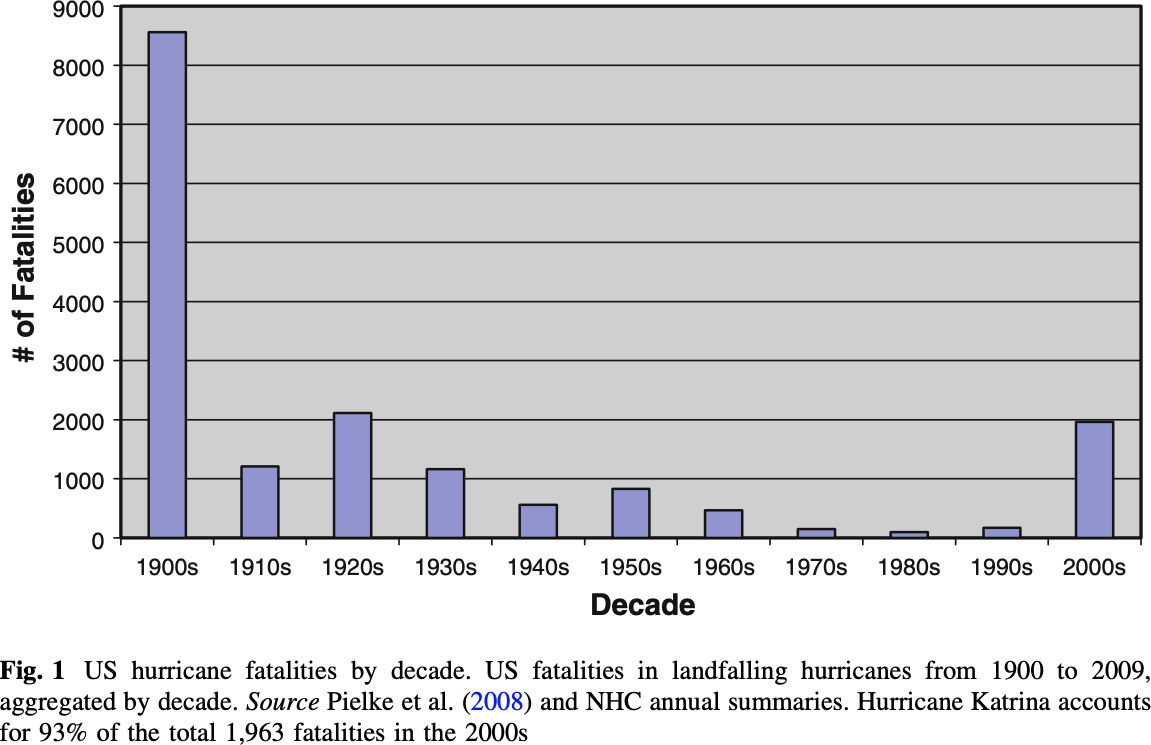
The number of people killed by hurricanes has been generally going down. All of this has happened as the world has been heating up. We can reduce fatalities even as the world heats up. The major exception to the downward trend is the 1,963 deaths caused by Hurricane Katrina, which makes up nearly all of the deaths in the 2000s. But this is a story of human choices - these deaths were not inevitable. Indeed, they were preventable. In New Orleans, levees hadn’t been maintained and they failed at less than their design tolerances. What went wrong in New Orleans wasn’t the hurricane, it was the fatal engineering flaws in the city’s flood protection system.
The biggest difference between today and historical hurricanes isn’t the global mean surface temperature or any aspects of the climate, but the amount of technology and infrastructure we have today. One hundred years ago they didn’t have satellites to give them advanced warning, or modern communication, or the transportation system to bring people to safety. Even if we’re unable to reduce the frequency or severity of extreme weather events, we’re better able to reduce the destruction they cause. We can build systems, whether flood barriers, evacuation procedures, or smarter cities, to keep people safe. We should focus more on doing these things and less on alarming people about a projected 4% increase in hurricane intensity.
Rising sea levels are a concern especially for coastal regions. I don’t know the specifics of how each region should best deal with this threat, but I do know that it’s possible to live below sea level. Amsterdam is about two meters below sea level – in fact, about a third of The Netherlands is below sea level – and they seem to be getting along just fine. How can this be? It’s because living near or below sea level is a challenge, but one that can be solved. The Dutch created a huge engineering project known as the Delta Works. It’s been declared one of the seven wonders of the modern world by the American Society of Civil Engineers, and it has allowed the Dutch to live peacefully and prosperously as the climate has changed. Although the specifics will vary in different places, this is a model that the world can follow. It’s time to build.
It’s unfortunate that so many people have fallen into despair about climate change. Not only does it cause the person to suffer, ironically, it’s also often obstructive to problem solving. After reading this book, not only do I think despair is unhelpful, I think it’s completely unjustified by the data. So, to those of you who are either fatalistic about climate change and those of you who think it's not happening: please read this book. Acknowledge what is real. Stop despairing. And let’s all work together to keep people safe from this manageable threat.
Appendix A — List of Acronyms and Abbreviations
AMO — Atlantic Multidecadal Oscillation (AMO), a natural variability occurring in the North Atlantic Ocean with an estimated period of 60-80 years; it has a large effect on hurricane behavior
AR — Assessment Report, these are the reports issued by the IPCC. They are the gold standard of climate information and consist of thousands of pages. They summarize the current state of scientific knowledge as it relates to the climate
AR5 — The 5th Assessment Report, which was released in 2014; this was the most recent Assessment Report when the book was written
AR6 — The 6th Assessment Report, which the first part of which was released in 2021
CDR — Carbon Dioxide Reduction, the process of removing carbon dioxide from the air
CMIP — Coupled Model Intercomparison Project, this is the ensembling of various climate models
CSIRO — Commonwealth Scientific and Industrial Research Organisation, an agency of the Australian Government responsible for scientific research
CSSR — Climate Science Special Report, a part of the NCA that is designed to be an authoritative assessment of the science of climate change, with a focus on the U.S.
EIA — U.S. Energy Information Agency, an agency within the U.S. Department of Energy that focuses on energy information
GHG — Greenhouse Gas, a gas that causes the Earth to retain more energy from the sun; these gases are a by-product of burning fossil fuels
GMSL — Global Mean Sea Level, the average of sea levels across the world
IPCC — Intergovernmental Panel of Climate Change, it issues assessment reports on climate change
NASA — National Aeronautics and Space Administration, this organization sponsors a fair amount of climate research
NCA — National Climate Assessment, a series of reports mandated by Congress to be definite reports for climate change in the U.S., roughly similar to a U.S. version of the IPCC Assessment Reports
NOAA — National Oceanic and Atmospheric Administration
PDI — Power Dissipation Index, an aggregate of storm intensity, frequency, and duration and provides a measure of total hurricane power over a hurricane season
SR15 — 2018 IPCC Special Report on Global Warming of 1.5 °C
SREX — Special Report on Extreme Events, or, more formally The Special Report on Managing the Risks of Extreme Events and Disasters to Advance Climate Change Adaptation
SRM — Solar Radiation Management, the concept of reflecting more sunlight into space to reduce the temperature on Earth
SROCC — Special Report on the Ocean and Cryosphere in a Changing Climate , published in 2019
SST — Sea Surface Temperature, the temperature of sea and ocean close to the surface
TC — Tropical Cyclone, the general term for what are commonly called hurricanes in the U.S.
UN — United Nations, the international body that sponsors the IPCC
WG1 — Working Group 1, the part of the IPCC that focuses on the state of climate science
WG2 — Working Group 2, the part of the IPCC that focuses on the impact of climate change