In 1940 the Empire State Building was the tallest man-made structure in the world, and if you stood at the top of it you could see the future.
Specifically, you could see this: the first NBC television broadcast transmitter, intermittently blasting 49.75 MHz audio and 46.5 MHz video signals across a hundred-mile swath of megalopolis.

A turnstile antenna, a ring of linked dipoles, and a crowning lightning rod formed the sharp point at the literal apex of human achievement. This is the lance that scraped the sky deeper than it had ever been scraped, the tip of the spear for a high radio modernism that would soon conquer the world. This is the needle that pierced the veil of the corporeal and pulled the thread of human culture into a realm of deracinated ghosts forever haunting the invisible airwaves.
Maybe this sounds overwrought and spooky. But I’m not just editorializing on my own here: this is how some of the guys who invented television talked about it!
I found this out by reading We Present Television, a collection of essays by various stakeholders in the earliest American TV broadcast systems—“televisionaries”, as they are occasionally referred to in the text. I rescued my copy from being pulped after it was weeded from a library. What got me to look at it was the odd handwritten title on the spine, and what got me to keep it was the shockingly early copyright date of 1940. This is not a pat description of a settled feature of American life; these pieces were written from the bleeding edge of a brand new technology. They were intended for the edification of a public for whom TV was a curious experimental luxury that only your richest friend’s richest friend might own[1].
The essays read roughly 90% as prosaic technical notes on the state of the art and 10% as wild-eyed futurist prophecy. Both modes offer a fascinating glimpse of a transformative new art in the process of being born. It is an approachable, Scientific American-style primer, but also, at times, the closest thing I have ever found to a dread grimoire written by the successful summoners of an Elder God.
Prose
In my mind, prior to reading We Present Television, the history of TV was a pretty firm thing stretching from the present back to the early 1950s and I Love Lucy. What was on TV before Lucy? I had no clue really. I suspect most people don’t. Lucy stands as a cultural totem of “early TV” the way that The Wizard of Oz and Frankenstein stand in for all of “early film” in the popular imagination.
But here was a book about television from a decade before Lucy and Desi ever got up to a single shenanigan! What could possibly have been going on on TV back then?
The answer is, for the most part, some weird stuff that it’s impossible to watch today. To continue the film analogy: “Talkies” as a medium have the advantage of a single solid genesis point with The Jazz Singer in 1927, just as “Classic TV” has the genesis point of Lucy being shot on 35mm film that allowed it to be preserved for future generations. The nascent television documented in this book is more akin to film in the 1900s and 1910s: a frontier technology still undergoing rapid technological progress and gradual artistic maturation[2]. And like those flammable early films, early TV was seldom preserved to leave any kind of cultural footprint, rendering it forgotten to all but a scholarly few today.
We Present Television is in large part the textual equivalent of a How It’s Made episode for “1930s television programming”. It comes at the subject from every angle and through every stage of the process, and ends up illuminating why early TV evanesced from the cultural memory even as the concept of television pervaded culture.
The Attainment of Television
If you associate “inventor of television” with a single name, it is likely Philo Farnsworth, the Utahan tinkerer who received the first US patent for it. The fabulously-named Waldemar Kaempffert, science editor for The New York Times from 1927 to 1956 and author of We Present Television’s introduction, thinks that’s a load of crock.
Kaempffert was evidently fond of technocultural prognostication (he got the NYT gig after writing an essay for Forum magazine on “The Social Destiny of Radio”), so a lot of his introduction falls into the realm of Prophecy and will be covered later in the review. But he also does a bit of historiography right at the top. In Kaempffert’s telling, television was inevitable from the moment the first fax machine was conceived in the 1840s[3], and it was midwifed into existence not by any one nameable genius but by the concerted effort of technocapital itself:
“What strikes the student of social sciences and the historian of technology is the manner in which this dream of television became a fact. The early facsimile telegraphers, cinematographers, phototelegraphers, and television empiricists all belonged to what may be called the laissez-faire school of invention. It was a school that educated itself by cut-and-try experimenting, that converted attics and cellars into laboratories, that had to hawk its patents until at last some imaginative capitalist bought them. Just as the laissez-faire school of economics gave way to planning, so the laissez-faire school of invention is giving ground to planned research. And for the simple reason that the attainment of television demanded a deeper knowledge of theoretical physics than any garret inventor could possess… [Television] is probably the very first great invention deliberately developed by organized research and born full-grown in most of its essentials.”
Kaempffert’s precis of the development of television goes on to describe an ever-increasing rate of advancement in which “time was telescoped”, driven by wildly extravagant capital investment that “probably exceeds $20,000,000”. The fruit of this investment is not just the television receiver that goes in your living room, but the television station that the rest of the book will go on to describe. One cannot profitably exist without the other.
The station is also the concern of our first proper essay, “Raising the Television Curtain”. This one was written by Alfred H. Morton, Vice-President in Charge of Television at NBC (which was, of course, primarily a radio concern at the time). Morton is proud to run the premier TV station in the country, though he graciously mentions the Don Lee broadcasting system in Los Angeles and the GE transmitter in Schenectady[4] which intends to relay programming from NYC to the Capital Region. These three islands form the archipelago of early American television.
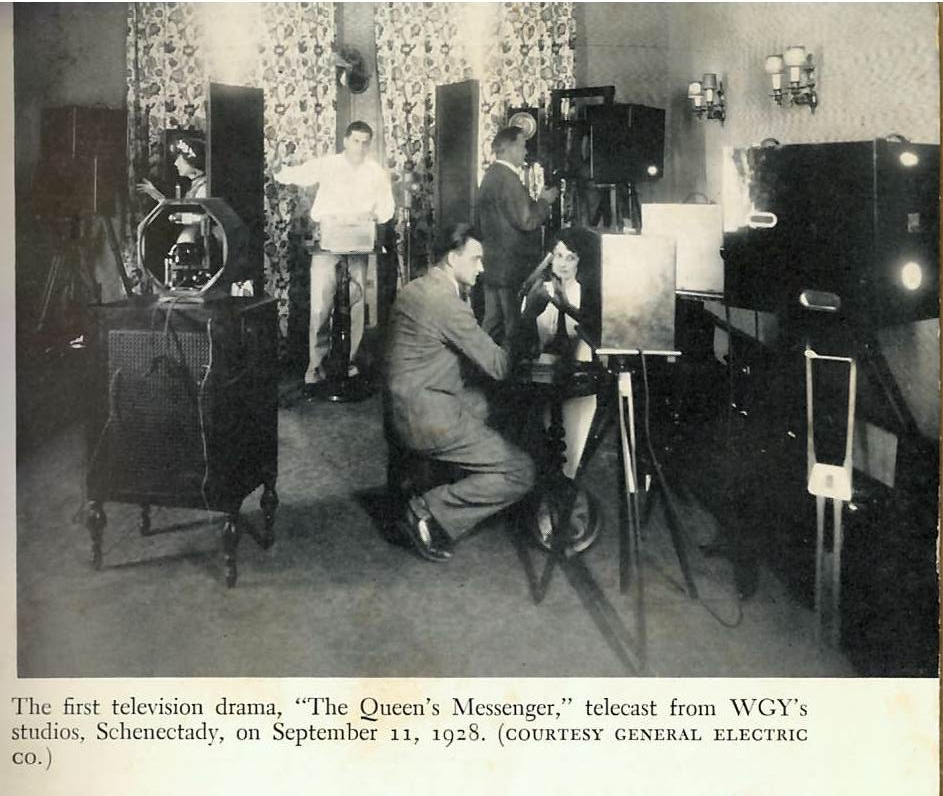
Both Kaempffert and Morton are a little defensive about how long it has taken for commercial broadcasts to begin in the United States. NBC’s TV broadcast debut at the 1939 New York World’s Fair lagged several years behind the BBC’s first efforts. Morton and others later in the book attribute the delay to a coordination problem. Morton speaks enviously of the concert with which the BBC was able to initiate its television programming:
“In England, where broadcasting is supported out of license fees levied on every radio receiver, the British Broadcasting Corporation established a television service at London in November, 1936. Being a monopoly, the BBC settled the troublesome question of technical standards by itself laying down what it considered, after due study, the best practicable specifications. Radio manufacturers thereupon made receivers to conform to those specifications.”
Simple! But in the free-market USA, independent actors from the broadcasters to the television retailers to the FCC had to somehow agree on technical standards, all the while hoping that the results were sufficient to turn a profit once offered to consumers. American television had to stand on its own two feet from day one, with no subsidies or license fees. So the development process was a game of everyone waiting out small marginal improvements to get to the minimum viable product.
Morton analogizes the experimental broadcast standards to the (then-)familiar concept of railway gauges. How foolish the would-be railroad tycoon would feel building out a network of narrow-gauge tracks, only to find out that the only trains capable of earning him any money require wide-gauge ones! So too with building broadcasting equipment which was capable of matching up with TVs anyone actually wanted to buy. Every scrap of resolution could make a difference in the viability of the new systems. Morton:
“[In] July 1936… NBC’s transmitter went on the air with the all-electronic system yielding an image in 343 lines, at the rate of thirty complete images a second. It was decided after some months of trial that a higher standard, namely, 441 lines, was necessary to provide sufficient entertainment value for the viewer.”
The terminology of ‘lines’ may seem odd to a reader accustomed to thinking in terms of pixels. In Chapter 2, “The Technique of Television”, whiz-kid radio engineer Donald G. Fink (who had started as an editor at Electronics magazine in 1934, aged 23) breaks down the technical aspects of television for the interested layman. This is the longest chapter in the book and goes into much, much more detail than I can provide here, but we can briefly cover the basics. The one key concept we must know, Fink starts by telling us, is that “television pictures must be sent on the installment plan.”
Essentially, the early TV camera tube (at the time, in the US, the iconoscope was standard) and the early TV receiver were the same technology, running in opposite directions. In both cases, a beam of electrons was carefully steered through an array of horizontal lines by the precise modulation of magnetic coils outside a vacuum tube.
In the iconoscope, the beam bounced off of a mosaic of tiny photosensitive silver capacitors which would get “full” if they had been exposed to light in the last 1/30th of a second, or sit empty waiting to eat up the electron beam if they hadn’t. This mosaic would be exposed to the light of the subject to be televised, creating the frame for the electron beam to read. The remainder of the beam, once it had hit the mosaic, was then passed on as the broadcast signal: strong and bright in spots where the capacitors were full, weaker and dimmer in spots where they had siphoned off some of the electrons.
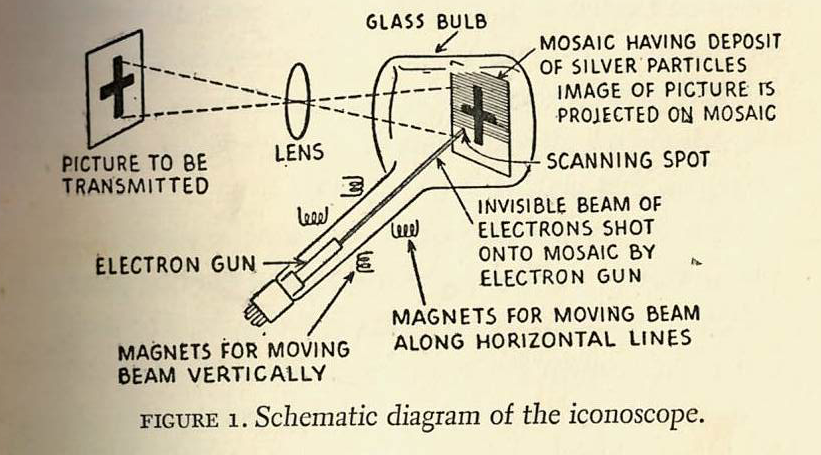
On the other end, in the TV set, an electron gun with strength determined by the modulation of the received radio signal was steered by similar magnetic coils and aimed at a corresponding array of fluorescent dots (“usually a compound of zinc, oxygen, and silicon or sulphur”). So the image received by the iconoscope was recreated in sequence, one line at a time.
And this all happened thirty times a second.
Fink is very impressed with the sheer volume of information being blasted over the airwaves in this manner (“The ancient Chinese have said that a picture is worth ten thousand words”, he tells us while comparing the bandwidth of a TV signal with that of a telephone line, “which is not such a bad guess”). Even on a 441-line television, each individual frame consisted of 200,000 points of light. It’s no wonder that the art of television couldn’t take off until all mechanical elements like “whirring belts and spinning disks” were abandoned: only a diaphanous electron beam manipulated by invisible magnetic fields was practicable for such precision work done at such immense speeds.
There is an inherent romance to this level of analog craft. Reading from the transistor age, when none of this photochemical wizardry obtains, it still kind of seems as miraculous as it must have back then. Nowadays “television” is just a subset of our generalized ability to program LEDs to emit arbitrary types of light, but back then it was a bespoke silvery magic.
The best part of Fink’s chapter is this diagram, which shows the “complete television system”:
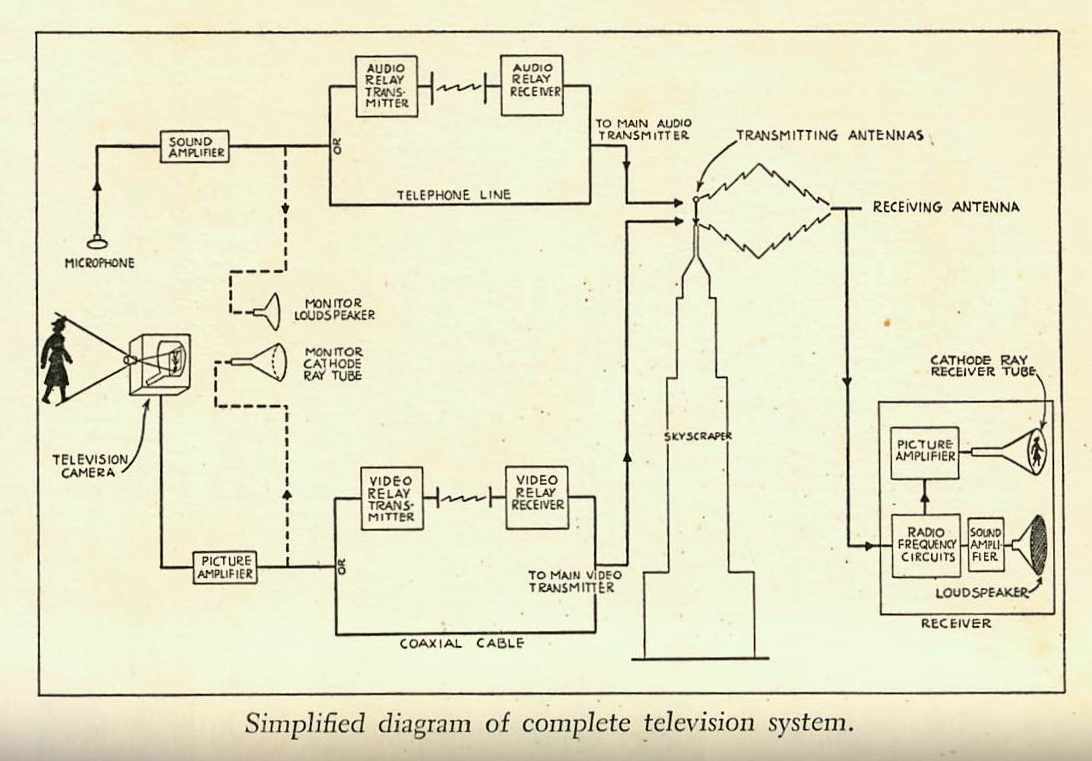
The casual inclusion of a skyscraper in the system enchants me. It is emblematic of the high radio modernism that pervades the book. The skyscraper is Part Of It. The world the televisionaries imagine is a world where we are all within eyeshot of the Empire State Building, or perhaps some grander edifice yet to be conceived.
What is a Television Program?
So that’s the technical side of the coordination problem solved, for now. 441 lines of light on a screen no larger than an A4 sheet of paper (and more often the size of an index card) were deemed sufficient to provide “entertainment value”. But the content side is still a big question mark. What will people actually watch?
Well, one non-negotiable is that they will watch ads. Securing sponsorships was (until the invention of cable many years later) the only way to extract money from the televiewer after they made their initial hardware purchase. In Chapter 10, “The Finance Problem”, Radio Daily staff writer Benn Hall breaks down the prospects of TV advertising relative to radio. He concludes that in addition to “double barreled” commercial spots shilling a product for both the ears and eyes, a great amount of “indirect advertising” (what we now think of as product placement) could eventually be worked into TV programs. But this circles back to the original question: what programs will lure people to watch the advertisements?
In Chapter 4, “Programming”, NBC Programming Director Thomas H. Hutchinson, who was paid to think a lot about every possible thing that television could do, starts by telling us he’s not quite sure:
“The basic problem that besets the program manager is stated quite simply: What is a television program? Therein lies both hope and despair. No one knows for sure what makes a good television program. There are as yet few rules for the building of either a television program or a television schedule.”
Despite this uncertainty, Hutchinson is able to suss out a few basic categories that form the backbone of the early television station’s programming. He enumerates the TV’s capabilities thus:
“Television can tell a story, with a technique which is a hybrid of stage, motion picture, and radio practices. It can also explain a process or portray the results of a process, which is the basis for many an interesting educational feature. Television is also capable of simple transmission of entertainment previously prepared for other media, such as vaudeville and motion pictures. Finally, its mobile units can rove about to relay actualities occurring in the city streets, and an indoor arena or an outside field. Studio shows, motion picture transmissions, and outside programs have, therefore, been the basis of our program experimentation since 1936.”
These silos formed the organizing principle for NBC’s production department. As Morton lists:
“[NBC] had a single television transmitter, one studio designed for the presentation of live talent programs, one studio for the scanning of motion picture film, and a complete mobile television station for relays of such outdoor events as we considered of general public interest.”
Let’s take a tour of the early studio and see what the rest of the book has to say about these three modes.
Studio Shows
Live, in-studio performances and exhibitions were the most distinctive part of the early television schedule and their description takes up most of the middle of We Present Television. Anything that you could do in front of bright studio lights, you could televise.
In some cases, these were the start of genres we know today like “cooking shows” and “variety shows”, but without all the pageantry that has accrued to them over the decades. In chapter 5, “The Director”, Thomas Lyne Riley describes the technical difficulties of livening up such prosaic displays using the tools available in the studio, i.e. two stationary cameras and one on a dolly. Somebody would just come in and make a meal, or juggle, or do a comedy routine, and the TV director had to do his best to make it dynamic and interesting for the audience watching at home by intercutting these three viewpoints. A framing device as simple as showing interstitials from a kaleidoscope and calling the variety show “Out of the Kaleidoscope” was considered wildly innovative.
I was tickled to find that the ancestor of the modern game show was simply a regular segment in variety hours presenting a live Spelling Bee. The only hint of showmanship is that “Paul Wing, who calls himself ‘The Spelling Master’” was the host, but it otherwise consisted of words being thrown at “well-known personalities or… ribbon clerks. It really doesn’t seem to matter a great deal, for spelling is a great equalizer.” It all sounds so dull now, in a post-Merv Griffin world where we associate game shows with splashy sets and well-defined gimmicks. But the core appeal of all game shows, the audience’s “not unnatural delight in knowing how to spell a word which is at the moment baffling the person in the studio” was already well intact.
The crown jewel of the TV studio, though, was its scripted live presentations. These get a huge amount of attention in the book. In Chapter 3 “The Men Behind the Camera”, O. B. Hanson delineates how a Program Director mounts and rehearses a dramatic presentation as if it is to be performed in a black box theater, while the Technical Director determines the most compelling way to capture it with the three camera setup. Actor Earle Larimore in Chapter 6 waxes rhapsodic about the potential of television to enrich the acting profession, both monetarily and in terms of “intimacy with his audience. Intimacy is, of course, the one quality that every actor strives for above all others.”
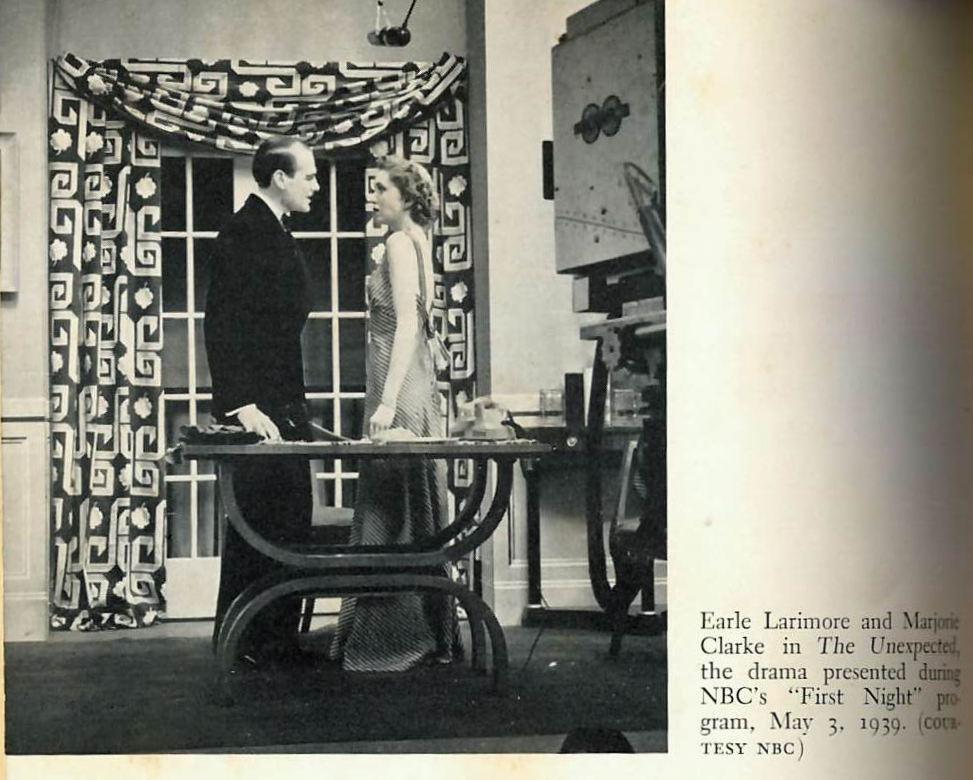
Seen here: Earle Larimore achieving intimacy
Most scripted studio shows were one-off productions telling a single story, but the idea of the recurring TV show was also starting to percolate. In Chapter 8, we are told in detail about the first television serial, Vine Street, broadcast in fifteen minute chunks to an L.A. audience starting in 1938 and featuring what we now recognize as soap opera drama about rising stars and starlets seeking their big breaks in Hollywood. It is impossible to watch any of Vine Street today; it went out live and, like almost all of the programs mentioned in the book, simply vanished into the ether.[5]
Everywhere in these chapters are deep discussions about the technical constraints afflicting the television craft. Actors must be broad enough to be read on a tiny screen, but not so broad the close-up camera reveals their falseness. Directors must present grand vistas that nevertheless fit into a cramped soundstage. Audiences must be convinced by the costumes and sets on display, but these must be furnished on a shoestring budget compared to cinema. There are even deficits compared to radio dramas. Hutchinson:
“Radio, with its tricks of sound effects and background music, whisks its audience in a trice from New York to Singapore; the listeners supply their own scenery and even costumes for the actors. I have yet to find a viewer who could do the same for a television drama. The upshot of it all is that television, having destroyed the worlds of the listener’s imagination, must supply new worlds.”
But it’s hard to build a new world every week! The necessarily live nature of early TV is an ever-present constraint throughout these essays, the one from which all other difficulties flow. Nowadays almost every scripted TV program is just a degenerate form of cinema, shot precisely the same way as a movie would be and distributed over the same digital networks. The craft of acting and directing for television is no technically different from acting or directing for a movie.
But this couldn’t have been further from the truth at the genesis of television: for its “studio shows”, NBC basically scooped the techniques of legitimate theater out from behind the proscenium, plopped them intact under unbearably bright lights, and asked them to do the transportative job of cinema. Sure, technical directors could take advantage of certain cinematic flourishes like the close-up[6] or a cut to a model shot. But the theatrical influence is so strong that Hanson endorses the view of the live studio show as “the strangest and most amazing form of theater I ever saw.”
Reading these chapters now, it is remarkable how endangered that strange and amazing form of theater is. On the major networks, only Saturday Night Live and the occasional gimmick sitcom episode still carry the torch of the live scripted broadcast. It’s no wonder that the practice faded as soon as it was technologically feasible to tape shows in advance, since everyone involved makes it sound incredibly stressful. But it does rob the medium of some strange power, one which many writers in We Present Television are quick to identify. As Riley puts it,
“Both television and the stage have one very great advantage over movies. Both convey action which is happening at the moment. Audiences are impressed with the magic of witnessing an actual event rather than a cold record of what has already taken place.”
That collapse between the event and the record of the event appears several times throughout the book; even when a broadcast is taped and rewatched later, there is a sense that what one is rewatching is “what really happened” that is absent in cinema. This impression of authenticity is the special magic that makes television television. As scenic designer Robert Edmond Jones puts it in the final chapter, “The Challenge of Television”:
“But the quality peculiar to television is that of immediate presence… The tiny screen seems to have a curious added vitality, the actors seem more real… As I have said, the essence of this new medium is immediacy, a kind of supercandor.”
Of course, not even everything that was on TV even in 1940 had that supercandor magic. Sometimes you had to fill the schedule with…
Motion Picture Transmissions
The tension between early TV and the motion picture industry is palpable whenever the subject of the movies comes up in We Present Television. Hutchinson delicately informs us that “Television, being a medium of entertainment largely visual in its appeal, has naturally aroused a certain amount of apprehension among the producers of motion picture films.” Harry R. Lubcke of the Don Lee system in LA ominously reassures his neighbors that “[television] will no more eliminate the motion picture than the telephone eliminated the telegraph.”
Morton, in Chapter 1, tells us more explicitly that he has “heard it said that a titanic clash between motion pictures and television is… inevitable.” He does not believe that this is necessarily the case, however, due to differences in the psychological needs served by each medium: television is for “relaxation in the home”, while talkies are a way to “break away from the routine of home or office, or both. Going to the movies is an event.” It’s striking how much this is still the discussion being had about the merits of theatrical exhibition vs. home releases in the age of Barbenheimer and Avatar. Eight decades have not resolved the tension.
Regardless of this supposed paradigmatic difference, some films were indeed brought on to serve as television programming. Hutchinson informs us that the major Hollywood studios held their productions rather dear, outside of the budget range of a television network which is “both poor and young”. For this reason, he finds he is “forced to rely on films held by independent distributors and on commercial films”.
This economic limitation explains why TV did not immediately degenerate into nothing but a secondary motion picture distribution system even though Hollywood had already produced enough movies to fill any programming schedule. All the good stuff was still too expensive, and there's only so many industrial films the television audience would put up with before wondering whether they'd wasted their money.
(As for the technical side of how films were aired on television, nobody ever actually goes into any detail about it in the book. Hanson briefly mentions a “scanning station” and Hutchinson claims that the films were simply “projected”, but due to the difference between cinema’s standard 24fps frame rate and TV’s 30fps, directly scanning and broadcasting films was not possible without some sort of timing remediation. If you’re interested in how this issue was resolved you can read this article about the Telecine, but properly it falls outside the scope of this review since Donald G. Fink didn’t see fit to tell us readers about it).
Outside Programs
The most surprising element of the early studio to me, and ultimately the most consequential, was the mobile unit. Despite the bulk, fragility, and immense power requirements of the equipment, by 1937 RCA had figured out how to send a complete television studio out into the world, on two beautifully boxy buses.
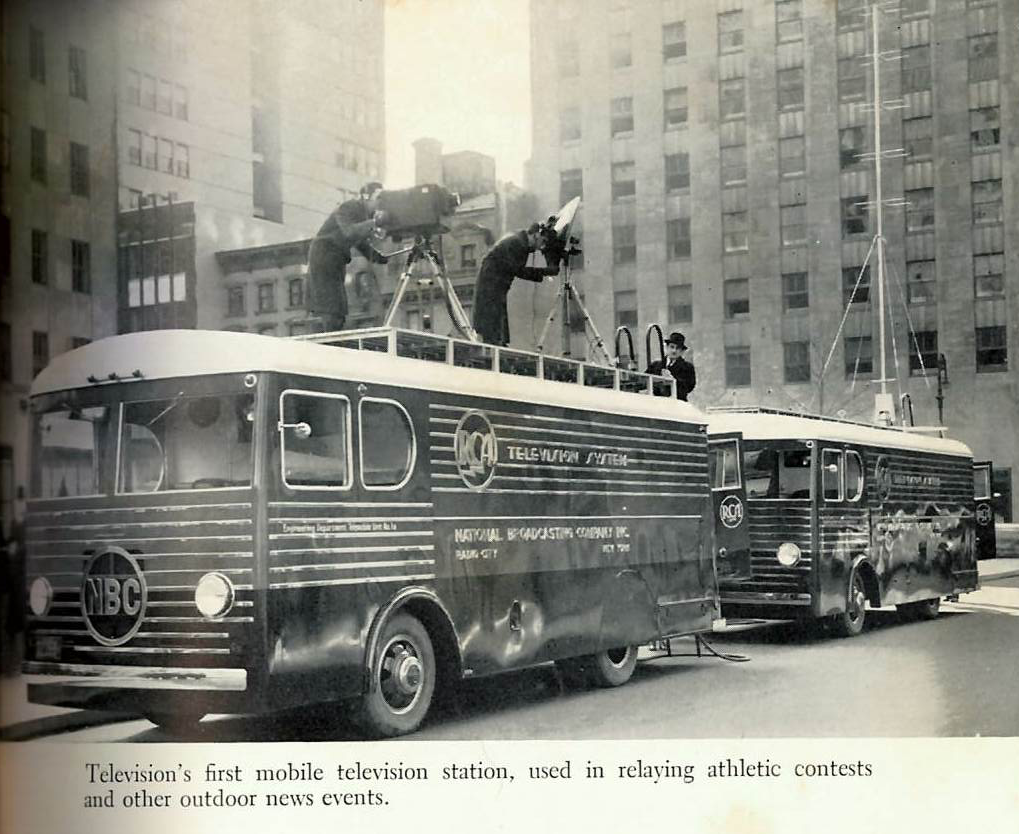
Imagine these guys rocking up to a 7-11 that got robbed.
In Chapter 7, “The New Newsreel”, noted radio writer Charles E. Butterfield breathlessly runs through a litany of outdoor and indoor events captured by the remote studio before telling us a little about how it works.
“When in operation, a crew of ten engineers is carried. One car has the video or picture apparatus, while the other houses the ultra-short-wave transmitter which relays the program to the main transmitter. The video van has a platform on top where both camera and long-distance pickup microphone can be placed to televise parades and the like. The interior is the counterpart of the studio control room. It contains all of the amplifiers and the many tubes needed to handle sound and sight as electrical energy… The second van, which houses the transmitter… is connected to the first with a coaxial cable and if necessary can be 500 feet away… Signals pass from it in as nearly a straight line as possible to the main transmitter… One conservative estimate placed the amount involved in building the rolling transmitter at $125,000 [$3,000,000 in 2026].”
As for the events that this two-vehicle setup and its more advanced successors could capture, there is almost no end to them. The NBC station debuted with remote coverage of the 1939 World’s Fair, featuring the first broadcast footage of FDR. Butterfield boasts about the success of the coverage of “the 1939 Thanksgiving Day Parade of Macy’s, large New York department store.”[7] A svelter mobile broadcasting unit was even mounted inside an airplane to show New Yorkers live views of the city from above.
A quick examination of the example schedule provided by Hutchinson shows that, on many days, the marquee event of the evening was a presentation of a sports match. The NBC mobile unit often parked outside Madison Square Garden to convey its sports offerings to the home audience.[8] This of course remains the predominant use case of live TV to this day; 45 of the top 50 most-watched broadcasts in the US last year were sports-related.
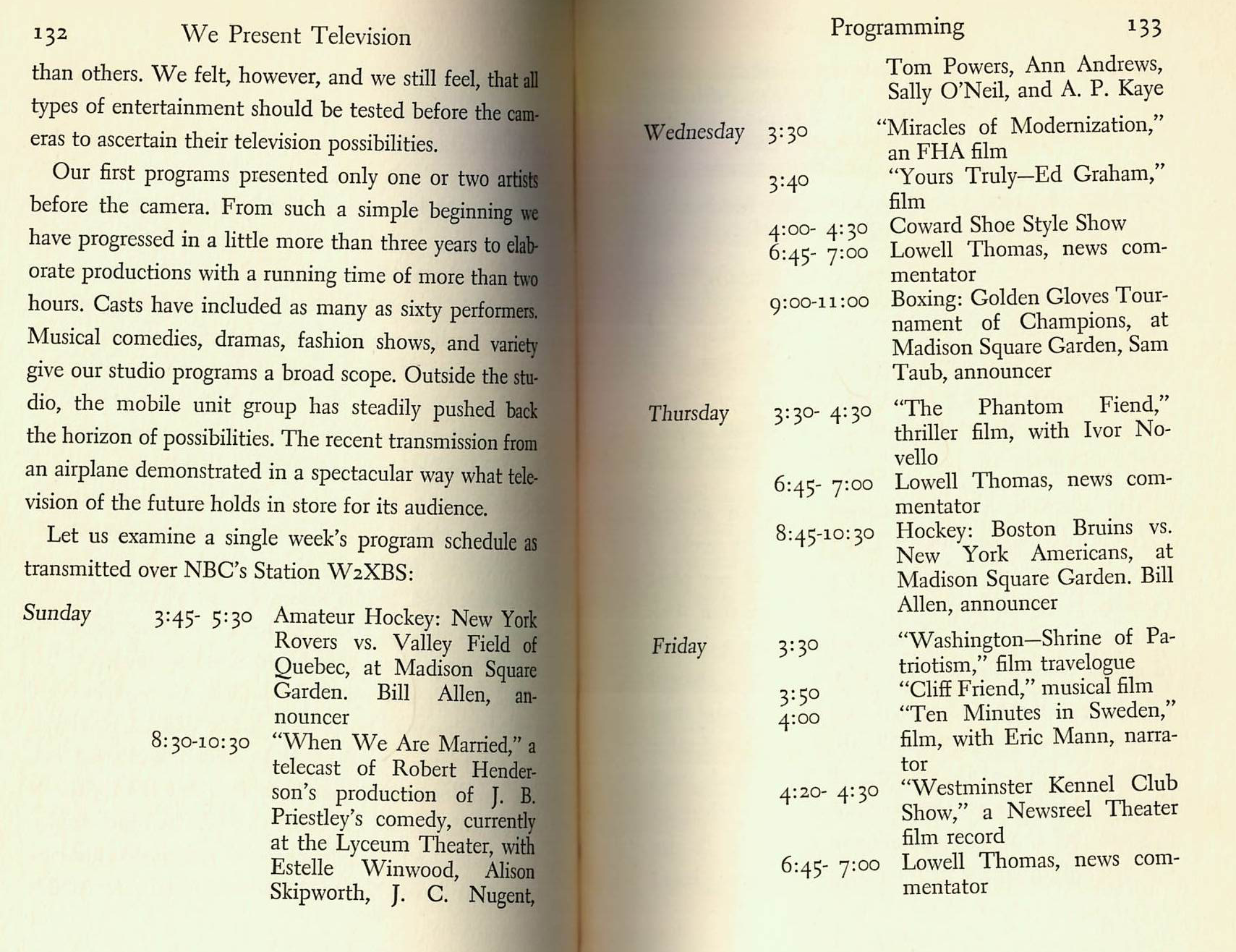
The “new newsreel” terminology used in Butterfield’s chapter feels very quaint today, because he was absolutely right that the television model completely supplanted the newsreel model for the dissemination of footage of current events. He struggles to articulate the sea change that he sees coming:
“Television is bringing forth a new newsreel—in fact, the new newsreel. It is a newsreel unlike that of the movies, unlike anything attempted heretofore. It is so different that ultimately it may not even be regarded as a newsreel, but more as the firsthand copy of an actual event as it takes place.”
Again we see the assertion that television, unlike cinema, presents actualities; that there is no conceptual gap between the event and its depiction. Butterfield floats a few dire potential names for these firsthand copies—“televiews, telescenics, teletopics, televents, teletime…”—but fails to realize that the new paradigm will win so thoroughly that we will eventually just call it “news”.
The true upshot of this mobile broadcast technology, though, is treated in passing by Butterfield. Due to the difficulty and expense of running the mobile unit, it could generally only showcase “set” events like games and parades where there was enough advance warning to get the cumbersome equipment into position. But “Spontaneously telecast outdoor scenes have come to attention on occasion” when the mobile unit was set up to capture something else and happened upon a more interesting sight.
The two examples Butterfield furnishes are both rather grim: a fire on Ward’s Island in the East River and “the now famous suicide leap recorded by an air camera as it was picking up scenes in the Plaza of Rockefeller Center”. But Hanson thinks bigger than just incidental tragedies. When discussing the development of “vest-pocket” mobile units[9], he offers this prediction:
“This marks, I believe, a very important step toward the ultimate goal of carrying television’s electronic eyes to every site of an important or interesting event.”
The mobile unit was the most consequential part of the early TV station because it eventually became the most pervasive. We do carry television’s electronic eyes to every site of every event. You have a mobile studio more capable than those ten-ton buses on your person right now. But we’re stumbling into Prophecy here, more on that later.
The Television Chimera
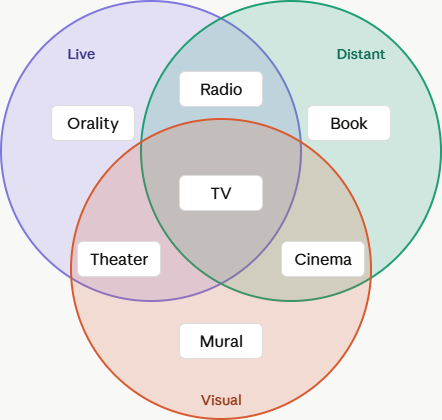
The tripartite studio we’ve just toured, with its dramas, movie scanning, and live news, maps neatly onto the influences on early TV that are often enumerated throughout We Present Television. These are, per Morton, “the legitimate stage, motion pictures, [and] radio.” Early television was seen as a chimera of these three earlier forms of mass media: Live like theater, shot and edited like film, broadcast from a distance like radio.
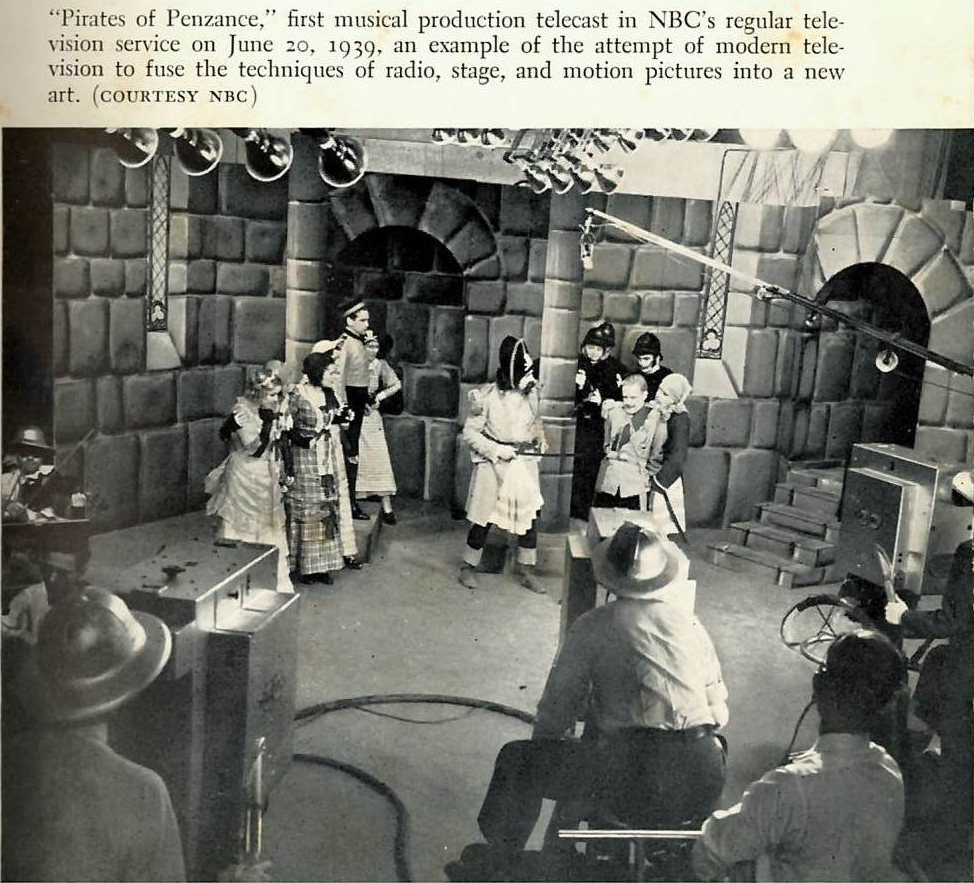
When translated into the television studio, each modality filled in some gap in its antecedents. It was at once radio you could see, cinema showing the present moment, and theater from the comfort of your own home.
None of the authors of We Present Television goes this far, but if you want you can create a three-way Venn diagram of these qualities. Even though this schema is my own elaboration, it is supportive of the point stressed over and over throughout the book that television rests uniquely at the crux of the live, the distant, and the visual.
How did this chimera start to become its own creature? In part through the instantiation of a poll. As early as 1939, Morton informs us, NBC was sending out weekly broadcast schedules with a spot for television receiver owners to mark down what they thought of each program, from 0 ‘Poor’ to 3 ‘Excellent’. Program concepts with higher average ratings were pursued more frequently, and those with lower ratings got dropped from the schedule. Already, The Algorithm was shaping content to the whims of the viewers. Programmer Hutchinson has no illusions about this:
“The televiewer, with his finger on the tuning knob, will forever be the court of final appeal. All of television must be shaped to his desires.”
Eventually, through decades of trial and error, our feedback pulled this awkward tangled braid of theater, cinema, and radio together into Television.
Prophecy
We Present Television is a relentlessly forward-looking work. The essays consistently pace through the brief history of their new medium and then take great speculative leaps beyond it. Hutchinson even apologizes about this tendency on behalf of all the book’s authors:
“It may seem that I have dwelt largely on promises of the future. We all look forward to the future of television with the utmost confidence and an almost total lack of restraint.”
The televisionaries’ habit of prophesying future developments is so consistent that little predictions kept sneaking into the first section of this review, despite my best efforts to save them all for this part. Some of the predictions advanced in the book read as laughably naive. Many more are uncannily accurate. And a few frame Television as a mystical force reshaping the entire cultural world, in a way that is hard to deny looking back now.
Laughably Naive
This quote jumped off the page at me as being as absurdly on the nose as the “Something Picasso” line in Titanic or any given line of dialogue in Walt Disney’s Carousel of Progress. But it was written by a real guy, Benn Hall:
“Figures have been bandied about freely, often based on the assumption that it will be necessary for television stations to provide continuous entertainment, just as radio stations furnish programs sixteen hours a day. It is doubtful, however, if the human eye could endure the constant strain of looking at small images, no matter how clear they are. It is also doubtful if any one person would care to concentrate on television more than a few hours daily.”
We sure showed him! Obviously TVs did get bigger as the average American household’s TV consumption rose to almost nine hours per day by 2009. But then we invented a smaller screen[10] and decided to make our eyes endure the constant strain of looking at that too!
Some of the other flop predictions are simply failed technical extrapolations:
- That we will someday have home smell-o-vision.
- That fax machines integrated into TVs will print the recipe from a cooking show while you watch it.
- That the “usual family audience” will ultimately be satisfied by “television pictures as large as 18 by 24 inches”.
- That TV will eventually acquire a third dimension, like Star Wars holograms.
And then there are the occasional sociological predictions, such as this rosy view advanced by RCA President David Sarnoff (as quoted by Morton to conclude Chapter 1):
“The ultimate contribution of television will be its service towards unification of the life of the nation, and at the same time the greater development of the life of the individual. We who have labored in the creation of this promising new instrumentality are proud to launch it upon its way, and hope that through its proper use America will rise to new heights as a nation of free people and high ideals.”
Whatever your opinions on America and its ideals, I don’t think it can really be argued that television has, on net over the last eight decades, “unified the life of the nation” or “developed the life of the individual”.
But there were far fewer laughable misses than I was expecting going into the book. I really thought this section would be longer!
Uncannily Accurate
Here’s a pretty typical prediction from the book. This is at the start of Butterfield’s chapter on TV news:
“Someday it may be a commonplace to switch on the home receiver and get a life-size picture in vivid colors on the living room wall, fortified with true sound reproduction and even accompanied by the pleasing aroma of a springtime flower garden. This may be carrying a prophecy too far; nevertheless enough has become an actuality to indicate that the complete fulfillment will be less of an impossibility than it sounds.”
So the smell-o-vision claim is hedged a bit, but the rest of it did come true. It took a surprisingly long time though:
- Color TV programming grew throughout the 1960s, and sales of color TV sets exceeded black and white in 1972.
- “True sound reproduction” wasn’t attempted until the introduction of the MTS standard in 1984, and surround sound did not become standard until the digital switchover in 2009.
- And actors in a typical medium shot did not start to appear life-sized on most people’s sets until the proliferation of 65” and above LED TVs in the 2020s!
The ‘someday’ of Butterfield’s imagination, minus the flower garden, is in fact today. The technical advances that could be easily imagined in 1940 took eight decades to attain. But we did attain them.
Maybe those technical extrapolations were easy shots to call, though. After all, everyone had just witnessed cinema go from grainy monochrome silent shorts to fluid full-color spectacle in just a couple decades. Maybe they shouldn’t get credit for assuming that television will have a similar glow-up. How about some more specific and granular predictions? Here’s Butterfield again:
“One could go even further and look forward to the day when presidential campaigns may be conducted almost wholly by television… The one who is most telegenic might even be the top vote getter.”
This, of course, immediately became the conventional wisdom about the first televised Presidential debate between Nixon and JFK in 1960, two decades after Butterfield imagined it. And even if the impact of that debate is sometimes overly mythologized, it’s impossible to overstate how politically consequential a poor TV debate performance could be by 2024.
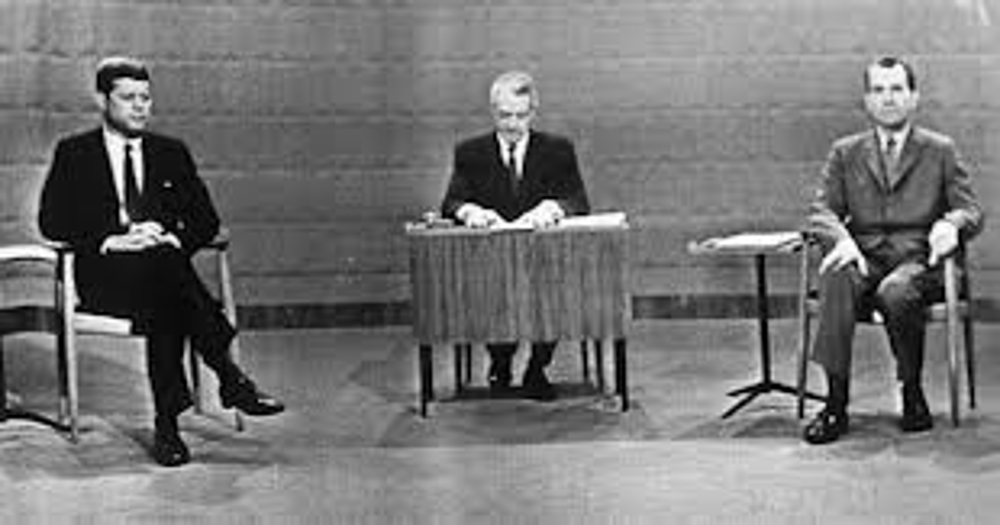
“After the program ended, callers, including my mother, wanted to know if anything was wrong, because I did not look well.” - Nixon
How about some business model specifics? Throughout the book, remarks about forming television networks and syndicating shows are constant and hardly deserve credit, since they are simply evidence of radio men applying their knowledge of radio practice and were fulfilled imminently. But in discussing TV advertising, Benn Hall predicts the eventual creation of premium subscription television (and its discontents):
“Another alternative is the rental system… It has been suggested that television might be developed into a subscription type service. Users would pay a regular monthly fee which would entitle them to a guaranteed amount of entertainment… Again the public would resent paying for such a service after being “educated” to expect free broadcast service.”
(As the reaction to every streaming service price hike proves, we also resent paying $X+2 for such a service after being educated to expect it for $X).
The possibility of pay TV was on the table due to doubts that the viewing public would put up with advertising as intrusive as TV ads were bound to be. Here’s Kaempffert in the introduction, imagining the TV commercial and the typical viewer’s reaction to it:
“The telecasting of a news event or a play by some “sponsor” will surely be preceded, followed or interspersed with images of men and women smoking cigarettes (the package and trademark conspicuously revealed), smacking their lips over a drink of some new brand of coffee or ginger ale, extolling the virtues of a face cream, all to the accompaniment of advertising patter. Will the masses like it?... Possibly we may be willing to pay the price of transitory boredom to see and hear a stirring play. It seems more likely that Ma will wash the dishes and Pa will read the newspaper until the announcer says: “The play is about to begin.””
What Kaempffert didn’t see coming was the invention of the mute button, which makes ignoring the ads even easier. That’s about the only thing he didn’t predict though. Kampffert gives us the most lateral-thinking and specific predictions in the entire book, working by analogy with the many uses found for the lightbulb within living memory.
“To Edison and his contemporaries the electric incandescent lamp was simply a competitor of the naked gas flame. Flood-lighting, the use of safe lamps in new ways on the stage and in the home, the introduction of little bulbs in surgery and medicine—these potentialities were not foreseen. In short, it is not the inventors or even their financial supporters who find all possible uses for new inventions but the public.”
From this, he goes on to describe Facetiming someone and hosting files on Web 1.0:
“[W]ho can doubt that someday we shall not only talk by telephone to a business acquaintance or a friend but that we shall also see him as we talk. “I called him up this morning,” we say now. Soon it will be, “I looked him up at his ranch in California.” George Bernard Shaw made the most of the possibilities in his Back to Methuselah. Documents will be displayed and read across the continent.”
As Kaempffert acknowledges, the concept of a video call had been around in science fiction already for a while (Shaw wrote the play cycle he mentions in 1922, and a video call appeared on screen in the film Metropolis in 1927). But as far as I know, he gets full marks in prognostication for being the first person to write about a Zoom meeting:
“The time is undoubtedly coming when the twelve directors of a corporation in twelve widely separated parts of the country will hold a meeting in the office of the chairman of the board without leaving their desks. Their opinions and votes rather than their physical presence required. But inasmuch as there are always opposing forces on every board the soft-spoken word may not be enough. Like poker players, directors insist on seeing one another. So, a few decades hence, a meeting may well be a meeting of electrically disembodied personalities. The chairman sits in the usual, very dignified, funereally upholstered room at the usual flat-top desk graced by the usual framed photograph of the wife and children. At the far end of the room are eleven television screens. In the office of each of the other directors are eleven identical screens. In twelve different offices twelve voices and images, twelve electrical ghosts confer.”
Iä! Iä! TikTok Fhtagn!
The main insight that reading We Present Television gave me is that “Television”, as a historical force, ought to be defined much more broadly than how we usually think of it. When we discuss “the television industry” we refer specifically to the broadcast television networks and their various corporate imitators in cable and streaming. We still think of “Television” (the concept) as being synonymous with the things you watch on “a television set” (the device).
A careful reading of We Present Television indicates that this is a mistake. These trappings are revealed as merely the ossification of a few jerry-rigged choices made at the dawn of the television age. The televisionaries would tell you that the TV set is not the heart of Television at all, any more than the tungsten filament is the heart of Illumination or the wooden propeller the heart of Aviation. The TV set and the TV stations that served them were in fact shackles imposed by the technological limitations of the day. All the considerations so enthusiastically documented in the Prose sections of the book are the things that made television possible, but they’re also the things that were holding it back.
Because the concept of Television, of Viewing From A Distance, is far more powerful, flexible, irrepressible, and dangerous than that first feeble instantiation achieved in the 1930s. In strange flashes of prophetic insight, We Present Television presents Television as an almost godlike force come to reshape the world in its infinitely variable image. The esoteric technical details amount to a summoning and binding ritual required to prepare an earthly vessel capable of hosting it. But soon it will break these shackles. As Jones says,
“Behind the development of television there is a dynamic energy that is irresistible. It simply cannot be stopped.”
Kampffert’s introduction sets a mystical tone right from the top. He prefigures Clarke’s Third Law with the question:
“What were the crystal-gazers of old tales but televisionaries of a sort? Unable to conceive of any mechanism that would disembody the sense of sight, they turned vainly to magic.”
And he returns a third time to the theme of magical, ghostly disembodiment in the final passage of the introduction:
“To attain this immediacy, this participation in distant events, the engineers have disembodied us. Senses are separated from us and flashed through space—first the sense of hearing and now the sense of sight. All about us are electrical ghosts… not ghosts of the dead are they but of living men and women who sit in their homes and their offices and send their discarnate personalities to the uttermost parts of the earth and charge them to deliver messages of love and hate, joy and sorrow… in the twinkling of an eye. Nothing in the dubious annals of spiritualism approaches this miracle.”
Kaempffert’s conception of Television is magical and all-encompassing. Business dictates that at first it must serve as a venue for frivolous entertainment, but beyond that commercial horizon Kaempffert sees new frontiers in science, communication, personal relationships, and ultimately a teleological progression towards the liberation of the senses, the freeing of the eyes and ears from the spatiotemporal prison of the skull.
He pulls a long passage from historian James T. Shotwell in Introduction to the History of History to assert that the advancement of Television may end up being as fundamental a shift in the noosphere as the dawn of literacy:
“...if the test for the distinction between pre-history and history is the use of writing we may be at another boundary-mark today. Writing, after all, is but a poor makeshift. When one compares the best of writings with what they attempt to record, one sees that this instrument of ours for the reproduction of reality is almost paleolithic in its crudity. It loses even the color and tone of living speech, as speech, in turn, reproduces but part of the psychic and physical complex with which it deals… Some day the media in which we work today to preserve the past will be seen in all their inaccuracy and crudity when new implements for mirroring thought, expression and movement will have been acquired. Then, we, too, may be numbered among the prehistoric.”
This all-encompassing, epoch-defining view of Television’s potential pops up a couple more times in obtrusions of almost religious awe into the text. There is Earle Larimore, the actor, making the grand pronouncement that:
“Television certainly must come. It is needed; it is the ultimate in communication between human beings.”
And in the final, dreamy chapter by Robert Edmond Jones, the eeriest passage of all, the one that framed this entire prophetic strand of the book for me:
“Deep in us all is a longing to know one another and to be known. In the last analysis we are all lonely and alone, and in our loneliness we reach out to one another. The human urge to “get together” is ancient and strong. It is my belief that we are moving very rapidly toward a society in which every human being can be immediately present to every other human being in the world. Our lives are becoming more and more public. Privacy is being abolished. An unseen force is drawing us all together moment by moment. That force now manifests itself in television.”
This passage is as close as you could possibly come to writing explicitly about the internet in 1940, but it also reads like something out of Lovecraft. To a first approximation, every human being can now be immediately present to every other human being in the world, and privacy has been abolished. That Unseen Force runs rampant across the globe. And like another deific entity first summoned by adding arcane metallic equipment to a New York skyscraper, it does not seem to have our best interests at heart.
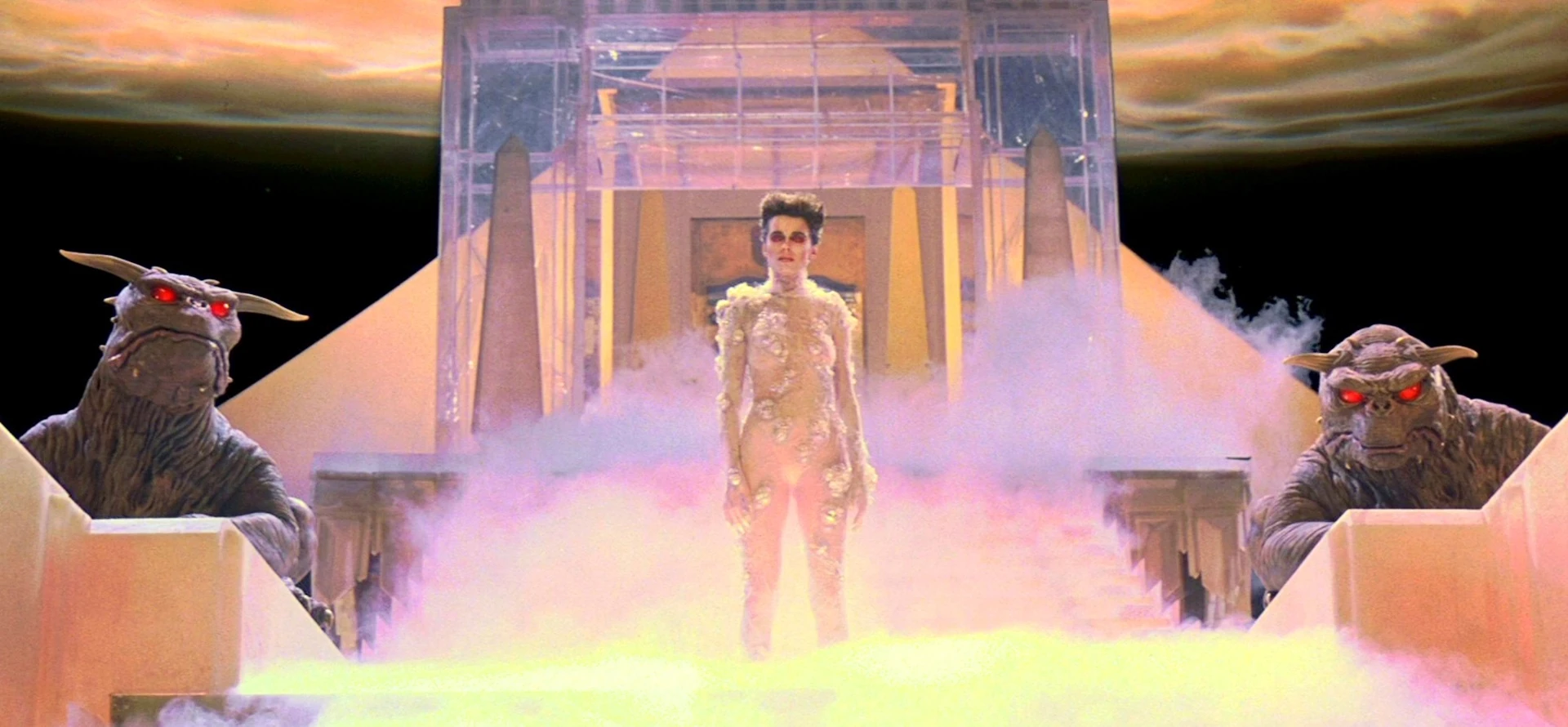
Donald G. Fink does not address whether the W2XBS broadcast antenna had a core of pure selenium.
For the Unseen Force is also stripping away the comforting artifice that used to mediate our impressions of the rest of our species. Jones:
“You will observe that we get successively further away from art—at least from visual art, as we have known it hitherto—as we get nearer to life. The old engraving was a product of careful reflection and painstaking execution. The new medium of direct instantaneous presentation gives little opportunity for selecting. The material is merely observed and projected.
The growing realism of photography, the candid camera, the motion picture, seems to have had the result of exposing people rather than revealing them. We have come of late to regard our fellow men as pretty poor creatures. The aspects of humanity that are shown to us do not credit humanity with its own inherent dignity… we seem to have become conscious of a disconcerting and disillusioning averageness in life.”
But despite the resulting disillusionment, we cannot stop looking at our fellow poor creatures. As Hutchinson asserts: “The emphasis in television programming, I believe, will continue to be on persons rather than on things.” And indeed it has been.
To weave back in a couple abandoned threads of prophecy from the previous sections: under the influence of the “Unseen Force”, we now “carry television’s electronic eyes” everywhere so that we may attain “disembodied” “immediacy” to any location of interest. The technology “abolishes distance itself”; our “discarnate personalities” can roam the far corners of the world, which is good, because it has also “destroyed the worlds of [our] imagination”.
Like Gozer, the Unseen Force invites us to choose the form of the destructor: “all of television” is now “shaped to our desires” by opaque algorithms of supreme subtlety and sophistication. And the form we choose, in ever-increasing quantities every day, is short form vertical videos of people talking about bullshit.
We Now Conclude Our Broadcast Day
The televisionaries did not see TikTok coming, specifically. I’m not going to stretch my premise that far. But I was amazed at how much they did see coming, how specific and wide-ranging some of their predictions were and how closely we have hewn to them in the decades since We Present Television was published.
The metaphors they used still feel trenchant to me, surfacing aspects of my existence in a Television-soaked world that I had always just taken for granted. It is odd that my senses can travel everywhere! It is odd that I see life-sized people I will never meet in my living room! These things were impossible to imagine a generation earlier, and impossible not to take for granted a generation later. The window during which it was possible to form lucid commentary on how strange they are was brief, and this book is right at the beginning of it.
Should you read We Present Television? If you can find a copy, sure! It is not an especially long book, 285 pages with large type and big margins. In this review I have extracted all of the bits that I found most interesting and thought-provoking, with the remainder being an avalanche of technical details. But if you are at all interested in communications technology the whole thing is worth perusing as a time capsule of a pivotal moment in history.
Due to its capital-intensive centralized nature, no other communications revolution has ever been quite as spatially and temporally concentrated as the creation of the first TV stations. For a couple years, some guys in the tallest skyscraper in the world really were the only ones who could see the future, and they happened to write this book about it from the inside.
They were able to describe our world so accurately because it is the world that they were actively building for us to inhabit. We are only just now reaching the limits of their imaginations, standing at that far horizon that they alone could see. The Unseen Force is still out there. Who knows now what the next 86 years might bring?[11]
Your message is stored now and emailed to the author after the contest ends. The author can reply to you, but their identity stays hidden unless they choose to respond.
Footnotes
- ↩
Only about 10,000 television receivers existed in the >2 million households of the New York metro area at the time, and each one cost about $400 (nearly $10,000 in today’s money).
- ↩
The comparison to early film was obvious even to the authors who had not yet witnessed television’s full maturation: in Chapter 3, O. B. Hanson describes some obvious next iterations of television technology as “certainties. And with them will come new production techniques that will make today’s practices seem like those of Edison, Biograph, and Lubin in the old movie days.” Alfred H. Morton in Chapter 1 also invokes “crude film in the studios of Edison or Méliès” as a conceptual match for early TV.
- ↩
Yes, the 1840s! Essentially as soon as the telegraph was invented someone thought to send a raster graphic over it, and the first commercial pantelegraph line was installed in France in 1863. Kaempffert views this realization of how to convey imagery via the modulation of a single electromagnetic signal as the only true insight needed to achieve television in principle: the work of making it function wirelessly and then doing it 30 times per second is just an engineering challenge that happened to take about a century to resolve.
- ↩
The GE labs in Schenectady were actually the site of the earliest telecasts in the US, with a drama production called “The Queen’s Messenger” going out in 1928. This was not a broadcast, though. No commercial television receivers yet existed, so the equipment which received the signal and displayed it on a 76mm screen was just as specialized and experimental as the equipment which sent it.
- ↩
It was possible to preserve TV broadcasts pre-Lucy, by means of the Kinescope: essentially just a 16mm or 35mm camera pointed at a TV monitor. This was the only way to syndicate programs to stations in other time zones, a practice mentioned speculatively in We Present Television as a potential economic boon for the nascent medium and which shortly thereafter became reality. But the quality of the Kinescope prints was quite bad and few survive to the present day. Lucy was shot directly on 35mm film precisely because, a decade on, audiences on the West coast would no longer put up with the poor quality of East coast Kinescope tapings of major programs being shuttled across the country to them.
- ↩
Still new enough as a cinematic technique that Hanson sees fit to credit its invention to “the great David Wark Griffith"—one of many reminders throughout the book that the entire developmental history of cinema, which now feels like ancient history to us, was still fresh in the memories of the televisionaries of 1940.
- ↩
“Towering balloons depicting the delightful characters of childhood stories were not too big to fit into the screen if they did not get too close to the camera. The result was one of the best outdoor transmissions up to that time.” Despite the local broadcast going over well, NBC failed to cover it in 1940 or 1941, and got scooped by CBS when regular network programming started going out in 1948. NBC got the parade back in 1953 and has clung tightly to it ever since.
- ↩
There is some confusion on this point between different authors, possibly due to the rapid development of the technology and delays between writing and publication; Butterfield speaks of the mobile unit parking at MSG, while Hanson in Chapter 3 says that eventually “an experimental wire circuit, for instance, is ordinarily used by NBC in relaying programs from Madison Square Garden to the transmitter.” The frequency of MSG programming in the sample schedule by Hutchinson certainly indicates that it was quite easy to broadcast from there by that point in the development of the station.
- ↩
Which, per Butterfield, consisted of multiple carrying cases weighing a mere “35 to 72 pounds”. Some vest!
- ↩
The modal size for TV receiver displays in the 1930s was 4” x 3”, slightly smaller than the average smartphone screen.
- ↩
Probably not smell-o-vision.