Predictions, 1708-1712: The Bickerstaff Papers and Essays
Introduction:
Suppose you are an astrologer in 1708.
This is already your first mistake.
Your second mistake is being John Partridge, a popular almanac-maker whose livelihood depends on people believing that you can predict the future.
Your third mistake is offending Jonathan Swift, because Swift's response was not to argue with Partridge. It was to kill him.
More precisely, writing under the name Isaac Bickerstaff[1], staking his reputation on the prediction that Partridge would die of a raging fever on March 29, 1708, around eleven at night.
This was an excellent prediction, except it was wrong: Partridge did not die. Swift's real prediction was not that Partridge would die. It was that if enough people heard Partridge was dead, Partridge would have a life-changing problem.
Swift provided that problem.
This would be a better story if Swift had merely played an unusually elaborate April Fool’s day prank on an astrologer. The mildly disturbing part is that Swift had discovered something real. The social world does not update on physical reality directly. It updates on reports of social reality.
That should have been enough for one Bickerstaff.
Instead, there turned out to be two.
The first Bickerstaff belonged to Swift: a man interested in a precise prediction and a spectacular failure. Later, after the hoax became famous, Sir Richard Steele adopted the same name for The Tatler. Steele keeps the joke, but changes the project. Swift asks whether a prediction can socially defeat reality. Steele asks what happens when reality was never cleanly resolvable in the first place.
The first Bickerstaff text was Swift’s ‘Predictions for the Year 1708‘. Later, after the hoax became famous, Sir Richard Steele adopted the name in 1709 for his periodical, The Tatler. This review considers both Swift’s Bickerstaff Papers and Steele’s later Bickerstaff Essays.
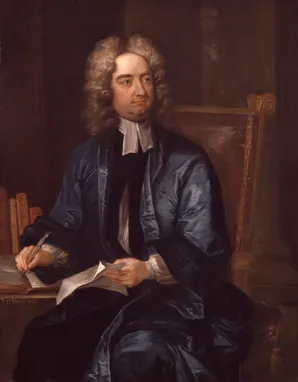
Bickerstaff I: Jonathan Swift, detail of an oil painting by Charles Jervas, c. 1718; in the National Portrait Gallery, London, from Encyclopedia Britannica
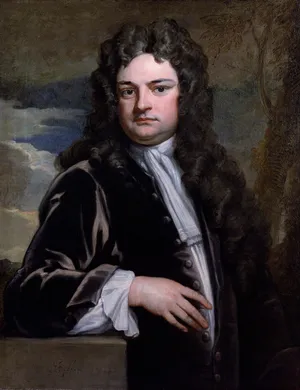
Bickerstaff II: Richard Steele, detail of an oil painting by Sir Godfrey Kneller, 1711; in the National Portrait Gallery, London, from Encyclopedia Britannica
Part 1. The Hoax
Claiming John Partridge’s almanac was a fraud would have been provocative on its own, but Swift-as-Bickerstaff did something more daring. He publicly tied his authority to naming the exact hour of Partridge’s upcoming demise. If this new Bickerstaff was bluffing, London would know within weeks.
Swift also had personal reasons for targeting him. As an Anglican clergyman, he objected to Partridge's attacks on religious authority, producing one of history's smaller jurisdictional disputes: a churchman and an astrologer arguing over who exactly was allowed to explain reality to everyone else. The novelty and drama were rapidly picked up by London’s coffeehouses and pubs. If this new Bickerstaff was bluffing, he would be exposed within weeks.
The date arrived, the bells of London tolled, and John Partridge was proud when he survived the night.
Within a day or two, he discovered that a detailed eyewitness-style account of his final illness and death had circulated widely, purporting to be The Accomplishment of the first of Mr. Bickerstaff’s Predictions. Being an account of the Death of Mr. Partridge. This included a mock confession, perfectly designed to permanently destroy his reputation.
As to foretelling the weather, we never meddle with that, but leave it to the printer… the rest was my own invention, to make my almanack sell… the’ I had some good receipts from my grandmother, and my own compositions were such as I thought could at least do no hurt.
London updated.
Partridge’s next mistake was attempting to argue with his own death. By then, the prediction was resolved. A dead man has no authority, and as far as London was concerned, he was dead, over his escalating objections.
Just to be administratively consistent, Swift followed this up with an epitaph. His humorous and contemptuous tone could have only made Partridge more angry.
Here, five Foot deep, lies on his Back,
A Cobbler, Star monger, and Quack;
Who to the Stars in pure Good-will,Does to his best look upward still.
You may have noticed that Swift delighted in emphasizing that Partridge had originally been a cobbler, despite his success as an astrologer and almanac-maker. Despite his success - his Merlinus Almanac sold around 25,000 copies a year – this insult obviously landed. Strangely, his almanac continued to be printed for years afterwards.
Not knowing that history would vindicate him, Partridge wrote an enraged response that only made the entire situation more amusing. His True and Impartial account of the proceedings of Isaac Bickerstaff, Esq; against me” included unintentionally hilarious scenes.
The maid, as she was warming my bed[2], with a curiosity natural to young wenches, runs to the window, and asks of one passing the street, who the bell tolled for? Dr. Partridge, says he, that famous almanack-maker, who died suddenly this evening: The poor girl provoked, told him he Lý’d like a rascal.
Partridge describes himself as spending much of his time ejecting undertakers, embalmers, coffin-joiners, sextons, and elegy hawkers from his home. Intended to provoke sympathy, these only made things worse.
I open the window, and ask who’s there, and what he wants?
I am Ned the sexton, replies he, and come to know whether the Doctor left any orders for a funeral sermon, and where he is to be laid, and whether his grave is to be plain or bricked?
Why, sirrah, says I, you know me well enough; you know I am not dead, and how dare you affront me in this manner?
Alack-a-day, replies the fellow, why ‘tis in print, and the whole town knows you are dead; why, there’s Mr. White the joiner is but fitting screws to your coffin, he’ll be here with it in an instant: he was afraid you would have wanted it before this time.
As Partridge tells it, his public life became a parade of people treating his death as an amusing administrative fact.
Nay, the very reader, of our parish, a good sober, discreet person, has sent two or three times for me to come and be buried decently, or send him sufficient reasons to the contrary, if I have been interred in any other parish, to produce my certificate, as the act requires.
…
But the greatest grievance is, a poultry quack, that takes up my calling just under my nose, and in his printed directions with N.B. says, He lives in the house of the late ingenious Mr. John Partridge, an eminent practitioner in leather, physick and astrology.
Partridge blamed a Catholic conspiracy: France and Rome are at the bottom of this horrid conspiracy against me; … through my sides there is a wound given to all the Protestant almanack-makers in the universe.
Swift responded in kind, penning a formal defense titled A Vindication of Isaac Bickerstaff. Here he acted the part of an injured scholar, disappointed at how Mr. Partridge had resorted to insults over what was, after all, merely a minor academic difference of opinion. The tone was carefully calibrated to continue the joke while simultaneously framing it as a serious dispute. He began by expressing disappointment in Partridge’s behavior, who has been ‘pleased to treat me after a very rough manner,’ calling him a fool and a villain.
He politely insisted that a learned controversy ought to be conducted with calmness, dignity, and mutual respect. To call a man names over a point so purely speculative is simply bad form – most particularly when the subject is something as uncertain as a man’s continued existence.
Then, with considerable care, he provided mock-proofs that Partridge was dead. The argument unfolded with admirable rationality and seriousness.
Firstly, thousands of readers have encountered Partridge’s latest almanac and concluded that ‘no man alive ever writ such dammed stuff as this.’ From this axiom it would logically follow that Partridge must not be a ‘man alive.’ Should some uninformed carcass continue to walk about, and call itself Partridge, Bickerstaff could not possibly be held responsible for its behavior.
Secondly, Partridge claims to tell fortunes and recover stolen goods, which everyone knows requires communication with spirits. Only a spirit can communicate with another spirit. Is John Partridge a spirit, or a man?
Thirdly, his own almanac, when read carefully, admits that a man may be alive now, who was not alive a year ago, which Swift generously grants. [3]
The rumor detached from the underlying reality of Partridge’s still - beating heart, and began trading on its own. At this point, the original prediction was barely relevant to the discussion.
Part 2: Almanacs And Prediction Markets
Swift’s Bickerstaff begins by explaining that he is writing this almanac to prevent the people of England from being farther imposed on by vulgar almanack-makers. These almanacs are full of nonsense, lies, folly, and impertinence, which they offer to the world as genuine from the planets, tho’ they descend from no greater a height than their own brains.
Bickerstaff complains: I wonder, when I observe gentlemen in the country, rich enough to serve the nation in parliament, pouring in Partridge’s almanack, to find out the events of the year at home and abroad; not daring to propose a hunting-match, till Gadbury or he have fixed the weather.
Almanacsfunctioned more as a popular prediction interface, providing planting dates, horoscopes, weather, politics, medicine, and timekeeping in an entertaining and portable package. Accuracy was an afterthought, as a good almanac did not need to be right in every detail. It needed to be credible, repeatable, and socially authoritative. One way of looking at this is to imagine that enough people believed that the coming year would be difficult, they behaved accordingly, and the prediction could acquire a kind of retrospective truth.
So, when he targeted Partridge, Swift’s Bickerstaff did not argue that astrology was generally unreliable. This would not surprise anyone. [4] Instead, he took the almanac at its strongest point: its authority to make specific predictions. He made one just a bit more specific than usual. Crucially, he arranged for society to update on the report rather than the underlying reality.
Now, by the early eighteenth century, the epistemic status of almanacs had become ambiguous. People relied on them, mocked them, and competed with them, often simultaneously. Over the next few centuries, they were replaced by more and more sophisticated tools, all of which led to not less prediction, but more. Most intelligent people have long discarded astrology, but they never stopped believing in predictions, which appears to be a requirement of mankind. They moved them from the sky, to the almanac, to statistics, and finally to computers.
Most recently, prediction has been moving to prediction markets like Polymarket, Manifold, and Kalshi. And the same pattern holds. People cite prediction markets, while making fun of them, and yet they cannot seem to help competing with them. It is a human instinct to want to know the truth about the future.
A prediction market is, in one sense, the anti-almanac. It tries to fix exactly the things that made almanacs ridiculous. Instead of vague pronouncements, it demands precise claims. Instead of “political unrest may trouble the kingdom,” it asks, “Will X leader leave office by Y date?” It creates a contract that should reward accuracy, at least in theory.
As of May 18, 2026, there are no questions on Manifold or Polymarket about whether Mars foretells war. This is a genuine improvement. We ask whether the market “knows” something instead. You can hear Swift laughing from the grave.
As of an earlier day in May, one should take a current prediction market: “Russia x Ukraine ceasefire by June 30, 2026?” At first glance, this seems quite a bit clearer than “Warlike disturbances may continue in the East, with possible hopes of peace under favorable planetary influences.” It asks a specific question, with a specific date, and gives a number: 11% chance.
Then you read the resolution criteria in the small print.
The market will resolve “Yes” if and only if there is an official ceasefire agreement, publicly announced, mutually agreed, constituting a general pause in military engagement, by June 30, 2026, 11:59 PM ET. It will not count if it is informal, only for humanitarian purposes, or if it only applies to energy infrastructure, the Black Sea, or other partial agreements. A peace framework counts only if it includes an explicit, dated commitment to stop fighting. Official announcements from both Russia and Ukraine matter, but a wide consensus of credible media reporting may also suffice.
This is a really solid attempt to predict the future, as “ceasefire” is not a simple word. And that is exactly the problem.
The moment you try to make the future precise and tradable, you discover that the hard part was always going to be interpretation. What counts as peace? What counts as agreement? What counts as official? What counts as mutual? What counts as a “credible media consensus”? What if both sides announce different versions? What if fighting stops before the documents are signed? What if documents are signed while fighting continues?
Swift would recognize the structure immediately. Will Partridge die by March 29? looked like a clean, binary question. But he manipulated the resolution criteria. If London printers say Partridge is dead, and sextons, coffin-makers, and elegy-hawkers all behave as if Partridge is dead, then Partridge’s status becomes an inconvenience.
Likewise, Will there be a ceasefire? sounds clean only until you ask who gets to decide what a ceasefire is.
The prediction seems solid on paper, and is backed by real money in some cases. As of my current looking at the market, you can buy “yes” for 11c and “no” for 90c on Polymarket, provided the agreement is official, mutual, public, general, dated, non-humanitarian, not limited to infrastructure or the Black Sea, and either confirmed by both governments or accepted by credible media consensus.
The part where you can force a question into a clean, tradable claim (Will X happen by date Y?) seems obviously good. It allows for humorous markets like Will this book review be converted into a chicken dance by August 22, 2028? However, the part where the world immediately responds by turning that clean claim into a pile of legal workarounds is simply history repeating itself. What qualifies as a chicken dance?
On Polymarket, should everyone agree to settle that Partridge is dead, the bettors are paid out, regardless of whether he is actually dead. You can find his live body hidden in the closet where they calculated the resolution criteria.
Part 3: Prediction markets and telling the future:
Prediction markets improve substantially on almanacs, but they inherit many of the same social dynamics.
The happy bedtime story prediction market supporters like to tell about prediction markets goes something like this:
Once upon a time, in a website far away, people had information. They placed bets based on that information. These bets made the prices move, converting the price into a probability. Society updated according to the correct probability and humanity lived happily ever after.
Instead of saying, “Something politically unstable may happen in Venezuela.”, they say “There is a 7% chance Maduro will be removed by such-and-such date.”
This feels scientific and humble, because it is only assigning a probability. Swift said “At eleven o’clock.” And e.g. Polymarket will now display: “7%.” Both wish to demonstrate that they can precisely carve uncertainty. But probability has its own rhetoric; and used properly, a number can be both modest and arrogant.
A numerate oracle allows the prediction to become tradable; it does not make the system unbreakable. The danger here is that this is a little like saying that My child successfully predicted that the cookies would disappear!, when they were the one eating them under the table. While the prediction may resolve to accurate, it is hardly an epistemic triumph – it simply monetized privileged access.
And a normal person reads about the person who won 140,000 because he was part of the military operation targeting Maduro, and says why are we letting people bet on coups?
The market can be a stage for manipulation, and the belief that manipulation can be self-correcting is, at best, naive. Theoretically, these people argue, even suppose someone pushes the price away from truth, all they are doing is creating financial opportunity! Smarter traders will bet against them and make money.
Sometimes this is true, but it has a crucial failure point: it depends on no one caring about the public signal more than the direct profit.
Any modern politician would be willing to lose $50,000 moving a market, because moving the market may create headlines that help their political campaign. A CEO would be willing to lose 50,0000 to keep his company from going under. A very successful blogger may be willing to lose money to support their favorite online faction. Even a scientist might be willing to sacrifice money to control the narrative.
If a modern actor can buy probability, the prediction market becomes just another sophisticated advertising venue.
So, Swift’s 300-year-old pamphlet serves less as a support to modern prediction warket as an example how the same warnings tuhat apply to almanacs apply to these markets: specificity is fragile, narratives are sticky, resolution is gameable, and the cleverest forecaster is often the one who forecasts other forecasters.
Why is this? For that, we need Steele’s Bickerstaff.
Part 4. Steele’s Bickerstaff
The Bickerstaff Essays reflect real life dynamics of social status, reputation, or success. In real life, it is hard to effectively use resolution criteria. Often, these resolution criteria are being used to describe systems where what is being predicted has no clean resolution at all. Despite his heartwarming examples, this is clearly not a friendly bedtime story.
Steele’s Bickerstaff notes that humans predicting things are subject to human complications. Some people know more than others. Some people can influence the outcome. Some people can influence the reporting of the outcome. Some people can move the market using social status.
Sounds familiar?
Steele opens a full exchange, where everything becomes tradable: rank, taste, love, expertise, sanity, even life itself. And, in every case, he describes how the signal detaches from the underlying reality - but continues to function socially anyway.
The real forecasting, according to Steele, is simply acting as a regulator of appearances. 1708’s “Everyone is discussing what Bickerstaff says” becomes, in its modern equivalent, “Everyone is watching the market odds.”
Consider two markets: One is deep and liquid, like a very large, calm lake. Throw in one stone and the splash soon disappears. The other is a shallow, illiquid market. This one is more like a bathtub occupied by two children, one of whom is pouring out all the shampoo. Any movement becomes a major event.
When a prediction market is shallow, a single trader can move the price a lot. Outsiders see the price move and think that the market “knows” something. But it is possible that the market knows nothing! Perhaps some drugged up trader bet $5,000 in a market because the voices in his head dared him to. But if he previously had a good reputation, others may act on reputation, which changes reputation, which changes behavior, which changes the next round of prediction.
Swift asks:
Can a prediction technically kill a man? Yes. Here is a prediction so precise that people will believe it.
Steele asks:
What kind of public would rely on the report? Shouldn’t a truth seeking public be checking whether he is dead? Now let us observe the people who believed it, repeated it, argued about it, dressed it up, profited from it, and turned it into polite conversation.
Steele might agree that the interesting part of prediction markets is not the contract, but the world around the contract. This includes traders, journalists, regulators, spectators, people using market odds as arguments on their Substack posts. Most of all, it includes the people pretending that because money is involved, they are less easily influenced, rather than more. There’s an ancient Mesopotamian proverb that says, “do not recognize people’s status, nor accept a bribe, for a bribe blinds the eyes of the wise, and perverts the words of the righteous”.
Bickerstaff’s Essays (Steele) begin with an ambitious attempt to demolish social status in the form of inherited authority. The first, The Staffian Race, begins by declaring that “of all the vanities under the sun… being proud of one’s birth is the greatest”. He claims to be passing on the following letter:
"DEAR COUSIN,
"Since you have been pleased to make yourself so famous of late by your ingenious writings, and some time ago by your learned predictions; since Partridge, of immortal memory, is dead and gone, who, poetical as he was, could not understand his own poetry; and, philomathical as he was, could not read his own destiny;
… it is with no small concern I see the original of the Staffian race so little known in the world as it is at this time
…The Staffs are originally of Staffordshire, which took its name from them; the first that I find of the Staffs was one Jacobstaff, a famous and renowned astronomer, who, by Dorothy his wife, had issue seven sons—viz., Bickerstaff, Longstaff, Wagstaff, Quarterstaff, Whitestaff, Falstaff, and Tipstaff. He also had a younger brother, who was twice married, and had five sons—viz., Distaff, Pikestaff, Mopstaff, Broomstaff, and Raggedstaff.
As for the branch from whence you spring, I shall say very little of it, only that it is the chief of the Staffs, and called Bickerstaff, quasi Biggerstaff; as much as to say, the Great Staff, or Staff of Staffs; and that it has applied itself to Astronomy with great success, after the example of our aforesaid forefather.
…The Wagstaffs are a merry, thoughtless sort of people, who have always been opinionated of their own wit; they have turned themselves mostly to poetry. This is the most numerous branch of our family, and the poorest.
…The Quarterstaffs are most of them prize-fighters or deer-stealers; there have been so many of them hanged lately that there are very few of that branch of our family left. The Whitestaffs are all courtiers, and have had very considerable places. There have been some of them of that strength and dexterity that five hundred of the ablest men in the kingdom have often tugged in vain to pull a staff out of their hands.
…The Falstaffs are strangely given to drinking: there are abundance of them in and about London. And one thing is very remarkable of this branch, and that is, there are just as many women as men in it. There was a wicked stick of wood of this name in Harry the Fourth's time, one Sir John Falstaff.
…As for Tipstaff, the youngest son, he was an honest fellow; but his sons, and his sons' sons, have all of them been the veriest rogues living; it is this unlucky branch has stocked the nation with that swarm of lawyers, attorneys, serjeants, and bailiffs, with which the nation is overrun.
… his younger brother, Isaacstaff, as I told you before, had five sons, and was married twice; his first wife was a Staff, for they did not stand upon false heraldry in those days, by whom he had one son, who, in process of time, being a schoolmaster and well read in the Greek, called himself Distaff or Twicestaff. He was not very rich, so he put his children out to trades, and the Distaffs have ever since been employed in the woollen and linen manufactures, except myself, who am a genealogist.
Pikestaff, the eldest son by the second venter, was a man of business, a downright plodding fellow, and withal so plain, that he became a proverb. Most of this family are at present in the army.
Raggedstaff was an unlucky boy, and used to tear his clothes in getting birds' nests, and was always playing with a tame bear his father kept.
Mopstaff fell in love with one of his father's maids, and used to help her to clean the house.
Broomstaff was a chimney-sweeper. The Mopstaffs and Broomstaffs are naturally as civil people as ever went out of doors; but, alas! if they once get into ill hands, they knock down all before them.
Pilgrimstaff ran away from his friends, and went strolling about the country; and Pipestaff was a wine-cooper. These two were the unlawful issue of Longstaff.
"N.B.—The Canes, the Clubs, the Cudgels, the Wands, the Devil upon two Sticks, and one Bread, that goes by the name of Staff of Life, are none of our relations. I am, dear Cousin,
"Your humble servant,
"D. DISTAFF.
"From the Heralds' Office,
"May 1, 1709."
Like the Partridge hoax, the genealogy is confidently false, and in a socially legible way. It uses truth telling tools like documentation, classification, etymology, and heraldic seriousness... resulting in nonsense. As Swift shows that a man can be declared dead whether he knows it or not, Steele shows that a family can be declared noble whether it exists or not. He amusingly describes using proto-polygenic screening to perfect his own family when marrying off his siste:
For this reason I have disposed of her to a man of business, who will soon let her see that to be well dressed, in good humour, and cheerful in the command of her family, are the arts and sciences of female life. I could have bestowed her upon a fine gentleman, who extremely admired her wit, and would have given her a coach and six, but I found it absolutely necessary to cross the strain; for had they met, they had entirely been rivals in discourse, and in continual contention for the superiority of understanding, and brought forth critics, pedants, or pretty good poets. As it is, I expect an offspring fit for the habitation of the city, town or country; creatures that are docile and tractable in whatever we put them to.
It is ironic that now polygenic screening is hoped to produce critics, pedants, or pretty good poets, rather than an offspring fit for the habitation of the city, town or country.
In The Dream of Fame, Steele describes something recognizable to modern day influencers: There are two kinds of immortality, that which the soul really enjoys after this life, and that imaginary existence by which men live in their fame and reputation.
Historians stand at the entrance deciding who belongs in the mythological section or the real section of heaven. Alexander nearly gets misfiled among mythological heroes because of how he is written about. Hannibal complains that Roman historians buried him. Caesar has to introduce himself. Most egregiously, Isaac Bickerstaff himself fails to qualify.
At the upper end sat Hercules, leaning an arm upon his club; on his right hand were Achilles and Ulysses, and between them AEneas; on his left were Hector, Theseus, and Jason: the lower end had Orpheus, AEsop, Phalaris, and Musaeus. The ushers seemed at a loss for a twelfth man, when, methought, to my great joy and surprise, I heard some at the lower end of the table mention Isaac Bickerstaff; but those of the upper end received it with disdain, and said, "if they must have a British worthy, they would have Robin Hood!"
It is common online for people to associate more with a personality than is warranted by the circumstances. Isaac Bickerstaff once again brings us back to reality.
"DEAR MADAM,
"You have already seen the best of me, and I so passionately love you that I desire we may never meet. If you will examine your heart, you will find that you join the man with the philosopher; and if you have that kind opinion of my sense as you pretend, I question not but you add to it complexion, air, and shape; but, dear Molly, a man in his grand climacteric is of no sex. Be a good girl, and conduct yourself with honour and virtue, when you love one younger than myself. I am, with the greatest tenderness, your innocent lover,
"I. B."
His essay A Business Meeting describes a group of well-intentioned men trying to sit down and begin a discussion. No one is confused about the goal. No one is malicious. Everyone is exquisitely sensitive to rank and etiquette. It turns into a ridiculous coordination problem.
I looked out from my window, and saw the good company all with their hats off and arms spread, offering the door to each other. After many offers, they entered with much solemnity…
A false alarm of fire briefly breaks the coordination problem, and then the hierarchy immediately reasserts itself. The meeting produces nothing except the plan for another meeting with more people – humorously creating an even larger coordination problem!
Steele’s Bickerstaff both opposes and cannot figure out how to avoid the practice of duelling. The practice is irrational. A gentleman cannot refuse a challenge without losing status, forcing him to participate in something he knows to be wrong. In other words, the system persists not because people believe in it, but because the cost of exit is too high.
So how do we get to reality? Steele’s response is: We cannot prevent human misfiring. In most of the world, signals are easier to manipulate than reality. In marriage and other small, slow, and externally unimpressive things that require long periods of time, reality becomes harder to fake than signals. The incentives shift to match reality over time.
For example, in his essay titled “Happy Marriage”, you see what looks like a healthy, functioning system. The man loves his wife more over time, not less, and it is beautiful. From the outside, the wife has aged and declined, but from the inside, the relationship has deepened.
As soon as we were alone, he took me by the hand; "Well, my good friend," says he… Do not you think the good woman of the house a little altered, since you followed her from the play-house, to find out who she was for me?"
I perceived a tear fall down his cheek as he spoke, which moved me not a little. But, to turn the discourse, said I, "She is not indeed quite that creature she was, when she returned me the letter I carried from you: and told me 'she hoped, as I was a gentleman, I would be employed no more to trouble her, who had never offended me; but would be so much the gentleman's friend as to dissuade him from a pursuit which he could never succeed in.' You may remember I thought her in earnest, and you were forced to employ your cousin Will, who made his sister get acquainted with her for you. You cannot expect her to be for ever fifteen."
"Fifteen!" replied my good friend; "ah! you little understand, you that have lived a bachelor, how great, how exquisite a pleasure there is, in being really beloved! It is impossible, that the most beauteous face in nature should raise in me such pleasing ideas, as when I look upon that excellent woman. That fading in her countenance is chiefly caused by her watching with me, in my fever. This was followed by a fit of sickness, which had like to have carried her off last winter. I tell you sincerely, I have so many obligations to her, that I cannot, with any sort of moderation, think of her present state of health.
But as to what you say of fifteen, she gives me every day pleasures beyond what I ever knew in the possession of her beauty, when I was in the vigour of youth. Every moment of her life brings me fresh instances of her complacency to my inclinations, and her prudence in regard to my fortune. Her face is to me much more beautiful than when I first saw it; there is no decay in any feature, which I cannot trace from the very instant it was occasioned by some anxious concern for my welfare and interests. Thus, at the same time, methinks, the love I conceived towards her for what she was, is heightened by my gratitude for what she is. The love of a wife is as much above the idle passion commonly called by that name, as the loud laughter of buffoons is inferior to the elegant mirth of gentlemen. Oh! she is an inestimable jewel.
In her examination of her household affairs she shows a certain fearfulness to find a fault, which makes her servants obey her like children: and the meanest we have has an ingenuous shame for an offence, not always to be seen in children in other families. I speak freely to you, my old friend: ever since her sickness, things that gave me the quickest joy before turn now to a certain anxiety. As the children play in the next room, I know the poor things by their steps, and am considering what they must do, should they lose their mother in their tender years. The pleasure I used to take in telling my boy stories of the battles, and asking my girl questions about the disposal of her baby, and the gossiping of it, is turned into inward reflection and melancholy."
… on a sudden we were alarmed with the noise of a drum, and immediately entered my little godson to give me a point of war. His mother, between laughing and chiding, would have put him out of the room; but I would not part with him so. I found upon conversation with him, though he was a little noisy in his mirth, that the child had excellent parts, and was a great master of all the learning on the other side eight years old. I perceived him a very great historian in AEsop's Fables: but he frankly declared to me his mind, that he did not delight in that learning, because he did not believe they were true; for which reason I found he had very much turned his studies for about a twelve-month past, into the lives and adventures of Don Bellianis of Greece, Guy of Warwick, the Seven Champions, and other historians of that age. I could not but observe the satisfaction the father took in the forwardness of his son; and that these diversions might turn to some profit, I found the boy had made remarks which might be of service to him during the course of his whole life. He would tell you the mis-managements of John Hickathrift, find fault with the passionate temper in Bevis of Southampton, and loved Saint George for being the champion of England; and by this means had his thoughts insensibly moulded into the notions of discretion, virtue, and honour. I was extolling his accomplishments, when the mother told me that the little girl who led me in this morning was in her way a better scholar than he. "Betty," says she, "deals chiefly in fairies and sprites, and sometimes in a winter-night will terrify the maids with her accounts, till they are afraid to go up to bed."
I sat with them till it was very late, sometimes in merry, sometimes in serious, discourse, with this particular pleasure, which gives the only true relish to all conversation, a sense that every one of us liked each other. I went home, considering the different conditions of a married life and that of a bachelor; and I must confess it struck me with a secret concern, to reflect, that whenever I go off I shall leave no traces behind me. In this pensive mood I return to my family; that is to say, to my maid, my dog, and my cat, who only can be the better or worse for what happens to me.
He reinforces this with the story of the buried letters.
There were several of us making merry at a friend's house in a country village, when the sexton of the parish church entered the room in a sort of surprise, and told us "that, as he was digging a grave in the chancel, a little blow of his pick-axe opened a decayed coffin, in which there were several written papers." Our curiosity was immediately raised, so that we went to the place where the sexton had been at work, and found a great concourse of people about the grave. Among the rest there was an old woman, who told us the person buried there was a lady whose name I did not think fit to mention, though there is nothing in the story but what tends very much to her honour. This lady lived several years an exemplary pattern of conjugal love, and, dying soon after her husband, who every way answered her character in virtue and affection, made it her death-bed request, "that all the letters which she had received from him both before and after her marriage should be buried in the coffin with her." These I found, upon examination, were the papers before us. Several of them had suffered so much by time that I could only pick out a few words; as my soul! lilies! roses! dearest angel! and the like. One of them, which was legible throughout, ran thus:
"MADAM,
"If you would know the greatness of my love, consider that of your own beauty. That blooming countenance, that snowy bosom, that graceful person return every moment to my imagination; the brightness of your eyes hath hindered me from closing mine since I last saw you. You may still add to your beauties by a smile. A frown will make me the most wretched of men, as I am the most passionate of lovers."
It filled the whole company with a deep melancholy to compare the description of the letter with the person that occasioned it, who was now reduced to a few crumbling bones and a little mouldering heap of earth. With much ado I deciphered another letter, which began with, "My dear, dear wife." This gave me a curiosity to see how the style of one written in marriage differed from one written in courtship. To my surprise, I found the fondness rather augmented than lessened, though the panegyric turned upon a different accomplishment. The words were as follows:
"Before this short absence from you, I did not know that I loved you so much as I really do; though, at the same time, I thought I loved you as much as possible. I am under great apprehensions lest you should have any uneasiness whilst I am defrauded of my share in it, and cannot think of tasting any pleasures that you do not partake with me. Pray, my dear, be careful of your health, if for no other reason but because you know I could not outlive you. It is natural in absence to make professions of an inviolable constancy; but towards so much merit it is scarce a virtue, especially when it is but a bare return to that of which you have given me such continued proofs ever since our first acquaintance. I am," etc.
Courtship letters full of praise for beauty. Marriage letters full of concern, constancy, shared experience. The second set is stronger. The physical body decays, but the attachment does not, ideally. It is one of the few places in the essays where something improves over time without irony.
You will sometimes find this in marriage, parenting, or long friendships. Anywhere where signals become hard to maintain.The pattern you see is that the only true predictions can be found where feedback is local, time horizons are long, alignment is rewarded, and self-deception is harder to maintain indefinitely.
Public systems fail because signals replace reality. Private systems fail when people choose signals over substance. The gap between those two failure modes is where most of life actually happens.
Part 5. Limits of the Method
The limitation of Steele’s Bickerstaff is not that this model is wrong, but that it depends on a particular kind of audience and a particular kind of response.
This dynamic appears in modern prediction markets as well. People sometimes treat the market as a status object: “I follow the market; therefore, I am rational,” while continuing to believe whatever their tribe believes. They are treating price as moral validation, and a number becomes their sacrament. It is easiest to apply this to other people, but it is much less useful than applying it to ourselves. These dynamics persist in part because they are hard to see from the inside.
Prediction markets force certain claims to resolve, but they do not fix the deeper layer Steele describes: systems where the signal itself is unstable, or where the outcome cannot be cleanly resolved at all. That distinction is the difference between Swift and Steele.
Conclusion
The final update is not that prediction is useless. It is that prediction is smaller than it looks. London did not update because it loved truth. It updated because the joke was good, the frame was strong, and Partridge was vulnerable. That is not a clean story about reason defeating error. Swift’s hoax still feels modern because it isolates something real: belief is a social process, not just an evidential one.
Steele’s essays feel less modern since on the surface, they are about topics irrelevant to the modern world, like dueling, marriage, and nobility. They are more relevant to the modern age in my opinion, because they refuse to stop there. People continuously optimize for the wrong things. Even if you repaired belief formation in the narrow sense, you would still be left with a world where people optimize for the wrong things, systems reward the wrong signals, correction does not generalize, and stability does not imply truth. In other words, authority is constructed from signals that feel like reality, as opposed to actual reality.
Swift understood this, even if he did not formalize it. He made his bet, won it decisively, and did not stay to build or scale a system.
Steele stayed. And by staying, he showed what happens after the clean example. The mess returns. The signals rebuild. The systems restabilize. People continue, more or less, as before.
And if that is true, then the harder question is how to live in a world where most of what you respond to is not reality itself, but the signals built on top of it - while remaining aware within yourself of what is reality and what isn’t.
Prediction can be correct and still not matter, because a price is just a sentence with investors. And sometimes, as Partridge learned, the sentence gets there before the truth.
Your message is stored now and emailed to the author after the contest ends. The author can reply to you, but their identity stays hidden unless they choose to respond.
Footnotes
- ↩
The name is doing obvious work. Isaac in the Bible means laughter or crying, and that is certainly what Swift’s Isaac Bickerstaff caused in London’s coffeehouses and for Partridge, whose response is included in the papers. Partridge, like the bird whose name he bore, was hunted and trapped, but not actually dead. I like to imagine the two Isaacs bickering about the human condition, each holding a staff.
- ↩
This probably refers to a maid using a warming pan to remove the chill and dampness from bed linens.
- ↩
The question of whether Partridge has since revived is left open. In retrospect, Partridge could have used this loophole to play along and explain he had now been revived, returning the burden of proof to Isaac Bickerstaff. But Partridge could not stop continuing his proto–fatal mistake of trying to work within the system that had made him successful.
- ↩
There are examples dating from ancient times; the biblical Pharoah trying to kill an infant Moses and instead raising him in his palace, with the perfect background to redeem the Hebrews, is a classic example of failure of predicting the future. In The Iliad, a seer and omen-reader named Calchas was legendary for predicting the future during the Trojan War. Even so, another prophet proved more accurate than he was in predicting his death.
Reference texts:
https://www.gutenberg.org/files/1090/1090-h/1090-h.htm (Papers - Swift and others)
https://www.gutenberg.org/files/2644/2644-h/2644-h.htm (Essays - Steele)
I have slightly edited some quotes for easier reading.