«It is bad and you should feel bad for liking it»
Preamble and the meta-review you never asked for
I don’t really approve of negative reviews. It’s not that I don’t dislike things – I dislike lots of ‘em, good and bad alike, to the point where some would say it’s my greatest talent. I find more enjoyment in disliking things more often than what’s appropriate, which is a state of affairs I feel a bit guilty about, so I try to use critically acclaimed works as a sink for all that negative energy coursing inside my veins. Nothing quite gets my old man yells at cloud-energy pumping like being confronted with something I am expected to like. And it doesn’t hurt the cloud if an old man yells at it.
The problem with negative reviews is that they aren’t very informative. Like a cat, there is lots of fluff – and like with the cat, when it gets wet, you realize that there is barely anything inside of all that fur. A negative review is mostly a very long-winded way of saying I don’t like thing. Well, thanks for sharing, I guess, I hear it’s therapeutic to open up about your feelings. But it’s not exactly what you would want from a review. If you have a pair of chopsticks, it’s a lot more useful to know that they’re great for bite-sized chunks of food, and even work for eating potato chips without getting your hands greasy, than it is to hear all about how they’re no use for soup or for steak or for fighting off a home invader. The process of elimination isn’t a super effective recommendation algorithm..
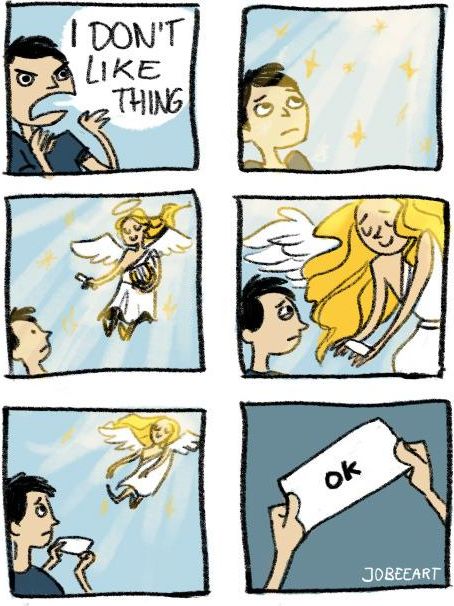
Image credit: https://wealldraw.tumblr.com/post/41441002018/do-you-ever-just
Without getting too badly sidetracked, I suppose I should mention that negative reviews are valuable in domains with a low barrier to entry. When navigating food stalls, they can make the difference between a really good burger and thirty exceedingly unpleasant minutes in a public restroom. But products that have to make their way through a variety of filters in order to reach their customers, such as books and movies, are practically guaranteed to meet a certain minimal standard.
Thus there is limited information left to extract, for the purposes of sorting them on a purely one-dimensional axis running from bad to good. Similarly to how the wave-like nature of photons limits what level of detail can be resolved with a microscope, the variation in taste between people limits the accuracy of one-size-fits-all reviewing. Matchmaking is the million dollar problem – that’s where all the alpha is, to borrow a term from the tech bros. Reviewing should help people pick those dishes on the menu that will appeal to their palate.
The problem with negative reviews is closely related to the Karenina Principle. Unfortunately, despite drawing its name from an excellent novel, this principle has become tainted by association with Malcolm Gladwell, whose writing is weapons-grade bait for any contrarian. I feel more comfortable borrowing from Aristotle’s formulation:
(...) it is possible to fail in many ways (...), while to succeed is possible only in one way (for which reason also one is easy and the other difficult – to miss the mark easy, to hit it difficult). Aristotle, Nicomachean Ethics, book 2
A single idiot can easily find hundreds of reasons to dislike any given product – a whole crowd of them can produce an endless stream of criticism, and like with the proverbial blind chicken, some of their complaints might even have a grain of truth to them. Nonetheless, the testimonies of @HarryXDraco2002 will give more valuable insight into the merits of a fanfic than those of a thousand detractors – not because @HarryXDraco2002 is a connoisseur of the fine arts, but because he is a representative of a disturbingly large demographic whose lack of taste is second only to their lack of shame.
You might think you want to know what that X between Harry and Draco signifies, but you don’t. Turn back. Walk away. There is still time. And like Orpheus – whatever you do, don’t look over your shoulder.
But as surely as a duck quacks, a contrarian will contradict, sparing no one – not even himself. I will have a little bit of negative reviewing, as a treat, in order to let you in on why – despite the unending stream of glowing recommendations – Adolescence is actually kind of dumb. Not like how you can buy a luxurious looking dress from Temu and end up with something that falls short, not just as haute couture, but even as a do-it-yourself Halloween costume. Adolescence has excellent production values. People who wear skinny jeans and obsess over acting and cinematography fawn over it. But behind the backdrops, as a piece of storytelling, it is paper thin and largely disappointing.

Image credit: https://www.youtube.com/watch?v=cc67Wufx30M
Okay, that was my hook out of the way.
Summary – here be spoilers
Adolescence is a British miniseries from 2025, telling a story in the aftermath of a homicide across four one-hour episodes. It’s not exactly a run-of-the-mill TV-show – for instance, each episode is presented as a continuous take without any cuts. But while the individual episodes are very focused on specific characters and events, this is not at all true for the series as a whole. There are large discontinuities between episodes, skipping chunks of time, changing the point of view and to some degree even the theme. The boy who functions as the main character of the show only appears on camera in two of the four episodes, which is definitely odd.
To give a very quick impression of the reception, a columnist from The Guardian describes it as the closest thing to TV perfection in decades, and the show’s Wikipedia page has a subsection titled Political impact. This is the sort of stuff that makes my inner contrarian fire on all cylinders. Adolescence can be fairly described as unique and compelling, maybe even groundbreaking. It is definitely well above average as far as TV-shows go – I don’t actually regret watching it, unlike everything on Netflix with the Harlan Coben brand on it.
However, Adolescence can also be fairly described as shallow and deeply flawed. I will briefly summarize the series, including my own “ratings”, episode by episode. It should be a decent refresher if you have already seen the show. And if you haven’t and aren’t allergic to spoilers, you will at least get some vague impressions of what it’s all about. I will not, however, pretend that every part of the review will make perfect sense without the full context of the TV show..
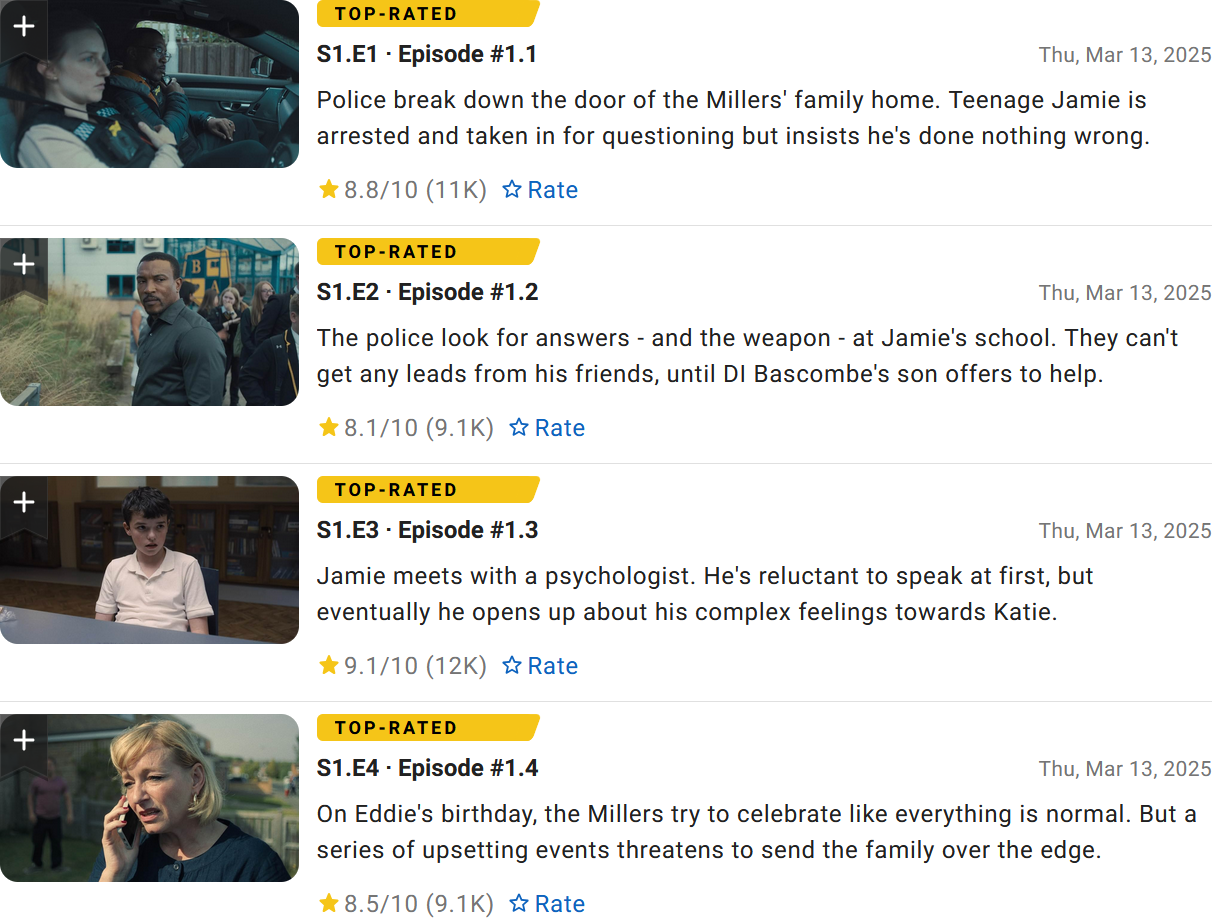
Image credit: Screenshot from imdb.com
Episode 1 – Arrest (4 out of 5 stars)
The first episode starts out with a quiet before the storm. Two police detectives are sitting in their patrol car, making conversation about their everyday lives before launching a dawn raid on a small residential home. The front door is battered down and police with guns and combat gear swarm the place, as if they are trying to get the jump on Pablo Escobar. Instead, they arrest a helpless and confused 13-year old boy, Jamie, in bed in his family home.
The episode proceeds in real time, giving ample time to dwell on all sorts of details that normally wouldn’t make the cut on TV – for a while, the show feels like it’s about the Kafkaesque process itself, a boy arrested without anyone willing to tell him why. The brutality of the initial raid seems almost comical and it is unpleasant to watch how the bureaucracy treats Jamie in the police station, not as much as a human being as something to be processed. All the professionals appear to be more concerned with avoiding anything that could resemble a procedural error than with explaining to the boy what is going on or what he is accused of.
After a number of uncomfortably long scenes, including fingerprinting (all ten fingers, one by one) and a strip search (penis inspection day becomes reality), we finally get to the police detectives interrogating Jamie in front of his father and his defense counsel. We still don’t know what crime is being investigated or how the boy might be connected to it, and the show has spent a fair bit of time on the attorney coaching the boy about his rights and what questions to answer. It is tempting to think of Jamie as the protagonist of the show and to assume that he is innocent – that the tension in the scene is that the police seem to have gotten the wrong idea and Jamie must avoid accidentally incriminating himself and being “railroaded”.
The interrogation proceeds in a rather adversarial fashion. It feels like the police detectives are on a bit of a power trip or as they dig into Jamie’s friendships, his social media and him having liked a variety of women’s modelling pictures, hoping to stumble over something they can use against him. But then everything suddenly takes a very strange turn, sort of pulling the rug out from under our feet – it turns out that what this is all about is that a girl from Jamie’s school has been found murdered, and the detectives play surveillance footage that they have been sitting on all along that shows Jamie literally stabbing her to death.
The boy starts crying, his father breaks down as well and the sixty-five minute continuous take has come to an end.
Episode 2 – Investigation (3 out of 5 stars)
The second episode follows the detectives from the previous episode as they investigate at the school of both Jamie and the murdered girl, wanting to get their hands on the weapon he used and to make some sense of what might have led up to a thirteen year old boy killing a schoolmate with a kitchen knife. The episode is a bit all over the place – among other things, it lingers on the general state of disorder at the school and the students’ lack of respect for their teachers and for the police, not to mention the memory of the girl who was brutally murdered just a few days ago.
The detectives follow two primary leads. First, the best friend of the victim, who is not merely rude but outright confrontational. She seems a lot more concerned with her own feelings than with helping the investigators and practically spoiling for a fight. Second, two of Jamie’s friends, who are just as unhelpful, but in a more evasive and less aggressive manner.
The detectives have been working on an assumption that the perpetrator and the victim were friends, based on contact between them on social media. The turning point of the school investigation comes when the son of one of the detectives, who attends the same school, gets so embarrassed by his father’s floundering that he decides to let him in on the secret “code” of the social media exchanges. What appears to be friendly messages is actually bullying – basically the girl shaming the boy as a sexually unattractive loser. The word incel is used, which feels like it’s brimming with fellow kids energy to me, but maybe that’s just me being out of the loop and the next generation is truly lost.
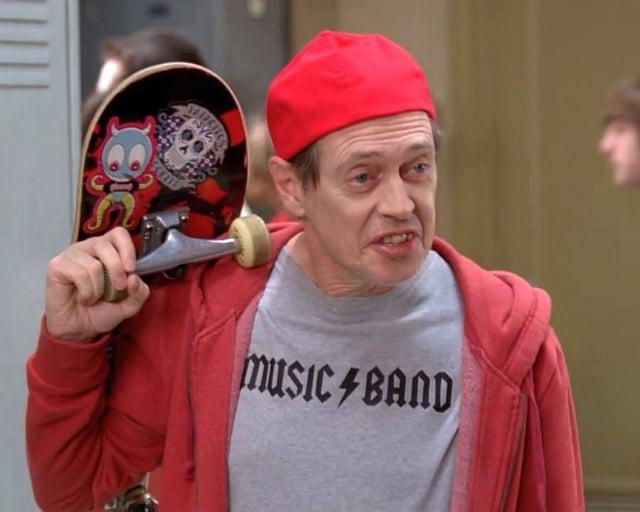
Image credit: Screenshot from 30 Rock.
During the one hour investigation, we are interrupted by a fire alarm set off by the students, during which the victim’s friend assaults one of the boy’s friends, as well as a not very convincing foot chase where a detective chases that very same friend down. The whole scene looks a lot like one person trying very hard to not catch up with the other. It turns out that the three boys in Jamie’s outcast group of friends have all been bullied, and that they borrowed him the knife hoping that he would confront her and put an end to the harassment – presumably not by stabbing her like fifteen times.
The episode ends with the investigator bonding with his son, taking him out to fish and chips, and the camera panning over to all the flowers at the memorial site for the murdered girl.
Episode 3 – Psych eval (5 out of 5 stars)
The third episode is by far the best one in the series, as is reflected by the IMDB ratings. Jamie is at a detention facility and a woman is interviewing him for a psychological evaluation to be used in the trial. Aside from some very minor breaks, where the psychologist gets drinks and talks a bit with a security guard, the entire episode is completely devoted to Jamie, the psychologist and their conversation, which develops a bit like a battle of wits. The psychologist is trying to break past the facade the boy presents and to understand his deeper emotions, while the boy is trying both to control the social situation and to stay composed to avoid hurting his own case in the upcoming trial.
Much of the conversation is filled with banalities – something Jamie remarks on himself – as the psychologist tries to feel Jamie out and avoid fake, rehearsed answers. They talk about family, about masculinity and about his feelings about women. In particular, we get to know that Jamie’s father tried to involve him in typical male-coded activities like football, which he had little talent for, leading both to the father being ashamed of Jamie and Jamie and feeling as a disappointment to his own father. We also get to see that Jamie thinks of himself as ugly and assumes girls will have no interest in him.
The best quality of the episode is the constant and subtle back and forths. It is well written and doesn’t feel like a screenwriter putting words in the mouths of some characters because that’s what we need to hear to move the plot along. You can feel the dynamics of the conversation – Jamie changing the topic when he gets bored or deflecting when he gets uncomfortable. It is clear that there are two people in the room and that they want completely different things from the conversation that they both work hard to get.
Jamie’s tragic flaw during the interview – his Achilles’ heel – is that he likes the psychologist a bit too much. Not just as an interesting person to talk to, but also as a sexually attractive young woman. This leads him to wanting to impress her, to assert himself, and he is repeatedly provoked to the point of losing his temper, revealing sides of his character that seem much more compatible with murdering a girl than his usual sensitive and quiet persona.
Somehow, the psychologist manages to get Jamie to reveal new details about the relationship between himself and the victim. We learn that part of how they got in touch was that topless photos of her were being circulated among the boys at school, after she had sent them to a date. Jamie figured that he might as well ask her out – while he considered himself too unattractive for any normal girls to take any interest in him, perhaps this girl, vulnerable after having been exposed to the whole school, might have no better options. This in turn led up to the bullying that was revealed in the second episode – apparently, the girl wasn’t quite that desperate and took Jamie’s advances as a personal insult. Considering his logic for approaching her, we can’t quite fault her.
In the climax of the episode, Jamie implicitly admits to the murder and emphasizes that, despite how he could easily have taken advantage of the girl during the confrontation that ended with him killing her, he didn’t, because he’s better than that. It seems that he hopes this will impress the psychologist, and that he wants to convince her that he isn’t the sort of creep or incel that he’s been made out to be.
The episode ends with the psychologist explaining that this is the final interview and that they will not meet again. This upsets Jamie, and in the middle of a tantrum he demands that she must tell him whether she likes him or not. After Jamie is taken away, the psychologist is shown sitting alone, all the unpleasant emotions she has hidden away throughout the interview washing over her.
Episode 4 – Harassment (2 out of 5 stars)
The final episode follows Jamie’s family – his father, mother and sister – at home while he is in custody and awaiting trial. It shows how they have been affected, both by having Jamie taken away from them as well by the local community harassing them, and how they try to come to terms with what their son has done. In the episode, they are trying to have something that approximates a normal day and to celebrate the father’s birthday, but they find that somebody has sprayed nonce on their van – a British slang term for a sexual offender. Despite their desperate insistence on acting like everything is normal, hoping that this will make everything normal, this illusion is impossible to maintain.
In real time, as always, we follow the family going through their day – Jamie’s father and mother reminiscing and trying to rekindle their romance or perhaps just trying to distract themselves from their current, desperate situation. The whole little family goes on a drive to a local mall to get paint, the father loses his composure and assaults some kids on suspicion of them having sprayed the slur on his van, before angrily pouring a whole bucket of paint over his van, making an awful mess out of it.
On their way back home, Jamie calls them, saying that he is thinking that he will plead guilty to the murder. Arriving home, the family finally gives up on their last plans of going out to celebrate the birthday, deciding instead to watch a movie at home and have some popcorn. The father and mother have a heartfelt conversation about how their son could have become a murderer, trying to understand what, if anything, they might have done wrong, but with little to show for it.
Continuous takes – gimmick or genius?
Adolescence’s hook, what helps it stand out in the ever more crowded world of television, is its use of continuous takes for each episode. While unusual, it’s not entirely original – as for all things on God’s green earth, Wikipedia has lists. Of the entries, I’m only familiar with 1917 (the World War I movie from 2019), which uses roughly the same gimmick to great effect. However, in 1917, this is an illusion, conjured by relatively long shots and clever editing, while what we see in Adolescence is supposedly the real deal. This is both impressive and baffling – baffling, because it seems much easier to get a more polished product by putting in less work if you cheat – and impressive, because they did not give in to that temptation.
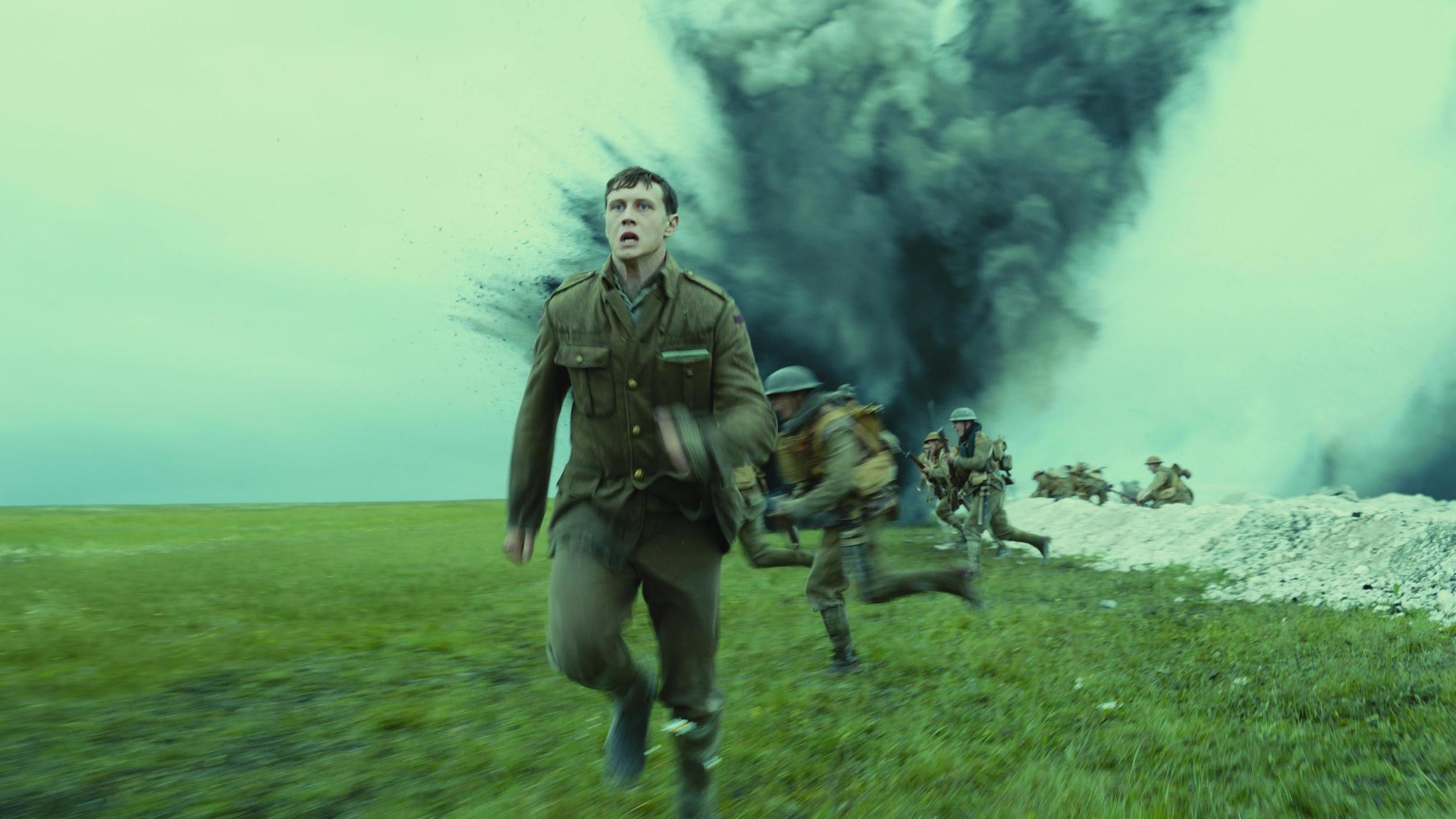
Image credit: Screenshot from 1917, Universal Pictures.
When someone tells me about the cinematographic qualities of a movie – about how it was shot on 35_mm_ analogue film or whatnot – I usually feel my eyes start to glaze over. But the use of continuous takes in Adolescence is not an insignificant technical quirk that can only be noticed by navel-gazing snobs. On every level, from the camera work in each individual scene to the overall structure of the story, the show has to respect the limitations imposed by never cutting.
It’s difficult to exaggerate how aggressively most shows and movies are edited, constantly jumping from overview shots to over-the-shoulder perspective to close-ups on faces to emphasize emotional reactions. There seems to be an almost religious fervor about not letting the camera linger and not letting scenes drag. Committing to continuous takes renders significant chunks of the standard moviemaking vocabulary “off-limits” for Adolescence, a bit like writing a novel without the letter e – though not as pointless.
The result is quite interesting, with a slower pace that is quite a breath of fresh air. It feels more like you’re part of events as they happen and less like you’re just watching a highlights reel after the fact. The experience of watching it almost makes me want to suggest that we’re all suffering from collective Stockholm syndrome from prolonged exposure to modern television – we’ve gotten so used to a constant barrage of cuts that we no longer notice how disorienting they are, that they rob us of a proper sense of space and time in the fictional universe. The continuous takes make Adolescence an unusually grounded experience and frequently takes it in interesting directions.
There are ways to skirt the rules when it comes to continuous takes. An obvious parallel is stage productions like theatre, where it’s impossible to do actual cuts, but you can still use a very standard scene-based structure by replacing the actors and props on stage as needed. Having a camera offers yet more freedom – pan from one room to the next, et voila, new set ready to go. Adolescence generally avoids workarounds like this, preferring to follow a single character’s viewpoint throughout each episode, though with a few exceptions inside of the police station in the first episode and numerous exceptions in the school in the second episode.
It is admirable that the creators mostly accept the constraints of the single shot format and choose to respect the rules instead of bending them. However counterintuitive it seems, necessity is the mother of all inventions – without limitations, what motivation do you have for getting off the beaten path? After the raid at the start of the first episode, Adolescence can’t just skip straight to the next critical event, like Jamie being coached by his defense counsel or the detectives interrogating him. Like it or not, the gaps in space and time must be bridged, and the resulting journeys are mostly worthwhile. We get to see the police separating Jamie from his father, we get to feel the awkwardness of the detective sitting in the back with him on the way to the station and we get to meet the staff who are more concerned with getting Jamie cornflakes for his breakfast than with explaining what exactly is happening and why.
Unfortunately, we also get a way too long fingerprinting scene and a ridiculous close up on Jamie’s father as the boy is strip searched during his arrest. There are definitely some misses mixed in with the hits. But overall, the continuous takes add more than they take away, particularly during the first and third episodes which are the definite highlights of the show.
AB-stories – the only thing worse than X is no X
Certain tricks are so useful that they cannot help but become victims of their own popularity. From the world of games we have player progression, originally in the form of RPG characters gaining experience points that unlock new gameplay elements. But game designers quickly caught on to how useful this trick is for making players feel invested and rewarded, coming back to satisfy their craving for more level up dopamine. So now you’ll find these RPG-like elements shoehorned into games regardless of whether they are a good fit, from free-to-play mobile games to Civilization 7. Somewhere along the way, the RPG mechanics lost their heroic fantasy lustre and started feeling more like busywork and office drudgery.
Image credit: https://knowyourmeme.com/memes/its-all-so-tiresome
Similarly, a storytelling technique sometimes called AB-stories has colonized television writing to the point where it’s no longer even a trick. Like nitrogen, it’s just part of the air we breathe, always there yet difficult to notice. In its purest form, the idea is just to have a main and a supporting story – the A and B stories, respectively – developing in parallel, normally with entirely different characters and no clear connection between them. The show will jump back and forth between these two storylines, and a competent storyteller will show them to be subtly converging, giving a vague sense that they are on a collision course. It’s underwhelming if the AB-stories turn out to be two independent storylines that each just do their own thing – ideally, the two stories fusing should be how everything resolves, the A and B stories providing the missing pieces to each other’s puzzles.
There are many reasons why AB-stories are so useful. The first one is that the scenes for the supporting storyline break up the main story. This might seem very odd – isn’t that a bad thing? Again from the world of games, we have Sid Meier’s quote about how it’s much better to have one good game than to have two great games – the idea being that two conjoined games distract from each other and compete for attention. Why doesn’t it work the same way with a TV show?
One of the main benefits of jumping back and forth between the two storylines is that it affords the writers more leeway. If you cut from one scene of Batman doing this to another scene of Batman doing that, the viewer cannot help but try to understand what happened in between. Having the previous scene fresh in memory invites scrutiny, an expectation of logic and continuity, that just doesn’t apply when the show cuts between entirely different storylines. The extra leeway provided by the AB structure can be extremely convenient – if nothing else, the reduced need for connective tissue makes room for more red, juicy meat – but it can also easily be abused by writers who realize that they can get away with telling stories that are mostly a grabbag of cool scenes that don’t actually make sense as a whole.
Another big benefit is that the B story can develop what is going to become the twist or the turning point for the main story. You can think of this as a sort of foreshadowing hiding in plain sight – since the connection between the A and B stories is not yet revealed to the audience, and since the A story is out of sight and out of mind during the B story scenes, there is much less need to perfectly model the viewer’s ability to follow your breadcrumbs. You can just throw things out there, without worrying about finding the perfect compromise between too obvious and too obtuse. And when the two parallel stories finally merge, there is the immense satisfaction of seeing the two halves finally click in place like how South-America fits into Africa. It helps you pull off plot twists that feel profound, rather than the disappointment of one that just blindsides you – the ill-reputed deus ex machina.
You can find a similar structure in Scott Alexander’s writing – frequently, he develops his essays as a first section that ends without really landing anywhere, instead jumping into a second section without even attempting to connect them. Gradually, with each subsequent section, a somewhat dim idea of an overarching theme forms, setting us up for the grand finale that is the last section, drawing on all the previously introduced elements and bringing them together into a single focal point, reaching a conclusion that is only really possible because of all the groundwork laid by the first few seemingly unrelated sections.
So how does this all relate to Adolescence? Obviously, the AB-story structure doesn’t make any sense without cutting. But as delighted as I was previously when praising the creativity and the freshness that continuous takes bring to the individual scenes and to the transitions between them, it pains me to say that I can’t say the same about Adolescence as a greater whole. It is not an AB-story, but it is also not a simple, linear story. It somehow manages to combine the worst of both worlds, spreading its attention thin over half a dozen different characters and side stories with little to show for it. Instead of weaving these together towards some satisfying climax, each episode seems to build up towards something that it fails to properly resolve, before the next episode veers off in a new, unexpected and unsatisfying direction.
The third episode is once again the exception, getting up-close and personal with what feels like the show’s actual premise: Could a 13-year-old boy really have stabbed a girl from his school to death? But there is so much meandering, too many side stories that are neither really relevant to the main story nor really interesting on their own – for instance the whole digression of the police detective father bonding with his son – and far too little depth to give a satisfying answer to whether a young, scrawny looking boy in early puberty could also be a cold-hearted murderer.
Defective stories and where to find them
After the unprecedented fall from grace of Game of Thrones in its final season, it became topical to ask if it is possible for a catastrophic final season to retroactively make the rest of the show bad, even though it used to be good. Like with a scissor statement, there are two answers that are both obviously correct, but also mutually exclusive. Even the worst possible ending to a story cannot travel back through time and undo the hours you have spent enjoying it, ignorant of the disappointment to follow. At the same time, it is quite difficult to fault someone for saying that his whole marriage leaves a bit of a sour taste in his mouth, after discovering that Ying Yue wasn’t really a naive exchange student, but rather a Chinese intelligence operative.

Image credit: https://x.com/Andr3jH/status/1862218915142639947/photo/1
Does the disappointing ending mean that no part of Game of Thrones is worth watching? Is it possible that the show would have been in some sense better, if it had just been dropped after the first six seasons and left unfinished? I think the right way of approaching this question is like with the philosophical problem of a tree falling in a forest. All the confusion stems from disagreement over how to interpret the word sound – if it is the physical waves that travel through the air, then of course the falling tree makes sound regardless of who’s present. But if it is the qualia of a brain processing that wave after it has been picked up by an eardrum and transformed into neural impulses, then obviously not.
Similarly, you can judge a TV show using two radically different frameworks. Borrowing terminology from Daniel Kahneman (I will restrain myself from going on a contrarian tirade here), we can talk about the experiencing self, which craves moment to moment satisfaction, and the remembering self, which asks with the benefit of hindsight whether something was worthwhile. The contrast between these two frameworks is the most stark when it comes to addictive behaviors, where indulging the addiction seems like the only possibility in the moment, but absurd and shameful in retrospect. Many such cases!
Despite occasionally feeling tempted, it is now twenty years since I first watched Death Note, the anime par excellence, and I still don’t know what happens past the 25th episode. I was once told that the final arc of the show is not nearly as good and makes for a much less satisfying conclusion, and why would I risk becoming conflicted about the show when I can instead feel reverent? It is perhaps not a coincidence that adaptations such as the Hollywood live action movie (an absolute travesty) and the Death Note musical (the crossover we didn’t know we needed) also pretend that Near and Mello don’t exist.
There is no particular reason that a TV show must appeal either to the experiencing or the remembering self. There are great works that work on both levels, please both the selves, but there is definitely a bit of tension between them. While it feels a bit rude to say it out loud, Lost is the poster child for what happens when short-term gratification gets emphasized, at the cost of long-term sustainability. The show got so caught up with throwing out intriguing hooks that it entirely forgot about grounding them in a coherent, fictional world.
Image credit: https://i.kym-cdn.com/entries/icons/original/000/040/653/goldblum-quote.jpeg
This is not just bad writing. Don’t get me wrong, it is bad writing, but more importantly, it’s Moloch personified. All communication depends on cooperation – we listen to someone, trusting that they are trying to tell us things that are some combination of true, useful and interesting, and we make aggressive use of that assumption when interpreting their mouth noises. There is a meta-joke called Nate the Snake, and I’m going to spoil it right here and now so that nobody wastes their time reading it. It’s got a word count in excess of ten thousand words, about a hundred times that of your run of the mill knock-knock joke, and the only payoff at the end of it all is an intentionally underwhelming pun – better Nate than lever. But Nate the Snake isn’t a joke – it’s a meta-joke, and the real punchline is at the reader’s expense, who was gullible enough to listen to all that nonsense, trusting that it was actually going somewhere.
Lost does something similar. It abuses your trust that the writers have an explanation for all the mysteries they are dangling in front of your nose. As each new layer of inexplicable complication gets piled on, the viewer’s sunk cost fallacy triggers and convinces him that since things now make even less sense than before, the inevitable resolution will be even more mind-blowingly awesome. Good luck with that, kiddo.
Image credit: https://www.cbr.com/lost-memes/
So what about Adolescence? It doesn’t suffer from the same strain of disease as Game of Thrones, with its poorly written, whiplash-inducing final act, or as Lost, where every mystery that gets peeled off reveals a deeper, less scrutable mystery. Adolescence’s pathology is a lack of meaning. Despite feeling compelling from moment to moment, what happens on screen keeps falling just a bit short of adding up to a coherent and meaningful story. Remembering self is not amused!
Episode 1 – Arrest (4 out of 5 stars)
Take the first episode. In the beginning, it seems to be about how a young, innocent boy is mistreated by the police, with particular emphasis on how nobody is willing to tell him why he’s been arrested. This interpretation seems reasonable when you’re watching for the first time, because we don’t know yet that Jamie has murdered a girl. With the benefit of hindsight, however, this understanding of the events doesn’t work any more. What we actually saw was a boy who’s committed a heinous crime suffering a bit of harshness and proceduralism from the bureaucracy, and this truth seriously undermines the police brutality angle, making it less man bites dog (Drake yes) and more dog bites man (Drake no).
Later in the same episode, the focus seems to be on Jamie being coached by his lawyer, suggesting it is crucial that he avoids saying something stupid or incriminating himself. The interrogation scene starts out as a bit of verbal judo between the detectives and Jamie, and we are led to believe that how Jamie answers all the questions about his friends and social media will decide whether he goes free or if he instead gets tangled up in a very serious investigation. But for the resolution of the episode, where the detectives play surveillance footage of Jamie stabbing the deceased girl, all of this is completely irrelevant. Jamie knew all along that he had murdered a girl, in a manner that he couldn’t possibly expect to get away with. And the police knew all along that they had the incriminating footage they needed to get him. It’s as if we were sold tickets to the World Cup finals, excited to see who is going to win, but when we show up it turns out that we’re just getting the awards ceremony. And remember the part about how AB-stories are great for foreshadowing, to make twists seem as if they don’t come out of nowhere? Yeah, this is the exact sort of storytelling pitfall that you’re hoping to avoid.
Episode 2 – Investigation (3 out of 5 stars)
I don’t want to belabor every little nitpick, but there is unfortunately a recurring pattern in the show of things happening that seem quite interesting, but they either don’t really matter or they don’t really make sense. The second episode is all about investigating at Jamie’s school, wanting to uncover Jamie’s motive (fair enough, important stuff) and to find the murder weapon (strong MacGuffin vibes for this one). Because we want the episode to make sense, we start to hope that there’s been a misunderstanding, that maybe there’s more to the case than meets the eye. Hope springs eternal, as they say.
Throughout the entire episode, both Jamie’s friends and the friend of his victim act dodgy, which again lends itself to the whole more than meets the eye interpretation. They are evasive, somewhere on the spectrum between uncooperative and actively hostile, and seem to have no interest in helping with the investigation. The purpose of this seems to be to inject some artificial tension into the episode. Unfortunately, there is nothing meaningful about this, in a narrative sense – it is sort-of explained by the victim’s friend being frustrated and angry about her own loss and Jamie’s friends trying to cover up their own very marginal involvement in encouraging Jamie to confront the girl, but it’s not a very satisfying explanation. Police investigations and homicides are serious business.
The only meaningful contribution the second episode makes to the main storyline is to reveal that there’s been some bullying going on at the school, particularly between the murdered girl and Jamie and his friend group. Some terms like incel get mentioned, which I assume is not meant to be taken entirely literally, but more as a vague gesture towards sexual entitlement and frustration. We get practically no detail, unfortunately. It’s not show and not even tell, just mention in passing and move on, relying on our imaginations to fill in the rest. The whole episode is in some sense about why Jamie murdered the girl, but at the end, it’s difficult to claim that we’ve made much progress towards an answer.
Episode 3 – Psych eval (5 out of 5 stars)
This episode is great, so my critical review won’t take much interest in it. It speaks directly to the central theme of the show and the tension that carries the episode is actually meaningful: What in Jamie’s psyche explains the murder? What was his relationship to the girl and what created the conflict between them? Will he admit to the murder? Will he be considered to have understood what he was doing at the trial?
If the whole series was as strong as this episode, the series would have deserved all its accolades and I would have had no choice but to write a glowing review – and, being an irredeemable contrarian, I would of course rather have written nothing at all. It even works perfectly as a single, continuous take. While the long conversation certainly has some lows to go with its highs, showing us every second of it is the right decision. The only complaint I could make about the episode is that it really seems to set us up for a great finish, but if the third episode is the quarterback, the fourth episode is the wide receiver who’s run off in the wrong direction and completely fumbles the ball.
Episode 4 – Harassment (2 out of 5 stars)
Like Game of Thrones without its final season, Adolescence would have been a much better TV show without this final episode. The third episode could have worked as the finale. It engages with the right themes and puts some crucial puzzle pieces into place. It’s not wholly satisfying, because wanting us to accept that this timid-looking thirteen year old boy is also sexually frustrated with a hair-trigger temper and psychopathic and narcissistic tendencies is a bit of a big ask. But it would have been good enough – certainly much better than this final episode we get subjected to.
The whole episode is devoted to looking at Jamie’s family and how they deal with having Jamie taken away, as well as their own guilt and relentless harassment from their local community. It’s not objectively bad TV, though much of the episode is boring, watching characters we don’t care much about dig themselves deeper into their holes for no good reason. The biggest problem is that it abandons the compelling premise of the show in favor of the day to day life of Jamie’s family, which is hard to really care all that much about. This could have been a brave choice, if it managed to circle back, bringing the original premise to a satisfying conclusion. It could have been defensible, if this digression was at least an interesting story in its own right.
Instead, it is a total belly flop. Nothing interesting happens, let alone surprising. We learn nothing meaningful about Jamie or about the case – except for a brief phone call where Jamie says that he thinks he’s going to plead guilty. Instead of trying to understand this change of heart, we instead get long, drawn out scenes establishing the obvious – that being the immediate family of a child-murderer is not great and makes it rather difficult to hold it together and act like everything is normal.
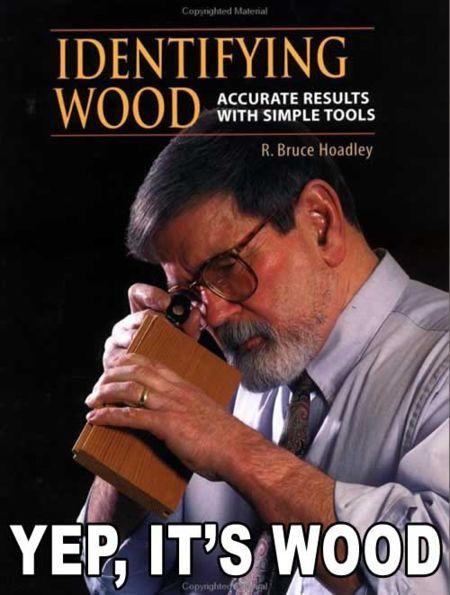
Image credit: https://www.finewoodworking.com/2012/02/07/yep-its-wood
The final straw, adding insult to injury, is Jamie’s parents asking if they did something wrong as they, like the viewer, try to make sense of how their son ended up murdering a girl. If you’re still hoping for a satisfying ending here, you’re like the guy who leafs through the dictionary, trying to look up the word gullible. The whole miniseries is in its final minutes, about to try to answer the central question it’s been supposed to grapple with for four hours (in fairness, it has mostly been procrastinating). Why did Jamie become a murderer? And its conclusion basically amounts to:
I dunno lol. ¯\_(ツ)_/¯
The anatomy of a story
Who is to say that a story has to have a conclusion? That it has to be meaningful? Why does a story even need a theme? Why not go full obscurantism and take a maximalist definition of stories? Every possible sequence of letters is a story. Probably won’t convince your six year old at bedtime, but don’t let that stop you.
Part of what made the Harry Potter books successful is the strong themes. Voldemort is the main antagonist of the series – he killed Harry’s parents, leaving the orphaned boy growing up with abusive relatives. He who must not be named himself and his various henchmen cause all sorts of trouble for Harry throughout his years at Hogwarts. So it is no coincidence that the series is wrapped up with Voldemort being defeated, and it is no coincidence that bravery, camaraderie and love are integral to Harry’s triumph.
It is also no coincidence that there is a bit of a weird coda, showing Harry and his friends decades after the main story, seeing their own kids off to Hogwarts. Because the story is not just about the struggle against Voldemort. It is just as much, or perhaps more so, about Harry and his friends growing up and taking their place in the adult world. So this final scene, even if it feels a bit hamfisted, does important work to properly conclude the entire story. Harry’s victory was not without sacrifices. Will he and his friends ever be able to move past the trauma they have suffered? Can Hogwarts recover from everything that has ravaged its campus, its staff and its reputation?
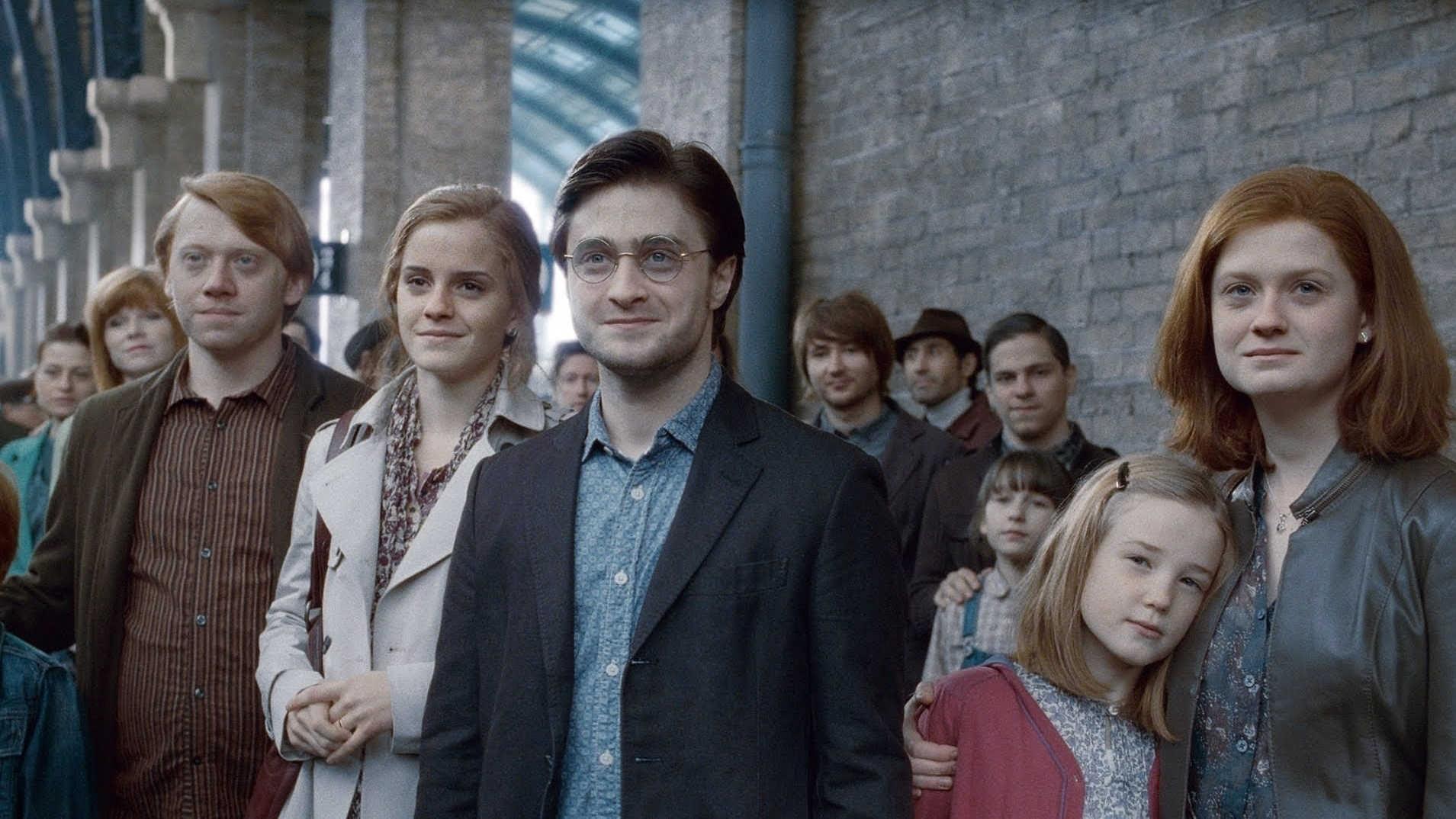
Image credit: screenshot from final scenes of Harry Potter and The Deathly Hallows pt. 2.
Yes. Commence warm fuzzies.
What about Adolescence? It’s not a sprawling epic like Harry Potter, and it’s not like every story has to have full blown OCD about tying everything neatly up with a bow. But could we at least have – something? At the end of it all, what I seem to be able to piece together is that Jamie suffers from a rather unusual combination of crippling self-esteem issues, sexual entitlement and violent temper. We get no real understanding of the dynamics between Jamie and his victim leading up to the murder – the social media bullying is mentioned at some point, but we don’t get to see any part of it and can’t get any feel for whether it was really that bad or if it was Jamie’s misplaced pride that drove him into murderous rage. The mini-twist towards the end, when Jamie suggests he’s going to plead guilty, undermines the picture the third episode paints of him as a sinister and remorseless psychopath – the show has a really unfortunate habit of cheapening its best moments in this way.
All the side stories about his lawyer, about the friends at school, the detective and his son, about the mother and sister – all of them seem rather pointless, failing both to carry their own weight and to add anything substantial to construction as a whole. A rather low bar for a good story is that it should come to a natural conclusion. It’s a really bad sign if you can watch the final episode and find yourself confused about wondering whether that was really the end, or maybe there’s another episode coming out next week. This is a bar that Adolescence doesn’t really clear.
The next point I want to make might seem excessively pedantic, but we’re so many pages worth of pedantry deep that I’m not sure what harm it can do. Why in the world is the show called Adolescence? Is that really what’s supposed to be its theme?
It is indeed about a boy in his early teens and his struggle with some fairly normal, adolescent insecurities, but Jamie himself is just too aberrant to allow the story to be about adolescence and not just about himself. I suspect, from some of the analyses I have seen of the show, that some people accept Jamie as an example of a relatively normal boy who has been warped by all the toxic masculinity in the water supply as well as “manosphere” influences. But if this is the point the show is trying to make – a tall mountain to climb, for sure – it doesn’t put in nearly enough work to substantiate it. Jamie’s behavior as shown in the third episode, particularly where he describes what a good boy he is for not having sexually abused the girl that he murdered, is profoundly “fucked up” on a much more fundamental level than what can be explained by just namedropping Andrew Tate.
Adolescence, the TV show, is about adolescence in about the same sense as Fight Club is about fighting or Harry Potter is about magic. Actually, the entire show is much more about parenthood, and it would have made for a much better story if it had accepted and embraced that. If only the name wasn’t already taken.
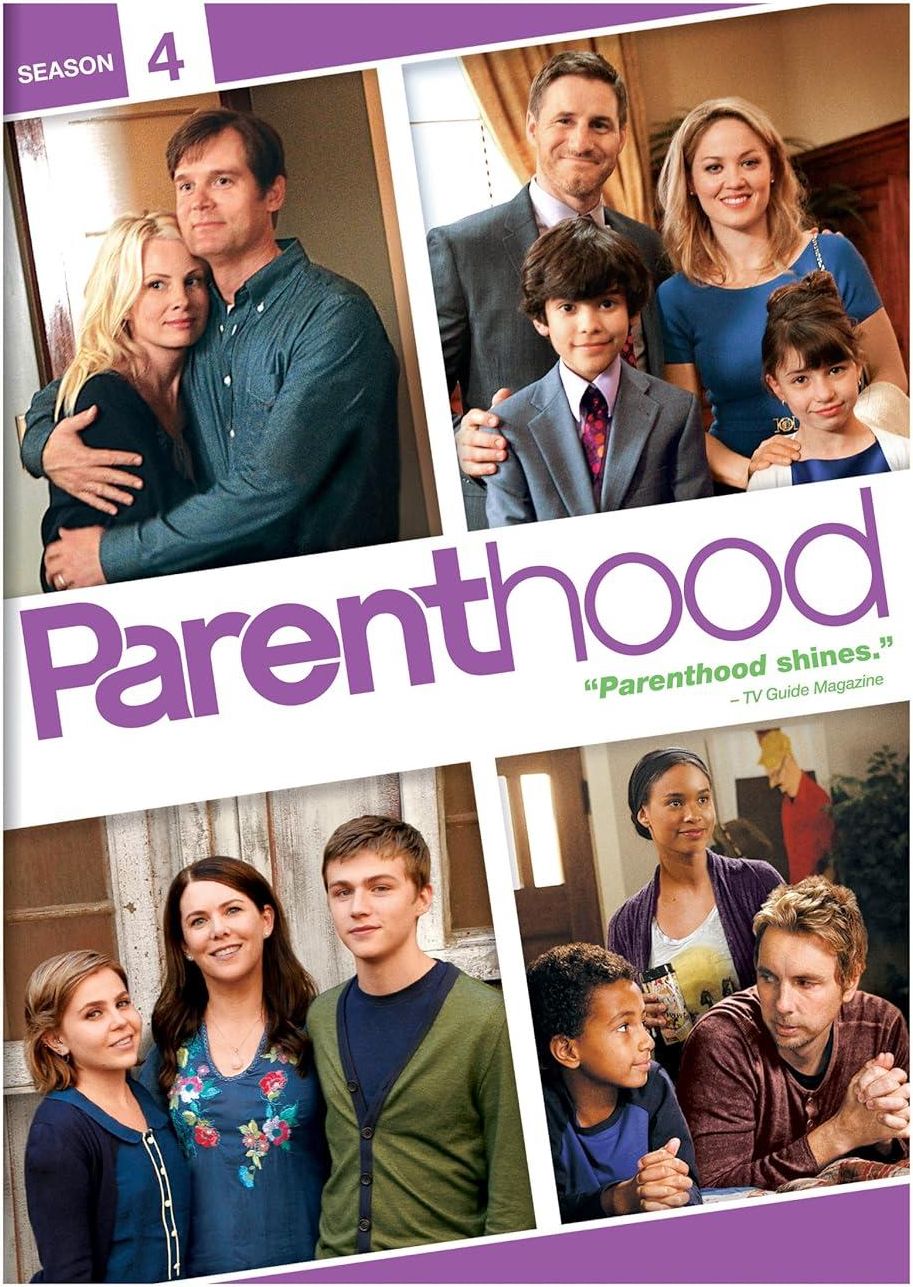
Image credit: DVD cover for 4th season of Parenthood.
The first episode works a lot better taking the point of view of Jamie’s father – we can identify with his humanity and he is in the same situation as the viewer, confused about why his son is arrested, upset with the way the police treat him and aghast to see the CCTV footage of his son murdering a girl. Even the second and third episodes can work quite well in this framing – the second episode would need to focus more on his father failing to notice and help out with his son’s difficulties; the third episode already delves a fair bit into the father-son relationship and its perhaps formative role in Jamie’s self-esteem issues. And finally, the fourth episode serves as a decent conclusion from the father’s perspective, showing his world collapsing on itself and his helpless frustration at realizing that despite all his efforts to do better than his own father, lightning struck and his son grew up to be a murderer.
Centered on Jamie, the whole psychopath explanation feels like a cop-out. It’s not that it’s unrealistic, really. Some people are just bad seeds for reasons we can not understand, perhaps for no reason at all. But it’s a kind of realism that really doesn’t make for satisfying stories. Surely there must have been some hostage situation that was resolved not by an elite SWAT team or by a charismatic negotiator or by a heroic captive, but by the terrorist just randomly having a heart attack. And even if it hasn’t actually happened, surely it could have. But using a random heart attack like that to resolve the main conflict of a story would be trolling on the highest level, exceeding even that of the previously mentioned Nate the Snake.
I can’t help but wonder to what extent Adolescence’s flaws owe to the limitations imposed by continuous takes. It’s easy to hate on flashbacks. They are lame, they are lazy, crutches that poor writers lean on for lack of any genuine talent. They even feel a bit patronizing, as if we’re incapable of connecting events without having them juxtaposed for us. But I would happily take flashbacks over the absence of cause of effect than plagues Adolescence. Continuous takes are stylish and all, but they are nowhere near cool enough to justify pivotal events happening entirely off-screen, leaving the story without critical, load-bearing elements. How does Jamie come to the realization that he should plead guilty? Is it an expression of remorse? Is it just an understanding that his case is hopeless and he stands more to gain from it? Who knows. Maybe the writers, but the whole point of telling a story is to divulge these things to the viewers.
Is it somehow impossible to tell a good story using continuous takes? I doubt it. 1917 works more than fine_. Memento_ doesn’t just manage to tell a story in reverse chronological order, but it’s fantastic.
It’s perhaps worth taking note of how, in both of these movies, the presentation of the story is not just a cute gimmick that’s been tacked on. For 1917, it transports us closer to the war and lets us experience it in a more visceral way, as if from the point of view of one soldier. In Memento, it confuses us and forces us to try to piece together an understanding of what might be going on based on insufficient information, which I realize sounds like an awful experience, but it beautifully mirrors the main character’s similar difficulties due to suffering from anterograde amnesia – basically an inability to form memories.
For Adolescence, I am almost tempted to guess that they started out wanting to do continuous takes, and then tried to stretch a story to that format even if it didn’t quite fit. The problem with this interpretation is that the single shot style actually works quite well in the first episode, and for the third episode it feels like a perfect match. Ultimately, where Adolescence falls short is the connective tissue – the different episodes, the various storylines, setup and payoff, cause and effect – it just doesn’t add up to a coherent whole.
So maybe it’s the same sort of thing that tends to happen when an amateur tries to write poetry in a very constrained form. Just conforming to the formal requirements of rhyme and metre can be so demanding that it’s easy to forget that a poem is supposed to do more than just check off certain technical requirements – ideally, it’s supposed to be meaningful and evocative, with artistic qualities beyond those of a sudoku solve..
But let’s close out on a somewhat positive note. A resounding yes to experiments in form. Adolescence is only rarely boring, and for all its flaws, it’s worth watching unless your time is very precious. Many will be inspired by its success and attempt to imitate it, and I hope they will achieve a decent baby to bathwater ratio. But a similarly resounding no to form over function, form divorced from function, and form without function.
And if it makes your life easier just stitch some cuts together. Maybe it will even save you some time to spend on getting your story straight. Remembering self will appreciate it, and you really don’t want to get on that guy’s bad side. He really knows how to hold a grudge.