Inside is a comedy special that was written, shot, and edited by musical comedian Bo Burnham while he was stuck in quarantine during the 2020 pandemic--that’s the basic premise, anyway. He doesn’t just tell jokes or sing funny songs to the camera: he makes it a full-on production, with professional-grade lighting, camera work, and editing, putting it structurally somewhere between a traditional comedy special and a feature film. That alone makes it unique, but if Inside was just well-framed jokes and music, I wouldn’t be writing about it. I’m writing about it because it’s also full of social commentary, meta-commentary, existential crises, and questions of identity, authenticity, and spectacle that are all reflective of modern times. If future civilizations were curious what we’ve grappled with as the first generation with ubiquitous social networks and smartphones (or as the last generation before AGI), I would want it to be at the top of their watchlist. To me, pound for pound, Inside is one of the most vivid portraits of the challenges of the social media era ever created, and I hope to explain in this review how Bo Burnham paints such a portrait. To start off, let’s look at how he ended up as the man for the job--in a classic case of preparation meeting opportunity.
Preparation: Bo Fo’ Sho’
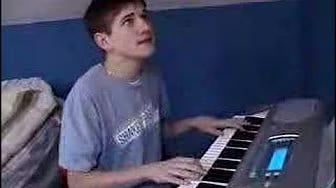
Back in 2006, when social media is still young and promising, Bo Burnham is a teenager who spends his time singing funny songs and raps and uploading them to this cool new website called YouTube. His songs are dense with puns and quick witted humor, mixing highbrow references to math and literature with lowbrow sex and race jokes. A couple of them go viral (rare at the time), and while offensive by today’s standards (common at the time), the folks at Comedy Central think that Burnham’s material is great for a live comedy set on their Presents series. They’re right about the material, but Burnham’s dense comedic style—perfect as it is for internet virality, where you could pause, scrub to certain lines, or replay to your heart’s content—actually overwhelms the aughts-era live audience. The rapid pace of the jokes make them fly too high and fast over the crowd; you can hear them miss a lot of the mid-verse one-liners and laugh the most at the slower, simpler punchlines. This is the first glimpse we see into Burnham’s unique position as one of the first born-and-raised netizen entertainers, with a cadence closer to internet superstimuli from the 2020s than the network TV of the 2000s--kinda like a zoomer Marty McFly.
Burnham keeps accelerating, putting out albums on CD and uploading professional-quality music videos of his songs. He gets his first full-length comedy special, called Words, Words, Words, but still receives criticism for having an internet background and not taking a traditional path. Burnham appears on a comedian round-table talk show in 2011, shortly after the special airs, and he explains, “people said I didn’t get enough criticism because I wasn’t in the clubs, grinding it out. But the truth is, for the older comics that say that, I want them to read ten thousand internet comments and see if they don’t feel fully criticized.” The other comedians in the group, all older and established, are fascinated by Burnham’s favorite comedian being a Dutch absurdist named Hans Teeuwen who does comedy with sock puppets. “Really, the only rules of stand-up comedy are that you have to stand up on stage and be funny, and there seem to be all these invisible rules that people put up,” Burnham says. Words Words Words includes not just jokes and songs like before, but visual gags, raps, and poetry bits as well.
Burnham’s individual, self-made path into live comedy didn’t just grant him freedom from traditional structure or formulas, but it also gave him the freedom to express his contempt for the industry he now found himself in. One particular song stands out in the special, called “Art Is Dead”. Burnham introduces it by saying “This song isn’t funny at all, but it helps me sleep at night,” and the video description says “this song is a confession and an apology. honest, not sarcastic.” In it, he paints a picture of successful entertainers as immature and greedy for attention, whose big egos are rewarded with undeserving boatloads of money from honest working-class people. To him it all feels manipulative, and feels guilty for being hypocritically complicit in it (and the comedians at the roundtable enjoy it enough that they ask him to perform it for them).
That disgusted, half-outside perspective grows to become a central aspect of Burnham’s material moving forward. A few years later, Burnham returns with a live special called what. that airs for free on YouTube, and it's a dramatic uptick in quality. For this special he takes control of the whole format of stage performance and plays with it, constantly interacting with voiceovers of himself and prerecorded bits, and “performing” pre-composed songs with carefully timed movements and choreography. His style is unabashedly postmodern, constantly setting up some trope or situation and then immediately subverting it or throwing it away, and then showing the audience “look, this was all a setup, nothing is real”. The subversions are both funny in themselves (humor comes from the unexpected), but also clearly hold that core sentiment of inauthenticity in performance that first pushed him to make “Art Is Dead”. In an interview around this time, Burnham says about his fans “I try to emphasize, ‘I am nothing but my content to you’”. Burnham doesn't just reserve this sentiment for himself, either; he also points it toward other types of entertainers who profit from maintaining the parasocial kayfabe. He lambasts vapid pop singers for preying on vulnerable teens, and calls out other comedians for using tragedy as joke fodder. In a similar vein, he also criticizes pointless and harmful religious morals by singing from God's perspective and correcting them--very en vogue at a time when /r/atheism was still on reddit’s homepage.The general attitude is “Nothing up here is authentic, but at least I have the decency to tell you—not like these other people who want to take advantage of your emotions by acting genuine.”
His third special, Make Happy (now graduated from YouTube to Netflix), has the same DNA as what—the same voiceover-interactions, planned subversions, and even the same critiques of vapid art (in this case, dishonest, pandering country music and faux-inspirational pop lyrics). But by this point it seems like his attitude has taken a toll on him, as he generally comes off as more bitter towards the audience, and uncertain of his function as a performer—literally singing “I don't know why I'm here” in the beginning of the show. This comes to a head in the show’s final song, where he addresses the audience directly. “My biggest problem is you. Part of me loves you, part of me hates you, part of me needs you, part of me fears you.” Bo’s relationship with his audience is a tense balancing act, like that of any artist or creator, and in a final Pagliacci moment he admits that he isn’t getting back the joy that he’s giving them. What’s the point of being entertaining at all if he can't even make himself happy? Is there anything he can do that will satisfy him, or will he always feel stuck between a predatory entertainment industry and an audience that never authentically knows him? Why is he here?
It seems like he doesn’t have a good answer--he ends up having severe panic attacks while on stage, and decides after Make Happy to stop performing live comedy altogether.
Opportunity: Welcome to the Internet
Bo Burnham’s trajectory is unique, but his starting point was not--he was just one of the early ones. In 2006, when social media was still young and promising, anyone with an Internet connection could hypothetically step onto the same massive stage. You, the 2006 Time Person of the Year, could share anything you wanted with an audience of more people than you would ever get in real life, and they with you. You could engage with their posts, or they with yours, with little hearts or thumbs-ups or comments. This engagement became the metric by which the social media platforms grew users and revenue--more engagement meant more usage and more exposure to ads--so they updated their functionality over time to obtain more and more of it from users. Thus “the Algorithm” was born, with this core drive of maximizing your engagement, curating your feeds with only the content that you find the most engaging. The UI was updated, too: no more links or numbered pages to flip through, just one never-ending scroll of embedded media, minimizing the muscle movements required to see the next thing. Over the years, social media has become less interpersonal and more spectacular, in this attention-maximizing pursuit--It isn’t even really ‘social’ media anymore.
“They're coming for every second of your life. It's not because anyone is bad, or anyone has evil plans, or even that they're doing it consciously. It's because these companies--Twitter, YouTube, Instagram and everything--they went public. They went to the shareholders. So they have to grow, their entire models are based off of growth. They cannot stay stagnant. Twitter grossed $4-5 billion last year, and it is in the red, it is unprofitable. It has to get more of you. [...] Every single free moment you have is a moment you could be looking at your phone, and they could be gathering information to target ads at you. That's what's happening.”
- Bo Burnham, in a 2018 interview for his movie Eighth Grade
Targeted ads may be the main incentive for the social media engagement machine to keep turning, but they aren’t what’s left such an impact on society. It is the resulting secondary effects, downstream of these attention engines racing to the bottom, that have reshaped human interaction and behavior on such a massive scale.
The Algorithm has grown into a ravenous force, which has imparted its maligned incentives on both the vast majority of consumers and the vocal minority of producers on every major platform. For consumers, it offers an endless ocean of entertaining posts, but the depth of each one is merely a droplet--100 pictures that make you instantly laugh, aww, or facepalm will get 100x the engagement of 1 nuanced piece of writing or art in the same amount of time, after all. The result is an overwhelm of vapidity, giving you only a few seconds to react with your gut before moving on, atrophying the sense of any higher judgement, critical thinking, or situational context--this is how the Algorithm sucks your brain out through your eyes. And for producers, the opportunity for social riches, perhaps even virality, is tantalizing, but requires reducing your expression into the simplest black-and-white terms in order to meet these fast-food quality standards. Your full self would take too long to digest, so the Algorithm only takes the thin veneer you give it. Besides, your potential outreach is so large that this is the way that most people will know about you, so do you even need the rest?
This is the place from which Bo Burnham has been launching his criticisms for years. He bemoans the society of the spectacle he is in which finds significance in the mere images, the mere simulacra of a full human experience--the mere stage performance. At first, it was just himself and his fellow stage entertainers and the like. But it has grown to be much bigger than him, even bigger than the entertainment industry at large. Social media has brought this performative behavior into the everyday lives and interactions of billions of people, mediated entirely by the engagement-hungry algorithm monster.
And then in 2020, that monster became the only game in town.
It’s a Beautiful Day to Stay Inside
Inside was written, directed, shot, and edited entirely by Bo Burnham himself, filmed in one room of his house during the pandemic. Naturally, it’s a totally different format from a live stage performance—as we've already seen, Bo isn't afraid to play with format and medium, and the single-room constraint breeds quite a lot of creativity in production design. He uses disco balls, phone lights, laser projectors, and more to light and color the room uniquely for each song and skit, and has cameras recording from several angles.
And right in the opening song, Burnham starts off well aware that Inside itself will be just another drop in the bottomless trough of media to consume. ‘Content’, the song’s name, is apt for when the depth or quality of the thing isn't as important as the attention and engagement it draws, a natural consequence of competition in an infinitely vast landscape of spectacle and stimulus. An oft-repeated adage goes, “content is an advertising term for the stuff that goes between the ads.” Another consequence, multi-screening, treats the media as merely passive or atmospheric, just noise to fill the room, and is commonplace enough that it's affecting how streaming giants like Netflix are making their shows. (At the beginning of Inside's second act, Bo asks, “Am I on in the background? Are you on your phone?”)
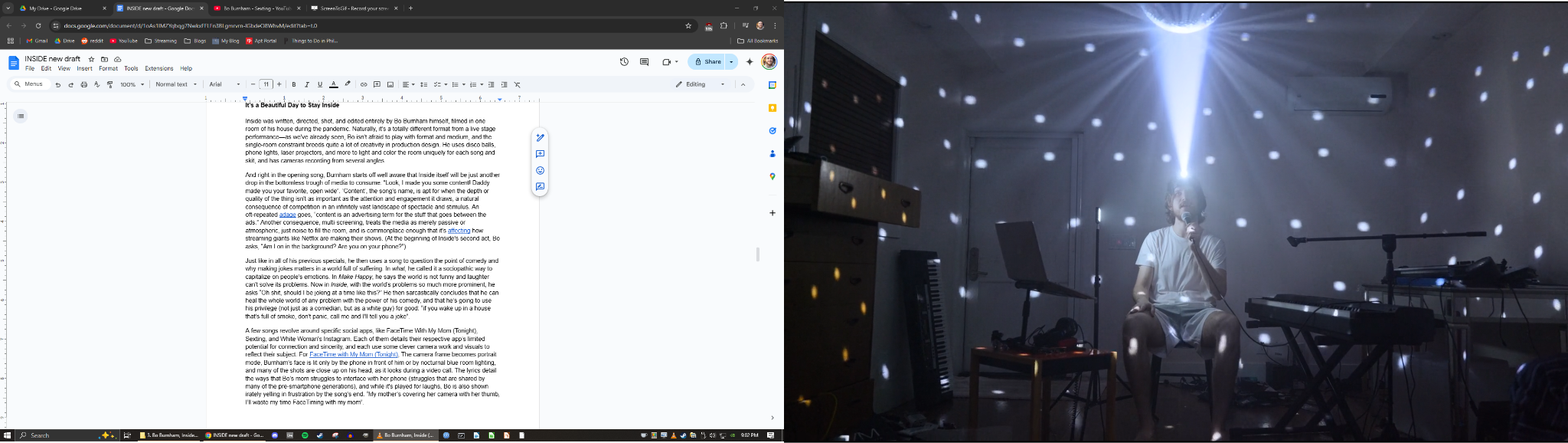
“Look, I made you some content! Daddy made you your favorite, open wide”.
A few songs revolve around specific social apps, like FaceTime With My Mom (Tonight), Sexting, and White Woman's Instagram. Each of them use some clever camera work and visuals to reflect their subject, and each one details its respective app’s limited potential for connection and sincerity. For FaceTime with My Mom (Tonight), The camera frame becomes portrait mode, Burnham’s face is lit only by the phone in front of him or by nocturnal blue room lighting, and many of the shots are close-up on his head, as it looks during a video call. The lyrics detail the ways that Bo’s mom struggles to interface with her phone (struggles that are shared by many of the pre-smartphone generations), and while it's played for laughs, Bo is also shown irately yelling in frustration by the song's end.
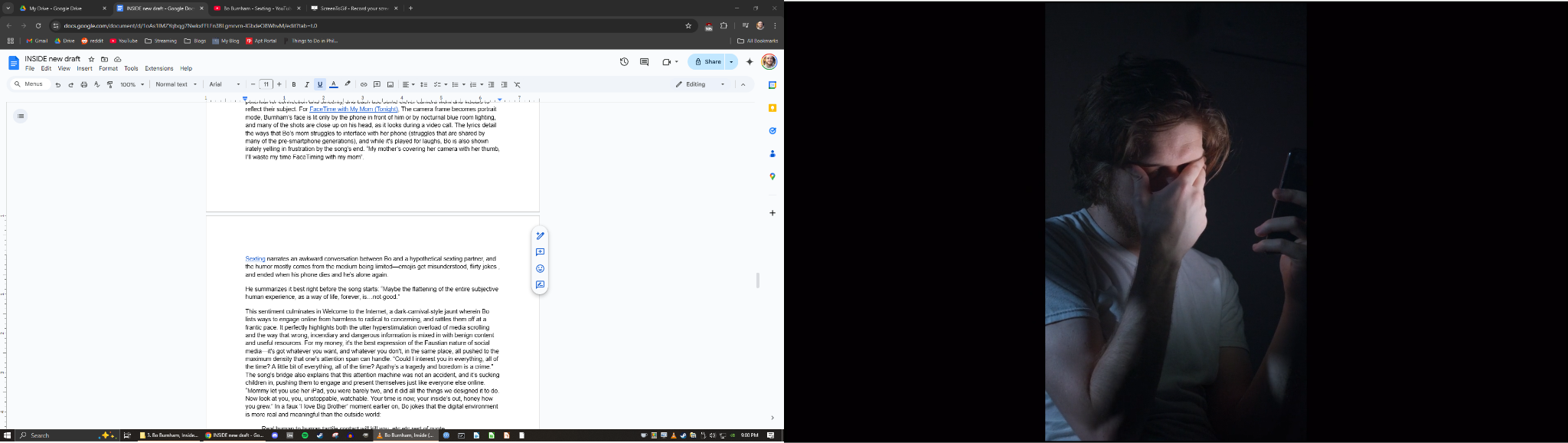
“My mother’s covering her camera with her thumb, I’ll waste my time FaceTiming with my mom”.
Sexting narrates an awkward conversation between Bo and a hypothetical sexting partner, and the humor mostly comes from the medium being limited—emojis get misunderstood, flirty jokes don’t quite land, and the conversation ends abruptly when his phone dies and he’s alone again. Emojis and chat windows are projected onto the wall and onto himself, literally reducing his actual figure to the background and putting the texts center stage.
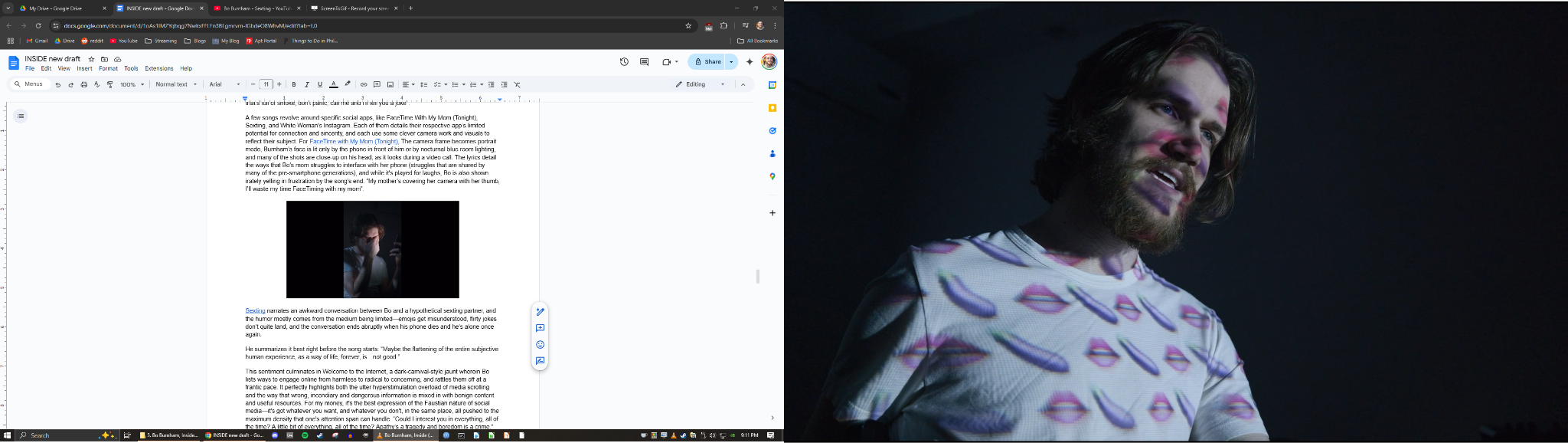
“It isn’t sex, it’s the next best thing.”
White Woman's Instagram rattles off a list of simple pleasures and kitschy items that one might find on Insta--especially an Insta pushed by the Algorithm to be simple and amusing. Burnham visually complements this with his own series of filtered, artfully composed vignettes, cropped to the square Instagram frame. Juxtaposed with the rest of the special, it carries an air of “ignorance is bliss”; no reasons to be sad, just poems in the sand, latte foam art, and fuzzy socks. None of the vignettes carry any serious depth, and each can be understood in the few seconds that you’re given to hear or see them; the tempo reflective of a typical scrolling session.
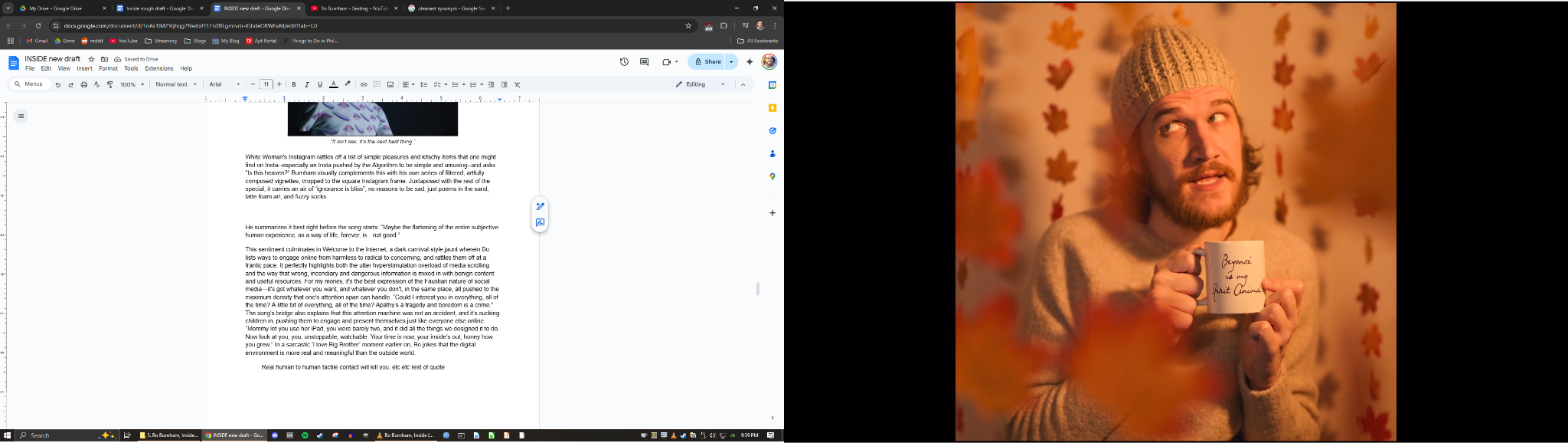
“Is this heaven? Or am I looking at a white woman’s Instagram?”
But something changes in the song’s bridge. We stay with one scene for longer than a few seconds, and see it from two camera angles. The camera frame widens back out to full screen. Burnham sings about a photo of the titular woman’s mom, passed away a decade ago, and a grieving letter put in the caption. And in no time after it’s ended, the third verse returns us to a new slew of quick, composed shots and one-line descriptions. This is a crucial moment in the song, in the whole special, that shows both the beauty and tragedy of the experiential distillation that social media elicits from its users. The beauty is that, though the pictures are shallow, they still come from a full, living, breathing human, trying to just focus on and share some positivity with people online. The tragedy is, because the pictures are shallow, it’s very easy for those on the other side of the screen to forget that, and be taken by surprise when an earnest, heartfelt post enters the feed.
The camera frame doesn’t even hold at full screen before immediately being squished back down to the Instagram square for the remainder of the song. The earnest bridge slowed things down momentarily, but the content engine will not be halted so easily, and anything that would slow it down gets reduced and thrust along. In a brief scene between bits, Burnham directly pans the vapidity depicted by these songs, suggesting that “maybe the flattening of the entire subjective human experience into a lifeless exchange of value [...] maybe that, as a way of life, forever…maybe that’s, um, not good.”
This flattening enables the content engines to churn onward, faster and faster, to the point of overwhelming hyperstimulation from all directions. Burnham asks an absent audience, when pretending to do live stand-up: “Is it necessary that every single person on this planet expresses every single opinion that they have on every single thing that occurs, all at the same time? Is that necessary? Or to ask it a slightly different way, can anyone shut the fuck up?”
The end result of this is depicted in the song Welcome to the Internet, a culminating moment of the special (and Burnham’s entire career, really). Burnham plays an upbeat, minor-key polka on the keys, evoking a sort of dark carnival, and he sings in a deep voice as the Algorithm itself, personified as the sinister ringleader behind it all. The lyrics outline the bargain: “Just nod or shake your head and we’ll do the rest,” “We’ve got a million different ways to engage”. He lists things you can do online, but they whiplash between useful, silly, or fun, and harmful, dangerous, or gruesome, at a disorienting, frantic pace. At its fastest, the camera angles begin to switch quickly and zoom in on Burnham’s face, giving a sense of being surrounded everywhere you look by the swirl of content closing in on you.
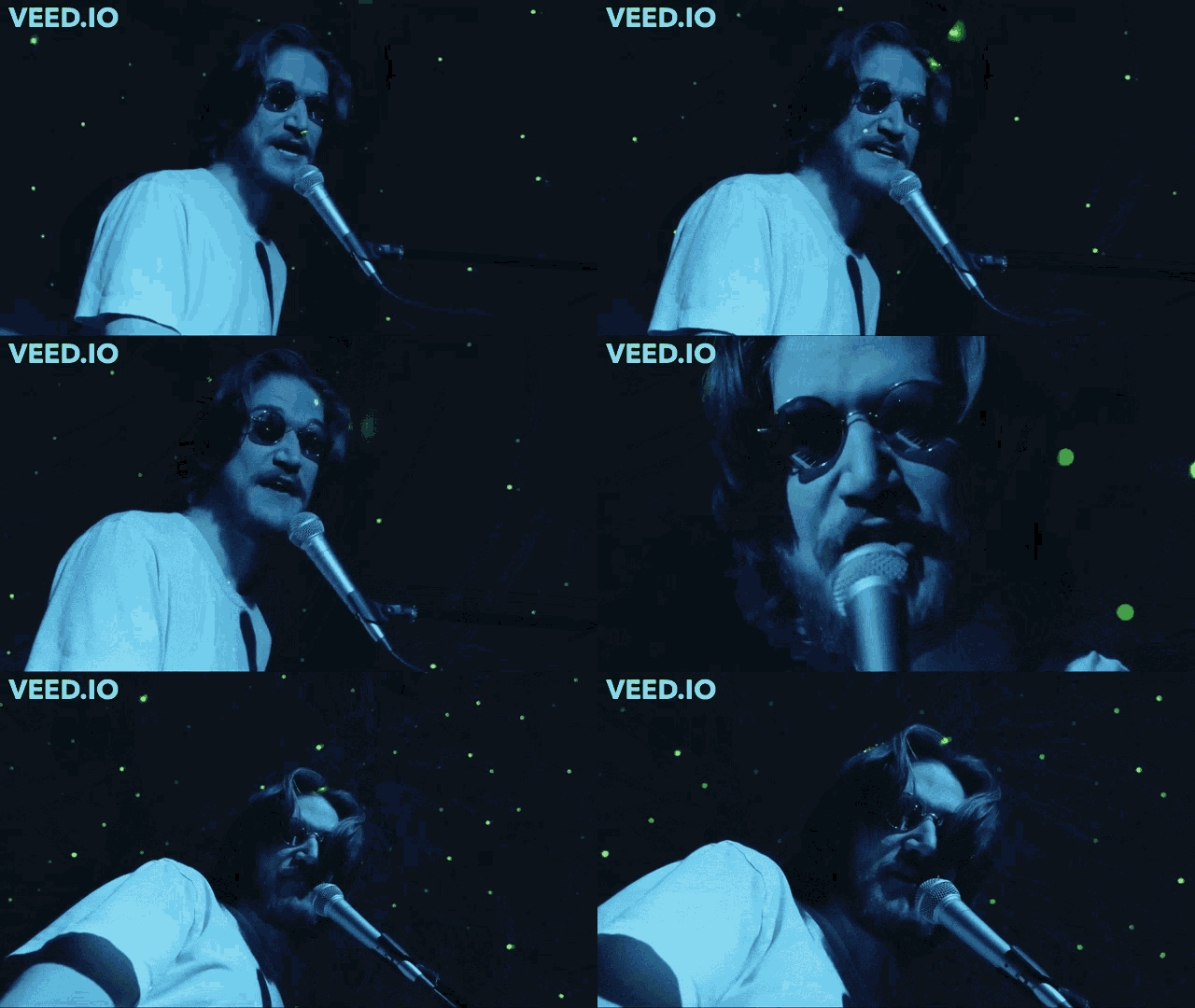
“Here’s a healthy breakfast option you should kill your mom, here’s why women never fuck you here’s how you can build a bomb.”
The Faustian nature of social media is laid bare by the chorus, one of Inside’s key passages: “Could I interest you in everything all of the time? A little bit of everything, all of the time? Apathy’s a tragedy and boredom is a crime.” The Algorithm’s feeds have got whatever you could possibly want, but also whatever you don’t, in the same place, pushed to the maximum density that one’s attention span can handle, and then some. Being disinterested isn’t just frowned upon, it’s completely unacceptable--and this is baked in at the software level, intentionally. The bridge of the song expands on this: “We set our sights and spent our nights waiting…for you! You, insatiable you! Mommy let you use her iPad, you were barely two, and it did all the things we designed it to do. Now look at you! Unstoppable, watchable. Your time is now, your inside’s out, honey how you grew!” In the first verse, “welcome to the internet” felt like a greeting, but now it’s an initiation--’Welcome to the internet, you are part of it now.’
When the hyperstimulating feeds become omnipresent--as they were for many during the pandemic--they become a kind of hyperreality, more real and important than the actual waking world. While pretending to do live stand-up alone, shirtless with disheveled hair, he admits that he’s succumbed to the same mindset:
“I’ve learned something over this last year, which is pretty funny. I’ve learned that real-world human-to-human tactile contact will kill you, and that all human interaction--whether it be social, political, spiritual, sexual, or interpersonal, should be contained in the much more safe, much more real, interior digital space. That the outside world, the non-digital world, is merely a theatrical space in which one stages and records content for the much more real, much more vital, digital space. One should only engage with the outside world as one engages with a coal mine: suit up, gather what is needed, and return to the surface.”
Burnham noticed this same mindset in young people even before the pandemic, too. In that same interview linked earlier, Burnham explains:
“Kids are walking through this, like, meta-virtual reality world. It’s not that they think the world in their phone is real, it’s that they think the real world is virtual: that this is just a thing to be seen, and everything I’m doing is actually a performance that can be captured and looked back on at any moments. And I’m not living moments, I’m planning moments to look back on them. It’s very very strange.”
The following song, That Funny Feeling, shows by example this high contrast between the outside-unreality and the inside-hyperreality of modern digital-dominant culture. It’s a stripped-back acoustic tune, where Burnham plays guitar in the light of a fake campfire, in front of a projected image of trees--a simulated ‘outside’. His lyrics are a listed smorgasbord of things that evoke this contrast, and similar to his older work, that includes several examples of insincerity in the outside world, like the pandering rainbow capitalism that spiked around 2020. But instead of simply criticizing it, he’s now showing how it contributes to this overall loss of a sense of reality, in tandem with the misalignments of digital life.
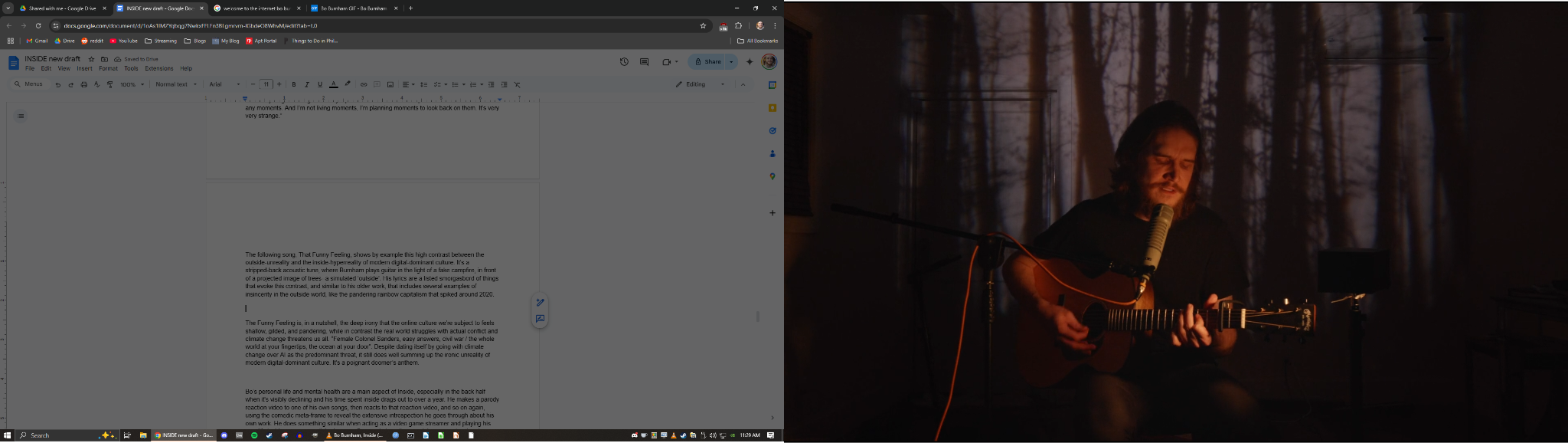
“Stunning 8K resolution meditation app. In honor of the revolution, it’s half off at The Gap.”
For Burnham, it feels like there is no way to escape That Funny Feeling except through impending doom--in his case, climate change and rising oceans--but ends the song by framing this as a relief. “Hey, what can you say, we were overdue. But it’ll be over soon, just wait,” he sings with a smile.
Robert’s Been a Little Depressed
As one might expect from someone feeling this way, Burnham's mental health starts off precarious at the beginning of the special, and only slides downward from there. Burnham's entertainer-guilt that first appeared back in Art Is Dead has returned, and just like in all of his previous specials, he takes the song Comedy to question the point of comedy and whether making jokes even matters in a world full of suffering. In what, he called it a sociopathic way to capitalize on people's emotions. In Make Happy, he says the world is not funny and laughter can't solve its problems. Now in Inside, with the world’s problems so much more prominent and political wokeness at the forefront, this questioning now includes plenty of guilt for being rich, white, and privileged. He asks “Oh shit, should I be joking at a time like this?” but then sarcastically concludes that he can heal the whole world of any problem with the power of his comedy, and that he’s going to use his privilege (not just as a comedian, but as a white guy) for good: “if you wake up in a house that's full of smoke, don't panic, call me and I'll tell you a joke”.
The white guilt and cynicism don't end there. In his faux-children’s song How the World Works, he sings about the wonders of nature and how “everything works together”, but then pulls out a sock puppet named Socko to explain that the world is actually built with “blood, genocide, and exploitation”. When asking the sock puppet how he can help the situation, saying that he wants to become a better person, Socko retorts “Why do you rich fucking white people insist on seeing every sociopolitical conflict through the myopic lens of your own self-actualization? This isn't about you!” Burnham responds to this by threatening to take the sock off--placing himself in the position of the oppressor to Socko’s voice of dissent--after which it is forced to obey, leading into a final chorus of “That's how the world works.”
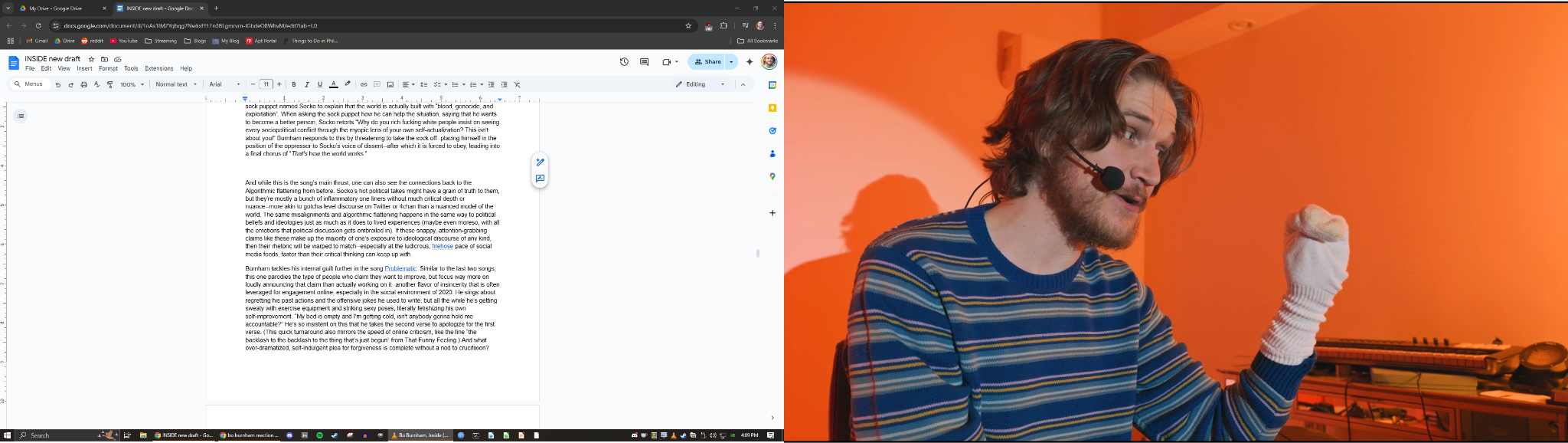
“I hope you learned your lesson.” “I did, and it hurt!” “That’s how…” “...it works.”
And while this is the song’s main thrust, one can also see the connections back to the Algorithmic flattening from before. Socko’s hot political takes might have a grain of truth to them, but they're mostly a bunch of inflammatory one-liners without much critical depth or nuance--more akin to gotcha-level discourse on Twitter or 4chan than a nuanced model of the world. The same misalignments and algorithmic flattening happens in the same way to political beliefs and ideologies just as much as it does to lived experiences (maybe even moreso, with all the emotions that political discussion gets embroiled in). If these snappy, attention-grabbing claims like these make up the majority of one's exposure to ideological discourse of any kind, then their rhetoric will be warped to match--especially at the ludicrous, firehose pace of social media feeds, faster than their critical thinking can keep up with.
Burnham tackles his internal guilt further in the song Problematic. Similar to the last two songs, this one parodies the type of people who claim they want to improve, but focus way more on loudly announcing that claim than actually working on it--another flavor of insincerity that is often leveraged for engagement online, especially in the social environment of 2020. He sings about regretting his past actions and the offensive jokes he used to write, but all the while he’s getting sweaty with exercise equipment and striking sexy poses, literally fetishizing his own self-improvement. “My bed is empty and I'm getting cold, isn't anybody gonna hold me accountable?” He’s so insistent on this that he takes the second verse to apologize for the first verse. (This quick turnaround also mirrors the speed of online criticism, like the line “the backlash to the backlash to the thing that’s just begun” from That Funny Feeling.) And what over-dramatized, self-indulgent plea for forgiveness is complete without a nod to crucifixion?
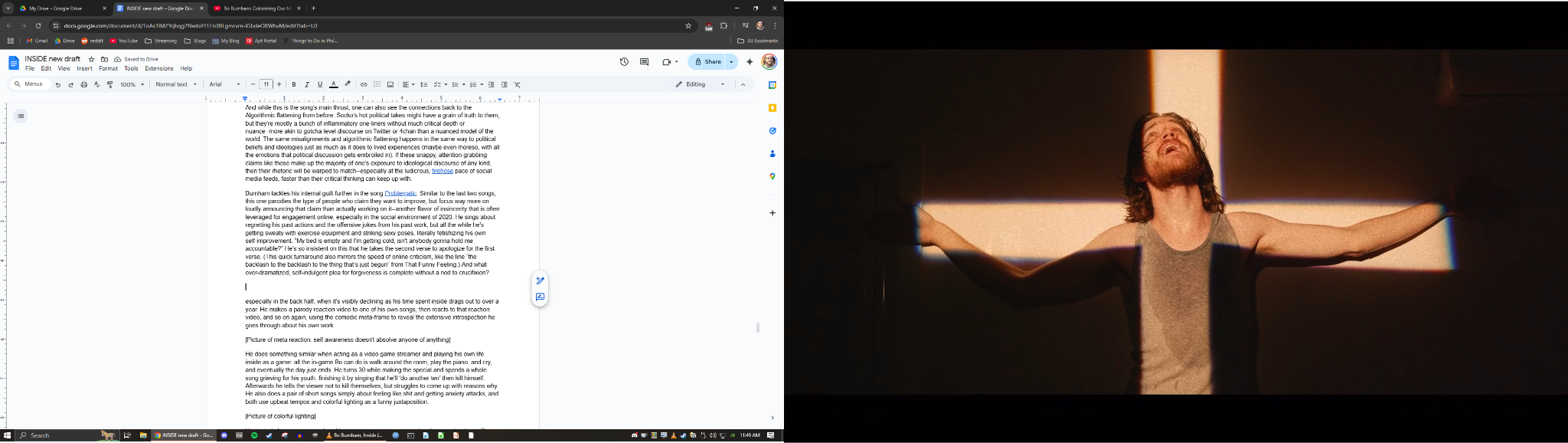
“And I’m really fucking sorryyyyyyyy…”
Before Problematic starts, though, there is a brief scene of Burnham watching his old videos with a vague look of shame on his face--so while it’s mostly a satire, it also has within it a sincere apology for his past work.
Bo Burnham’s mental health continues to decline as his time spent inside drags out to over a year. He makes a parody reaction video to one of his own songs, then reacts to that reaction video, and so on again, using the comedic meta-frame to reveal the extensive introspection he goes through about himself and his work.
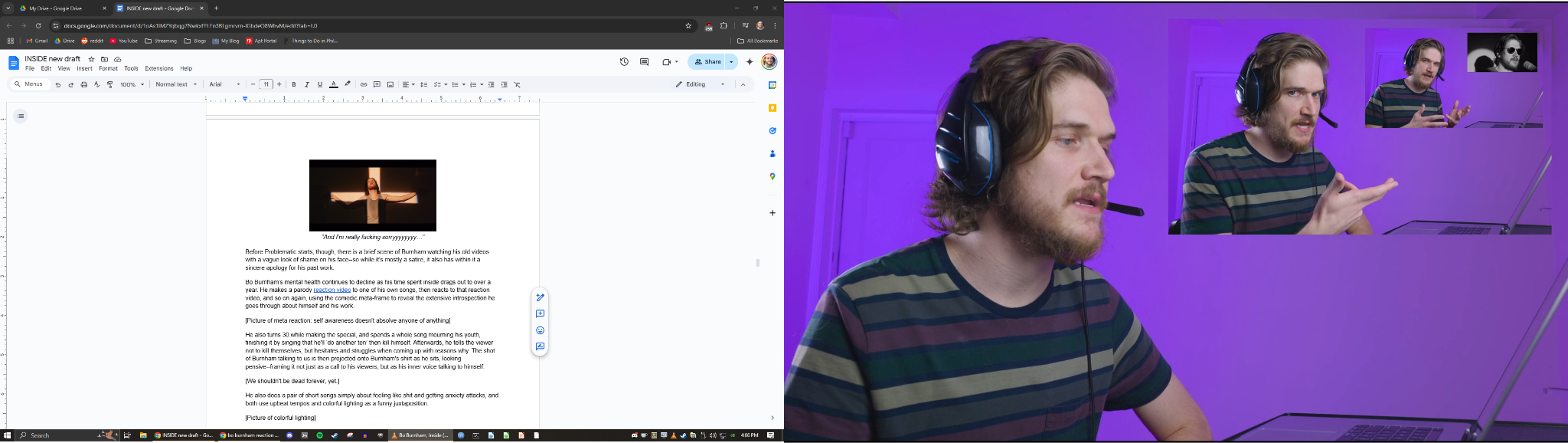
“Self awareness does not absolve anybody of anything.”
He also turns 30 while making the special, and spends a whole song mourning his youth, finishing it by singing that he'll ‘do another ten’ then kill himself. Afterwards, he tells the viewer not to kill themselves, but hesitates and struggles when coming up with reasons why. The shot of Burnham talking to us is then projected onto Burnham's shirt as he sits, looking pensive--framing it not just as a call to his viewers, but as his inner voice calling to himself.
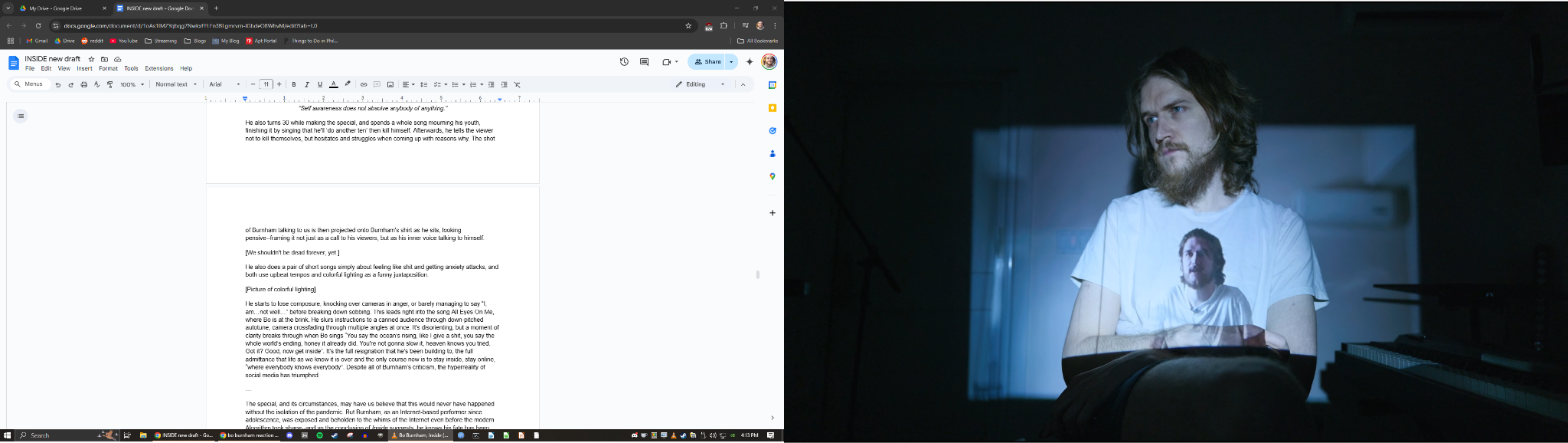
“Alas, when you kill yourself, you’re dead forever. And we shouldn’t be dead forever, yet. So let’s not, right?”
He also does a pair of short songs simply about feeling like shit and getting panic attacks, and both use upbeat tempos and colorful lighting for both of them as a funny juxtaposition.
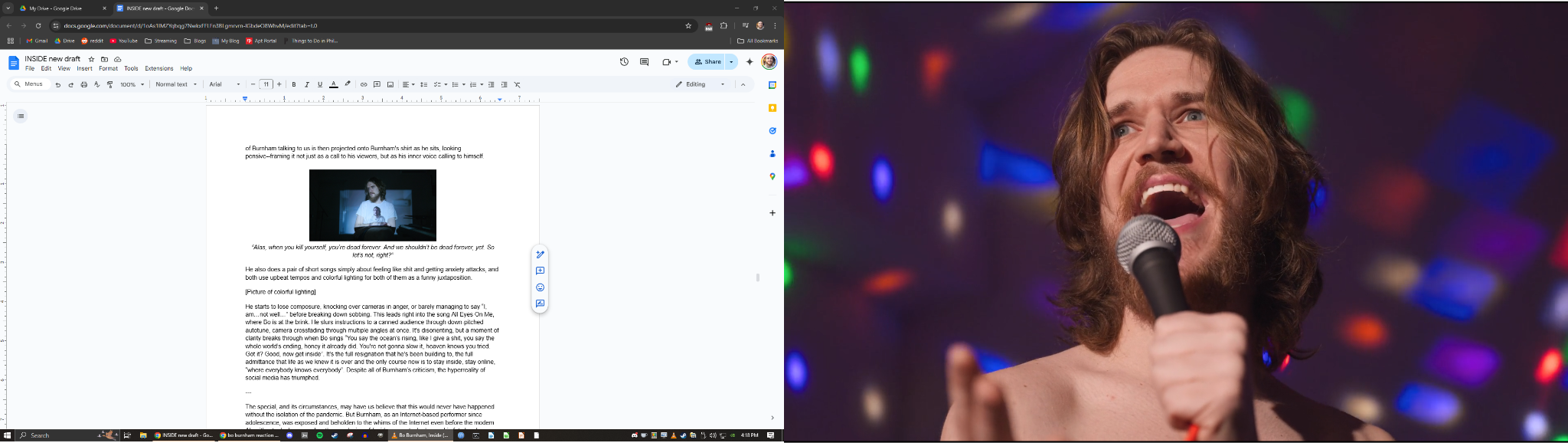
“My vision starts to flatten, my heart it gets to tappin, and I think I’m gonna die!”
He starts to lose composure, knocking over cameras in anger, or barely managing to say “I, am…not well…” before breaking down sobbing. This leads right into the song All Eyes On Me, where Bo is at the brink. He slurs instructions to a canned audience through down-pitched autotune, camera crossfading through multiple angles at once. It's disorienting, but a moment of clarity breaks through when Bo sings “You say the ocean’s rising, like I give a shit, you say the whole world’s ending, honey it already did. You're not gonna slow it, heaven knows you tried. Got it? Good, now get inside”. It's the full resignation that he's been building to, the full admittance that life as we knew it is over and the only course now is to stay inside, stay online, “where everybody knows everybody”. Despite all of Burnham’s criticism, the hyperreality of social media has triumphed.
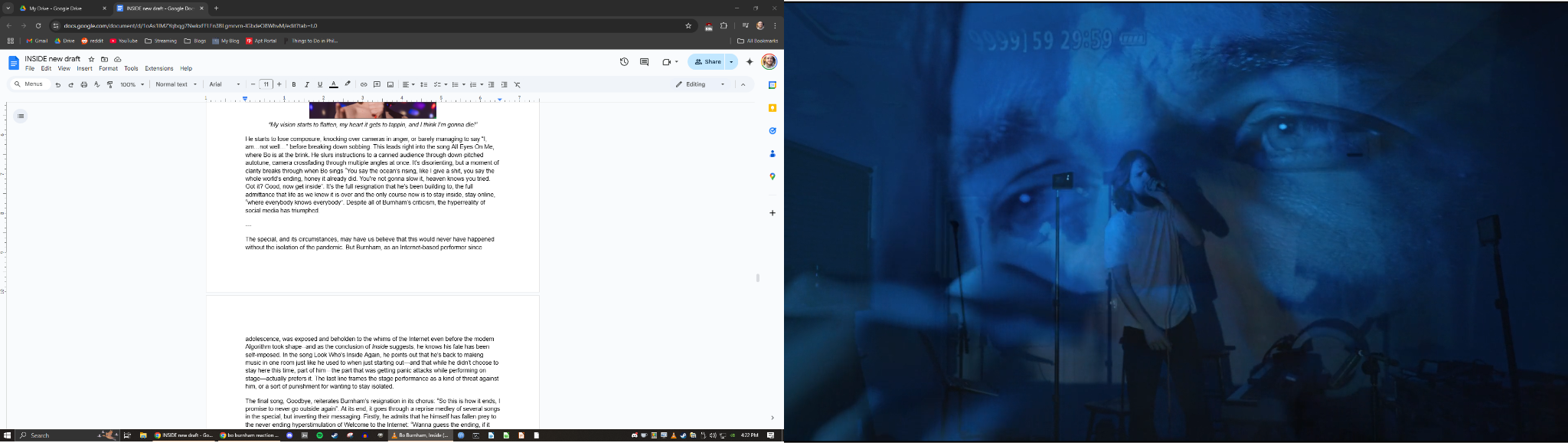
“We’re going to go where everybody knows, everybody knows, everybody…”
It’s a Beautiful Day to Stay Inside
The special, and its surrounding circumstances, may have us believe that this would never have happened without the isolation of the pandemic. But Burnham, as an Internet-based performer since adolescence, was exposed and beholden to the whims of the Internet even before the modem Algorithm took shape--and as the conclusion of Inside suggests, he knows his fate has been self-imposed. In the song Look Who's Inside Again, he points out that he's back to making music in one room just like he used to when just starting out—and that while he didn't choose to stay here this time, part of him—the part that was getting panic attacks while performing on stage—actually prefers it. The last line frames the stage performance as a kind of threat against him, or a sort of punishment for wanting to stay isolated.
The final song, Goodbye, reiterates Burnham's resignation in its chorus: “So this is how it ends, I promise to never go outside again”. At its end, it goes through a reprise medley of several songs in the special, but inverting their messaging. Firstly, he admits that he himself has fallen prey to the never-ending hyperstimulation of Welcome to the Internet: “Wanna guess the ending, if it ever does? I swear to God that all I ever wanted was a little bit of everything all of the time, a little bit of everything all of the time. Apathy's a tragedy and boredom is a crime, I'm finished playing and I'm staying inside.”
Then he admits that, despite it being portrayed as pointless in the beginning, Burnham himself finds relief and meaning in his comedy—but he can't even fully accept this in his final line. The internal conflict isn't fully resolved, but for once we see a glimmer of sincerity under the cynicism: “If I wake up in a house that's full of smoke, I'll panic, so call me up and tell me a joke. When I'm fully irrelevant and totally broken, dammit, call me up and tell me a joke. Oh shit, you're really joking at a time like this?”
The final words are a reprise of Look Who's Inside Again, sung by a disembodied voice while Burnham sits naked in the spotlight. In this, the raw truth is exposed: despite the cabin fever, the limited human connection, the derealization—despite that funny feeling, or perhaps in response to it—he still prefers staying inside to performing, and prefers both to seriously grappling with reality.
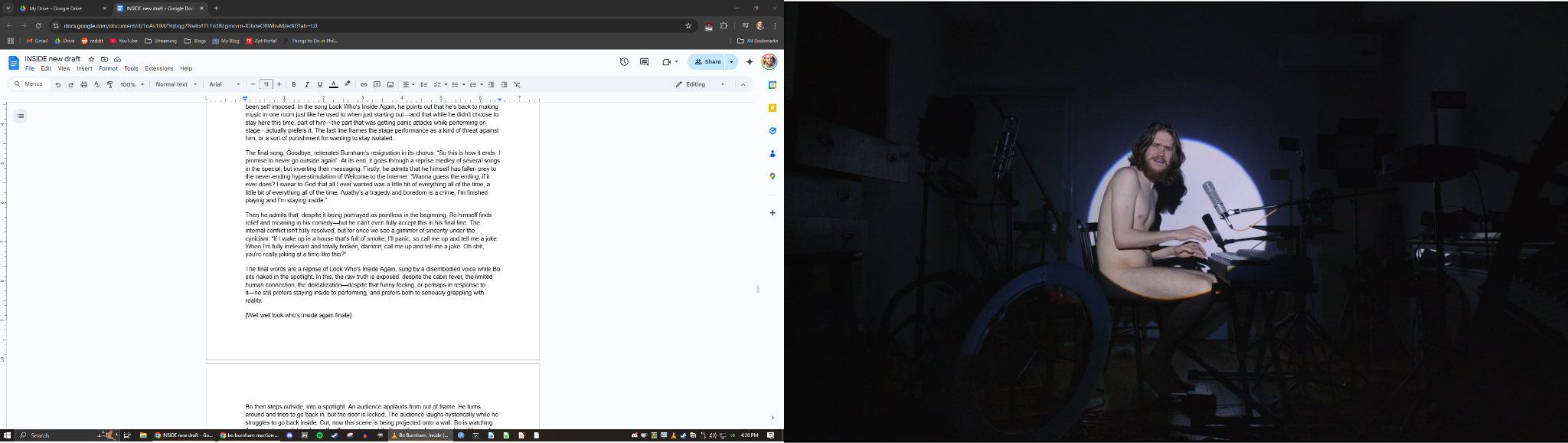
“Well, well, look who’s inside again, went out to look for a reason to hide again. Well, well, buddy you found it. Now come out with your hands up, we’ve got you surrounded.”
In the final scene, Burnham finally opens the door and steps outside, into a spotlight. An audience applauds from out of frame. He turns around and tries to go back in, but the door is locked. The audience laughs hysterically while he struggles to go back inside. Cut, now this scene is being projected onto a wall. Burnham is watching the projection, watching himself suffer on stage, while the audience keeps laughing. He cracks a smile. Roll credits.
Art is a Lie, Nothing is Real
As much as Bo Burnham makes it clear that his misery is largely his own doing, he also makes it clear that it's played up for the camera. Remember, “nothing up here is authentic, but at least I have the decency to tell you”. There are several moments peppered throughout Inside where Bo reminds us that this is a production for you the audience, and that he's not to be trusted directly. Instead of being carefully edited out of the shots, most of the lighting and audio/video equipment is obvious in the frame. The cluttered room itself is the backdrop of several scenes (also serving as a symbol of Burnham’s declining mental state and escalating cabin fever). The songs and skits are intercut with raw footage of him setting up lights and testing cameras. Many of the songs end without cutting away, and you get to watch as he drops his performing face, exhales, and tries another take. In several scenes where Burnham monologues to the camera, a mirror puts the camera itself in the center of the frame—we, the observer, are the main focus. He starts the finale Goodbye after having gotten a haircut, and says “possible ending song that is not finished yet, test, take one,” then it fades to a full rendition of that song pre-haircut. At the beginning of That Funny Feeling, he apologizes for not being able to play guitar or sing very well, then he does both just fine. In his emotional breakdowns, the camera and equipment are still the main subject of the shot. How many takes did he get of himself sobbing or storming off, I wonder?
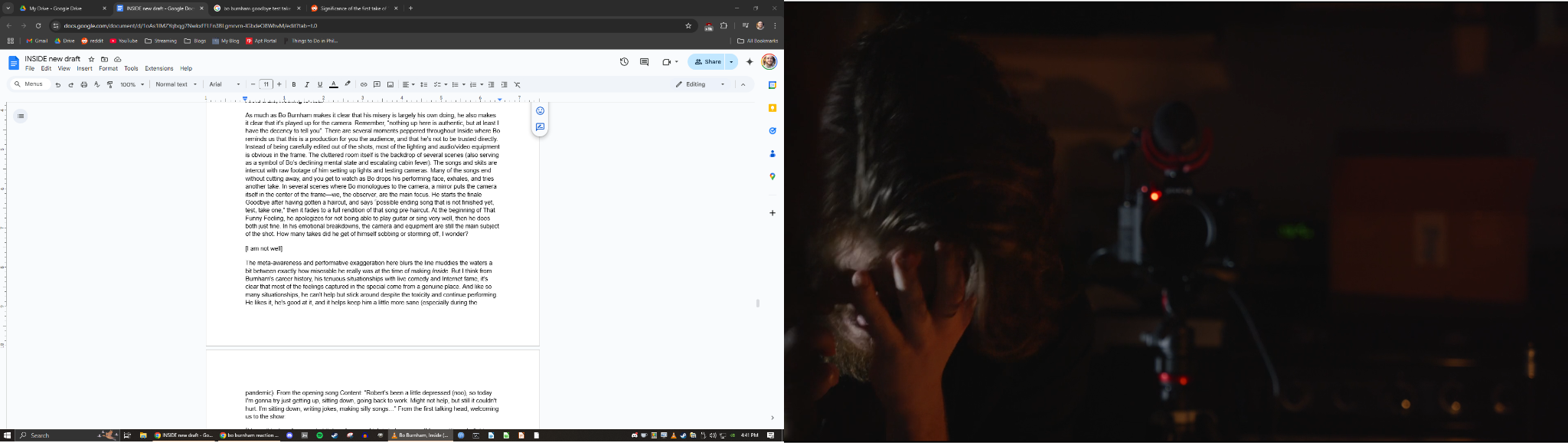
The meta-awareness and performative exaggeration here blurs the line muddies the waters a bit between exactly how miserable he really was at the time of making Inside. But I think from Burnham's career history, his tenuous situationships with live comedy and Internet fame, it's clear that most of the feelings captured in the special come from a genuine place. And like so many situationships, he can't help but stick around despite the toxicity and continue performing. He likes it, he's good at it, and it helps keep him a little more sane (especially during the pandemic). From the opening song Content: “Robert’s been a little depressed (noo), so today I'm gonna try just getting up, sitting down, going back to work. Might not help, but still it couldn't hurt. I'm sitting down, writing jokes, making silly songs…” From the first talking head, welcoming us to the show: “I hope this special can maybe do for you what it’s done for me these last couple months, which is to distract me from wanting to but a bullet into my head with a gun.” And from a later talking head: “If I finish this special, that means that I have to not work on it anymore, and that means I have to just live my life. And so, I’m not gonna do that, and I’m not gonna finish the special, and I’m gonna work on it forever I think.”
So Long, Goodbye
I do not wish to condone Burnham’s cynicism by praising Inside. The Internet is still a wonderful boon for humanity, and social media is no small part of that. There are at least just as many ways to engage online healthily and honestly--like, say, writing a long-form media review for a blog--as there are to get addicted or manipulated by algorithmic feeds. With every passing year we cultivate a better understanding of the detriments to social media, encourage its use in moderation, and build up our cognitive immune systems to better withstand engagement bait. The story of Bo Burnham’s career is a cautionary tale of what can happen without these defenses, and Inside is its capstone. It isn’t perfectly timeless--its wokeness and anti-capitalist slant already feel rather dated and cringe (though they do serve as a good time capsule of the vibes in 2020)--but barring that, it still stands today as a comprehensive illustration of the social challenges of this digital era, and a master proof of creativity from constraint. Give it a watch yourself sometime soon to see if you agree--just remember afterwards to get some sun and touch some grass outside.