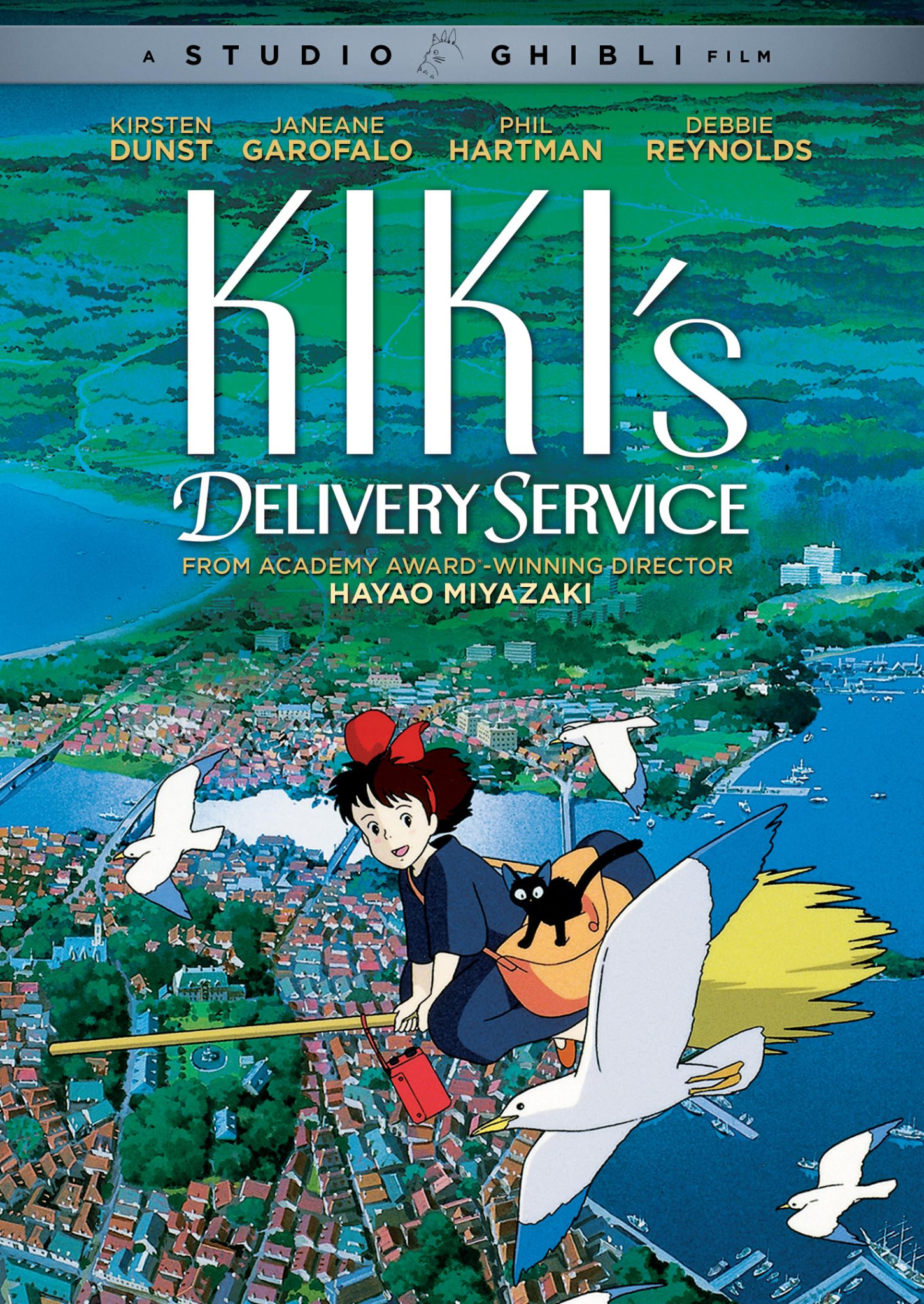
On a clear moonlit night, with her talking black cat Jiji and small radio in tow, 13-year-old Kiki sets off on her broomstick to make her way in the world. According to tradition, witches her age are expected to leave home to complete their magical training in a new town.
This 1989 Studio Ghibli film fulfills the fantasy of every viewer’s inner precocious teenager. Wouldn’t it have been so nice to already be grown up and leave home at that age? Yes, she has some struggles along the way, but the movie stands out by glorifying “being a grown-up” in a way that doesn’t make it seem miserable.
While the worldbuilding in this universe is intentionally vague, it’s established early on that a witch in training is supposed to specialize in a particular magical skill in her role as the future Town Witch. Kiki’s mother specialises in potions, but Kiki, being a bit of an airhead, hasn’t decided yet.
When the stormclouds roll in halfway through her moonlit ride, she stows away in a boxcar to stay dry. She awakens in the morning to find that the train has carried her all the way south, to a city on the coast [1].
Kiki grew up in the wild and magical northern countryside, and she has travelled south to (somewhat) modern civilization.
As she explores this beautiful, walkable, vaguely northern European city, she doesn’t get the warm welcome that she’d been expecting. Townspeople question who she is and demand to speak to her absent parents. A hotel clerk rebuffs her request to stay for the night. A policeman chases her after she flies into traffic.
Lost and confused, she sets up by a water fountain in the park with her meager supplies, asking Jiji what they were going to do. Jiji, ever the practical one, simply admits that neither of them have much of a plan. Her first scary adult question emerges: “Where are we going to sleep tonight?”
When the police car passes by, still looking for her, she ducks down some side streets.
She comes upon a bakery owner calling out to a customer down the hill who had forgotten her baby’s pacifier. Kiki offers to fly the binky down to the woman, to stunned applause from the bakery owner, Osono.
She explains that the reason Kiki had received such a cold welcome was because witches weren’t around in this city anymore. Nobody had seen a witch in years; Osono had only ever heard stories.
Hearing that Kiki has nowhere to stay, she offers her the room in the attic in exchange for helping out at the bakery. Kiki happily accepts.
Since there aren’t any other witches nearby, Kiki still wonders what she’s going to do for her apprenticeship. Lacking interest in other types of magic, she realizes she really likes flying and starts a flying delivery service. She works as a cashier in the mornings and makes deliveries in the afternoons and evenings.
What follows are several eventful deliveries, trials, and tribulations - but she overcomes them and ends each day with happy customers.
What sets Kiki’s Delivery Service apart from other Studio Ghibli movies like Spirited Away or Whisper of the Heart is not just the fact that it’s a coming-of-age story, but a coming-of-age story grounded in real adult problems. Chihiro in Spirited Away emotionally “grows up” by fighting evil spirits, while Kiki grows up by, well, growing up. She starts a business to support herself, and it’s portrayed as this totally legible and straightforward task. Yes, running a delivery service has its challenges, but she overcomes them in a very mundane way.
She’s playing capitalism on easy mode, and it’s absolutely delightful and heartwarming. She finds a fantastic niche, her service spreads through word of mouth, and she’s surrounded by people who love her and support her in an incredibly safe and low-crime city. Even the bakery itself is quaint and cute; the business takes up the main floor of a mixed-used building where the family lives upstairs. This is the perfect embodiment of asabiyyah, a sense of civilizational belonging.
Osono and her husband have a spirit of camaraderie and community about them. Osono takes Kiki under her wing as a member of the family and gives her lots of business advice - including letting her run her delivery service out of the bakery. Just think about how remarkable that is: they let her live up in the attic for free, with a hot breakfast every morning, in exchange for watching the cash register.
Don’t let the witch magic fool you - this movie is about growing up and becoming a functional adult. She faces some very adult fears: “Where am I going to sleep tonight? How will I pay the rent? How can I afford groceries? These supplies cost a lot of money. I gave the cashier my bills, and only got a tiny handful of pocket change back.” But then she overcomes them with minimal on-screen effort. She only needs to work an easy job to “pay” her rent, and her delivery business starts making money hand over fist.
But under this veneer of successful adulting, Kiki is confronting feelings of intense alienation among her peers. Tombo, a local teen and flying machine aficionado, has been trying to befriend her this whole time, but the rest of his friend group treats her like an outsider. All the adults treat Kiki with kindness, but according to the slightly older teenagers, she’s the freak with a job who doesn’t go to school.
During her deliveries all over the city and surrounding countryside, it becomes clear that the modern era is slowly edging out the magical past. The bakery has an outhouse, but it’s fitted with a flush toilet [2].
A customer’s fancy electric oven breaks, but the old wood-fired oven is still in the wall, in good enough condition to be used as backup. Kiki, having grown up in the north, knows how to properly light a fire in the oven, wait for it to burn down, and stoke the coals for baking at the right temperature.
There’s an unasked and unanswered question in the background: what happened to all the witches? Nobody had seen a witch in decades - to the point where an elderly character reminisces about her grandmother telling stories about witches from when she was young. That’s easily a 100-year gap between witness and storyteller.
But... why? Was there an in-universe version of the Salem Witch Trials? Surely these people knew that living, breathing witches were just a train ride away? Why act like they were all extinct?
Upon reflection, and going by the very limited worldbuilding, it seems like they were simply another piece of the past that got left behind. Who needs witches on flying broomsticks when you have digibles? Who needs potions when you have modern medicine? The southern witches may have simply chosen to pack up and retreat to the north where they were still welcome. They became as obsolete as the wood-fired oven or the unplumbed outhouse.
As time goes on, Kiki encounters every trope about someone who makes their hobby into their job. Flying goes from being a fun pastime to being a slog. After a particularly upsetting delivery where she flies through the pouring rain, only to be greeted by a sneering teenager, she slinks home and falls ill with a fever.
Although she recovers from her fever, she struggles to keep it together. Tombo comes to visit her and they have a nice afternoon together. But when the rest of his friend group arrives in their car, Kiki notices that one of the members is the same surly teenager from that awful delivery. Kiki declines to hang out with them and goes home, still exhausted and sick.
The next morning, Jiji yowls at her instead of speaking. Panicking that something is wrong with her magic, she tries to fly, but her broomstick can’t lift her up. Getting desperate, she runs down a hill to take off, only to fall and break the broomstick underneath her.
It turns out that all those easily-surmountable struggles were just the warm-up round for when she loses her ability to fly.
Unable to deliver packages from the air, she neglects her business. She still does her menial job at the bakery to stay afloat, but she sinks into a deep depression. She struggles to find purpose in her life.
But even in her darkest moment, she’s still surrounded by people who love her. A hippy artist she met on an earlier delivery comes to visit her at the bakery. They hitchhike back to her cabin in the woods, and the artist imparts all her wisdom about not fighting it when the creative juices aren’t flowing. She reassures Kiki that her magic will return when she needs it.
When Kiki get back to the city, the old woman with the broken stove bakes her a cake. Slowly but surely, she’s reconnecting with the magic she’s lost.
Then, Tombo gets into danger. He is swept away while clinging to a rope hanging from an out-of-control dirigible. He’s literally at the end of his rope, about to fall. Only someone on a flying broomstick can save him now!
Kiki’s adrenaline kicks in, she grabs a random broom from an onlooker, and her magic returns. She flies to the rescue and catches him in the nick of time. Roll credits.
In the time-skipped post credit scene, she has regained her magic and is living happily as the Town Witch. She’s seen flying around next to Tombo’s new pedal-powered glider, and even Jiji finds love and has some kittens.
What is it that draws me so much to this movie? Kiki’s Delivery Service strikes at all my neoliberal sensibilities that “surviving under capitalism” should be this easy. Rent should be cheap. It should be simple to start a business and perform services for money. Life should be easily maintained by holding down a low-stakes job as a bakery cashier while your business takes off. Local merchants should be ordinary, honest people who extend a helping hand to lost witches. We should encourage our young people to leave the nest and make their way in the world.
But nowadays we don’t have that. Starting a business requires a mountain of paperwork, and those cute mixed-use buildings are illegal to build. The rent is too damn high, and so are groceries. And good luck asking for a favor from a local Panera manager.
But whenever I put on this movie, I get to indulge the part of me that wants to be more like Kiki.
Which is why I was surprised to learn that Miyazaki is a communist.
Wait, what?
Well... sort of. It’s complicated.
Miyazaki spent his early career at Toei Animation, where he served as the chief secretary of the union in the 1960s. When he moved on from Toei and began his directing career, Marxism heavily influenced his early work. This is most overtly shown in the 1978 television series Future Boy Conan. On a post-apocalyptic Earth, after the United States and Soviet Union have destroyed civilization with super-nukes, the titular character Conan must stop an evil warship named Industria from attempting to rebuild the world on the backs of an enslaved underclass.
Given this political subtext, there’s an obvious alternative way to interpret Kiki’s Delivery Service:
Magic is being steadily crowded out by modernity. It used to be a sacred act of the Town Witch offering up her services for free, but she now has to grovel and put up with rude customers in the context of running a business. Before, she would have been taken care of by the community and revered for her magical abilities. But when she first shows up in a modern city, she’s given the cold shoulder. Her very survival is dependent on her continuing to work and make deliveries, turning her sacred magic into a lowly commodity. Then, the grind of this makes her (almost) lose her magic entirely. It isn’t until she hangs out with people who care about her and learn to vibe with life that her magic returns.
This is probably closer to what Miyazaki was going for.
When I first found out about this, I wasn’t really sure what to make of it. My first instinct was to invoke Death of the Author and file this away with some other movies that had an obvious intended message - but then delivered a very different message.
Except Miyazaki’s political views at the time were a bit more complicated than that. While Miyazaki called himself a Marxist in his youth, he later disavowed certain elements of it. This shift occurred while he was working on Nausicaä of the Valley of the Wind from the mid 1980s through the ‘90s. This was the same time period when Kiki’s Delivery Service (1989) came out. Much of his Studio Ghibli work is centered on “human industry versus nature” instead of class struggle. He could be better characterized as an environmentalist than a strict leftist.
So... which is it? Is the movie portraying business and commerce as good, or bad? Is trade a sacred pact of civilization, or is it a lowly magic-killing act of commodification?
Eh, you decide. Go watch the movie. It’s great.
Footnotes
- ↩
Miyazaki based the city on the Swedish town of Visby, with bits of Stockholm mixed in.
- ↩
At first I thought the flushing sound effect was added to tell the audience that Kiki had just used the bathroom, even though real outhouses don’t have flush toilets. But no, outhouses with plumbing were an actual thing for a brief period. The first bathrooms were really just fancy outhouses.
- ↩
“Self serve” grocery stores debuted in the 1910s.