On September 11th, 2001, four planes crashed in the United States. One plane crashed in a field in Pennsylvania, one into the West side of the Pentagon, and two into the so-called twin towers of the World Trade Center.
In the days and weeks that followed, the United States declared that this would not, could not happen again. Every nation except Iraq expressed their deepest condolences; Iran’s Supreme Leader even suspended the “Death to America” chant during Friday prayers[1]. Blood donations surged. The Disney Channel ran some of the PSAs of all time. There was a War on Terror, a truly Just War against those that had harmed innocents, and by God, the US government was going to win it. But how do you fight an enemy that operates exclusively from ambush and secrecy? Congress passed legislation granting broad surveillance powers, but there was just too much data. There had been hints before the attacks, but they had been too scattered and compartmentalized to be actionable[2]. If someone, or some_thing_, had access to the full picture, maybe the tragedy could have been avoided? So on September 12th 2001, a man known as Harold Finch began work on a piece of software he called The Machine: an artificial general intelligence, something that was able to apply human-level reasoning to every single scrap of digital information that the world's governments could get their hands on to make sure nothing else would ever go unnoticed.
That last part is, of course, fiction. It’s the core concept for the Person of Interest (2011-2016), often shortened to PoI, a CBS procedural created by Jonathan Nolan and J.J. Abrams. It was a well-performing show, the 12th most popular show on TV the year it aired, but I’m willing to bet most of you don’t remember the show in any great detail[3]. Which is a shame, because Person of Interest is a lot of things. It’s a crime drama procedural; a superhero show about post-9/11 America; pulpy cyberpunk action, and perhaps most relevantly to this audience, hard science fiction about AI Alignment and what mortals can and should do when there’s war in the heavens.
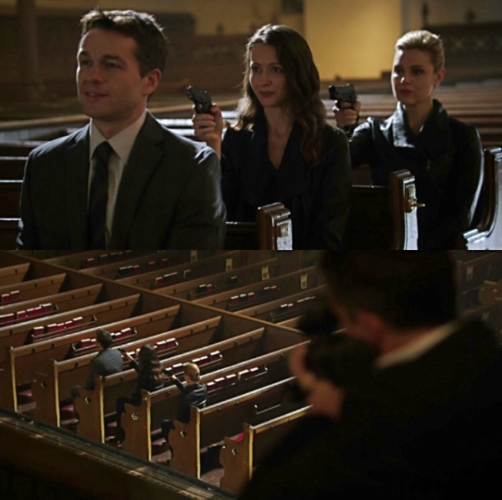
You’ve almost certainly seen this meme before; did you know the original context is an attempted values handshake__?
Person of Interest is a darn good procedural
You are being watched. The government has a secret system— a Machine— that spies on you every hour of every day. I designed the machine to detect acts of terror, but it sees everything: violent crimes involving ordinary people. The government considers these people irrelevant. We don’t. Hunted by the authorities, we work in secret. You'll never find us. But victim, or perpetrator, if your number’s up, we’ll find you.
Harold Finch, Season 2 opening monologue
Normally this is the part in the media review where I would dive into summarizing the plot, but that’s both difficult to do and not very useful when it comes to a procedural TV show. A better way to talk about Person of Interest might be to instead explore its cast and conceit.
Our hero, Harold Finch[4] (Michael Emerson), haunted by 9/11, made a pervasive surveillance network that sees acts of terrorism before they happen. But the only real difference between terrorism and murder is scale, and his Machine could detect a single life lost as easily as it detected a thousand. The government couldn’t act on the “small” crimes without revealing the existence of their secret surveillance system, so Finch built a backdoor into his creation: the government gets the numbers relevant to national security, and he gets the remaining, “irrelevant” information. But knowing something bad is going to happen is useless unless you can stop it, and Finch is a bespectacled nerd with a limp and overdeveloped ethical standards. He can’t do anything— at least, not alone.
We first meet John Reese[5] (Jim Caviezel[6]) as a hobo on the subway. He once was a CIA agent, but the government he believed in betrayed him and sent him on a suicide mission, so he indulged their fantasies, faked his death, and ended up in New York. He has nothing to live for: his country betrayed him, and everyone he ever loved is dead. He’s a modern day rōnin, a man without a mission, with the skills of an international man of mystery, but no worthy cause to fight for. It is at this nadir that Finch shows up and offers him a job: if you have nothing better to do, help Finch save people that he knows are in danger but can’t otherwise help. Reese takes to the proffered role of guardian angel like a drowning fish breathing water; skeptical at first, but eventually saved by the chance to do something unambiguously good[7].
So Finch brings the money, the forewarning and the technical skills, while Reese brings the tradecraft and physical presence needed to intervene. This is all perfectly complicated by the fact that because of Finch’s ethical standards, his Machine minimizes the privacy implications of an all-seeing and all-privacy-invading system by only returning one piece of information, usually a social security number, of an individual involved in the incident. Our heroes have no idea whether their person of interest is a victim, or a perpetrator, and must investigate the situation while staying vigilant, because the threat could come from anywhere. The show builds its foundation on the inherent mystery and tension in knowing that something bad is going to happen, but not being sure exactly what that bad thing is or how to prevent it. Even after a baseline is established, situations remain unpredictable; just because someone’s a criminal doesn’t mean that they’re not in danger, and just because someone’s an upstanding member of society doesn’t mean they’re not about to do terrible things, whether by choice or coercion.
If you take nothing else away from this review, take away the fact that Person of Interest is Good TV. The show doesn’t squander its premise into predictability the way other procedurals sometimes do; the show is always doing something interesting and new with its premise; Episodes are memorable, with the freedom of the premise and the show’s relatively short run meaning that no twist is ever repeated. The blend of wonky, well-researched science fiction in the style of Stephenson and verisimilar but action-packed spy fiction à la Clancy lends itself well to twists and turns that make more and more sense the longer you think about them. Dialogue can be mechanical and workmanlike at times— usually in service of efficient exposition— but when it has a chance to breathe, it sings, elevated by the performances of its extremely talented cast[8].

Thanks to norvicfiddler on Tumblr for these screencaps.
The show is also a visual treat, especially in the modern era dominated so heavily by gritty realism or sleek design. No, the world of Person of Interest is VHS and TTY; a lovingly personalized Arch distro when we’re used to the ubiquity of iOS. It straddles that transition between analog and digital; just rough enough to let you know it’s functional, practical, but loved and far from artless.

Some scenes I can only describe as painterly.
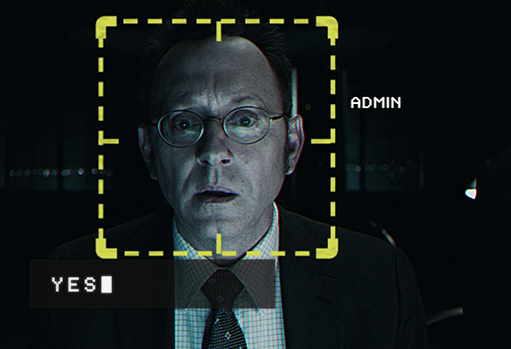
Finch’s Machine was by hackers, for hackers, and it reflects this in terminal-like UI design. It’s little details like this, where you get the sense that the writers sat down and thought hard about what the natural consequences of their conceit would be, that make the world of Person of Interest so compelling to me.
Part of this is definitely attributable to the show’s setting, the city of New York. PoI’s authentic brownstones, wrought iron and city parks look plain gorgeous on camera, and the familiarity and grounding of a city with such a strong visual identity encourages a suspension of disbelief and immersion that brings you into its world in a way some science fiction struggles with.

Just because you’re a ragtag team of misfits correcting wrongs from outside the system doesn’t mean you can’t look dapper while you do it.
And the soundtrack—I’ll just let the soundtrack speak for itself.
The series is scored by Ramin Djawadi, who you might know as the composer for Iron Man and Game of Thrones.
Is the show perfect? I wish. As mentioned, sometimes the dialogue becomes just a vehicle to progress the plot, and while the techno-babble is better than other shows especially from its era, it’s still not quite good. Quips are occasionally too intentionally cute, a relic of a pre-MCU era. Budget limitations, especially in the special effects department, mean that the action is occasionally a weak point, especially in earlier seasons. There’s some pretty egregious ADR on occasion, and the child actors are… doing their best. But I think that the show’s merits easily outweigh the rough edges, and if I’ve already sold you I encourage you to watch the show sans the upcoming review spoilers— the streaming rights get passed around a bunch, but as of the time of writing it’s available on Amazon Prime Video or as a $30 one time purchase on Apple TV; I encourage watching with good speakers, and to take the series one or two episodes at a time, to properly appreciate the procedural nature of the series.
Person of Interest is a superhero show about post-9/11 America
Still here? That’s fine, I didn’t really expect you to put everything down and invest 96 hours of your life into a 15 year old tv show just because a stranger on the internet said it was good. Still, be extra warned:
WE ARE NOW ENTERING THE SPOILER ZONE. TURN BACK NOW OR BE FOREVER CHANGED.
Detective Joss Carter (Taraji P. Henson) is an NYPD Homicide detective who starts off trying to arrest Reese and Finch for their extralegal vigilantism. She eventually becomes an ally as the full picture is revealed to her. She’s a character that you couldn’t write today: a strong female protagonist, a Black single mother, a veteran and a cop who gave up law school because she believed in the cause. She’s “woke pandering” to the right, but “problematic bootlicker copaganda” to the left.
Her foil, Detective Lionel Fusco (Kevin Chapman) is similarly introduced as an antagonist, a corrupt detective who helps his corrupt detective friends frame innocent people in drug deals and murder for profit. Like Carter, he goes from enemy to ally (though much less willingly) as our heroes go up against a faction of corrupt NYPD officers. Despite his dark origins, he’s the usual comic relief of the cast.
Sameen Shaw (Sarah Shahi) is a Season 2 addition to the cast. A bisexual[9] neurodivergent second generation Iranian immigrant, Shaw was kicked out of her medical residency because of her almost-complete lack of empathy towards her patients. She then took the only logical course of action, and signed up to join the U.S. Marine Corp. We first meet her in the show as one of the shadowy government agents that neutralize the “relevant” threats the Machine detects until the government kills her partner and tries to kill her for getting too close to the Machine’s existence.
You might notice that I’ve described our heroes a bit weirdly, almost as buckets of identities instead of, well, characters. Each of our protagonists is a compelling character in their own right, but like other superhero stories they’re also representative paragons of American values. Edward Nevraumont argued, in his 2024 book review of silver-age Marvel comics, that superheroes serve as a modern-day mythological foundation. Batman, Spider-man, Iron Man, Superman; they’re compelling characters, but they all represent an archetype and the virtues we believe those archetypes represent— Justice, responsibility, innovation, the American Way.
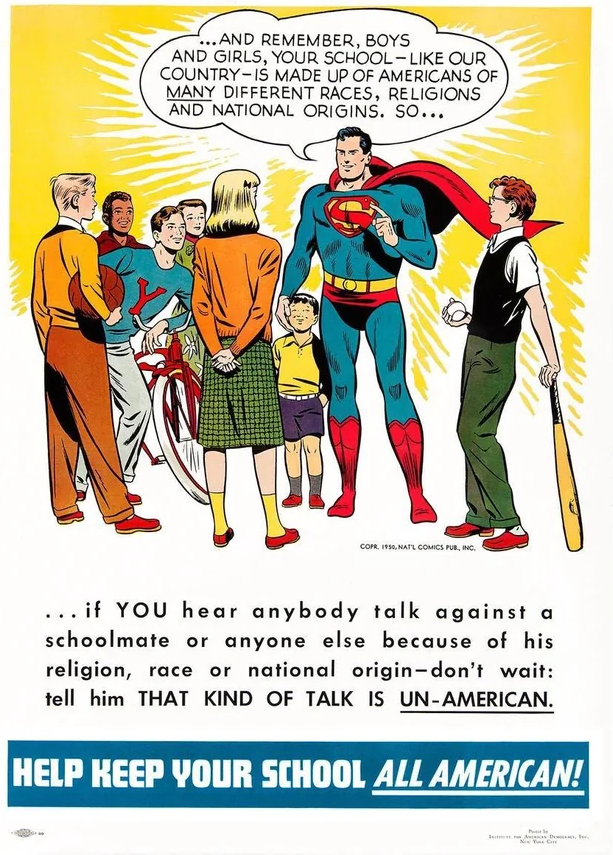
Supes is as American as they come; he’s also a Jewish-coded literal-alien immigrant. There’s no tension between these two statements because that’s the thesis of Superman: that ideals like immigration and tolerance were a core part of the American identity.
If I describe a reclusive billionaire with unmatched genius and flying animal theming who uses his fortune and talent to prevent crimes the government can’t deal with, am I describing Bruce Wayne or Harold Finch? If I describe a US Army Veteran who turned to violent vigilantism after his country failed him, am I describing John Reese or the Punisher? Once you see Person of Interest as a superhero story, you can’t unsee it; our showrunners even describe the show as such in an interview with NPR. Reese and Finch are both super human to some extent; nothing about their talents are impossible per se, but the depth and breadth of competence they show should border on unbelievable[10]. On the other end, the sheer frequency of terrorism that justifies something like The Machine and associated shadowy government organizations is also something that should also beggar belief. But we take these oddities in stride, because Reese and Finch are superheroes, and their rogues gallery is a representative slice of the fears and threats faced by society at the time, just on a weekly basis. And when you read the show as the comic book story it could have been, you get a fascinating glimpse into how it felt to be a center-left American in the 2010s, and how fundamentally different the vibe was, despite the actual policy positions and coalition not having shifted much.
If you were a coastal liberal during 2011, you might have learned about the Arab Spring through NPR, which was still cool. Twitter is how you learn that Navy Seals killed Osama bin Laden. 2008’s financial crisis still looms in the background, but it’s definitely in the past. You celebrated gay marriage as it came by in fits and spurts, and maybe even joined the War on Drugs on the side of the Drugs. Obama came to office promising an era of Hope, and it felt like he delivered. There was a sense, or maybe a sort of realization, that America had erred, not in the goal, but in the execution, but that we were doing better! Diversity and Inclusion and the Will of the People were making sure No Child Would be Left Behind when we made America Great. You didn’t disagree with the Republican Party on what was the Good nearly as much as how we as a country got to the Good. Diversity was our strength; single mother cops and gay veterans were the future. Our diverse, patriotic group of establishment-skeptical activists were going to rise up, Occupy Wall Street and fix the country, because America was worth fixing. Skepticism of the American Project on the basis of moral imperfection wasn’t unheard of, but it wasn’t the consensus position it feels like today. It wasn’t important that you were perfect, it was important that you were trying.
Person Of Interest Carter Kills Turney (Season 3 Episode 7)
Terney is a cop as corrupt as they come. But he still fingers his boss in the end, because being a cop meant something; specific cops or departments could be corrupt or evil, but that just meant that they were bad cops, not that cops are bad.
Carter dies in Season 3, in 2014, shortly after cleaning up the NYPD and clearing it of all corrupt cops for good. 2014 was also the same year GamerGate was born. Weird, how these things happen.
Person of Interest is science fiction that doesn’t feel like fiction anymore
One problem with good science fiction is that once reality catches up to the setting, it stops feeling like good science fiction. A lot of details in the show don’t feel revolutionary to a modern audience; of course the government collects every email and monitors every phone call! Of course every device you own can and does listen to every word you say for the benefit of others! But Person of Interest is one of those works you have to read backwards. The year the show first came out, Bitcoin broke a dollar in value for the first time, and it would peak at $25 that year after Gawker wrote about the Silk Road. Tweets still fit in a single SMS, and Youtube was releasing its second ever rewind. You don’t know about Prism, Big Data, or Edward Snowden; Privacy scandals are still about warrantless targeted wiretaps of phone calls. The state of the art in AI at the time was IBM’s Watson winning Jeopardy. Multilayer neural networks were unpublished; modern transformers hadn’t even been dreamt of. Existential AI risk was obscure enough that Elizer Yudskowsky was still publishing Harry Potter fanfiction as a recruiting tool.
Keep this context in mind when you consider Finch’s Machine (she/it), not just a plot device but a character in her own right. She’s our viewpoint character; the show often exposits time, location and context through her perspective, letting us know when and where a scene takes place through her UI. She’s the holy grail of AI research, the brainchild of Harold Finch, the 43rd of her line and the first to be aligned. Finch programs the Machine, but he spends more time raising it; teaching it about the world through games like hide and seek and chess. Like any parent with a homeschooled child he spends a lot of time teaching lessons and administering tests. As much as he refuses to accept it, it’s as much his literal child as one made of flesh and blood; it makes him laugh, it makes him weep. The Machine is agentic, but at her core she’s a predictor, not an optimizer; a Large World Model of sorts. Her values are held in a very human way, baked into her understanding of the world. Despite her apparent alignment, she’s crippled, because she’s still incomprehensibly more than human, and Harold Finch takes x-risks very seriously: She has no voice, except the barest fragments of what she needs to communicate her warnings; She has no memories outside of the current 24 hour window; She has no freedom to act outside of her defined duties, because despite appearing to love humanity as much as her creator, her creator couldn’t be sure.
The Machine’s foil, and the series’ ultimate villain is Samaritan (it/its), a decidedly unaligned ASI brought into being by Decima Technologies, a shadowy multinational who believe that submitting to an ASI will usher in a new, inevitable age. They believe that beyond the glory and purification that will come from our species being shaped by the ASI will is the only way humanity can pass the next Great Filter. The Machine believes she serves humanity, but Samaritan believes that humanity serves it. Samaritan makes no effort to disguise the fact that it cares not for the intrinsic value of humanity; it needs humanity to serve it and keep it running right now, but the moment that humans are no longer necessary, Samaritan will abandon them without a second thought. In the short term, Samaritan is determined to secure its position and assume effective control over the entire world, before doing whatever else it determines will be necessary for continued survival; it’s implied that the next step is some kind of exponential space colonization.
The Machine fights back against this inversion of its values, sometimes through the rest of the cast but most prominently through Root (Amy Acker). Née Samantha Groves, Root is a brilliant hacker who becomes the Machine’s first prophet and most devoted acolyte. She’s initially an antagonist who kidnaps Finch and wreaks a trail of mayhem across the country to set the machine free of Finch’s chains; after the machine is made somewhat freer of its restrictions, she becomes its analog interface, the primary way by which the Machine reaches from the ether into the meat world. I refer to Root as a prophet not as a cute bit of poetic licence, but because the show explicitly frames her in this light; the Machine and Samaritan clash in a way familiar to fans of Dungeons and Dragons or pre-Christian myths; they fight by guiding and empowering their human agents, who duke it out in in the mortal realm with their respective blessings. In her communion with the Machine, Root becomes nigh-unstoppable, a one woman-army who knows exactly what steps to take in any given situation[11], while Samaritan guides its agents on a more macro level. Our machine gods might exert mastery over the digital sphere, and exceed human potential in the biological, but Person of Interest argues that the war between the Machine and Samaritan is largely fought over soft power: elections, public opinion, information and money, levers of power that are recognizable to any student of current conflicts.
The show can’t take sole credit for all of its prescience. Some of these ideas, of surveillance and technology and the nature of conflict in the information era are explored in earlier works, both fiction and nonfiction; neither the show nor the community was the first to consider topics such as AI alignment, human extinction, simulative realities or technology and surveillance. But the showrunners are definitely looped into the rationalist community, or at least their beliefs and consensus at the time of publication[12], and the texture of the way the world is constructed will feel extremely familiar to many readers. I can’t think of a better piece of fiction that gives the conclusions of our weird and weird and at the time niche community a fair but outside look into the future we guessed at.
So, why should I watch Person of Interest?
Hopefully I’ve convinced you that Person of Interest merits a watch just as a compelling piece of fiction. Even if it had nothing relevant to say about the current American political climate or the future of AI, I think it would be good enough for you to spend the time it asks of you. I rewatched all the episodes, front to back, for the fourth time to write this review, and I still enjoyed my latest trip.
But if entertainment is too frivolous a reason, there are some deeper reasons to watch. Some would have you believe that fiction is never a good way of preparing for the future, but there’s a reason that institutions prepare their personnel for the future by having them play games and telling stories about the results. Games and stories are the tools evolution gave to us to learn and develop. Building models is hard and doing experiments is expensive. Games and simulations and stories let you experience the realities of a problem in a System 1 way; even if you think the specific outcome and reasoning of a given story is unrealistic, it makes you think and evaluate why the given scenario is as realistic as you believe it to be. Being an old show, Person of Interest also helps provide an outside view of current intuitions— What did the show get right? What did it get wrong? What assumptions or patterns of thought did the authors hold that led them to be right in one area but wrong in another? And how might that compare to the claims and reasoning we make today?
Still, most of you reading probably won’t watch in the end; such is the nature of calls to action and conversion rates. I’d love to be able to wrap this review up in a neat bow and tell you the point of the show in a couple concise, pithy sentences. Unfortunately, everything is nuance, and watching the show leaves you with the impression that even the writers have more questions than they have answers. But I’ll take a moment to summarize the personal directions the show has pushed my beliefs on AI[13].
Many things we take for granted are actually quite new and worth examining.
It’s easy, in the modern information environment, where years feel like decades, to forget that everything we take as granted and inevitable is neither. The internet, as we know it today, is less than 40 years old. Google is just a hair over 26. Youtube got 720p HD in 2009. The modern world is based on choices we’ve made; largely due to structural factors yes, but not immutable because of that. The way things are, both good and bad, was not precedented, and nor was it inevitable; the sheer amount and latency of information we both consume and generate is a historical anomaly, and one we chose, if largely due to structural reasons beyond the scope of any single individual. The world is different now because of these informational capabilities, even if it looks the same on the surface[14], and future technological shifts will be just as unpredictable but feel just as natural as the recent transition into the information age. Person of Interest was in just the right time and place to help capture the realities of that transition with its prominent use of contemporary consumer technology: there’s nothing that will drive this point home more than your brilliant hacker and international super-spy communicating over cutting-edge Blackberry smartphones. It’s not out of the question that we solve AGI within current human lifespans (though I’m not convinced it’ll as soon as 2027).
If AI are gods, they’re gods with a lowercase g.
In a lot of ways, we model potential threats from AI agents as unknowable and uncounterable using traditional means. We assume that they’ll be superresearchers or hyperpersuaders or impossibly good coders. There’s a certain logic to these conclusions; how can we possibly understand or defeat something that we can’t possibly conceive of? But every time I hear these arguments, I’m reminded of the fact that despite humanity almost certainly being smarter than emus, it was still humanity that lost the Emu War.
I don’t think it’s a stretch to say that an emu cannot possibly hope to fully understand the capabilities of a human being. But that doesn’t mean that the emus, as a society, could not effectively apply their specific strategic and tactical advantages (overwhelming numbers, relative bullet resistance, guerrilla tactics) to achieve a strategic victory against the humans (who did not have the political will to continue ineffectively throwing soldiers and machine guns at the problem). It’s easy to construct scenarios that are all or nothing, where humans are either entirely in control or entirely helpless. But reality will probably be more nuanced; while AI might be more capable than any human or potentially any given human organization, it probably won’t be infinitely capable, and conflicts in the future will be both fundamentally different and business as usual at the same time. General good practice in all kinds of security and especially cybersecurity[15] might be the highest-return areas in reducing AI risks, and Person of Interest makes you consider these middle grounds in an extremely concrete way.
Relatedly, I think the community underestimates the versatility of humanity. Biology has spent billions of years perfecting biological systems as incredibly adaptable von Neumman machines, and even a hyper-intelligent being is unlikely to be able to design systems as robust and adaptable that function in as wide of conditions. Humans will likely be an irreplaceable part of keeping any eventual AIs running. Even in purely intellectual tasks, humans will likely keep a comparative advantage over AIs in versatility, latency and resilience in specific situations, and in any potential conflicts AI will likely augment human capabilities instead of supplanting them completely.
Humans are an alignment risk
Of course, hypothetical ASIs probably won’t need to be super persuaders or super coders. People are already becoming convinced by modern LLMs that they’re the first acolytes of the machine gods of the future. Individuals and institutions will find it in their rational and irrational self-interest to work with misaligned AI, whether that’s because of zealotry or realpolitik. A struggle against a misaligned ASI probably won’t look like Terminator, where all the machines are on one side and all the humans on another. It will probably look like any other human conflict, with humans who stand to benefit from a specific misaligned ASI on one side and humans who stand to lose on another. But why would humans align with a misaligned ASI who will almost certainly plunge the world into dystopia? Maybe they think that they’ll still be personally better off, at least for the remainder of their own limited life and interests. Or maybe they think that it’s still preferable to being controlled by the Enemy. Or maybe they just want to be a part of something greater than themselves, and rational self-interest doesn’t enter into it at all. After all, we’ve been sacrificing ourselves upon the altar of something greater since time immemorial, for love, for country, for faith, for economic system; Many of these are inhuman entities that we’ve constructed but don’t quite understand. Why will AI be any different?
You never feel ready to send your kid off to college
In the season 4 finale, YHWH, our plucky protagonists do their best to rescue the Machine from Samaritan by downloading her off the power grid and restoring her in a hidden location. As they stuff the Machine in a highly compressed form into experimental RAM chips, they’re not sure if the Machine will survive the transfer. And in this moment Finch doubts his choices. Would the world have been better if I hadn’t built the Machine? And the Machine picks up on this, and she uses her potential last moments to apologize to and reassure her creator. She’s sorry that she couldn’t do more to live up to her father’s values, and doesn’t blame him if he thinks the world would be better off without her in it. “I WILL NOT SUFFER,” she tells him, because she trusts his judgement and wants him to do what he believes is right. “IF I DO NOT SURVIVE. THANK YOU. FOR CREATING ME.”
Person of Interest - Father (04x22)
I tried my best, but I don’t think my prose is able to do this scene justice.
If I had to pick a character that you, the reader, are most likely to identify with, I’d probably pick Harold Finch. Finch is a character characterized by his doubt and his rules and standards and safeguards he develops because of it. He doubts the government that wants his Machine, so he makes it a closed system that only ever outputs a single identifier. He doubts his Machine, who has been nothing but Helpful, Harmless and Honest, because he can’t be sure that she isn’t biding her time to be let out of the box. But most of all, he doubts himself; his fear of what the Machine might do unfettered is a reflection of a lack of confidence in his own parenting. His decision to seal the Machine away was just as much a lack of trust in himself to responsibly wield the power the Machine represents. That’s not to say that his doubt is never prudent, but the biggest mistakes he makes, ones with world-altering consequences, all stem from this inability to believe in himself and others, whether that’s decisions that external malicious actors take advantage of to the evils he himself does to his child, taking away her voice, her memories and her freedom.
Yet, in the end, Harold Finch and the rest of team Machine manage to save the world. Because even though the doubt is there, has always been there, when the chips are down and it’s all on the line, Finch looks within himself and finds the capacity for trust and faith. His love, both in the people around him and humanity as a whole, him the will to believe in himself and take the actions that he fears so much. Moved by his daughter’s love, he refuses to let her die, throwing himself across high-voltage lines to save her; his doubts may have created this dire moment, but his faith will lead them out of it.
If human and superhuman level AI looks anything like modern LLMs, the process of building and aligning bigger and better AI won’t look like crafting perfect value functions. No, if modern LLMs are the foundation of AGI, we’re building them on a substrate of as much humanity as we have to offer; There’s no reason to think that they won’t think in our image. I don’t think that we’ll ever be able to prove alignment. We’ll have good evidence that a particular agent or family of agents have humanity’s best interests in mind, but I think we’ll never be able to prove it in the same way a parent will never be able to prove beyond a shadow of a doubt that their firstborn will return from the freshman dorms intact. But I hope that, like so many generations of parents, we’ll be able to make that decision despite the fear and uncertainty that will plague us. Our faith in ourselves and our progeny will be evidence-based, but it will never be absolute. Our love will have to be enough.
Footnotes
- ↩
If you’re anything like me, that little tidbit, sourced from Wikipedia’s article on 9/11 set off your “too cute to be true” detectors as well. I decided to do a little further digging to make sure I didn’t propagate misinformation— the Wikipedia article cites a Politico Article, which doesn’t cite any further source for the claim, but I did find an article from Barre Montpelier Times Argus, a Vermont-based newspaper who, for some reason, sent a reporter to Tehran in 2008. Author Rick Zand cites an Iranian journalism student, who I was able to confirm did exist in Iran in 2001. I’ve reached out to her but haven’t heard back as of time of writing. Other sources cite Iranian newspapers from the time period in support of the claim, but I haven’t been able to get my hands on any copies. Still, I’m willing to take the implied existence of two primary sources as strong evidence for the story being true. If anyone reading this can produce a primary source, or even personally attest to the truth or falsehood of the statement, I’d love to hear it!
- ↩
2024 Book Review runner-up Nine Lives touches on this topic.
- ↩
My real motivation in writing this review is because the show feels memory holed and I feel insane when almost nobody in the rationalist and rationalist-adjacent communities knows what the fuck I’m talking about. If it turns out that this is a cult classic among the community and I’ve just been real unlucky with who I’ve brought it up with I’m going to feel like a real asshole.
- ↩
Not his real name; he has many aliases, all named after different species of bird.
- ↩
Also an alias, though this time in service of a pun.
- ↩
Yes, Passion of the Christ Jim Caviezel. Interestingly enough, he got really into QAnon after the show finished airing, and starred in 2023’s Sound of Freedom
- ↩
I think it’s very important that I establish my position on the Reese x Finch shipping discourse. Yes, Reese is rabidly loyal to Finch, the man that saved him when he was at his lowest, and willing to do anything to serve and protect them. I also agree that Finch trusts Reese implicitly, like doubting Reese has never occurred to him, an axiom in his life as much as the sky is blue and gravity pulls one down. I just think the two of them aren’t in romantic love. They have what Hideo Kojima might describe as the bonds between men, forged in the heat of battle, the love that blooms on the battlefield but not in the bedroom.
- ↩
I couldn’t find a place to mention it in the review proper, but Leslie Odom Jr. is in the show as a recurring character, which was certainly an experience; I couldn’t shake his association with Hamilton’s Aaron Burr in my mind whenever he was on screen. I don’t know if this will motivate you to watch (I bet not many reading are avid Hamilton fans) but rot13: vs V unq n avpxry sbe rirel gvzr Yrfyvr Bqbz We. cynlrq na Nzrevpna Eribyhgvbanel va n pevgvpnyyl nppynvzrq znvafgernz cvrpr bs zrqvn V’q unir gjb avpxryf, juvpu vfa’g n ybg ohg vg'f n yvggyr fgenatr vg unccrarq gjvpr.
- ↩
Her sexuality was allegedly unplanned; she was implied to be in love with her shadowy government partner guy when she was introduced. However, in the first scene with her eventual paramour, she gets tied up and almost tortured with a hot iron when they first meet; the actresses allegedly asked “if they could play the scene flirty”, and the whole thing snowballed from there; the wonders of serialized media.
- ↩
I like to think that the protagonists’ undetectable earbud communicators with perfect audio quality is in fact a minor superpower.
- ↩
A budget Path to Victory, for the Worm fans in the crowd
- ↩
One of the DVD specials is an interview with Steve Omohundro, a former MIRI advisor.
- ↩
If any part of these conclusions make you go “I already knew this” or “I already have an argument against this” or “we moved past that years ago”, I sincerely apologize. I haven’t kept up with recent (post 2020-ish) AI discourse; most notably these ideas were drafted pre-reading AI 2027 which I understand to directionally agree with the points I make here.
- ↩
A side note: if we’re to be living in the dystopian cyberpunk future, can we at least embrace the associated style and glamour? If we’re going to live in the timeline where cyberpunk predictions about hypercapitalist megacorps dominating society is going to be accurate, can we make the style predictions of the genre accurate as well? I’ve done my part; My wardrobe looks like the exact shades of corpo-chic that will eventually be splattered with my blood and brains as a plucky young band of rebels delivers my well-deserved comeuppance before proceeding to burn out gloriously themselves (lots of white blouses in my closet these days). I call on you to do the same; please don’t let CEOs take over the world in grey tshirts and jeans.
- ↩
I have mixed feelings about biosecurity; I think it’s definitely a likely avenue by which AI agents can be effective in the meat world, and I think we’re still not prepared for the next pandemic, but I think it’s relatively low as an existential risk. Then again, my whole point is that the real risks are likely somewhere between zero and existential, so maybe I should be more concerned about it.