In the opening scene of Princess Mononoke, a boar god turned demon attacks a village. A trio of three basket-carrying village girls are caught at the outskirts of the village. One of them stumbles as the boar attacks. The other two stand their ground and draw their swords.
Ashitaka, the warrior prince protagonist of the film, arrives at the scene and slays the beast. As the boar god lays dying, the old crone of the village arrives and speaks a prayer, begging its forgiveness:
Where you have fallen, we will raise a mound and perform rites. Bear us no hate, and be at peace.
In response, the boar god speaks a curse with its dying breath.
You loathsome humans… you shall know my hatred and my suffering.
When Lady Eboshi first appears in the film, she is leading a group of her followers up the side of a mountain in the rain. They prepare for battle as the princess San and her wolf mother arrive to attack the group.
Eboshi’s first words are barked orders as she commands her followers to form ranks and fire on the enemy. The snarling wolf god Moro charges straight for Eboshi. Eboshi shoulders and fires her rifle. Moro and some of the human combatants are flung off the mountainside and into the fog below. Eboshi and her troops survive the battle, at a price.
She did some damage.
Move out.
What about the ones who fell?
Move out!
It is a callous first impression. Eboshi and her followers are disciplined, organized, warlike. Eboshi’s command to move out and abandon the fallen is given without hesitation.
The prince Ashitaka comes across Eboshi’s wounded followers at the base of the mountain. He rescues two of them, carrying one on his back through the forest.
They return to the ironworks. The people of the ironworks are overjoyed to see the comrades they thought lost. They are thankful that Ashitaka has saved their own, but are suspicious of his ability to navigate the forest, which is the domain of the hostile animal gods.
The wife of one of the wounded appears and comically scolds her husband, an ox driver, for returning in such a condition. She then also scolds one of the guardsmen for leaving her husband to die.
This dialogue is important because the viewer knows it was Eboshi who was responsible for this decision. It is then that Eboshi appears for a second time.
Eboshi appears at the top of the stair leading to the ironworks, standing poised in a formal robe while the roughly dressed laborers of the ironworks mill around her.
I would like to thank the traveler. Bring him to me later.
Koroku… it’s good that you’re back. I apologize.
Tears well up in the eyes of the ox driver. The gathered crowd stares up at Eboshi. The viewer is struck by their awed regard for her. The people of the ironworks love and revere Eboshi. But Eboshi’s apology is a formality, and everyone knows it.
Ashitaka takes a meal with the people of the ironworks and learns more of their home. Eboshi is an arms dealer; she has saved women from brothels and given outcast lepers shelter. The people that she has saved love her and work ceaselessly to manufacture her weapons of war.
The implied suggestion is that Eboshi manufactures weapons, razes forests, and strips the earth as a necessary evil so that she can crusade for the downtrodden and the oppressed.
But Eboshi refuses to justify her actions this way. This is a repeated point throughout the film; Eboshi never justifies her actions.
When Ashitaka takes out the iron ball that poisoned the boar god Nago and tells Eboshi he has come to seek the truth, Eboshi sneers. She laughs. She takes him to her inner sanctum, where she shows him the new firearm she has begun to manufacture. In half-jest, one of the lepers insinuates that Eboshi wants to conquer the country.
Ashitaka accuses her with righteous indignation. His cursed arm writhes, and he comes close to drawing his sword and slaying her on the spot.
You stole the god of the mountain’s woods and made a demon out of him.
Now you will breed new hatred with these guns?
Eboshi responds with a mocking half smile.
I regret that you suffer. I surely fired that shot.
It is me that brainless pig should have cursed.
She offers no further explanation.
In the second half of the film, the priest Jigo, at the head of a group of elite hunters, comes to hunt the deer god. The emperor believes the head of the deer god will confer immortality. Jigo enlists Eboshi to join with him in the hunt.
Eboshi stalks through the forest with Jigo’s hunters as they search for the deer god. Her men are with her, their strength greatly reduced after a battle with a second boar god.
The shogun launches a surprise attack against the ironworks. Ashitaka arrives and asks Eboshi to return to the ironworks, where the women and lepers who remain are fighting for their lives. Eboshi’s loyal guardsman entreats her to do the same. Eboshi refuses.
I’ve done all I can. The women can defend themselves.
Eboshi’s words could be interpreted as a declaration of confidence in her followers, a vindication of the choices she has made - that through the weapons she has created, she has given her downtrodden women the means to defend themselves.
This interpretation is overshadowed by the clear truth of what she is doing. She leaves her people to their fate so that she can commit the ultimate transgression against nature. This is not a moment of betrayal - no one who follows Eboshi is surprised by her choice.
After Eboshi speaks her refusal, she strides on alone, ahead of the others. Jigo and his hunters hang back a pace behind her, and discuss how they can dispose of her after the task is done.
Eboshi knows she is being used, and she knows that the people who love and need her are in danger. She doesn’t care; Eboshi is lost in the hunt, totally absorbed in the act itself.
Eboshi takes her rifle and fires the bullet that takes off the deer god’s head. She is not coerced into the act, and she knows that no possible calculation of material reward could justify the cost.
Watch closely.
This is how you kill a god.
When the prince Ashitaka sets off on his journey, the first person to help him is the priest Jigo. Ashitaka stops in a village and unsuccessfully attempts to barter a gold pellet for a bag of rice. The squat priest steps in and makes a show of the pellet’s value to the shopkeeper and the gathered crowd.
From the start, the viewer can tell that Jigo is more than what he claims. His leery smile is a little too wide. When Ashitaka is riding on his elk steed, Jigo is able to keep pace on his stilted sandals a little too easily.
He has a little too much worldly knowledge for a priest. When Jigo identifies a group of thieves trailing them, and suggests that he and Ashitaka flee before they are robbed in their sleep, the viewer wonders if Jigo did not have the same plan in mind.
But then the viewer finds Jigo totally uninterested in Ashitaka’s gold. Instead, he praises Ashitaka’s prowess in battle. You fight like a demon. He probes into Ashitaka's story, cooks Ashitaka’s rice for him, spoons it into his bowl. He offers some advice of his own:
The land teems with the clamoring of bitter ghosts…
Dead from war, sick or starved and fallen where they stood.
A curse, you say? This world is a curse.
We all die eventually. Some sooner, some later.
…avoid the jaws of death, while you can.
In the morning, Ashitaka slips away alone. As he goes, Jigo, thought to be sleeping, opens one eye and smiles to himself. I knew you’d go.
Jigo later appears in the second half of the movie as an antagonist. By this point, the viewer understands better the world of Princess Mononoke. It is not such a surprise when the squat priest turns out to be the cunning old warrior at the head of a group of trained killers.
When Jigo’s hunters rise out of the grass and march down the mountain, their movement marks their caliber. The viewer can see that beyond Jigo’s cheery demeanor and willingness to abase himself, he is a battle-hardened veteran and a leader as ruthless and ambitious as Eboshi herself.
During the hunt for the deer god, Jigo’s hunters appear wearing the corpses of slain boars. They snake across the ground, hidden by the boar pelts, no human limbs in view. They move as fast as wolves and appear as something sinister and demonic, neither man nor animal.
As the hunt progresses and Jigo and his corpse-wearing hunters proceed deeper into the woods, fighting the boars, the wolves, and Ashitaka himself, one asks why. What could possibly be worth this?
In one of the final scenes of the movie, Jigo and his men race across the edge of the wood carrying the severed head of the deer god, trying desperately to survive until sunrise.
The scene has a comic edge; the world has turned into a hellscape; the beheaded deer god has become a black pestilence that destroys anything it touches, and by this point, only Jigo and two of his hunters remain. But still they persist.
Promises of riches? Orders from the Emperor? These are pretexts.
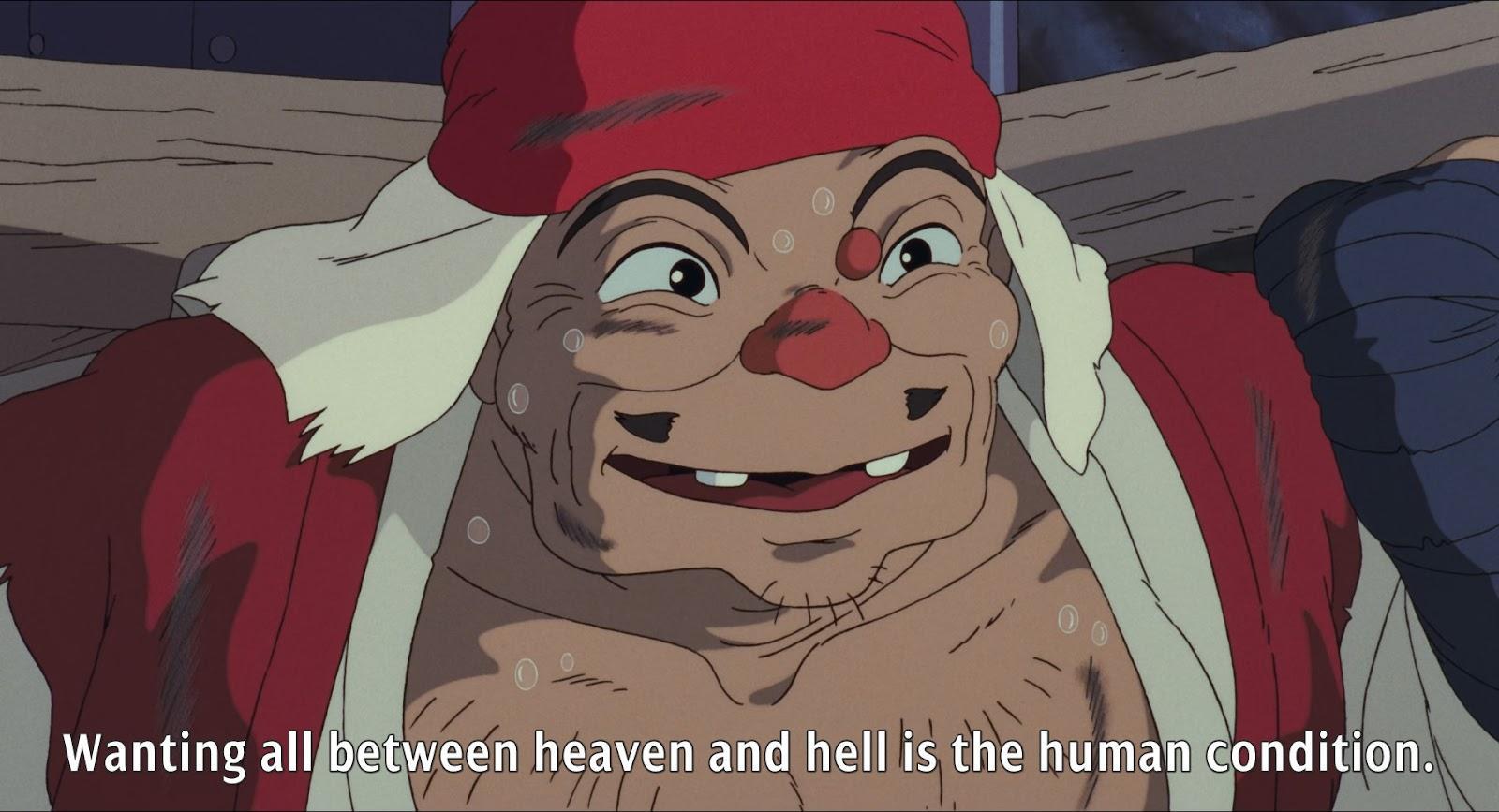
The gods of the forest are themselves full of wrath, hate, and pride. They have their own ancient rivalries and storied pasts.
The initial encounter of the wolves and boars is openly hostile. The boars question why the deer god chose to save a human and left their brother Nago to die.
The deer god saved him? The deer god healed his wound?
Why did he not save Nago? Is he not the guardian of the forest?
The deer god gives life, and takes it away.
Have you boars forgotten even that?
No! You begged the deer god for him. You did not beg for Nago!
He feared death… I, like him…carry with me a poisoned human stone.
Nago fled. I remain, and contemplate my death.
The boars feel anger and betrayal, and their assessment is correct; sensing the end, Moro and the deer god have chosen humans over their own kind.
Okkoto lurches forward and silences the other boars. Okkoto’s skin is mottled and sags off his ribs. His eyes are cloudy and ooze pus.
My thanks to you, young one.
It grieves us that a demon has come from our tribe.
Lord Okkoto… do you know how I may lift the curse?
Leave this forest. Next time we meet, I will have to kill you.
You cannot win against the guns of the humans.
Look on my tribe, Moro.
We grow small, and we grow stupid.
To continue on in this manner is to end as dead meat the humans hunt for.
To risk all on a final battle is to play into human hands.
I ask not for the help of wolves.
Should we die even to the very last, we will leave the humans in awe.
Even diminished, Okkoto still has the presence and spirit of a king.
Ashitaka’s heroic quality comes from his total lack of hesitation. The viewer cannot imagine Ashitaka deliberating, or feeling self doubt, or considering how he appears in the eyes of others. He is pure impulse, and he feels only the heroic impulse.
Ashitaka saves San’s life and carries her out of the ironworks. Staggering from a gunshot wound, he collapses on the opposite riverbank. San stands above him and holds a sword to his throat. She demands to know why he saved her.
Ashitaka, on the brink of death, is only able to speak in a whisper.
I didn’t want you to die.
I’m not afraid to die if it will drive the humans away!
I knew that when I first saw you.
You’ve wasted your life by getting in my way!
I’ll cut your throat!
That’ll shut you up!
Live…
Still talking! I don’t listen to humans!
You’re beautiful…
The scene should be trite. Instead, it’s heart-wrenchingly romantic. Ashitaka is not playing a game. He is not engaging in a mating dance. He is only capable of acting from the heart. The scene is raw and perfect.
Ashitaka is not human in the same way as Eboshi and Jigo. He lacks the full range of human emotion. He is pure and serious and perpetually distant. When the women of the ironworks coquettishly tease him for his handsome face and his strength, the words roll off of him. One cannot imagine Ashitaka blushing, or feeling self conscious.
Ashitaka has no self conception. He is not self-aware. He never hesitates. He never wavers. He feels no fear. He only acts from the heart. This makes him beautiful and good and gives him the divine aura of a hero of myth and legend.
In the same scene where Ashitaka collapses on the riverbank, San defends his body from the apes. The apes appear only briefly in Princess Mononoke; they are a sea of red eyes and dark outlines with a menacing, languid speech.
They throw stones at San and the wolves, trying to drive them away from Ashitaka.
Let us eat man.
Why would the tribe of apes want to eat a man?
We eat man. We have his strength.
We want strength to drive humans away.
You won’t get that power by eating a man.
All that will do is turn you into something else!
San is earnest. She does not want the tribe of apes to sully themselves with evil. She begs the apes not to give up.
The deer god is with us. Don’t give up. Plant your trees.
We will fight with you to the last!
Deer god will not fight. We die.
Wolf girl not care. Wolf girl human.
At this, San wordlessly recoils, and Moro lunges forward as if it were an insult. The scene is very sad. The apes have spoken the truth, and all present know it. San will never be one of them.
San’s mother later speaks to Ashitaka from atop a cave embedded in a cliff, as San sleeps inside the cave.
She is a daughter of our tribe.
When the woods die, so will she.
Set her free! She’s human!
Silence, boy! What can you do for her?
The humans who violated the forest threw her in my path as they ran from me.
Now she cannot be human, and she cannot be wolf.
My poor, ugly, lovely daughter…
When Ashitaka first meets San, her mouth is stained with blood from Moro’s wound. When San attacks the ironworks, she lopes across the rooftops on all fours. When Ashitaka stops the fight between her and Eboshi, San snaps at his arm with her teeth. When Ashitaka is weak and injured, San chews up a strip of meat and feeds him from her own mouth.
Because of her half animal, half human nature, San is stunted, incomplete, grotesque. But the extremity of her jagged edges give her supernatural beauty. She is foolish and naive and childish but feels more strongly, more wildly. Her stunted naive childish animal passion is what allows her to fight so fiercely for a doomed cause and an impossible dream.