I
The Tale of the Princess Kaguya is a 2013 Japanese film directed by Isao Takahata and produced by Studio Ghibli. At a whopping 49 million dollar budget, it is the most expensive Japanese film ever made, with the possible exception of The Boy and the Heron. It's a story based on the oldest known Japanese monogatari, called The Tale of the Bamboo Cutter.
If you've encountered Ghiblification, then this is not the movie that represents the phenomenon because it doesn't look much like other Ghibli films. The art style is unusually minimalistic, and it's missing the crisp outlines that are commonplace in anime. The backgrounds are all drawn in watercolors, and characters are drawn as part of their environment rather than separately, as is typical for Ghibli films (this is called cel animation). Many of the frames have parts that are not missing per se, but where the color gets very pale and the edges of the drawing look as though they're fading into nothing. The animation is different as well, with Takahata insisting that outlines that are usually discarded once frames are digitized are instead preserved and animated.
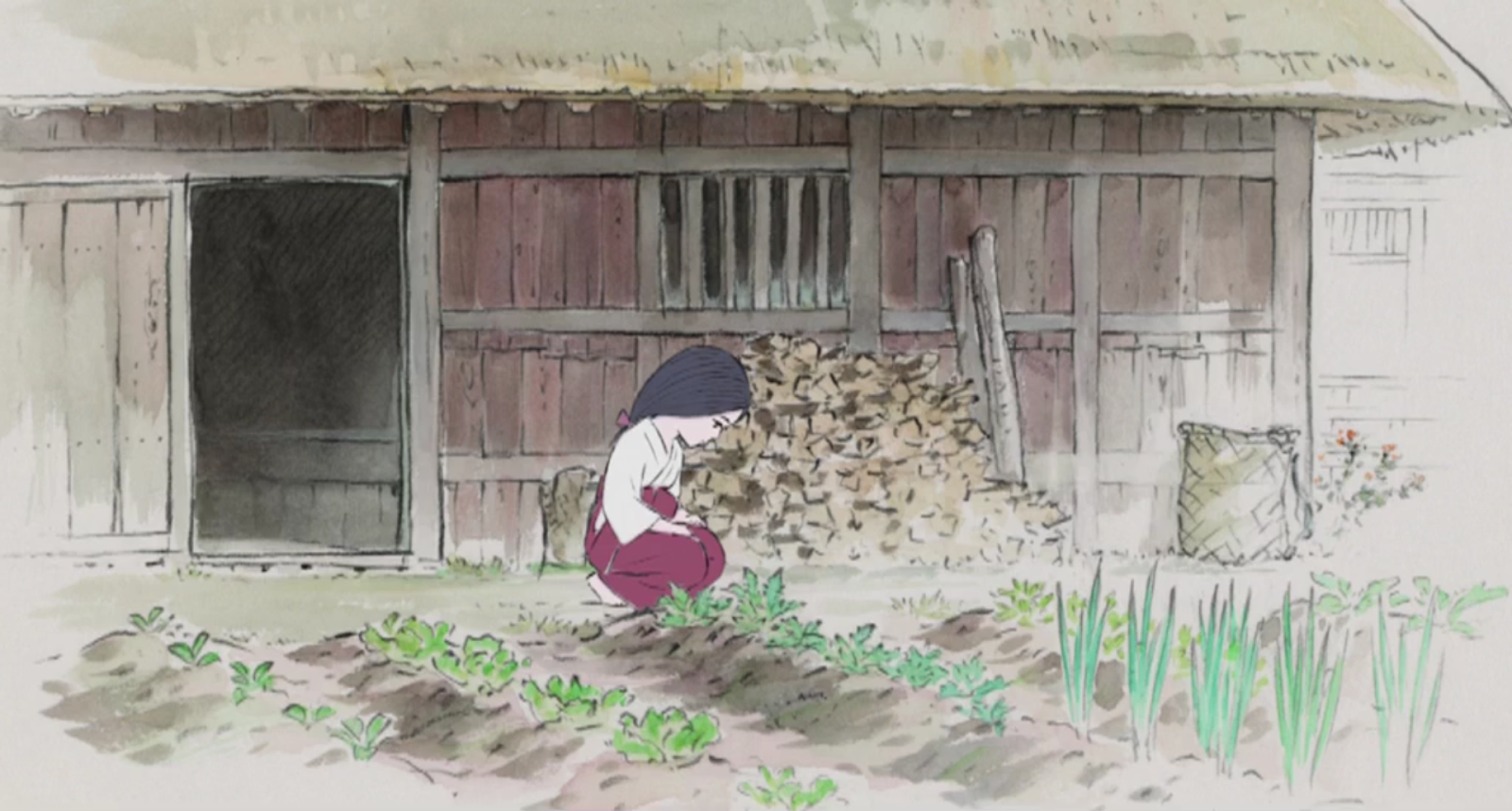
Every image included in this review is an unedited screenshot from the movie.
Is a highly experimental adaptation of an ancient fairytale (that doesn't even have Miyazaki's name behind it) with a 49000000$ price tag commercially viable? The answer appears to be no. The movie grossed less than half of its budget despite what Wikipedia would call universal critical acclaim. The only reason it got made is that the chairman of a major Japanese television station Seiichiro Ujiie liked Takahata's past projects so much that he fronted 40 million dollars for what is essentially a gigantic passion project. Even though Takahata had to be talked into directing the film at all, once he did, he was almost absurdly perfectionistic about it, which contributed to the production hell and obscene cost.
As interesting as this backstory is, though, I think much more interesting is the film itself. Spoiler Warnings! If you're considering watching it first (which is not required), then the only warning I’d give is that, among many other things, The Tale of the Princess Kaguya is an extraordinarily sad movie.
II
It is the Heian period (794–1185 A.D.). Somewhere within Japan, a bamboo cutter finds a tiny girl the size of a doll in a magically glowing bamboo stalk. The girl is the princess Kaguya (かぐや姫), the main character of both the movie and the review. As he takes her home, she transforms into a normal-sized baby, and he and his wife decide to raise her as their own. They are both important characters as well, so I'll simply refer to them as Kaguya's father and mother. We shall have plenty of opportunities to get creative later.
For a while, they live in their small forest village. Throughout this time, Kaguya spends most of her days foraging with other indigenous people and seems to be thoroughly happy. She also grows close to a friend of her father called Sutemaru (捨丸), who completes our list of important characters.
One day, her father finds a large amount of gold in another bamboo stalk, and on another day, a collection of beautiful robes. He surmises that heaven wishes for Kaguya to be raised as a princess and decides to have a mansion built for her in the capital. Although neither his wife nor Kaguya herself wants to leave, he makes them both relocate there once the mansion is built. He also hires servants, including a woman tasked with teaching Kaguya the behavior of a noble princess.
Kaguya dislikes the lifestyle and isn't shy about showing this during training, but she does understand it and can play her role well whenever she wants to.
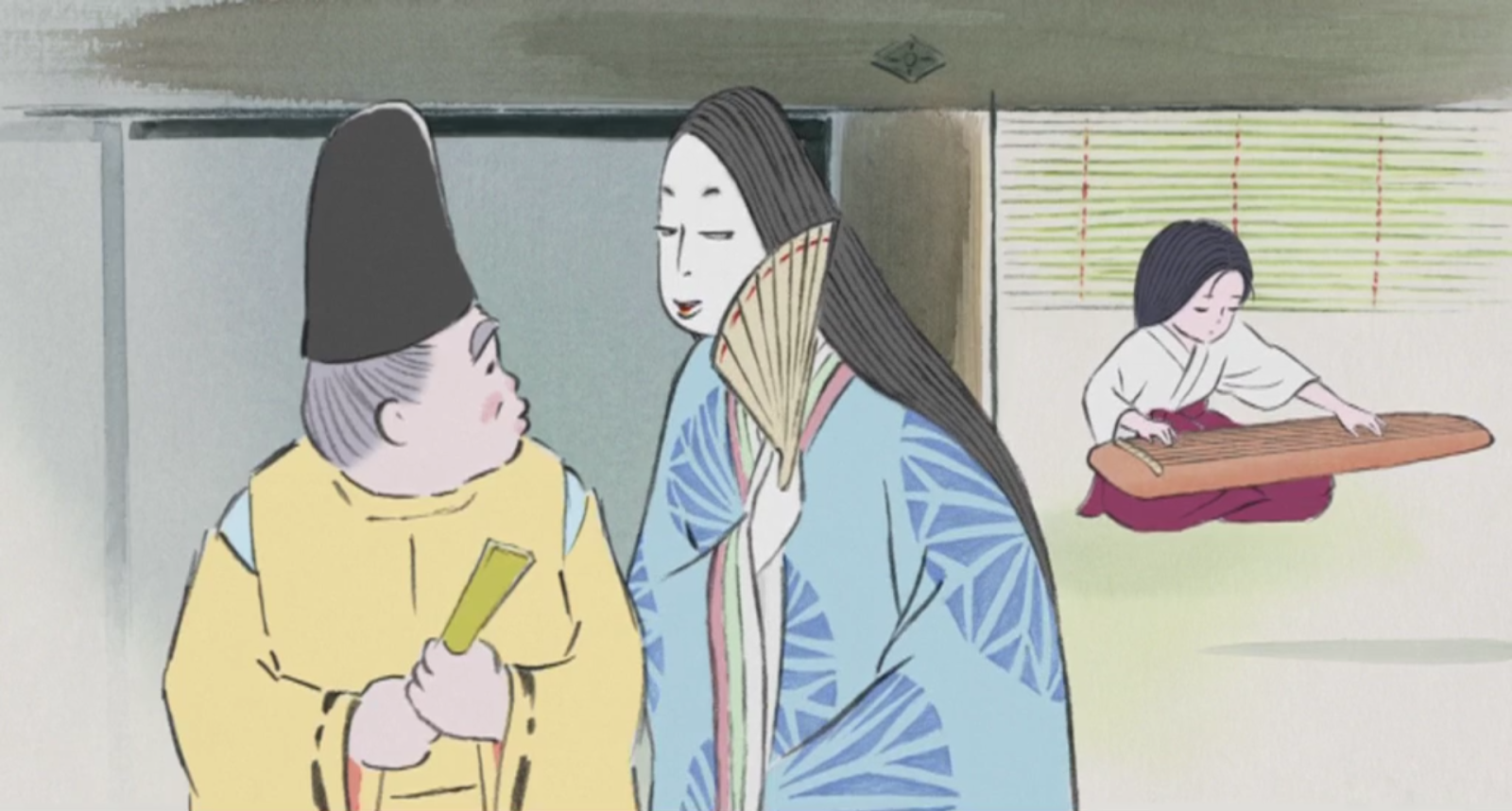
"Whenever she does apply herself, everything turns out beautifully!"__[1]
(Note: footnotes in this review are used solely to provide the original Japanese of movie quotes.)
When she has her first period, her father holds a celebration in honor of her coming of age. Because ancient Japanese traditions are weird, she is to spend the entire three-day celebration behind a curtain, hidden from the eyes of guests. After hearing the guests speculate that she may truly be ugly, she has a mental breakdown and runs outside, out of the mansion, and back to the forest village. Once there, she finds that the people she's known have moved on, but a native man tells her they're only waiting for the land to regenerate and will return eventually. She is seen passing out in the snow, only to wake up back in her room in the mansion, where the celebration is still ongoing.
From there, she plays the role of a princess properly, and her reputation grows. Soon, she attracts the attention of five noblemen who wish to propose to her. The woman who trained her (from the screenshot above) frames this as achieving the ultimate goal of her training (and indeed, her life's purpose as a princess) but Kaguya doesn't want to marry.
During their proposals, each of the noblemen compares her to a legendary item as a means of flattery. To make them go away, she tells them she'll marry the first one who brings her the item he compared her to.
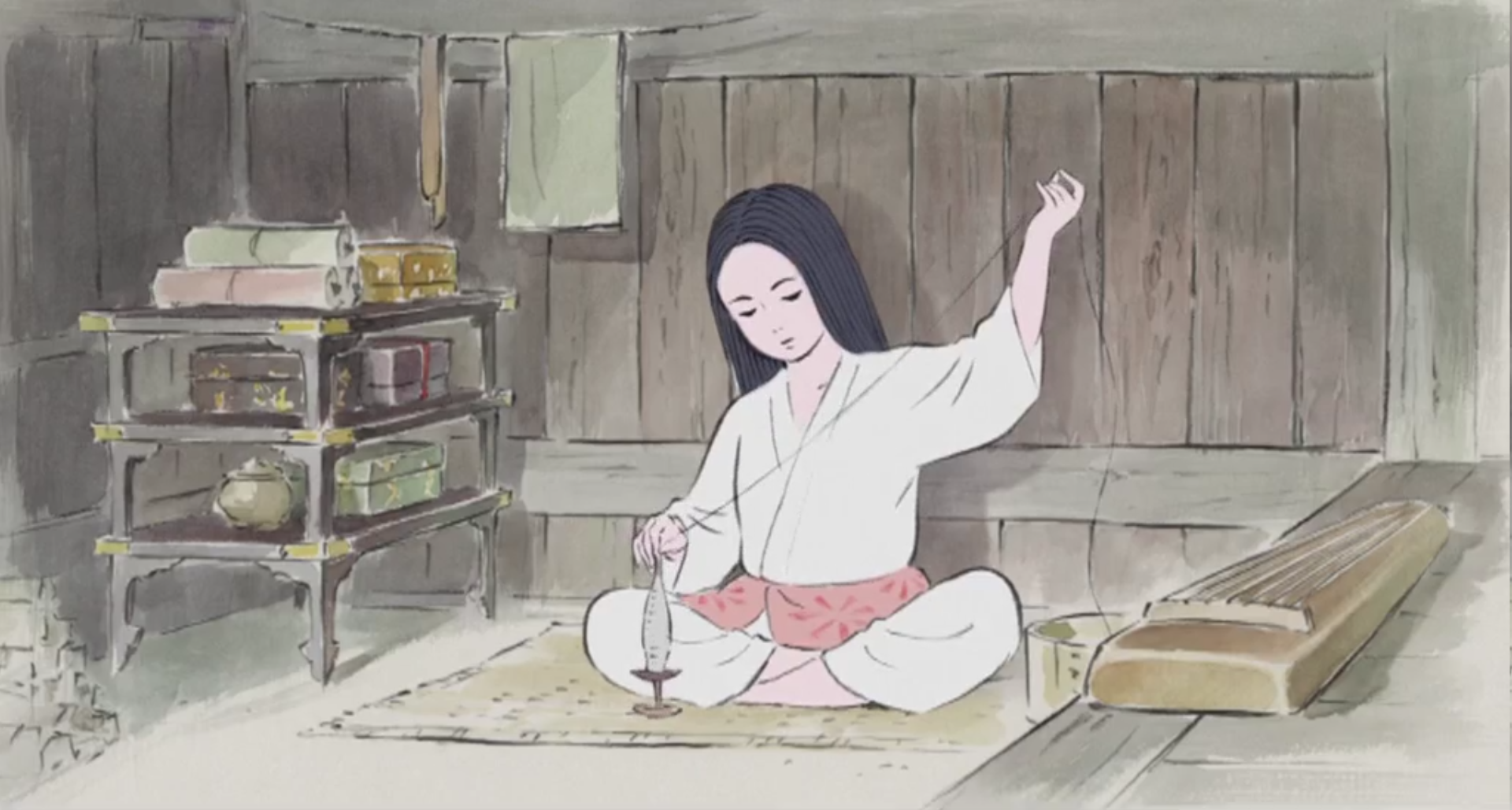
Enraged by her actions, her teacher leaves the mansion, allowing Kaguya to drop the princess act, although she makes no attempt to convince her father to move back to the forest village. She spends her time tending to a little garden in the mansion (the one from our introductory image), playing hanetsuki (essentially badminton) with a servant girl, weaving fabric, playing the koto (the instrument from the previous screenshot), and making trips to the forest. And you may want to put a pin into the garden because it will matter a great deal for this review.
But first, let's talk about the noblemen's attempts to win her affection.
III
Ever since moving to the capital, Kaguya was deliberately shielded from interacting with men, so she probably had no way to foresee the consequences of her little stunt. But you have likely received a lot more relevant data about how the male brain works, whether you’re inhabiting one yourself or not. So it may not surprise you to hear that, rather than giving up, all five of them take a stab at their challenge
The first nobleman was asked to retrieve the Jeweled Branch of Horai. He returns with a fake. He's caught when the artisans who created the branch visit the mansion to demand their payment.
The second nobleman – the highest ranking one – was asked to retrieve the fur of the fire rat (火鼠). He also returns with a fake. He is caught when Kaguya demands to test the item's authenticity by tossing it into fire. It does not pass the test.
The third nobleman was asked to retrieve a glistening jewel from a dragon's neck. He gets frightened when facing the dragon at high sea and abandons the quest, and did you by chance just expect something else? No, the men don't all try the same thing – the movie is more interesting than that. The third nobleman never returns to the mansion.
And the fourth? He attempts to win by sidestepping the rules altogether. I will tell you what he tried in the next paragraph, but perhaps you can guess it first? What might a smarter man try to genuinely win the princess' heart and hand, never minding the reasons why this may not actually be a worthwhile goal? Someone who knew about the sheltered upbringing of noble women at the time, and who didn't have much in the way of moral scruples?
The fourth nobleman was asked to retrieve the Buddha's begging bowl but instead returns with a simple flower, giving the following speech as Kaguya receives it.
Since I was a small boy, I have been fond of flowers and other plants. I am also entranced by the nameless flowers that grow by roadsides or in meadows. And in my heart... I always wished that I could live, as do these flowers that bloom in the fields. [x]
Princess, I want you to come with me, to that place. Together, we could leave this
loud city and its formalities. We could go to a rich green land where flowers bloom
in perfusion. Where birds sing and fish leap. [...][2]
His attempt fails because Kaguya's mother interferes in time, putting an unattractive servant in her place just before the nobleman pulls back the curtain. However, Wikipedia's plot summary claims that she was about to accept, and while I don't know how the author knows this for sure, it doesn't seem implausible. At the point where I've put the [x], Kaguya is seen shedding tears.
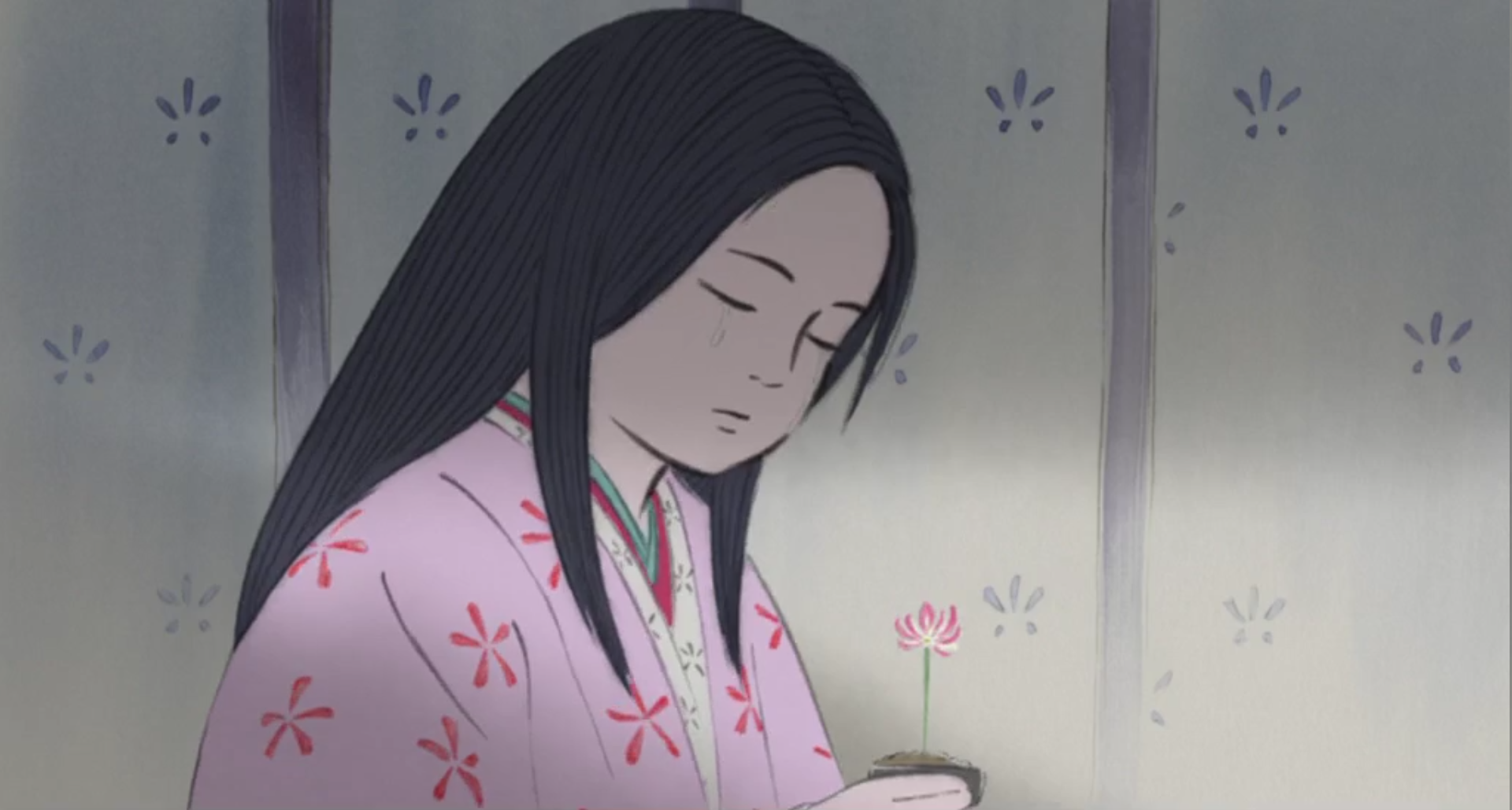
Might she have been genuinely happy if her mother hadn't stepped in? Kaguya never talks about the incident, but her mother says this immediately after:
Would she have been just like all the others? Plucked from the field like a flower and then thrown away? How many more princesses would be forced to shave their heads and go into a nunnery?__[3]
If she is reporting on the real history of the nobleman, then we have to assume that the answer is no, and just because he seemed to display some level of understanding doesn't mean he is actually a good person. (It's almost as if appearing attractive and actually being a good partner are two different things – shocking!) The movie also does not show the scenes he talks about, so he might not even be telling the truth. For all we know, it's possible that he never lifted a finger until now. Maybe it wasn't even his idea. Maybe he got one of his existing wives to write the speech for him.
Regardless, we still haven't answered the question: why did this approach work better? Or, to start easier, what was wrong with the original proposals?
Given that the noblemen all compared Kaguya to inanimate objects, one may respond that they were ineffective because they're objectifying. And sure, that's part of it. But there’s also another reason why at least I would find all four proposals to be deeply unattractive. It's worth noting here that our smartest nobleman initially had what's probably the worst pitch of them all:
Princess Kaguya, if you consent to be my wife, I will worship you morning and night. My forehead pressed to the ground in utter devotion, you are a treasure I would revear as much as the stone begging bowl of Lord Buddha himself.[4]
Simply put: terrible. Yes, I don't want to be objectified. But I also don't want to be worshipped. I am not better than you. I don't want people to look up to me. This is the deeper problem with all the proposals. I'd assume that's something the nobleman wants, but if so, he is committing the mind projection fallacy in all its glory.
Here are just some words that I would never want to be called by a romantic partner. Treasure. Lady. Madame. Jewel. Or even princess (語).
It's evident that the second speech taps into Kaguya's dislike for the “loud city and its formalities", as he calls it. But I would argue that an equally important part is just that it doesn't put her on a pedestal.
IV
If the fourth nobleman represents the empty promise of a happy relationship, then who represents the real thing?
There's a scene I've skipped over in the plot summary earlier. Right after the noblemen make their initial proposals – years before the first one returns – Kaguya takes her mother and a few servants in a carriage to the countryside. When she arrives at a cherry blossom, for a few seconds she is radiantly happy, laughing and spinning around under the leaves. This is the scene which the film's promotional poster is based on.

Then she bumps into a tiny girl who just walked up to the tree. She briefly worries about having hurt her, but what happens instead is much worse: the family sees her as a high-born and is terribly afraid of being punished for the incident, so they start apologizing profusely. Then they go away, and Kaguya gets to watch them be careless and happy as soon as they realize they're not in trouble. The incident thoroughly breaks the illusion of having reconnected with her old life, so although they've just arrived, Kaguya makes the carriage head back.
On the way home, they notice noises in the street, and someone calls the name "Sutemaru". Kaguya steps out of the carriage, finding herself face to face with her old friend from the forest village, who is holding a stolen pheasant. They stare at each other for almost ten seconds, then Kaguya shrieks and retreats into the carriage. Takenoko! (タケノコ) Sutamaru calls after her – this is the nickname she used to have back then, and it means Little Bamboo (as translated by the English Subtitles) or Bamboo Shoot (translated literally). He approaches the carriage but is caught by a bulky man, likely the owner of the pheasant. Kaguya rushes back out to see him beaten up as her carriage rolls away.
So the answer to my leading question is Sutemaru. Sutemaru represents the chance of a happy life, and note that this is not restricted to a romantic relationship. (It may not even include one – see section VII.) Instead, it relates to pretty much every aspect of how Kaguya wants to be seen and treated. Having these two scenes (the noblemen's proposal and the encounter with Sutemaru) back to back first shows the audience what Kaguya can have but doesn't want, and then what she wants but cannot have.
But wait – there's more.
Another scene I've skipped over is from very early in the movie. It's her last day in the forest village before her father relocates her. Because of her unnatural growth, Sutemaru just said he's worried that she might outgrow them all and leave the village behind. She replies this:
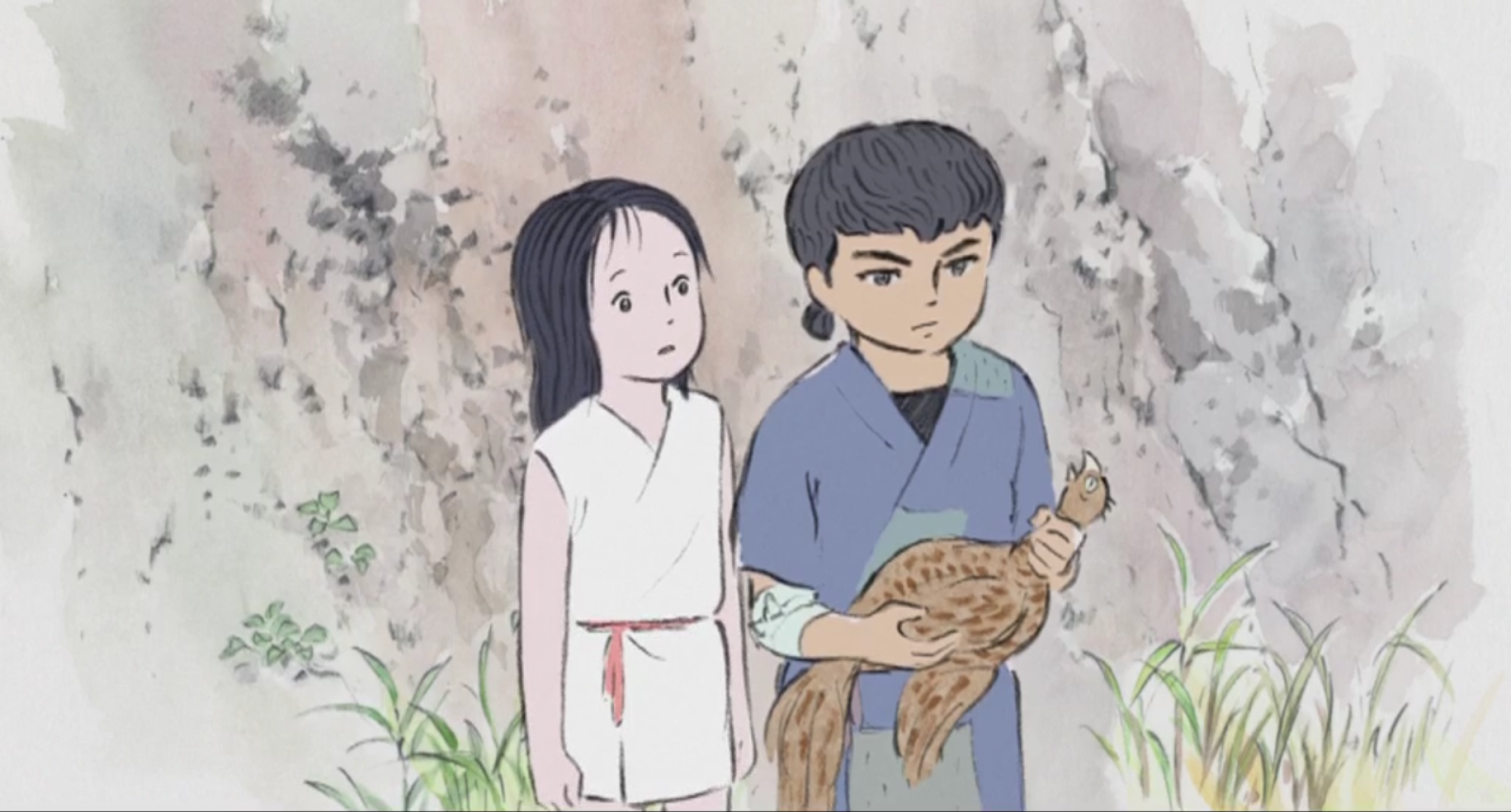
Your Little Bamboo will be here with you forever, Sutemaru.__[5]
Earlier I've listed a few terms that I would find unattractive, which are all terms the noblemen used. Conversely, here are some words that I wouldn't mind being called. Honey. Dear. Girl. Sweetie. Darling.
Or, Takenoko (Little Bamboo). That would also be fine. I wouldn't mind that at all. And there's little doubt about how Kaguya feels because this scene right here is literally the only time in the movie where she refers to herself by a name at all.
A nice detail is that, in the city scene, Sutermau gets beat up for stealing a pheasant. Here, he's holding one that Kaguya just helped him catch in the scene before.
And finally, just notice the way she looks at him. Wouldn't you want a girl to look at you that way?
V
The fifth nobleman was asked to retrieve a cowry shell amulet. He dies in the attempt. When she hears this, Kaguya drops the flower pot she's been holding in utter shock, and in the next scene, we see her just standing outside, looking miserable.
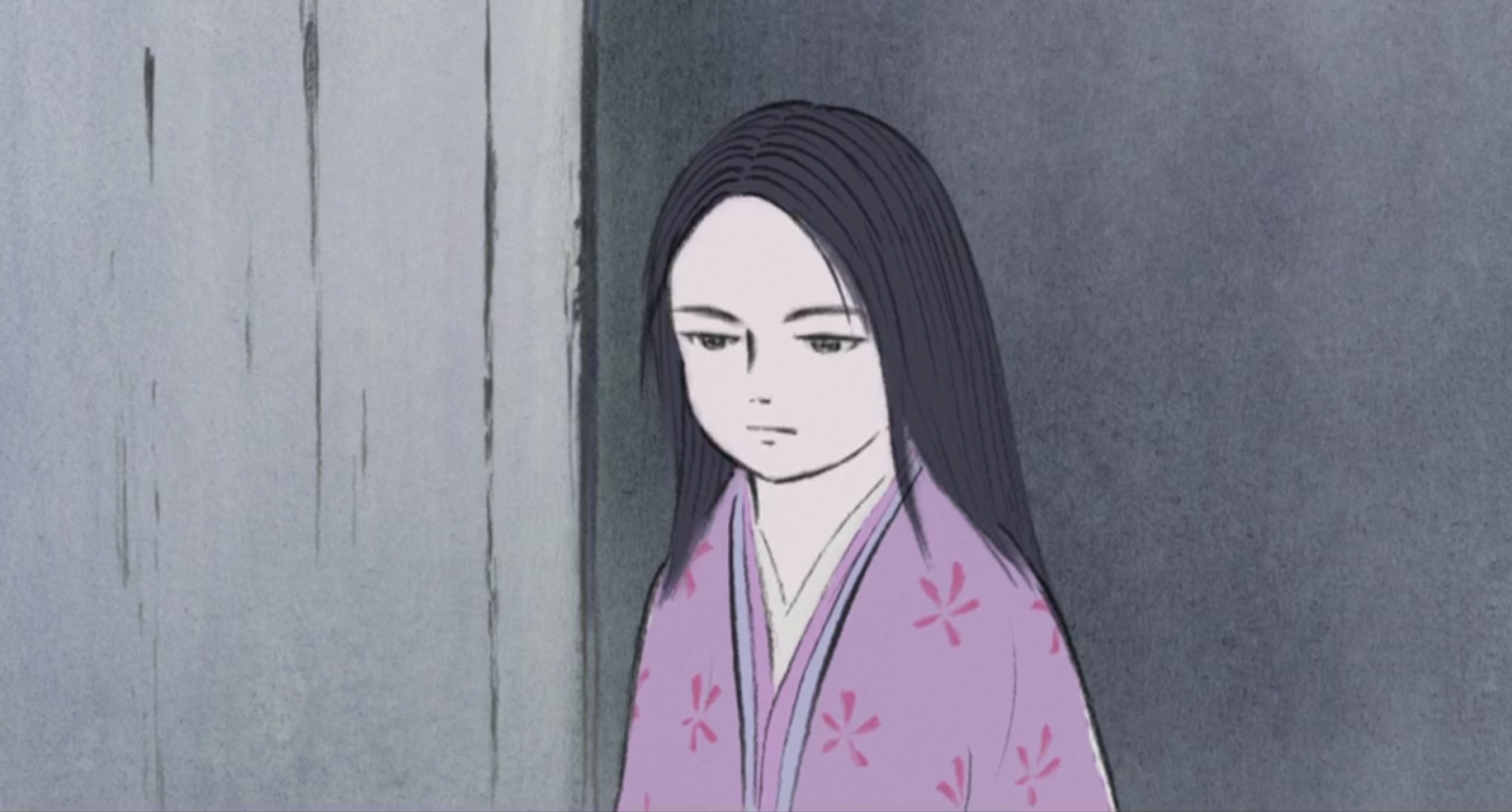
Then, she starts running through the garden, mindlessly hitting cutting things with a sickle. This garden – it's fake, she cries, fake! fake! It's all fake, and so am I!__[6]
Now, if you're expecting some kind of deep dive into what it means for her to be fake in relation to the noblemen...
... then I have to disappoint you because we're done discussing that stuff. No, I want to talk about something completely different. Remember how I said the garden would play an important role in this review?
So here's the thing. One can debate whether the accusation is correct for Kaguya herself, but as far as the garden goes, it's straightforwardly true. Kaguya created it as a reminder of her past in the forest village, so its whole purpose is to remind her of a place she would rather be. She's put a tiny prop of a hut there to remind her of the buildings back home, she's carved a little trail into the ground to remind her of the paths back home, she's put a branch across a tiny ridge to look like a bridge back home, and so son. There is a scene where she and her mother lie their heads on the ground to view it in perspective where it looks grander and more real.
... and then her father rushes in, complains that they're in the kitchen all the time (the room next to the garden), and tells her of the return of the first nobleman.
It's also not just the gardening that has no practical function – the same is arguably true for everything Kaguya does. Her father seems to have enough money to sustain them indefinitely, so she doesn't have to work. She has nothing but free time, and she spends most of it in a confined space doing discrete tasks, either alone or with a few other people.
I don't know how much of this other people can relate to. Maybe it's specific to me. But here is an experience that I have, not often, but more often than I’d like.
For context, I spend a lot of time in front of my computer, both for work and for fun. Not all the time – I also go out, and I exercise ... well, sometimes ... and I meditate. And cook. And do chores. All of that good stuff. So, not all the time is spent in front of a screen. But a lot of time is.
And for the most part, this seems fine. I'm healthy. I don't lack a sense of purpose. I'm working on things, some of which I believe are important, and I've even received some validation for those. On the whole, I'm not complaining.
But there are these moments where I get this feeling of dread, and suddenly, it all seems so pointless. I viscerally realize how much time I've spent in my room, how much of that wasn't even for anything useful. My life up to this point suddenly seems like a gigantic failure, my current lifestyle proof of all my poor choices. I certainly haven't done the things that really matter. I'm still single. But above even that, I just get this feeling that it is all fake. Artificial. That I'm missing out on the real life. I don't even know what exactly that means. I don't think having a job where I spend all my time outside would actually be a good idea. But it doesn't matter because it's not an intellectual concern. Whether it makes sense or not, this is what it feels like.
If you're drawing the connection to the movie, you may notice that what happened to Kaguya doesn't have any real connection to her life choices – it's not like if the fifth nobleman were still alive, anything about her own life would be different. This is correct. It's also exactly how these moments feel like for me. What triggers them has usually nothing to do with my goals and plans; it's just an unrelated event that's deeply upsetting, for whatever reason.
Am I really drawing a parallel between the feeling of artificialness in the year 2025 and a movie that not only takes place a thousand years in the past but is also about a folk legend?
Well, yes. Yes, I am.
In fact, this was one of the first things that I felt when considering writing this review, which is that even though this movie looks like something confined and unrelated from afar, when you look closer, it has so many more substantive things to offer about life today than most things you could watch. For a while, I was considering opening this review with a joke comparison of how normal people think about Rome all the time, wheras I-
I mean, I don't know. Maybe it’s not really similar. Maybe I’m just projecting here. All I can say is that, when I watch Kaguya try to use this tiny field or earth to remind her of her past life in an actual forest, while living in a mansion in the capital and never actually having to forage for food, it feels uncannily reminiscent of me daydreaming about a vaguely defined natural life while squinting against the light from my monitors.
VI
Alright, let's talk about something less dark for a bit.
In rationalist-adjacent internet circles, occasionally, there's been discussion about the common behavior of socially punishing people. Most of the time, this comes from girls (at least that's the assumption), though it certainly doesn't have to. The classic case would be where two people are in a relationship, and the guy does something the girl doesn't like, so she makes him feel it by being rude to him for a day, or by withholding sex, or whatever it is. There was this tweet back in 2020 where someone joked that a libertarian girlfriend may charge you money in such a case, and Eliezer parroted that this would actually be preferable since you're gonna pay the price either way – the difference is just how explicit it is. "Everyone gets charged to use the floor. A libertarian partner tells you what the price *is*."
My take on this is the same it's always been, which is that social punishment sucks. It sucks for the same reason that revenge sucks, which is that it's based on the concept of responding to a bad thing with another bad thing. I actually agree that Libertarian social punishment sucks a little less because transferring money is at least net neutral – in theory, anyway – so the reaction to the first bad thing doesn't make things worse. Doing a second bad thing in response to a first bad thing just means that there are now more bad things in the world. A hurts B, then B hurts A; now both are hurt. Everyone loses.
Prior to the scene before the second-last screenshot I've shown (section IV), Sutemaru fell down a short cliff while catching the pheasant. A worried Kaguya climbs after him but ends up losing grip, making the already battered Sutermaru have to catch her. He briefly gets angry, understandably so, scolding her for climbing down after him.
Given my lengthy setup, I'm sure you know where this is going. Instead of pouting, making him apologize, or doing any number of different things that would make the situation worse for both of them, Kaguya just apologizes. Then she notices that he's bleeding, rips off a part of her headdress, wraps it around his wound (you can see it in the image), and beams at him. "There you go!" (これで よし!). Then comes the exchange I've quoted earlier.
Notice that this isn't just not social punishing; it's the opposite of social punishing. It's responding to a bad thing with a good thing. Sutemaru did something she didn't like, and instead of signaling that she didn't like it, she signaled that she wasn't angry about it.
This behavior isn't an isolated case; it's what Kaguya is like throughout the movie. Whenever someone does something she dislikes, unless it's so bad that she can't handle it, she responds by doing something to dissolve the tension, making it so the other person doesn't have to feel bad about it.
I've mentioned that her father held the coming-of-age ceremony after Kaguya had her first period. What actually happens is that she sits in the kitchen together with her mother, understandably disturbed. Her father, not very attuned to the emotional state of his daughter, proclaims they have to host this stupid ceremony, and she responds like this:
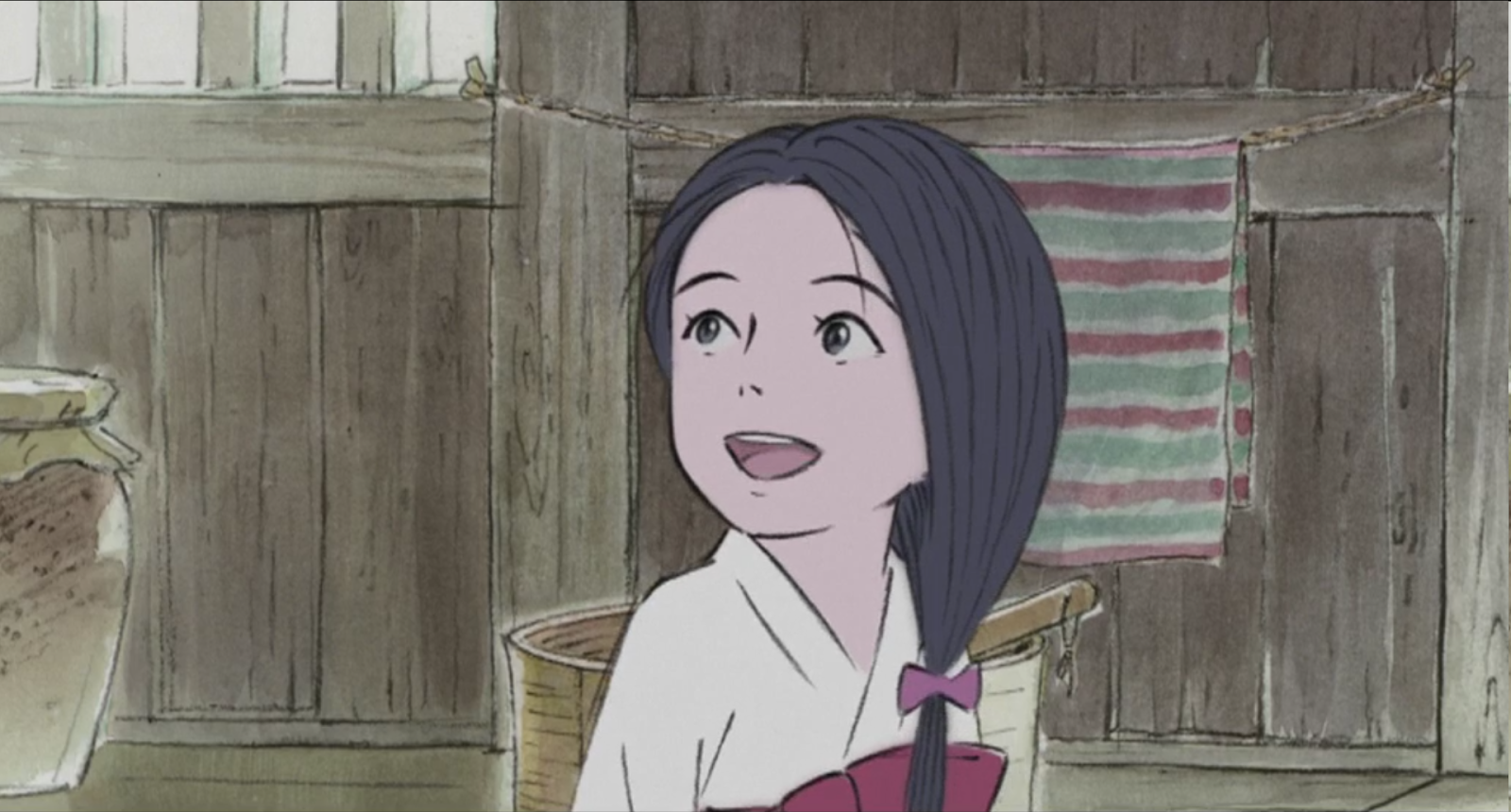
Since it's a celebration, it's okay to invite everyone, right?__[7]
Understanding that she refers to friends from the forest village but remaining clueless about her emotional state – as well as her goals, desires, or really anything about her psychology – her father says no. Of course they can't invite common people for a high-status event like this.
Hearing this, Kaguya goes out into the garden and... asks her mother if, given that she can't see her old friends for real, she may use part of the garden to build something that reminds her of them. Of course her mother says yes, and that's how we get her connection to the same garden we've already talked about.
A response you may have to all this is that it's not that easy. In many cases, the reason to socially punish is not an intellectual belief about it being a morally good thing to do – it's that you're pissed off at someone and want to get back at them. And yeah – I mean, I agree with that, of course. I do it myself, sometimes. I'm not saying I have a magical recipe that will solve anyone's real-life problems. All I'm saying is that I think Kaguya would be a blast to be around. She's so kind. So authentic. So uncomplicated. All she wants is for everyone around her to be happy. Her behavior is actually much easier to predict than most people’s because it lacks all the annoying status games that normal people play. In her regular life, she is everything I aspire to be.
Another response you may have is that this is too much cooperation. It's one thing to not socially punish; it's another thing to just not fight back. There are ways of fighting back that are constructive! And Kaguya doesn't do that, either – not in the scene above, and not much in general. Her father makes all of these terrible decisions, and she just goes along with them.
I agree with that, too. And we will return to this point...
VII
... but first, I want to take a section to talk about a bunch of stuff that doesn't fit anywhere else. A lot of this doesn't really tie into any of the bigger themes.
In all instances in this review where Kaguya addresses Sutemaru (including the upcoming one), she says 兄ちゃん (niichan), which literally means big brother. According to GPT, this phrase doesn't necessarily preclude romantic interest but is "more innocent than romantic". The English subtitles don't include this, which I guess is understandable, but I do think it's pretty cool and kind of significant that the movie doesn't frame her desire for a different life as necessarily tied to romance. In fact, in the upcoming scene (section IX), Sutemaru is shown to have a wife and at least one child.
Speaking of interpreting Japanese, I haven't always used English subtitles for movie quotes; sometimes I've had the Japanese explained to me and then changed the translation into something that I think is more authentic. I am continuously fascinated with just how context-dependent Japanese is, which is also why I included the footnotes.
I've mentioned that none of the noblemen's initial pitches were any good. The truth is that most of them are so hilariously awful that I suspect someone had a lot of fun writing them. The one I've quoted (from nobleman #4) is probably the worst, but #3 is almost as bad:
Princess Kaguya, to me, you are like the fire-rat’s fur said to come from India –
a garment that, even when cast into flames, does not burn, but only sheds its impurities,
and shines even more brilliantly within the fire. They say that only in distant Tang do such pure princesses exist, you are truly such a rare and precious treasure.[8]
Dude, fu... um. I mean, no thank you. #1 is also very funny:
Your Highness, Princess Kaguya, if I were so fortunate that you became my wife, it would be as if I plucked a branch of the tree of jewels that grows on the mountain of Horai, whose trunk is of gold and its fruits are the whitest of pearls. Princess Kaguya, you are an exquisite treasure that is as unattainable, precious at that [...][9]
It seriously sounds as though he is trying to be unattractive. Here’s #2:
Princess, to me, Councilor Otomo, you are a fine glistening jewel, a jewel that shines intensely from above. A gem with more radiance than the five-colored jewel that shines on the dragon's neck![10]
The only one that isn't completely terrible is from #5, the one who dies:
For me, Princess Kaguya is something more precious and natural, like the warm cowry shell amulets, swallows use as a charm for safe birth. That is a true treasure![11]
Hmm – a warm cowry shell amulet – I guess I could get behind that? Maybe? This is also the only one Kaguya reacts to – not audibly, but the film shows her murmuring, "a true treasure" to herself. I don't know how much intent there was behind this detail, but I do find it interesting. If nothing else, it makes his death even more tragic.
I’ve made a big deal out of Sutemaru calling Kaguya Takenoko; it’s worth noting that her father constantly refers to her as 姫 (hime, which means princess) or 姫様 (hime-sama, which is just princess plus an expression of respect), and even her mother uses 姫. But she presumably never tells them to change it, which also ties into the next section.
There is a documentary about this film called Isao Takahata and His Tale of the Princess Kaguya__. I don't think it's very good, but take this with a huge grain of salt because I've literally never watched a documentary I liked. The narrator's voice bothers me; it feels so unnatural and fake-professional (please use your existing grain of salt for this information). I had also hoped it would tell me more things I didn't already know.
The movie has a theme song, written and performed by Japanese pop singer Nikaido Kazumi. I personally can't stand it; her voice does not fit the tone of the movie at all, and the lyrics... I don't know. My Neighbor Totoro also has a theme song – as do most Ghibli films; I'm just mentioning this one because I remember almost tearing up the first time I read the lyrics. This one did nothing for me. And I have to wonder whether Takahata agreed with me on some level because despite claiming to be happy about his choice in the documentary, in the movie the song only plays during the ending credits.
The movie's soundtrack is pretty incredible. It was made by Joe Hisaishi, the same person who scored all the Hayao Miyazaki films except the first. This is the only non-Miyazaki Ghibli film he's scored, and I'm glad he did. You can check out a live performance or the full OST on YouTube.
At 44 minutes, there is a scene of her teacher trying to get Kaguya to blacken her teeth, a particularly disturbing ritual at the time (although at least a practice that actually seems to be good for the teeth, which arguably makes it better than many other ancient beautifying practices). They get into an argument, and this happens:
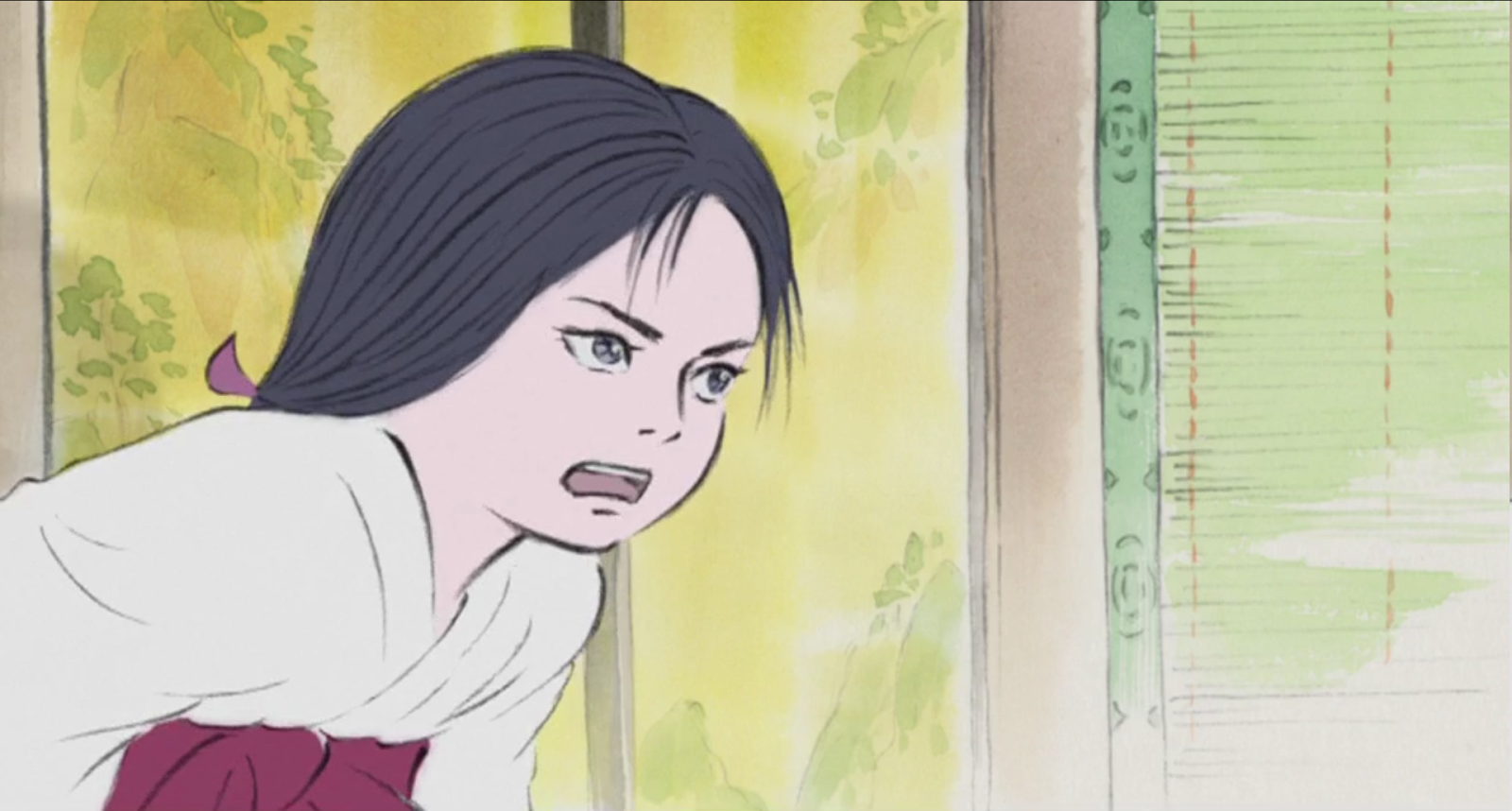
Even a noble princess must sweat and sometimes want to laugh out loud! Surely they wanna cry, or get mad and wanna scream!__[12]
The scene has no depth to it – not that I can see, anyway – but I find it delightful to hear Kaguya passionately defend the rights of noble princesses to be human.
VIII
When news of the noblemen's failure spreads, the emperor himself summons Kaguya to his palace to be one of her wives. Kaguya's father is overjoyed when hearing this, rushing into the kitchen to tell Kaguya the news. The way their exchange goes down will be important for our last major theme, so I will quote the entire thing here.
Father: Your Highness! I have joyous news! You've now come to the attention of His Majesty,
who is summoning you to serve in his court!
Kaguya: What?
Father: It's extraordinary! You'll be one of His Majesty's wives. Not only that, I will wear
the hat of a court official! Ah! This is wonderful!
Mother: Listen to you! You still don't comprehend how your daughter feels?
Father: It is you, who doesn't understand! All that we have done has been for the sake of this! For a girl born in this land... there is no greater happiness than joining His Majesty in holy wedlock! None! Now at last, after all this effort, Her Highness will finally be happy!
Kaguya: Father... I'm sorry, but please refuse.
Father: What?
Kaguya: I couldn't possibly be a court lady now.
Father: What are you talking about? You're refusing to serve at court?
Kaguya: Father, my answer is no!
Father: But, you can't... No one in this land is allowed to disobey an order from His Majesty! In the slightest degree! So quit thinking of just yourself, please!
Kaguya: Father... If disobedience to His Majesty is considered a crime punishable by death...
well then... the only choice is to kill me!
Mother: Princess!
Kaguya: Poppa, if your happiness depends on wearing the cap of a court official... then I will go to His Majesty as you wish...
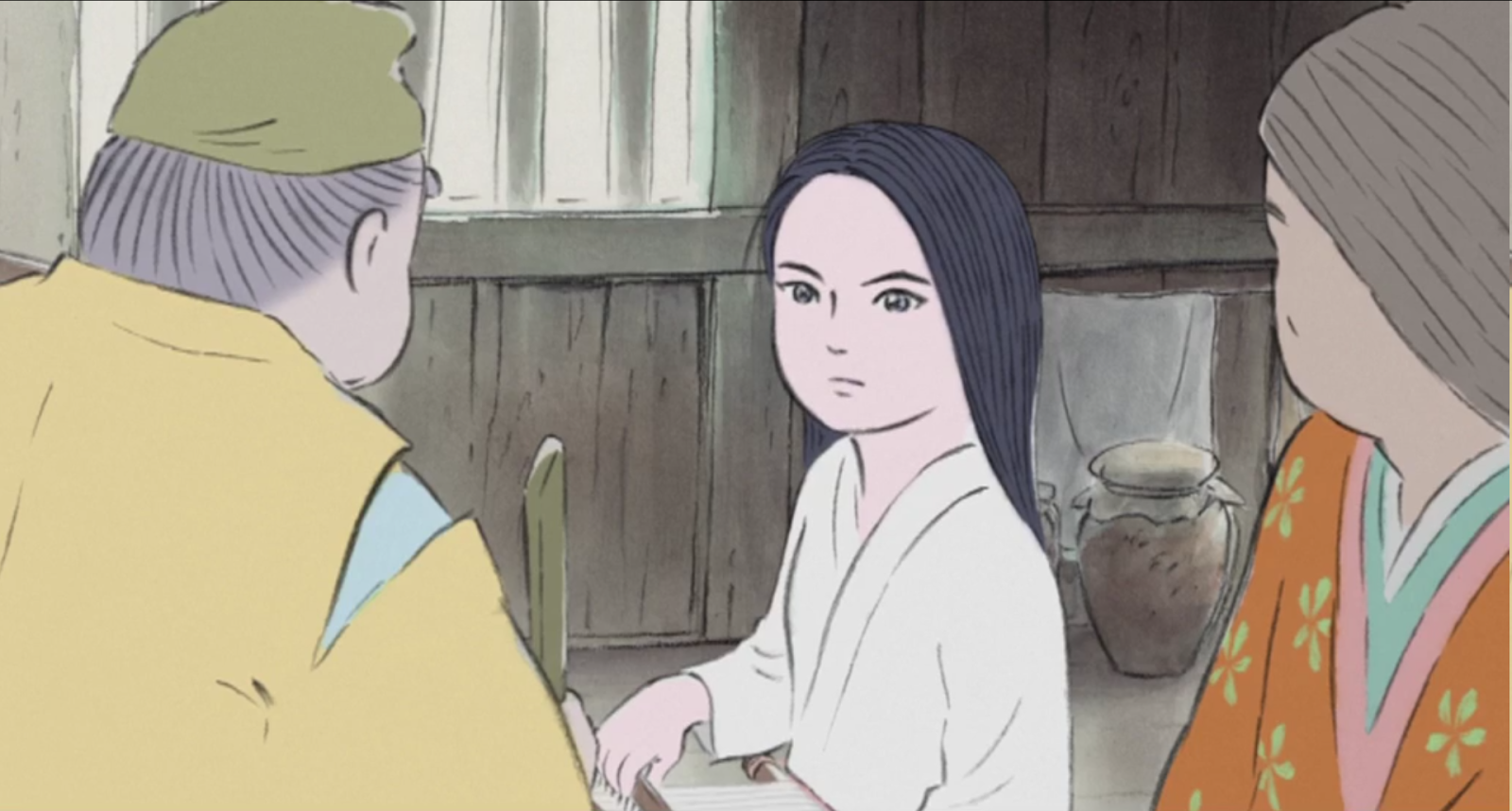
... and after you have put on that cap as part of the court... I will kill myself.__[13]
After this, her father does not press the issue.
Of course, you already know that her refusal will make the emperor want her even more. Soon after, he visits the mansion personally to take Kaguya with him. He departs when she rejects him, but not before entering unannounced and embracing her from behind. At that point, Kaguya instinctively prayed to the Moon, from which she came in the first place, to come save her. Despite wanting to stay, she can't take back the request, and on the next full Moon, a delegation is sent to pick her up.
In the remaining time, her mother prepares a carriage for her to travel back to the forest village to be with Sutemaru, where she expresses that she should have stayed with him instead. With you, Sutemaru, I would have been truly happy.__[14] Sutemaru briefly doubts that she would have been willing to endure the lifestyle, but she easily proves him wrong. They run away and even fly, but then she falls into the ocean and he wakes up on the ground without her, surmising that it was a dream. In the next scene, she is back in the mansion. The implication is that both this and the incident when she ran away during her naming ceremony really happened, but were effectively undone by the Moon's magic. There are also visual clues suggesting as much.
Knowing what's coming, her father hires a small army to protect her, which is immediately, effortlessly, and non-violently overpowered (seemingly put to sleep) as the delegation from the moon arrives. They pick her up, wholly indifferent to Kaguya’s feelings or that of her parents, and return her to the Moon.
The Moon is described as a place where people experience no emotions, though this is not absolute – Kaguya decided to visit Earth when she saw another woman who had been there before cry after reciting a melody from Earth. She also briefly looks back once on the carriage, despite being supposed to have lost all attachment at that point. The movie ends immediately after her return.
IX
While many bad things that happen aren't her fault – and I include the noblemen's reactions here because I don't know how she could have anticipated them – I think Kaguya makes one terrible mistake throughout the movie. It's a mistake that may be understandable, but it was also preventable, at least in the sense that anyone could have chosen to do things differently.
I'm going to spend most of this section arguing that there is a generalized version of this mistake that people make all the time – so often that any examples of not committing it are extremely rare. But the concrete formulation can be simply put as Kaguya failing to resist her father.
You may protest that her father had all the power – Japan was a thoroughly patriarchal society at the time. Wikipedia thinks so as well:
Some of the most striking themes introduced are feminism and the restriction of women. Evidence of them is when Princess Kaguya and her adoptive parents moved to the capital city in order to find her a husband befitting her royal status. Such a decision confronted Princess Kaguya's wishes, but her father's urge to make her live a princess' lifestyle prevailed. Her mother's submissive role in terms of decision-making is evident.
As a descriptive statement, this is true enough: her father did call the shots throughout the movie. But did it have to be this way? What's important to understand here is that Kaguya's father is an idiot, not a villain. All he ever wants is for his daughter to be happy; he's just not smart enough to understand how to make that happen. Arguably almost all of his actions are mistakes, but they're all honest mistakes, which makes it pointless to blame him for what happened. Insofar as responsibility is a coherent concept at all, it can only apply to the people who are smart enough to understand what the stakes are.
The question is not whether Kaguya resisted him – we know she didn't – it's whether she had the ability to resist him.
So, did she? At the point where they first moved to the capital, the answer was probably no. Kaguya was just a... well, the analog of a teenager, probably... and even if she had resisted, it would have been unlikely to change anything.
But over the course of the movie, the power dynamic shifts. Kaguya became an adult, and her father probably understood on some level that she was far smarter than him. By the end of the movie, the answer is an unambiguous yes. The conversation from the previous section proves as much. In fact, not only does it demonstrate her ability to resist, it also shows that she knew she had this ability. Her comment about taking her own life ends the debate immediately, a one-punch knockout, and she knew that this was going to be the result. She just wasn't willing to go there any earlier – it took being confronted with a sufficiently unpleasant outcome for her to utilize her power.
The upshot of all this is that Kaguya absolutely did have the ability to return to the forest village. But she didn't.
Which begs the question: why not?
Perhaps just bad writing? Well, I mean. I don't think so. Shocker, I know.
I think there are two answers, and both of them are relevant.
The first is that she didn't want to hurt her father. Moving back out of the capital would have meant explaining to him that everything he had done since finding gold in the bamboo stalk had been misguided. It would have been painful for him, and because Kaguya wants everyone around her to be happy, especially the people she loves, it would have been painful for her, too. A few unpleasant days or weeks for a lifetime of happiness, and this was a price that Kaguya wasn't willing to pay.
The other is... that it never even occurred to her. It's not in her nature to call the shots. It's not in her nature to impose her will on someone else, especially if that someone is an authority figure. It's her nature to make herself small to accommodate what people around her want.
In reality, these explanations aren't cleanly separated because humans don't make choices at discrete and well-defined moments. If something is unpleasant to someone, then they'll spend less time thinking about it, and if someone spends less time thinking about something, it makes it less likely for them to commit to an important decision. Explicitly deciding against it is usually not required.
So, what is the generalized thing that everyone does wrong? Let me set this up with a question. Suppose you knew everything about Kaguya and her life situation that I've described in this review, except for how it ends. (Alternatively, you can imagine an alternate version in which she gets to stay on earth for longer.) You know that resisting her father would be a really good idea and wouldn't even be that hard. Would you expect her to do it? Would it matter whether it's a fictional or real-life example?
If the answer is “no” in both cases, then this shows that you're already aware of this phenomenon on at least an intuitive level. To formulate it explicitly: for most people, there is a set of things that they almost certainly won't do, even if there is no rational reason to preclude them – indeed, even if doing them would be extraordinarily valuable. This tendency to just Not Do The Genuinely Hard Things – and to really not do them, ever, no matter what – is what I want to talk about in this section. It's also what I mean by the word floating in the review title. It’s particularly depressing in this film because it comes from a person who I otherwise really admire.
When I look at the real world and how people make decisions, I often feel this sense of helplessness from this principle, where I want someone to do a thing but know that it's not going to happen, that they're not going to do it, that it doesn't even matter what the merits of the decision are, or what they've said in the past about it, not even that they’re a person who otherwise seems to be able to think strategically; that I simply know they're not going to do it regardless of any of this, I just know that they just. won't. do. the thing.
Here are a few real-life examples:
- In the early days after Elon Musk acquired Twitter, many people still viewed him as both a moral person and a serious intellectual. Add to that his considerable wealth and the fact that Twitter is plausibly a net negative for the world, it seemed like shutting down the entire thing would be, at the very least, something worth considering. Some people even advocated for it. And yet, did anyone actually expect it to happen?
- In the email exchange between Sam Altman and Elon Musk that led to the founding of OpenAI, the very first email that Sam sends indicates that he thinks it would be preferable for AI not to be developed at all (followed by the claim that it probably can't be stopped, that it's bad if it's developed by Google, and that this is why founding another company makes sense). Based on just this information, it seems like shutting down everything now – to the extent that this is still possible – and publicly condemning AI research in the strongest possible terms would at least be a move worthy of consideration. (I'm not saying it would be the most likely move to expect – it's not what he wanted to do initially – but it's aligned enough with his stated goals that it should at least be worthy of consideration, especially if AI looks less controllable than initially expected.) And yet, do you think there is even the slightest chance it will happen? Would you take the over/under on 5%? 1%? 0.2%?
- Many people work full-time on things that aren't actually worthwhile, not because they're ill-intentioned but because they have mistaken views, sometimes about matters of fact and sometimes about philosophy. How often do you see them change their mind and renounce their life's work? Among the cases where this did happen, how often was the new view something without a significant social movement behind it (e.g., environmental protection)? How many researchers have changed their minds about the value of their past work after just a regular conversation with a colleague who made some good points?
It's worth noting that what's Genuinely Hard is different for different people. Going against the person you love is hard for someone like Kaguya or me; it wouldn't be all that hard for many other people, especially those with more confidence and a less gentle nature. Conversely, many of those people might find it Genuinely Hard to ever go against their own ego, which is probably something that Kaguya would be capable of.
Of course, none of this is an exact science; you may recall that I've motivated the principle by an appeal to your existing theory of mind. And I hope it’s clear that it requires a level of psychological conflict or violation of principles; something like working a lot or performing difficult physical feats are not examples, even if one might call them “hard” in the regular sense.
The dependency on personality means that real-life examples are harder to judge than fictional ones; but some traits are prevalent among most human beings, so even if you don't know someone at all, there are a few actions that are usually pretty good guesses as to what is Genuinely Hard for them. Foregoing a lot of money is often a good guess. Denouncing your life's work is almost always one. Admitting to an important mistake is often a good guess, especially in the absence of outside pressure. This last one has been partially corrupted by humility signaling, but you can usually tell whether any specific case is still in that category.
Okay, so as rare as it might be for real people to do the Genuinely Hard Thing, surely it's much more common in fiction? You know, since authors can just make the unlikely thing happen if it makes for a good story?
Well – no, actually. I would argue that even within fiction, this almost never happens. That said, here are the few examples that I could think of:
- Ned Stark confessing to treason at the end of the first season of Game of Thrones.
- Also from Game of Thrones, Daenerys reopening the fighting pits in season 5. (It doesn't have to be a pivotal, life-defining choice.) Note that the show explicitly shows how emotionally repulsed she is by her own action.
- And also from Game of Thrones, Jamie leaving Cersei at the start of season 8. He later goes back to her; make of this what you wish.
- I believe Methods of Rationality was getting at something like this around and before the Roles chapter sequence (#90-99). (But full disclosure that I had to scramble to get this review done in time and didn't have time to reread any hpmor to confirm this.)
I would love to provide an example from Harry Potter proper, but I don't think it exists – in fact, I would argue the series actively promotes a moral principle like being true to your nature no matter what, which is in direct contradiction to doing Genuinely Hard Things (because some level of conflict with your core principles is what makes a choice Genuinely Hard).
For instance, you may remember Lupin offering to join Harry's search for Horcruxes in the final book, and Harry rejecting him because he thought Lupin shouldn't abandon Tonks. You could make an argument for accepting his help on utilitarian grounds – or you might reject such an argument, but either way, the point is that by refusing, Harry did the thing that feels better for him, and the books frame his choice as morally correct, even heroic. This is usually how it goes, where moral instinct aligns with the author’s moral framing. It’s quite rare to have a case like Ned Stark, where a choice that feels genuinely bad is nonetheless framed as morally correct.
(Note that I'm not saying that Harry accepting Lupin's help would be a Genuinely Hard Thing – just going along with something usually isn't. Though, if he had asked for his help, knowing that it would destroy Lupin's chance to be happy with Tonks, then we might have a conversation.)
I also don't think there are any examples in Lord of the Rings. I don't think Faramir letting Frodo go counts, and I couldn’t think of anything else that even seemed worth considering. And this exhausts the really popular franchises I know.
As for real-life examples, the one public thinker I would nominate is Sam Harris. He permanently left social media despite having a sizeable audience, lost numerous personal friendships (including with Elon Musk) for essentially not falling pray to audience capture (mainly embracing anti-vaccine sentiments and related ideas), and still has a program where anyone can get free access to all his paid services (podcast, substack, and meditation app) for however long they want if they ask for it (although you now have to wait a few weeks). He always looked to me like someone who actually just does whatever he thinks makes sense, without exceptions for cases where the result is sufficiently psychologically uncomfortable.
(And since I have used "researchers approximately never radically change their views based on non-public arguments from colleagues" as an example earlier, I feel obligated to mention that alignment researcher Alex Turner claims to have done precisely this.)
With all that said, there is of course a gigantic albeit unavoidable bias here toward major decisions from public figures. For every such example, there are bound to be numerous cases of lesser-known people making less important decisions that are just as admirable, but I’ve never heard of them.
There's just one last point I want to make about this principle. Within fiction – even extraordinarily mature fiction like A Song of Ice and Fire – examples of people failing to do Genuinely Hard Things are bound to be skewed toward cases with visible consequences. Alliser Thorne failed to do the Genuinely Hard Thing of making peace with the people he hates and got publicly executed for it. Theon failed to do the Genuinely Hard Thing of accepting that his father sucks and paid the largest imaginable price for it. If Daenerys hadn't reopened the pits and George R. R. Martin thought this was a political mistake, more likely than not, he would have written the story such that she eventually has to pay a price for her mistake. And so on.
In the real world, this usually won't be the case. In the real world, failure to do the Genuinely Hard Thing is unlikely to be Death, physical harm, or public humiliation. It is much more likely to look like this:
That is, it’s most likely to be invisible. Most Genuinely Hard things are opportunities to radically change something, and failure to do this will just look like you going about your regular life, doing regular things, without a sign that anything significant has changed or happened.
X
In the brief time when she is still on Earth but knows what is coming, Kaguya expresses regret about her life’s choices.
What have I been doing here in this land? Throwing tantrums because I didn't want to belong to anyone... ignoring what you want from me, and fooling myself with tiny fake meadows and mountains.
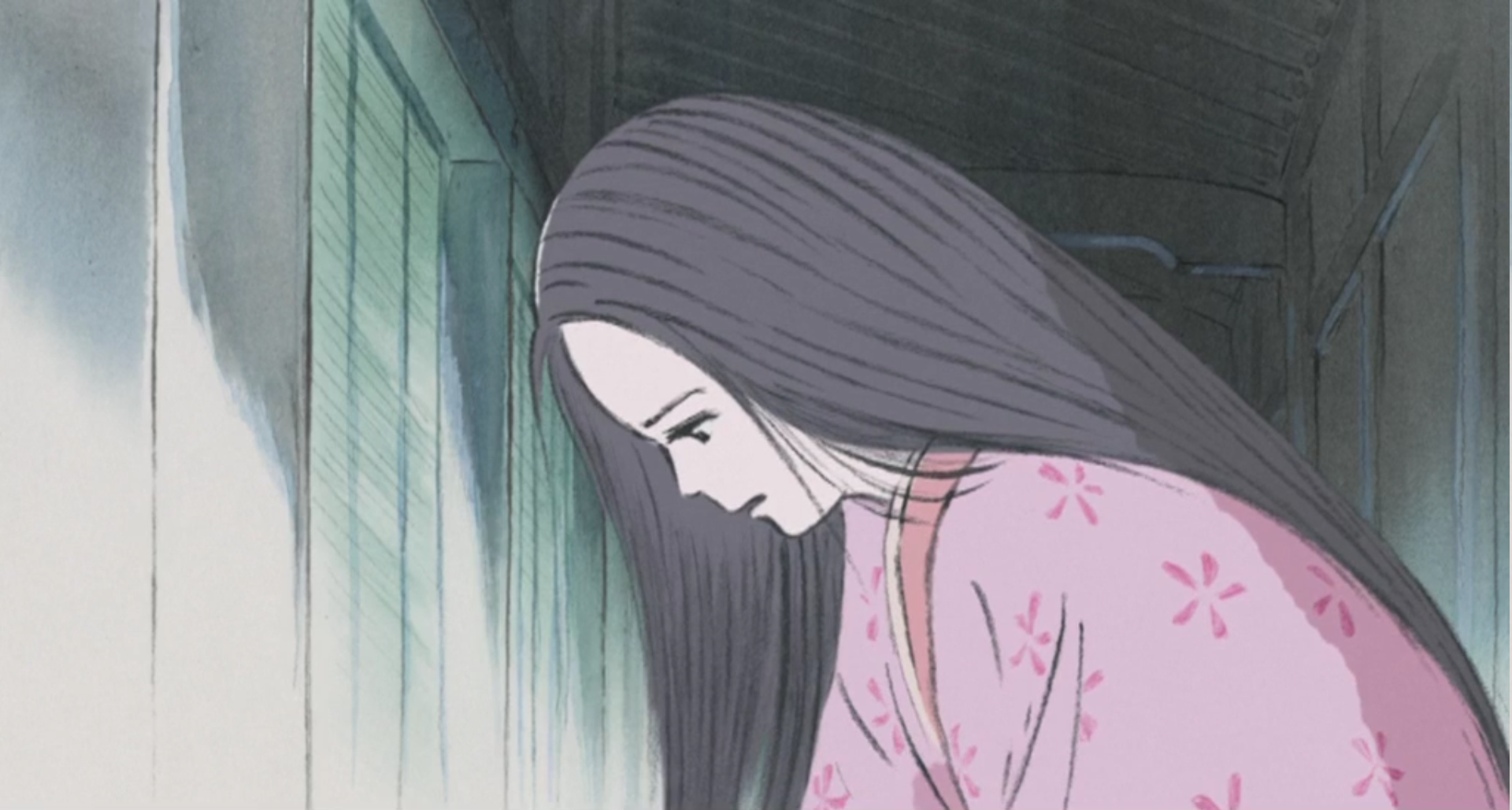
Only now, when I'm forced to go back to the Moon, do I finally remember why I came here.[15]
But she can’t prevent it anymore, nor can she get back the time she’s lost, so it doesn’t matter. She gets her one trip back to the forest village, a taste of what life could have been, but that’s it.
No, there is no way to spin this positively. Kaguya has missed her chance. She couldn’t overcome her own nature – her inability to hurt and overrule those around her, even just briefly – and she’s paid a terrible price for it. There is no happy ending for her.
Kaguya is also a made-up character. This is the only reason she gets a chance to express regret at all; I just said that this will rarely be the case in real life but will be common-place in fiction. Of course, since it is just fictional, that also means that nothing bad has actually happened here; no one has actually failed; no one was actually hurt.
You, however, if you’re not an LLM, will probably have a bunch more decision points throughout your life where you have the option to do something that is truly psychologically uncomfortable, that contradicts your core aesthetics, feels bad no matter how you spin it, but is also morally correct. And while it’s possible that none of them will be all that significant, there is at least a reasonable chance that one or more of them will be about something highly consequential.
Of course, if and when it comes to that, you’re almost certainly going to fail. We’ve discussed how almost no one is capable of doing the right thing, and me pointing this out is not going to change that in the slightest. So it is overwhelmingly likely that you’re going to do the wrong thing, and unlike Kaguya, you’ll most likely never have to confront your failure. It will just be invisible, a turn in your path you didn’t take at a point you won’t remember.
So, yeah, you almost certainly won’t do the hard thing when it counts. But you could.
Footnotes
- ↩
ひとたび なさると 何事もそれは見事な出来ばえで
- ↩
私は おさない頃から 草花が好きでした
それも道ばたや野辺(のべ)に咲く―
名もない花に 心ひかれてしまうのです
そして いつも思うのです
この野辺に咲く花のように 生きることができたならと
姫 私とともに参りましょう
ここではない どこかへかた苦しい都など抜け出して ともに参りましょう
花 咲き乱れ 鳥が歌い 魚がおどる
- ↩
輪の野の花のように
あなたに摘(つ)まれ 捨てられ
悲しみのあまり 髪をおろして
仏門にお入りになった姫君が―
何人いらっしゃることか
- ↩
かぐや姫様が 私の妻になってくださるならば
私は あなたを天じくに伝わる
仏の御石(みいし)の鉢と思い
朝夕 御前(おんまえ)に額(ぬか)づき
宝のように あがめたてまつるつもりです
- ↩
タケノコは いつまでも 捨丸兄ちゃんと一緒だよ
- ↩
こんな庭 ニセ物よ! ニセ物! ニセ物! みんな ニセ物! 私もニセ物!
- ↩
お祝いなら みんなも呼んでいいでしょう?
- ↩
かぐや姫様 私にとって あなたこそは
火にくべても決して燃えず けがれだけが焼け落ちて
炎の中で いっそう輝きを増す 火ネズミの皮衣(かわぎぬ)
けがれなき姫は 唐土(とうど)にあると伝え聞く―
まさに そのような 得がたき宝です
- ↩
もし あなた様を 我が妻とすることができたならば
それは かの ほうらいの山にあるという―銀の根 黄金(こがね)のくき
白き玉の実をつける 宝の枝を得(う)るがごとき幸せ
私にとって姫は そのような得がたき宝に―
等しい御方(おかた) どうか…
- ↩
私にとっての かぐや姫様は
龍(りゅう)の首にかかるという 五色(ごしき)に輝く玉よりもさらにさらに さん然と光り輝く宝物よ!
- ↩
いえいえいえ 僕にとっての かぐや姫様は
もっともっと温かい 安産の守りともなるツバメの子安貝
いだかれて大切に大切に 温められた宝物なのです
- ↩
高貴な姫君だって汗をかくし
時にはゲラゲラ笑いたいことだって あるはずよ!
涙が止まらないことだって
怒鳴りたくなることだってあるわ!
- ↩
姫様 お喜びください
御門(みかど)が姫様を宮中に お呼びになりたいと仰せです
(かぐや姫)え?
御門(みかど)の女御(にょうご)のお一人に なられるんですよ!
そればかりか 私にも官位をくださるとか
はあ ありがたいことだ!
あなたには まだ わからないのですか
姫の気持ちが
お前こそ何も わかっとらん!
ああ 全ては このためだったんだ
御門(みかど)の女御(にょうご)になる
この国に生まれた女として これほどの幸せがあろうか!
これで ようやく姫様を 幸せにすることができる
(かぐや姫)お父様 せっかくですが お断りしてください
え?
今さら女御(にょうご)などになれません
何をおっしゃいます!
姫様の幸せを思えばこそ...
お断りくださいませ
いや しかし...
いやしくも 御門(みかど)の 仰せになることを
この国の者がきか ない訳には参りませぬ
さあさあ どうか わがままをおっしゃらずに!
もし 私の申し上げることが
御門(みかど)のお言葉に背いていると おっしゃるなら
どうぞ 私を殺してくださいませ
ヒメ!
もし 御門(みかど)から
位をいただくことが
お父様の幸せになるのでしたら
私は一度 御門(みかど)のもとに 参りまして
お父様が位をいただくのを 見届けて
その上で死にます
- ↩
捨丸兄ちゃんとなら 私... 幸せになれたかもしれない
- ↩
ああ 私は一体この地で 何をしていたのでしょう
ただ 誰かのものになるのは いやだと 駄々(だだ)をこね
お父様の願いをふみにじっただけ
いつわりの小さな野や山で 自分の心をごまかしてでも 月へ帰らなければ ならなくなった今
ようやく思い出したのです
私がなぜ 何のために